New Research: Cochlear Implant Users Feel the Beat in Music

Yes, music can evoke various feelings when we listen to it. But, what about if you can’t hear it? Imagine experiencing music without hearing music. Take a look at a performance by this group of deaf percussionists from Singapore. They hear the music through their whole bodies as they experience the beat!

ExtraOrdinary Horizons plays us a beat
This is exactly what researchers hoped to confirm in a recent study conducted at the International Laboratory for Brain, Music and Sound Research in Montreal – that even those with cochlear implants “…can enjoy a myriad of musical benefits if the composition significantly emphasizes the beat…”

Previously, many who used cochlear implants for profound hearing loss were given very little, if any, exposure to music or musical movement because the implants are deficient in transmitting the pitch and tone quality of music, and all that was heard through the implants was noise.

Fast forward to the study led by Dr. Jessica Phillips-Silver.  Dr. Phillips-Silver’s premise proved correct.  By using music that emphasizes a beat, cochlear implant users experienced improvement not just in music perception, but also in language perception.  In writing about the research results, Dr. Phillips-Silver’s team asserted that not only could language use and understanding be improved by exposure to the beat in music, but there could also be corresponding improvement in “emotional and social quality of life.”

iStock_000003815422X girl clapping good beginning“We know that music training engages some brain plasticity — it refines the sense of rhythm, benefiting the perception of speech, so that may help them understand spoken language. But also there is so much enjoyment in music — a strong beat activates the joy of body movement,” Phillips-Silver says. “What we hear is what we feel and what we feel is what we hear.”

All of this supports research findings from this study done in 2007 which found that “…[c]hild implant users enjoy music more than adult implant users. Moreover, younger age at implantation increases children’s engagement with music, which may enhance their progress in other auditory domains.”

These exciting research findings confirm yet again the incredible power of music to touch not just our emotions, but to profoundly affect nearly every other part of our being – music is good for our brains, our bodies, our hearts, and our souls.

Here at Kindermusik, we believe that all children can – and should! – experience music.  Contact your local Kindermusik educator to learn more.  www.Kindermusik.com


Call for Entries: Nominate Your Favorite Music Teacher

Singing-Our-Praises-NominateMusicTeacher-INSTAGRAM-640x640-3Every Music Educator we meet inspires us. After all, we share the mission of bringing music to children and each educator brings her or his own unique talents and gifts into the classroom! As we celebrate Music in Our Schools month, we wanted to mark the occasion by singing the praises of music educators and giving YOU the opportunity to do it, too!

Sing the praises of a local Kindermusik educator, a school music teacher, or both by nominating them below. All nominated educators will be featured on our Facebook page. Five finalists in each category will be recognized for their remarkable impact and featured in more detail on our Facebook page. The community will then vote on their favorite educator from both categories to receive a special package from Kindermusik.

Deadline for nominations is March 23, 2015. The five finalists will be announced on April 6, 2015 and the winner on April 13, 2015. Here’s how to nominate an educator!

How to Nominate a Kindermusik Educator

Is there a Kindermusik Educator who inspires (or inspired) you? Let the whole world know! We are now accepting entries for the #SingingYourPraises nominations.

Who’s eligible?

Current, full-time music educators around the world who teach music in a Kindermusik licensed studio.

One winner will receive:

  • $500 worth of Kindermusik instruments and product for their Studio.

How to Nominate a School Music Teacher

Do you know a music teacher from school who is impacting the lives of others through music? We are now accepting entries for the #SingingPraises nominations.

One winner will receive:

  • If the winner is an elementary school teacher: a Kindermusik classroom kit of their choice
  • If the winner is not an elementary school teacher: a Kindermusik classroom kit in which they can “gift” to an early childhood program of their choice.

Nominations due by March 23! Nominate your favorite Kindermusik educator! 

 Nominate your favorite school music teacher!

10 Reasons Why Music Belongs in Our Schools

This year we celebrate a significant milestone:  30 years of Music in Our Schools month. Thirty years ago music in schools meant recorders and “Hot Cross Buns.” Now, it still means recorders and “Hot Cross Buns,” but it also means English Language Arts, Math Class, Social Studies, and more. Here’s why we should be celebrating Music in Our Schools today… and 300 years from now!

30 years of Music in Our Schools Month

10 Ways Music Plays at School

Music & Math Class. Music teaches young children foundational math skills, including geometry, pattern recognition, and numbers. Watch these children read and repeat various music patterns.

Kindermusik rhythms
Music & Social Studies. Music teaches children about other cultures through songs and dances. Long before people could read or write, the culture of a nation or people was passed down through song. That tradition continues in the drum circles of the Native Americans, the Shakuhachi flutes of Japan, or an Irish jig. …

Music & Creativity & STEM. Music provides children a creative way to express their thoughts, ideas, and emotions. That creativity spills over into STEM (science, technology, engineering, and mathematics) classes as well, where young children are also encouraged to explore, question, and create solutions.

Why STEM should be changed to STEAM

Music & English Language Arts. Music supports phonological awareness needed in English Language Arts. In fact, our brains process language and music in similar ways. For example, understanding the spoken language requires a child to hear (and identify!) the individual phonemes combined with the intonation communicated through pitch. With music, a child must hear the individual notes along with their rhythmic value.

Music & Group Work. Singing together lowers stress and relieves anxiety. Plus, children gain practice working together to create something beautiful. Play along with this song…and try NOT to smile.

Music and group work
Music & Transitions. Musical cues teach children how to easily transition from one activity to another. Young children can struggle with transitioning from one activity to another as they also experience rapid—and turbulent—emotional development. Singing a song to signal the end of one activity and the start of another helps children navigate those feelings and learn how to move on to something else.

Music & Recess. A classroom dance party gets young children up and moving around on those days when it is too cold or wet to play outside for recess. Getting out those wiggles can help children be ready for whatever is next in the lesson. A quick song of “Head, Shoulders, Knees, and Toes” or the “Hokey Pokey” can bring lots of giggles to the classroom, too!

Music & Language Development. Songs and rhymes teach children the rhythm of language, its construction, and its acquisition.  Singing songs and saying rhymes give children practice with words and sounds that not only help children learn to speak clearly, but also effectively, by teaching the vital skills of communication and conversation.

Music & Memory. Children who learn through movement show a marked improvement in memory.  That’s because movement wakes up the brain and gets it primed for learning.  But music can also aid memorization of facts… like learning U.S. states and capitols later on in elementary school.

music aids learning
Music & English Language Learners. When English Language Leaners clap their hands to the beat of English nursery rhymes or songs, they practice active listening and pattern recognition. Research shows that students who are better at recognizing patterns in language learn another language more quickly than those who do not.  Here’s an example of how clapping, tapping, and playing along with a music video from our Kindermusik @Home Materials gives fun practice with recognizing patterns.

Change-the-world-Facebook-Profile-Image1“Music in our Schools Month” is the perfect platform for the message to resonate – music matters!  And here at Kindermusik, we believe that music can change our world, one child and one family at a time.

Do you want to bring more music into your school? Learn how. http://www.kindermusik.com/schools/

Happy World Read Aloud Day!

WorldReadAloudDayIt’s World Read Aloud Day.

Presented by LitWorld.org, this day represents a global literacy movement to show the world that the right to read and write belongs to all people. Of course, we think the best way to celebrate is to read a book out loud with children like this Kindermusik mom and daughter.


[youtube]https://www.youtube.com/watch?v=ha1GKAwFf0s[/youtube]

The Educational Benefits of Reading Aloud to Children

In many homes around the world, this scene of a parent and child sharing the joy of reading together repeats itself over and over again—and children love it! In fact, the latest Kids & Family Reading Report from Scholastic, shows that when it comes to being read aloud to at home, more than eight in 10 children (83%) across age groups say they love(d) or like(d) it a lot—the main reason being it was a special time with parents.

In addition to bonding, reading aloud holds other benefits, whether reading aloud with a parent, teacher, or other caregiver. Reading aloud increases a child’s print awareness, teaches them the cadence of language, boosts vocabulary, and expands a little one’s understanding of the world. It’s no wonder one of our favorite children’s authors, Kate DiCamillo said: “Reading should not be presented to children as a chore or duty. It should be offered to them as a precious gift.”

3 Quick Kindermusik Tips for Reading Out Loud

  1. Read children’s books YOU love. One of the ways children learn to love reading is when the adults in their lives model that love!
  2. Encourage movement by imitating what you read. A child who moves around during story time is still gaining the benefits of reading. Plus, “jumping” when a character jumps or “reaching up high” to pluck an apple from a tree gives children a greater sense of the vocabulary words.
  3. Use funny voices and speak animatedly. This makes it fun for both the reader and the listener!

Watch how this Kindermusik educator puts those tips into action.

[youtube]https://www.youtube.com/watch?v=3ObHpJlQIcw[/youtube]

Looking for more ideas on supporting a young child’s early literacy development? Visit a Kindermusik class to experience the connections between music and reading!

Contributed by Lisa Camino Rowell, a freelance writer in the Atlanta area.

The One Thing that Isn’t on Your Baby Registry But Should Be

Congratulations! You are having a baby. Whether pregnant with your first or fourth, all babies need certain things. Usually, this means adding them to a baby registry or shopping at your local consignment sales (or a combination of both!). Typically, the parents-to-be wish list includes diapers, rocker, crib, clothes, baby bathtub, stroller, specific toys, etc. However, there is one thing not on most baby registries but it really should be…music. Wait. What?

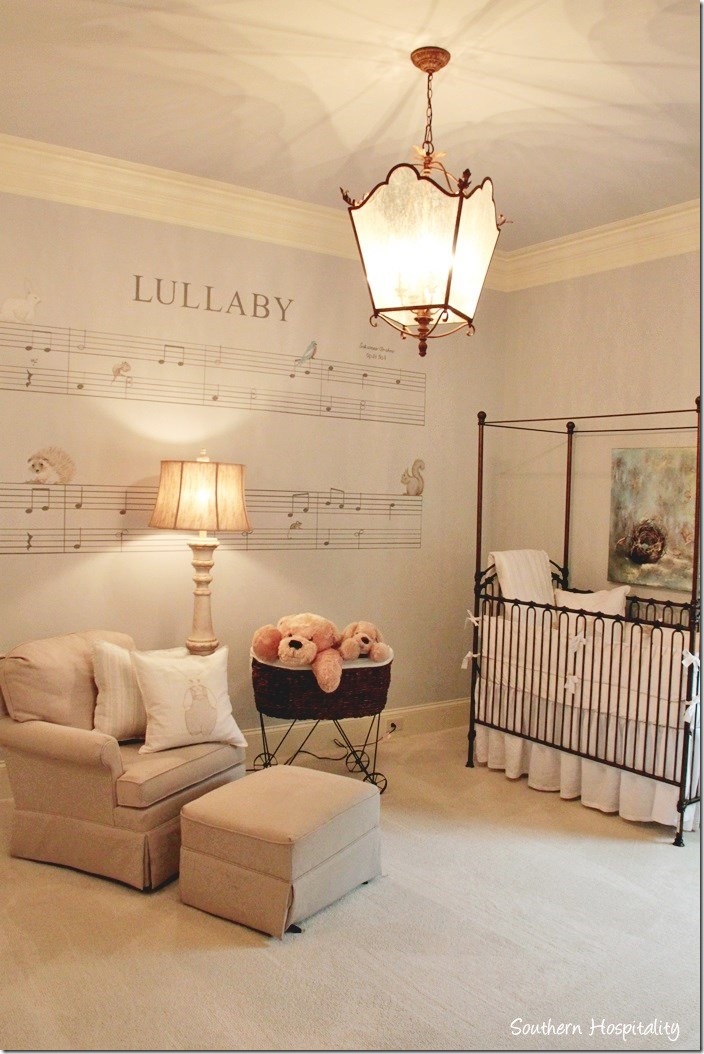
Musical NurseryMusic marks so many important milestones in our lives, such as singing a song on your birthday or walking across the stage to receive your diploma while listening to “Pomp & Circumstance” or dancing the first dance together on your wedding day. So of course, music should be a part of this season in your life, too! Plus, music gives parents a go-to resource for playtime, bathtime, bedtime, and hanging-around-the-house-in-our-pajamas time! You don’t need to deck out your child’s nursery like this one in order to bring music into your child’s life. (Can we pause to say “Wow!”?) Here are some ideas of what to include on your baby registry.


What to Include on Your Baby Registry for Music Lovers

  1. Lullaby Music—Music can help babies sleep better and even from an early age signal the start of the bedtime routine. Some of our favorites include:
  2. Baby safe instruments—Develop fine motor skills right from the start with instruments specifically created for the littlest member of your family. Plus, you Gift Certificate Baby Boynever know when you might want to start your own family band! Consider including:
    • Egg shakers
    • Chime balls
    • Baby bells
  3. Musical books like these: (Check out our “Books for Kids We Love” board on Pinterest for hundreds of more ideas.)
    • Hand, Hand, Fingers Thumb by Al Perkins
    • Elephants Can Not Dance by Mo Willems
    • I Know a Shy Fellow who Swallowed a Cello by Barbara S. Garriel
    • Zin! Zin! Zin! A Violin by Lloyd Moss
    • Any rhyming book!
  4. Gift certificates to a music class. Music classes can provide some tender one-on-one time between you and your baby and also get you plugged into a community of other families with children the same age as yours.

Gift Certificate Baby GirlGift Certificates to Kindermusik class make a great baby gift, too! We will get you started with one free class for your baby boy or baby girl. Find your local educator today!

Contributed by Lisa Camino Rowell, a freelance writer living in the Atlanta area.

Kids Sing the Cutest Things

Wrong LyricsWe’ve all sung the wrong lyrics to a song. Pre-Internet days, we probably even engaged in some spirited dialogue with friends about the words to certain songs when the artist did not include the lyrics! (Hold me closer, Tony Danza, anyone?)

Somehow, though, when children mis-sing a song, our love for them grows and we run to get the camera to capture the cuteness! Take this sweet little nugget. He is singing a beautiful rendition of “Fifty Nifty United States,” including Georgia, Hawaii, Indiana, and the newest state of the union: Massachusettsippigan.

[youtube]https://www.youtube.com/watch?v=Ol2yx162ydA[/youtube]

Mis-sung lyrics is one of the reasons we include lyrics in Kindermusik classes so we can read the words to an unfamiliar song. However, while Kindermusik certainly supports early literacy development, most Kindermusik students are not fluent readers so they can create some of their own interesting lyrics.

Here are 5 “mis-sung” lyrics heard in a Kindermusik classroom.

Floating Down the River:

  • Misheard lyric: “Two in the middle and ketchup juicy.”
  • Actual lyric: “Two in the middle and you can’t jump, Josie.”

Mama Paquita

  • Misheard lyric: “My mom buys pizza”
  • Actual lyric: “Mama Paquita”

Home on the Range

  • Misheard lyric: “Hold, hold on the reins.”
  • Actual lyric: “Home, home on the range.”

My Bonnie:

  • Misheard lyric: “Bring back, bring back, oh bring back my body to me, to meEEee….”
  • Misheard lyric: “Bring back, bring back, oh bring back my bunny to me!”
  • Actual lyric: Bring back, bring back, oh bring back my Bonnie to me!

YC boy with new logoDoes your child sing the cutest thing, too? Upload a video of your little one’s funny moments singing the incorrect lyrics on YouTube, Facebook, or Instagram. Tag with #KidsSing

Let Music Draw Out Your Emotions. (Literally!)

socialResearch continues to show that academic success relies heavily on social and emotional well-being, right from the start. Helping young children to recognize and label feelings supports healthy social-emotional growth and is a vital skill in early childhood education. Emotional awareness includes:


  • self-awareness
  • self-regulation
  • social competence
  • social awareness

The Arts can be a tool to help children recognize and express emotions. Music inspires a variety of feelings in the listener and sometimes those feelings can be expressed through yet another art form, such as art, dance, drama, or writing. Try this game at home or in the classroom to support social-emotional development.

Music Game: “See the Music”

Listen to six different pieces of music, each paired with a piece of art. Then, can you match them back up again?

Feel the Music Game

Here are some fun ways to extend the learning of this game:

  • After playing the game a few times, point to some of the paintings and ask children to verbally describe the type of music that each painting represents. (Would the music be loud/soft? Fast/slow? What kinds of instruments might make the music?)
  • Play the musical samples from this game, without the visuals. Encourage children to be inspired, and away from the screen, to draw, write, paint, dance, or enjoy any other art form while listening! How does their artistic expression change if the music changes?
  • Talk with children about how they feel when they listen to each piece of music. Can they use feeling words (not just sound words or visual words) to describe what they’re hearing?
  • Put on some brand-new music, of your choice, and create art in response to them.

Kindermusik@HomeAll Kindermusik classes include activities and resources to extend the learning outside the classroom. Learn more about the educational activities created specifically for families to do together outside of the classroom.

Helmets and Music Training Both Protect Kids’ Brains

Researchers continue to find more and more connections between music training and cognitive function. In a recent study, scientists determined that music training in the early years prevented the decline of speech listening comprehension, or speech recognition, in the later years of life.

What may seem like a hearing problem in older adults may actually be a decline in the brain’s ability to parse, sequence, and identify sounds. However, the Bidelman study found that older adults who had at least 10 years of musical training as children did not experience the same declines as older adults who had not had musical training.

music note“The latest findings add to mounting evidence that musical training not only gives young developing brains a cognitive boost, but those neural enhancements extend across the lifespan into old age when the brain needs it most to counteract cognitive decline.”

We couldn’t agree more. In Kindermusik, we start musical “training” with children as young as newborns and continue through age 7, after which Kindermusik graduates are more than ready and excited to take the next step into success with traditional music lessons. Our early childhood music training in Kindermusik takes the form of happy singing, creative movement, listening, instrument play and exploration, and fun activities that teach foundational music concepts and skills.

You wouldn’t dream of letting your child ride a bike unprotected and without a helmet. So don’t forget another kind of protection… the lifelong protection of your child’s cognitive functioning that can come from music training, especially in the early years.  We promise, they won’t fuss about putting on their music “helmet,” especially not with Kindermusik!

3 Favorite Musical Activities that Support Cognitive Development

listening-moving-playingFocused Listening

Whenever your child’s attention is focused in on one sound, he or she learns to compare the differences between sounds and how they are produced. And unlike the physical act of hearing, listening is an intellectual and emotional process that involves listening “between the lines” to understand what is NOT said as well as what IS said.  What better time to get started listening to music than at the very youngest ages, during those critical early years when the brain is developing the most rapidly!

Movement

Movement is the key to learning! A young child’s brain NEEDS movement in order to develop fully. Crawling, rolling, walking, skipping, swinging, jumping… When you observe and encourage your child to move in lots of different ways, you are helping to ensure your child’s healthy brain development. That’s because our brains fully develop through all kinds of movement activities – the more variety, the better the capacity for learning.

Instrument Exploration & Play

Exploring instruments may seem like just fun and games, but it is actually a very crucial part of early learning. For example, when children are given an egg shaker to explore, they will likely use several of the five senses because the senses are their basis of discovery. This kind of sensory learning develops long-lasting cognitive skills… AND if you add in an egg shaker play-along, also develops a wonderful sense of rhythm and steady beat!

Learn more about more of the wonderful benefits of early music training. 

Contributed by Theresa Case whose award-winning Kindermusik program is located at Piano Central Studios in beautiful upstate South Carolina.

Educators Love Kindermusik Because…

Social-Badges-Educator Quote“I love Kindermusik because it settles the perfect conditions for grownups and children, strangers and friends, to play together as a bunch of friends!” ~ Miss Vane

“It brings together my two greatest loves; music and children.” ~ Johanna Clancy

“I love Kindermusik because they treat each educator like family! One of my teachers passed away and I received a sympathy card signed by the entire corporate office!!!!!! So grateful to be a Kindermusik business owner.” ~Stayc Sharrow Simpson


“I love Kindermusik because it is fulfilling to share my passion for music with children and their families! To play a part in providing a strong foundation to a child’s overall development, and a place where family bonds can be nurtured and strengthened brings me great JOY!” ~ Corrie Horn Rose

“I LOVE Kindermusik because it allows me to share with my students adventures around the farm, up in the sky, to the beach or even to the carnival… Each smile and hug and look of wonder makes it all worth it!” ~ Kindermusik with Miro

“From the day I stepped into the training room 17 years ago to just last week, KindermusikKindermusikMovesMe-Logo-Hashtag-2331x869-2331x869 has given me joy, purpose and friendships that have defined much of my life. I tell my Kindermusik trainees that the side benefit of becoming a Kindermusik educator are the wonderful friendships that are created among colleagues and parents – and the children, of course! Thank you for being a part of my life forever!” ~Julee Kowallis

“My students love kindermusik, the day is not complete without music and movement in the classroom.” ~ Tess Mari Poblador

[youtube]http://youtu.be/c_Q0ncbc0uw[/youtube]

Schools love Kindermusik because…

Kindermusik_PreschoolClassroom_MusicAndSensoryLearning“We are LOVING it.The kids are doing great. We have done it three days a week and they are not tired of it at all. I may just be imagining things, but some of my quiet kids are talking more. They are engaged and busy and doing exactly what I am asking them to do. We started lessons 3 and 4 today and I was shocked at what they remembered from last week! They were saying the poem and remembered all of the hand gestures. It has been so exciting to watch.” Jan B. – Preschool Intervention Program Teacher, SC

“Students who are physically impaired are jamming to the music and using vocabulary that they haven’t used before. Some children who have Autism Spectrum Disorders and have been totally nonverbal are not only using phrases, but complete sentences as well.” ~ Sheryl Koscso, Director of ECE Curriculum Instruction, FL

[youtube]https://www.youtube.com/watch?v=xCBUn2kcoKc[/youtube]

“I’m excited to report the language learning gains [from using Kindermusik curricula] were above the 70% significance level.” ~Penny Collins, Director of Special Education, Osceola County, Florida

“I have a wide range of needs in my classroom from significant visual impairment to developmental delay. The ABC Music & Me program accommodates all my students and has engaging activities that are easy to adapt for students with special needs. I would recommend the ABC Music & Me program to any Pre-K teacher.” ~Rebekah K., Pre-K Teacher, NC

Special needs ABC classroom“Good morning!  I just wanted to tell you about something wonderful that happened in my last ABC Music & Me lesson.  I have a student who has lower cognitive functioning and limited speech. He does not follow directions or imitate movements during music, etc. He LOVES listening to music and instruments but will either stick the instrument in his mouth or throw it to the floor. He refuses to play it, even with hand-over-hand assistance. We have been working with him since August and have seen little progress in his participation skills. Last week when we were doing our ABC lesson, he played two different instruments appropriately AND independently during the whole song segment! And he was imitating some of the movements that were going on during other segments as well!  My aide and I almost cried!  What a breakthrough for him!” ~ Kimberly L., Early Childhood Teacher

We Love Kindermusik