6 Ways Music Delivers on the Promise of Early Learning

Especially when it comes to teaching children the skills they need in order to be successful in school, there’s a critical window of learning that’s widest open only during the first seven years of a child’s life.  In fact, the kind of early childhood learning and experiences a child has before the age of 7 can actually change the trajectory of his/her life.  But what kind of early learning opportunities have the greatest, most long-term effect?

6 ways music delivers on the promise of early learning

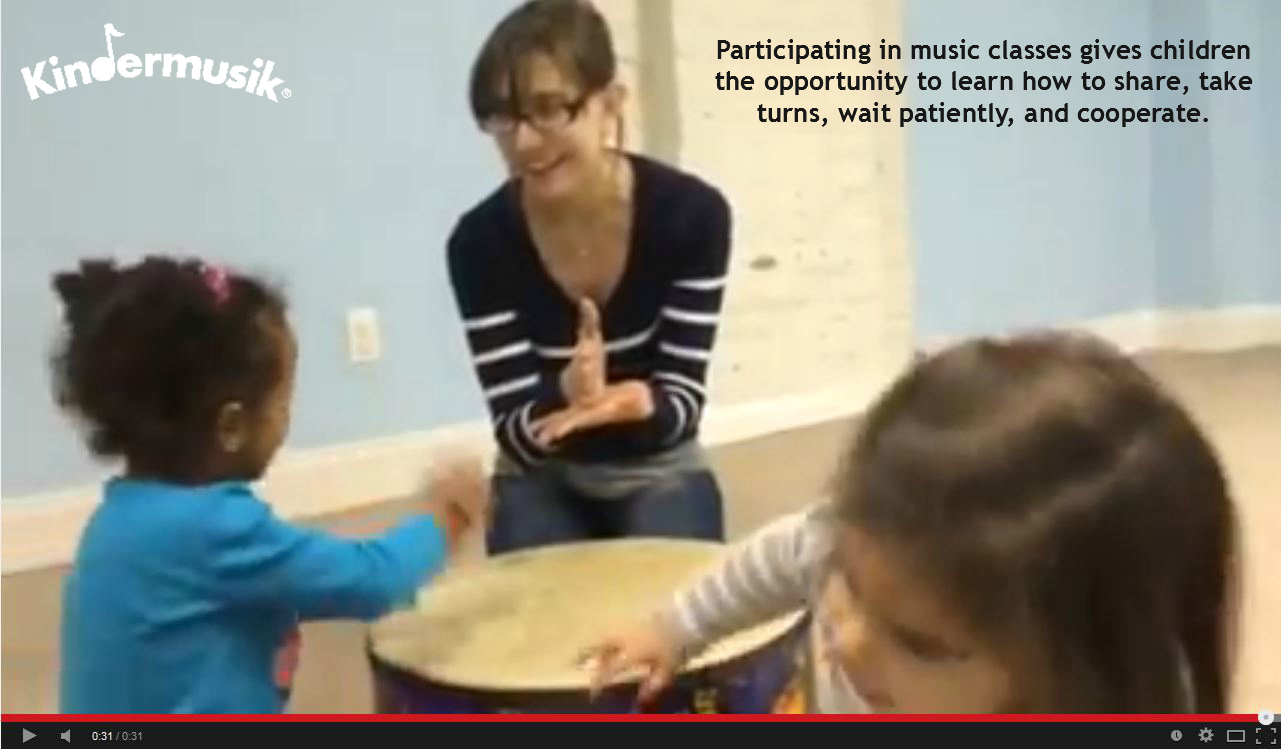
1. Cognition: Young children actively engaged in music-making develop foundational math skills, including patterns, geometry, and number awareness.
One, two, tie my shoe.
Three, four, shut the door.
Five, six, pick up sticks.
Seven, eight, lay them straight.
Nine, ten, let’s do it again!
2. Language & Literacy: Music improves early literacy skills, including phonological awareness, auditory discrimination, and auditory sequencing discrimination.
For example, in 2012-2013, an independent research firm found that students who participated in ABC Music & Me for as little as 30 minutes each week experienced 32% greater gains on the Phonological Awareness Literacy Screening (PALS™).
3. Social & Emotional: Music teaches children inhibitory control, which many early childhood teachers say is one of the key skills needed to be “ready to learn” in Kindergarten.
benefits of music
4.  Physical: Music supports motor skills development: playing instruments (fine motor skills) and moving to music (gross motor skills).playing instruments and moving to music
5. Creative: Kids love music and dancing…. and learning should be fun! Music classes teach children to love learning and school. Through music, children can express themselves in unique ways, share ideas, and celebrate the ideas of others.
What shall we do when we all go out,
All go out, all go out?
What shall we do when we all go out,
When we all go out and play?
6. Parent Involvement in Education: Parents love music too. Music engages parents. A parent is a child’s first and best teacher. Singing, dancing, and playing instruments together throughout the week supports a parents’ pivotal role in a child’s life.
Kindermusik - A parent's story
Find out more about how music – and Kindermusik! – delivers on the promise of early learning at www.Kindermusik.com.

Parents’ Involvement in Screen Time Matters

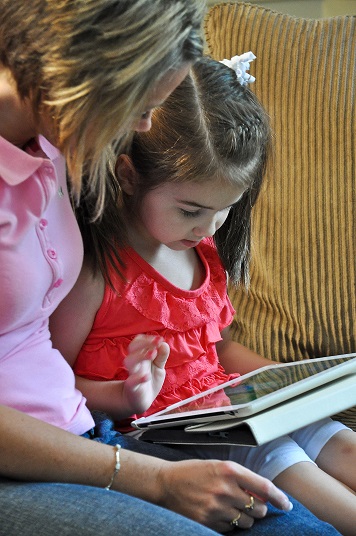
mom and young girl reading ebook togetherYoung children learn best through hands-on, multi-sensory experiences with a loving and trusted caregiver. However, with technology firmly imbedded into the daily lives and routines of families today, parents and early childhood educators often struggle with knowing the ideal ways to incorporate screen time that also supports what we know about how children learn.
One thing we do know without a doubt is that parents’ involvement in screen time matters. A new report from Zero to Three, “Research-Based Guidelines for Screen Use for Children Under Three Years Old,” offers some practical suggestions for parents concerning screen time and technology. Here are a few of the tips.

3 Tips for Healthy Screen Time with Young Children

1. Parents should participate in the screen experience and make it a language-rich, interactive activity. As parents and children watch or play screen-based games together, parents can talk with their children about what they are seeing. We love how this mom beautifully incorporates a video field trip from Kindermusik@Home into on-the-floor, sensitive, child-centered play with her toddler. Notice how she encourages counting and asks questions about what they see on the screen:
[youtube]https://www.youtube.com/watch?v=t19lH9ly7rs[/youtube]
2. Make connections between what children see on the screen with the real world. In the school years, children will be asked to make those connections when reading, such as text-to-self and then later text-to-text. Early childhood offers the ideal time to lay a foundation for recognizing associations between things. For example, if children learn about the different letters of the alphabet by playing a game on a tablet, parents can later point out various objects in the room or at the grocery store that start with those same letters. Or, if a character in an interactive ebook learns over the course of the story how to share a favorite toy with a friend, parents can refer back to that lesson when teaching their own children how to share with friends.
3. Create ways to extend the learning away from the screen. For example, in the video above, the parent and child can go on a walk together and notice the various dogs they encounter or visit a pet store to see the fish. While there, the mom can point out the different colors they see, encourage counting, and make connections between what they watched at home.

Find out more about Kindermusik at www.Kindermusik.com.

Contributed by Lisa Camino Rowell, a freelance writer in the Atlanta area.


Repeat After Me: Kids Learn from Repetition

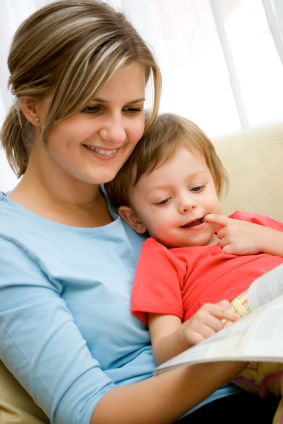
mom reading to her baby“Again! Again!” It is not a coincidence that young children ask to read the same book 22 nights in a row. While the adults involved may secretly (and not so secretly) wish for more diversity, all that repetition strengthens the learning or growth of neural connections in children’s brains.
Repetition is good for children. In fact, it’s how they learn. A one-time experience is not enough for a neural connection to form and stabilize. Children need repeated exposure to an experience. Each time an experience is repeated the neural connection grows stronger. Think about it. Even as adults, we don’t usually learn how to do something the very first time we try it. According to Conscious Disciple, for a child to learn a new skill or concept, it takes 2,000 times in context. Whoa! That is a lot of readings of Good Night Moon!
Repeated exposure also helps children become comfortable with new objects and experiences. So, for example, in a Kindermusik class the first time we bring out a new instrument children may only want to watch it being played, but the next week they might decide to try playing it, and the next week they may try suggesting a new way to play it.

Why We Love Repetition in Music

Musical repetition can be heard across most musical genres around the world. There are reasons for it, too. According to the TEDx video, “Why We Love Repetition in Music,” people actually prefer familiar music. During repeated passages or songs, listeners shift their attention and hear or notice different sounds. (By the way, this happens with repeated readings of the same book, too!) In one scientific experiment, people even rated music with repetition as more enjoyable and more interesting.
Watch the TEDx video here:
[youtube] https://www.youtube.com/watch?v=1lo8EomDrwA[/youtube]
Kindermusik Tip: Tap into a child’s love of and need for repetition. Repeat songs and re-read books to children. (It’s one of the reasons we repeat songs, stories, and activities from week to week!) Point out different sounds and instruments or fast and slow parts of the music. In books, make note of the illustrations in the story—the different shapes, colors, or even the numbers of objects on the page.

Find out more about Kindermusik at www.Kindermusik.com

Contributed by Lisa Camino Rowell, a freelance writing living in the Atlanta area.

Why Halloween Should Last 365 Days a Year

child playing dress up

child playing dress upIt’s Halloween! In many parts of the world, this means dressing up in costumes and pretending to be a cowboy, ninja, ballet dancer, or even a cowboy ninja ballet dancer. (Hey, it could happen!) While the stores—and Pinterest—overflow with costume options for children this time of year, truth be told, children love dressing up and pretending all year long. And they should! It’s good for them.

Pretend play develops imagination, creativity, social skills, and language

Imitation is the first stage of pretend play and begins as an infant when a baby mimics an adult’s facial expressions. As children grow and imitation evolves, pretend play becomes more imaginative. Children use pretend play to re-examine life experiences by adding or changing what actually happened. Pretend play lets children try out their ideas and solve problems as they create characters and “rules” in their imaginary world.
During pretend play activities, social interaction between children—and participating adults—is usually characterized by a heightened use of action and language, helping to develop children’s language and social skills. In addition, pretend play helps children learn the difference between reality and fantasy, and even experience emotional support from parents as they pretend along with kids.
So, don’t put up those Halloween costumes on November 1. Keep them out all year round. After all, you never know when you might need a cowboy ninja ballet dancer to come save the day.

Learn more about Kindermusik at www.Kindermusik.com.

Contributed by Lisa Camino Rowell, a freelance writer in the Atlanta area.


Got Rhythm? Rhythm Skills Could Predict Reading Disabilities

Do you know the old jazz standard by George and Ira Gerswin: “I’ve Got Music. I’ve Got Rhythm…Who could ask for anything more?” Well, apparently all that music and rhythm brings even more than a really good dance number by Gene Kelly. New research implies that young children’s rhythm abilities before they can read may eventually help doctors predict future reading disorders.
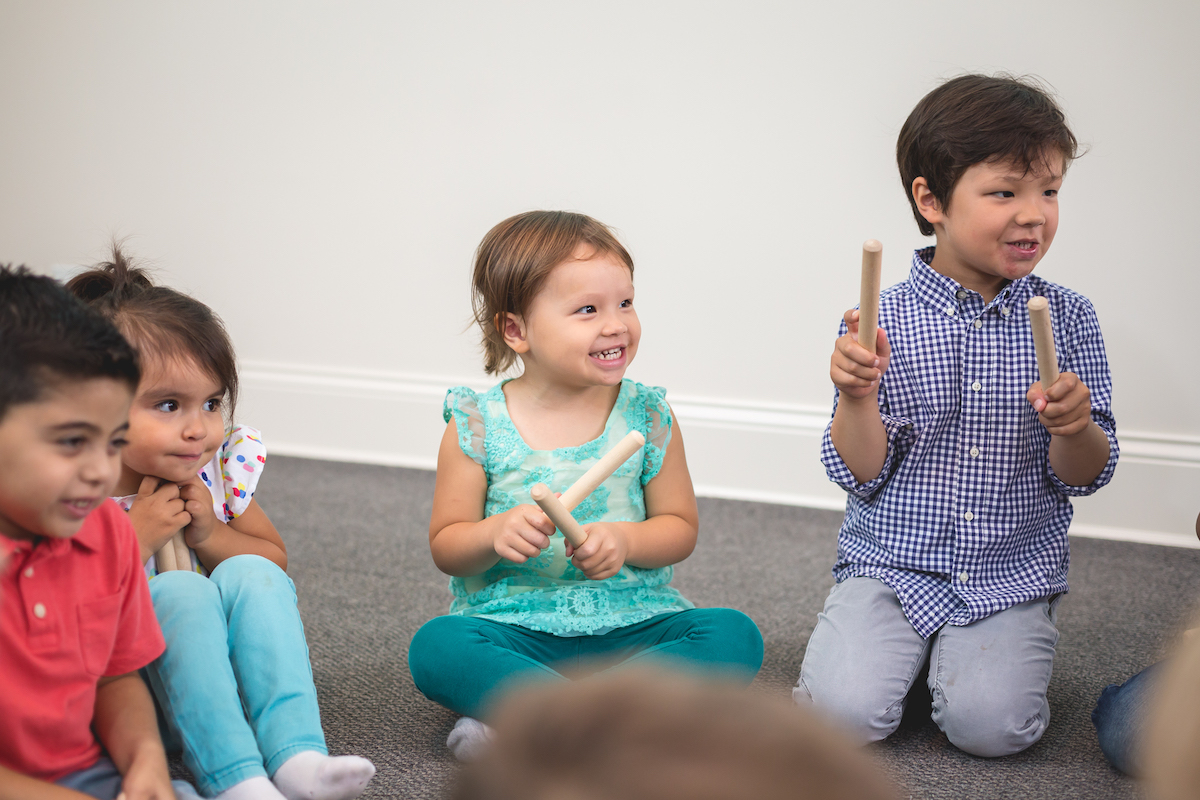
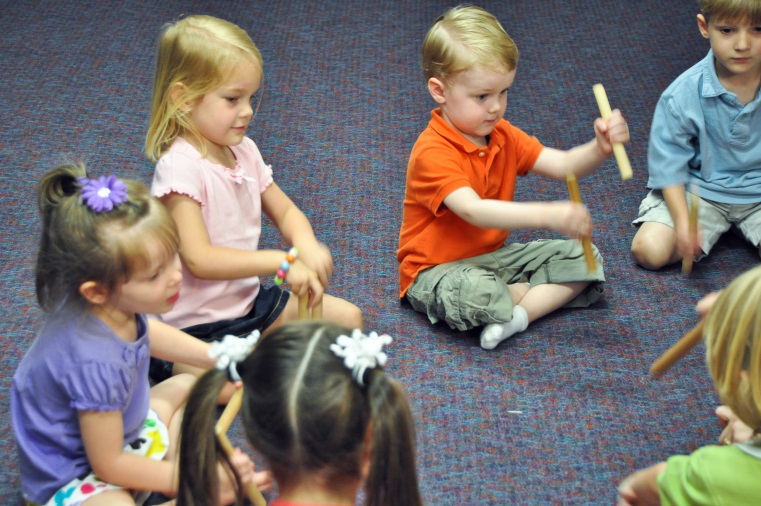
KindermusikClass_RhythmSticks_TeachChildrenImportantSkillsAn ongoing study  by Nina Kraus indicates that a preschooler’s ability to follow a rhythm and keep a steady beat can accurately predict early language skills and reading skills. While this is only the beginning of a five-year study, the team plans to track the participants to determine whether these rhythmic and steady beat abilities (or lack thereof) can predict later reading disorders, even with children as young as newborns.
“Detection this early could lead to intervention strategies such as music games to improve at-risk children’s rhythmic perception when their brains are most malleable,” says neurologist Gottfried Schlaug of Harvard Medical School in Boston in a press release.

We already know that early childhood music instruction:

  • Improves phonological awareness
  • Refines auditory discrimination
  • Increases auditory sequencing ability
  • Strengthens listening and attention skills
  • Enhances speaking skills
  • Heightens oral language development
  • Enriches vocabulary

Take a peek inside a Kindermusik classroom to see young students reading and playing rhythm patterns:

[youtube]https://www.youtube.com/watch?v=-IEm17m3evI[/youtube]
 

Learn more about the connections between music and reading at www.Kindermusik.com.

Contributed by Lisa Camino Rowell, a freelance writer in the Atlanta area.


Early Language Development Flourishes through Music

Pediatricians will often recommend music classes for children with language delays.  Speech therapists regularly incorporate music and rhymes in their therapy sessions with young children.  Researchers have identified talking and singing with a small child as one of the most effective tools for closing the word gap with under-served populations.

nothing more powerful than musicHere are six music activities that support early language development – all six are favorites of our Kindermusik parents in class and at home:

Vocal Play – “Bah-bah-bah.” (pause) 

Conversational back-and-forth play with parts of words, whole words, parts of songs, and short rhythms gives mouth muscles practice forming syllables and words.

Nursery Rhymes – “Hey diddle-diddle, the cat and the fiddle.

Nursery Rhymes are not only rich with the sounds that vowels and consonants make, they are also catchy and repeatable.

Timbre – Scritch-scratch, tap-tap, jingle!

Hearing and labeling the very different and distinct sounds of instruments expands listening skills and enriches vocabulary.

Movement labels – Gallop, skip, twist, twirl!

Simultaneously moving and labeling the movements engages the brain with the body and grows a bigger vocabulary.

Steady beat – “ta – ta – ta – ta and stomp-stomp-stomp-stomp!”

Recent studies have found a close link between rhythmic skills and language skills.  So the more you dance, march, and play-along with music, the stronger your music and language skills will be.

Instrument Exploration – “Can you say guiro? It goes ritch-ratch, ritch-ratch.”

Exploring and labeling instruments and their sounds in a relaxed, non-structured time of instrument exploration provides another perfect opportunity to practice and repeat sounds and words that we don’t always use every day.
So go ahead.  Sing, chant, listen, label, move, and explore your way through your day with your child.  You’ll be amazed at how a little bit of music and some musical activities here and there each day will enhance his or her language development!
Kindermusik is where music and learning playLearn more about how Kindermusik can give you the inspiration you need for improving your child’s language development at www.Kindermusik.com or by clicking on the buttons to the right.
 

Babies Benefit from Learning Two Languages at the Same Time

Baby learning two languagesWe get fired up about the importance of early childhood education. The reason is simple. In the first seven years of a child’s life, their brains are firing up with learning—literally! Every new experience lights up the synapses in the brain and repetition makes those pathways stronger.
At the age of two, a child’s brain includes over a 100 trillion synapses. That’s 50 percent more than we have as adults. While these new connections form rapidly and are strengthened through repetition, the brain also prunes connections not used frequently. This strengthening and deleting that happens in young children’s brains ultimately helps them process thoughts and actions more quickly.

Babies’ brains ripe for learning more than one language

All that action in the brain makes children under the age of 7 the ideal age for engaging in new experiences, including learning more than one language. In fact, new research conducted with six-month-old infants in Singapore indicates a generalized cognitive advantage that emerges early in infants raised in a bilingual home and is not specific to a particular language.
“As adults, learning a second language can be painstaking and laborious,” explained co-author and Associate Professor Leher Singh in a press release. “We sometimes project that difficulty onto our young babies, imagining a state of enormous confusion as two languages jostle for space in their little heads. However, a large number of studies have shown us that babies are uniquely well positioned to take on the challenges of bilingual acquisition and in fact, may benefit from this journey.”
The study found that:

  • The infants raised in a bilingual home become bored with familiar images faster than children brought up in a monolingual home.
  • Those same infants paid more attention to new images when compared to babies living in a monolingual home.

So what does that all mean? According to the press release, previous studies show that a quicker response to familiar objects and interest in new objects can predict preschool developmental outcomes, including non-verbal cognition and expressive and receptive language. Think about it. Children learning two languages at the same time are exposed to the sounds of more than one language and must learn to distinguish between the two. This makes for more—and stronger—neural connections! See why we get fired up for early childhood education?

Rocking the bilingual brain

At Kindermusik, our ELL curriculum, ABC English & Me,  uses songs, story time, puppets, and Total Physical Response for English Language Learning. Research shows that music ABC English & Me - Teaching English to Children through Musichas a positive impact on learning a second language. For example, in class ELL students may hear and repeat the rhythmic language of a nursery rhyme or song multiple times. The repetition creates stronger connections in the brain and helps children learn to speak and later read in English as their English language phonological awareness increases.

Learn more about using music to learn English as a second language at www.Kindermusik.com.

Answer that Baby Babble to Speed Up Language Development

Hang around babies long enough and you start hearing things. From soft sweet coos to long monologues of “dadadadadada,” babies talk a lot—even though we have no idea what they are really saying! That’s okay. We don’t need to understand all the words (or non-words!) to join in the conversation.

How Parents Respond to All that Baby Babble Matters

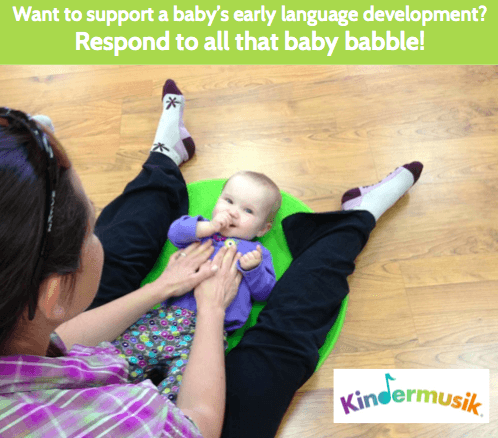
VocalPlay_Boosts_Early_Language_Development_KindermusikNew early childhood research from the University of Iowa and Indiana University found that how parents respond to all that baby talk can speed up a baby’s vocalizing and language development. That’s great news for those of us no longer fluent in Baby talk.
“It’s not that we found responsiveness matters,” explained co-author Julie Gros-Louis in a press release, “It’s how a mother responds that matters.”
In this six-month-long study, the research team watched the interactions between a dozen mothers and their 8-month-old babies two times a month for 30 minutes. During this free playtime, the researchers monitored how mothers responded to their babies’ positive vocalizations when directed toward them.
Researchers learned that how the mothers respond makes a big difference in the language development of their babies:

  • Babies with mothers who responded to what they thought their babies were saying showed an increase in developmentally advanced, consonant-vowel vocalizations.
  • The babbling of these babies became sophisticated enough to sound more like words.
  • Over time these babies also began directing more of their babbling toward their mothers.
  • Babies whose mothers did not try as much to understand them and instead directed their infants’ attention to something else did not show the same rate of growth in their language and communication skills.

Bottom line: Respond to all that baby babble!

How to Answer that Baby Babble with Music

Babies love the sound of their parents’ voices. Parents can feed that love and grow their babies’ use of language at the same time by singing, listening, moving, and dancing to music. After all, music is a language parents and babies both understand.  Musical activities, such as those included in every Kindermusik class, help parents engage with their children and be responsive to them. Here are ways for parent-baby pairs and other caregivers and teachers to use music to support the early language development of babies.
1. Engage in vocal play—one of the earliest stages of language development. Vocal play is how babies’ learn to use the tongue, gums, and jaw muscles needed to produce vowels and consonants. When caregivers participate, too, they expose babies to the sounds that make up our language and encourage them to practice taking turns communicating. Vocal play works best when a parent and baby can see each other’s faces, making it easier for a child to mimic mouth movements. Plus, this eye contact also helps parents and babies bond.
Parenting Tip: Sing “Old MacDonald Had a Farm” with your little one. Pause after key parts of the song, such as “E-I-E-I-O” and wait for your baby to respond. You can also explore the different sounds the animals on the farm make like these families did in Kindermusik class:
[youtube]https://www.youtube.com/watch?v=lsLil1s_wbE[/youtube]
2. Let babies experience steady beat by bouncing to music. The brain processes music in a similar way to how it processes language. Research even shows that children who can repeat and create a steady beat show increased neural responses to speech sounds when compared to other children. Steady beat competency relates to a child’s ability to speak and read fluidly during the school year.
Parenting Tip: Put on some music and bounce to the beat with your baby on your lap or on your hip. This lets babies experience steady beat with their whole bodies. Try one of our favorite lap bounces: Pizza, Pickle, Pumpernickel.
3. Rocking the way to language development. Gently rocking babies throughout those quiet moments of each day gives parents the opportunity to combine vocal play and steady beat—and receive 2x the benefits!
Parenting tip: At the end of the day or after a feeding, hum “Hush Little Baby” (or another favorite lullaby) while you gently rock or sway your little one to the beat. As with “Old MacDonald,” pause during key phrases and wait for your baby to respond. Before too long, your baby will grow into your toddler and be able to “rock” in a new way, like this Kindermusik toddler does at home while listening to music from class!
[youtube]https://www.youtube.com/watch?v=dFP_DVDKezA[/youtube]
Throughout the Kindermusik experience, we use music to help parents engage with their children, be responsive to them, and gain developmental insights and practical tips along the way. After all, a parent is a child’s first and best teacher.

Learn more about using music to support early language development at www.kindermusik.com.

Contributed by Lisa Camino Rowell, a freelance writer living in the Atlanta area.
Put More Jingle in Universal Music Day with Homemade DIY Instrument Crafts for Kids

make a homemade drum

make a homemade drumWhat better way to celebrate Universal Music Day than with some homemade DIY instrument crafts that don’t cost a lot of money, but will mean lots of together time, happy smiles, special memories, and joyful music-making! Instrument crafts are the perfect way to get young children engaged in hands-on learning, exploring their creative side, and even practicing some early science skills as together you investigate and experiment using different materials to create different sounds.
 

Homemade Instruments for Kids

Making your own homemade instruments doesn’t have to be complicated or expensive. To get you started, here are two simple ideas from Kindermusik@Home:
Homemade Ankle Bells and a Homemade Guiro.
homemade ankle bells - Kindermusik@Home  making a guiro - homemade instruments from Kindermusik@Home
And if you want to add to your collection of homemade musical instruments or you want to play some musical games with the instruments you have made, check out these 20 Fabulous DIY Musical Games and Instruments. Though these ideas are geared for toddlers, they’re actually fun musical games and great homemade music instrument ideas for preschoolers and big kids too!

Kindermusik Giveaway

Families can enter for their chance to win a Kindermusik Gift Package ($50 value).
Facebook.com/KindermusikAll families who submit a photo or video of their child making or playing a homemade instrument to the Kindermusik Facebook page from October 5, 2014 (12:00PM EST)  – October 12, 2014 (12:00PM EST) are automatically entered for a chance to win a Kindermusik gift package ($50 retail value), filled with Kindermusik instruments, music, and books.
We encourage everyone to participate in our celebration of Universal Music Day! Check out the Kindermusik Pinterest page for more ideas!