
How Scarf Play Amps Up Early Development

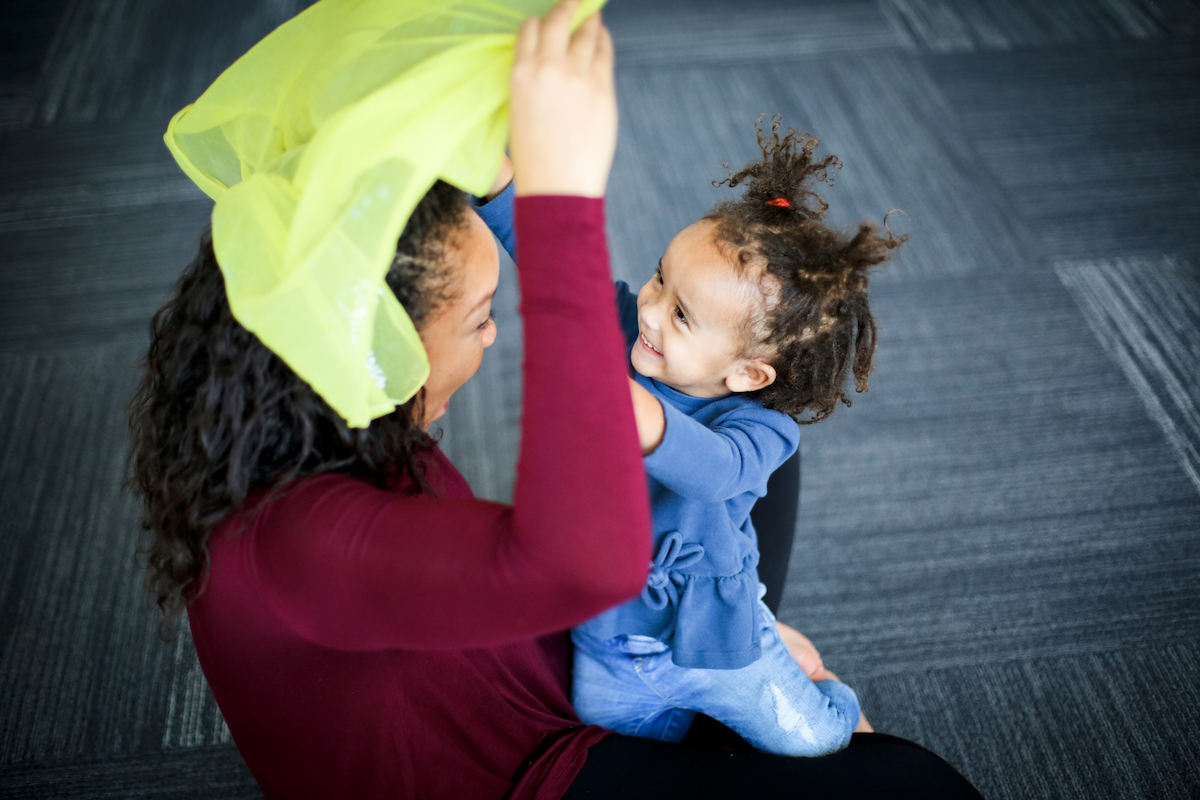
Mom uses sheer yellow scarf to practice scarf play with 3-year-old daughter in a Kindermusik class.

Swish. Twist. Float. Twirl. Bounce. Wave. Scrunch. Toss. Peekaboo…there are a thousand and one ways to promote early childhood development with scarf play.

That’s precisely why scarves are such a valuable prop at home, in a school setting, or in a musical play class. Surprisingly, what looks like just fun and games is actually enhancing brain, body, and social-emotional growth, especially when you combine scarf play with a song, chant, or rhyme.

So, what exactly happens when you take out those scarves?

6 Benefits of Scarf Play

Imagination Building.  “Can you move your scarf like the wind?” That connection between our mind’s eye and an animate object is powerful, so children not only get to imagine how the wind might flow, they get to demonstrate it. That satisfaction spurs more and more curiosity.

Try this: Grab a lightweight towel, blanket, or scarf and follow the prompts with your child(ren) in “Wind and Rain” in the free Kindermusik App. Watch how they “bounce like rain drops” and put their imagination to use.

Directional Tracking.  For babies in their first year, swaying a brightly colored scarf back and forth and tossing it up and down to the music is a safe and easy way to maintain their gaze and monitor progress for this important milestone.
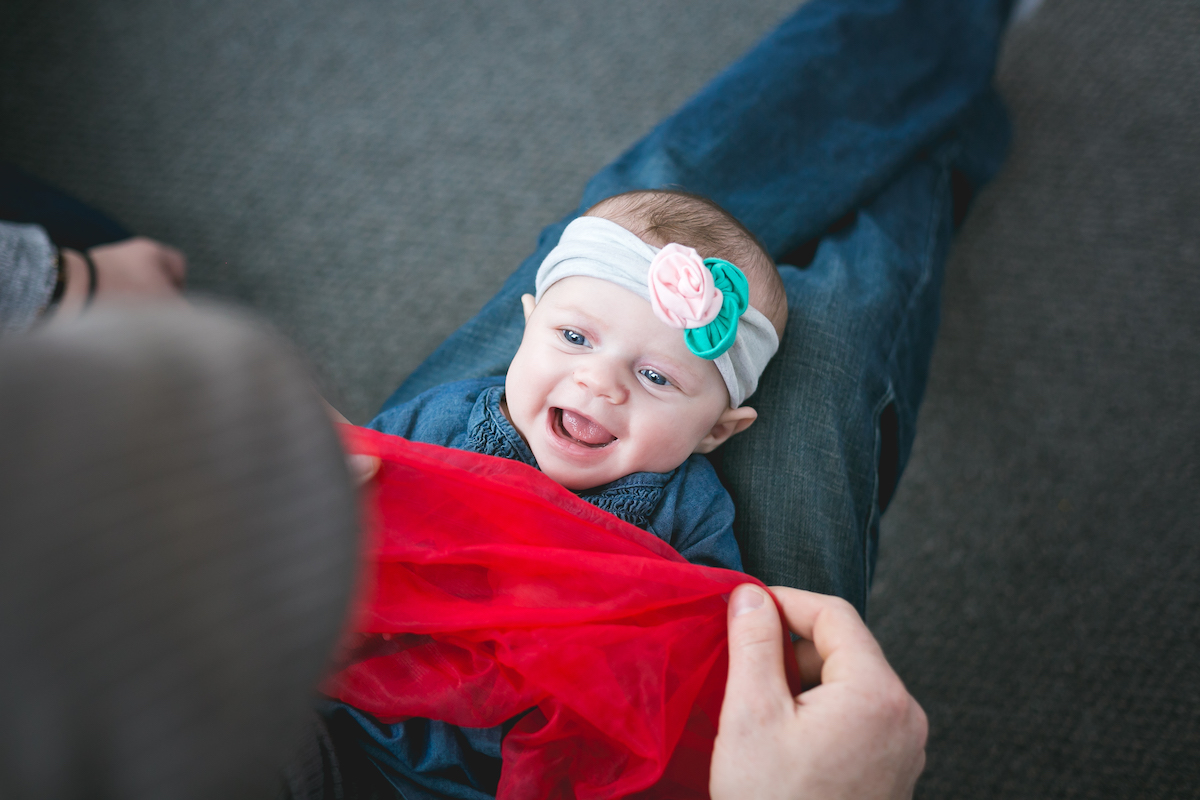
Dad plays peekaboo using sheer scarf with 6-month-old baby girl during a Kindermusik class. This example of scarf play demonstrates object permanence.

Object Permanence. Another baby-specific benefit of scarf play is the demonstration of object permanence. Scarf peekaboo with babies helps them understand that something can exist without them seeing it (like a parent!).

Eye-hand Coordination. For babies, reaching out and grasping a scarf is a big deal! They can clench it, pull it, and swish it around while building up those motor skills. For older toddlers and preschoolers, tossing and catching scarves is an ideal exercise to increase eye-hand coordination needed for everything from brushing their teeth to catching a ball.

Early Handwriting Skills. Trace it. Pinch it. Twirl it. For preschoolers, scarf play can help build the directional and fine motor skills needed to write. Kiddos can easily practice the pincer grasp with something like a lightweight scarf—it’s a great brain break from and supplement to traditional practice workbooks.

Try It: Check out these three no-cost musical scarf play activities to help prep your little ones for handwriting success.
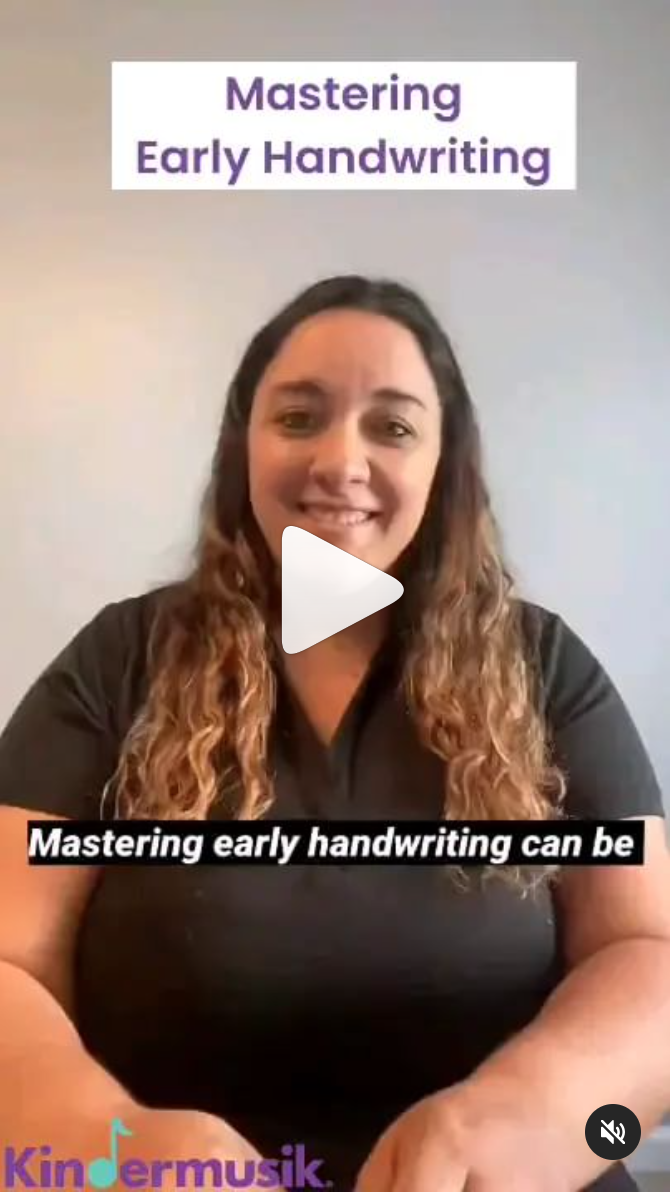
A Kindermusik Educator demonstrates three different scarf play activities to build early handwriting skills.

Vocabulary Enhancement. Verbally describing actions during scarf play (like “Up!”, “Down!”, Toss!”, “Float!” ) helps build vocabulary and comprehension skills.

Aside from the developmental benefits of scarf play, one of the pluses to incorporating it into your activity rotation is that it’s transferrable from class to home and back, and it’s full of joy.

Try scarf play in a group setting.

The best kind of learning happens with repetition, play, and support. Scarf play is a big part of our grownup-and-me studio classes and within our curricula kits for schools and other learning environments.

Join a Kindermusik class near you (in-person and virtual options available) or check out our teach-along solutions for your early learning space!
What Your Musical Tastes Might Say About Your Personality

I must confess. Back in the days of CDs, I would always ask to browse the collections of CDcollectionnew friends. Okay…I wouldn’t always ask. Sometimes, I would stealthily investigate their musical offerings. The insights gained by glimpsing the soundtracks to their daily lives and memories offered a pathway to understanding them akin to reading their diaries. Of course, it would be socially awkward to ask to read a copy of a person’s diary, unless “of a Wimpy Kid” followed “Diary.” Right?
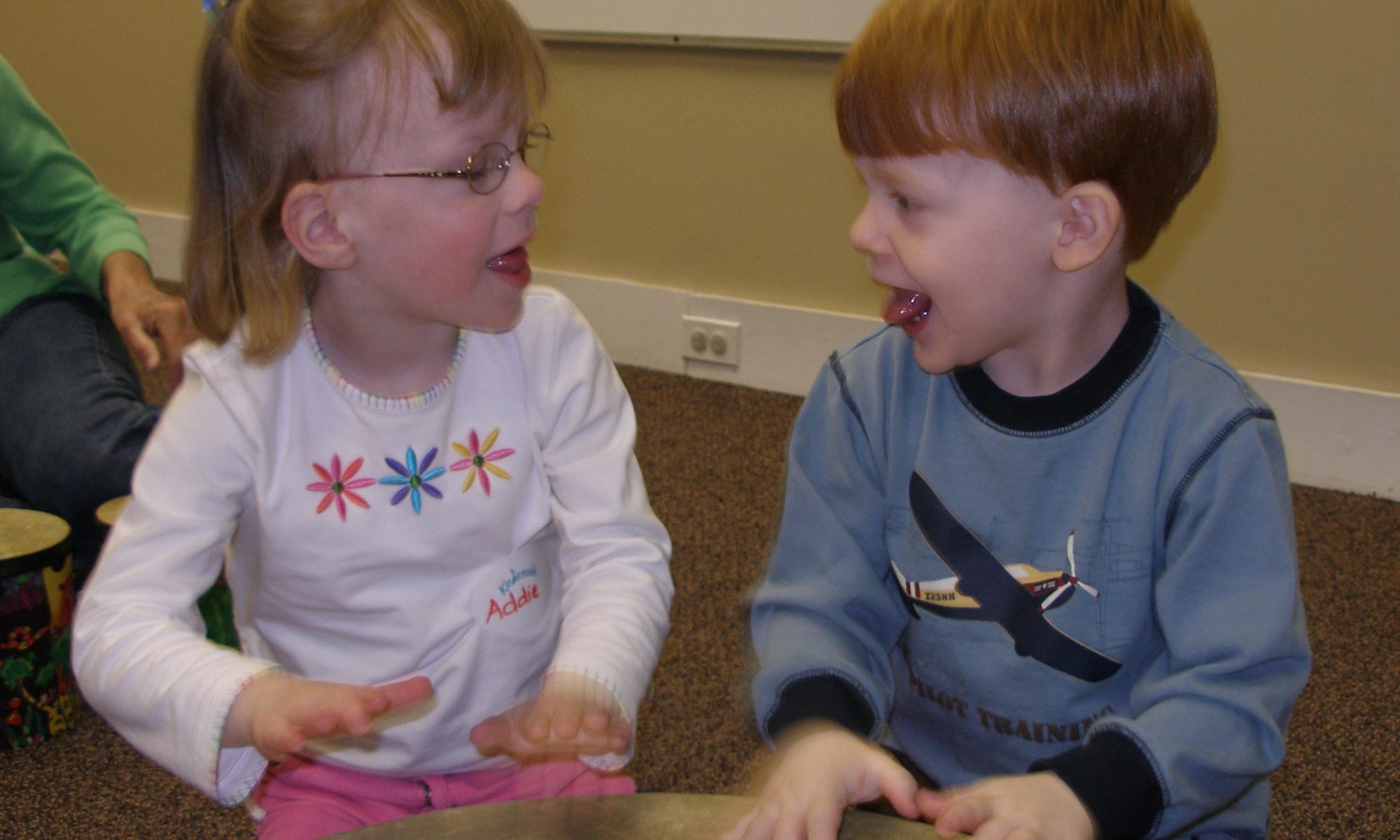
I am fairly certain I am not alone in my confession. You probably did (and do!) the same thing! I know I often busted my friends digging through my music with their eyes on more than one occasion. Well, it turns out we were all on to something. A new research study indicates that the “field research” we conduct by looking at a person’s musical collections really does offer insight into their personality.

Are You a “Systemizer” or an “Empathizer”?

A new research study conducted by a team of psychologists categorized people’s thinking styles into two categories:

Empathizer: A person who likes to focus on and respond to the emotions of others.

Systemizer: A person who likes to analyze rules and patterns in the world.

Depending on which category of ‘cognitive style’ a person scored highest in during the testing accurately predicted musical choices. The research team conducted multiple personality studies with over 4,000 participants and used musical selections from 26 genres and subgenres.

“Although people’s music choices fluctuates over time, we’ve discovered a person’s empathy levels and thinking style predicts what kind of music they like,” said David Greenberg, one of the researchers. “In fact, their cognitive style – whether they’re strong on empathy or strong on systems – can be a better predictor of what music they like than their personality.”

The Results Are In

The Empathizers: Participants who scored high on empathy tended to prefer mellow music (from R&B, soft rock, and adult contemporary genres), unpretentious music (from country, folk, and singer/songwriter genres) and contemporary music (from electronica, Latin, acid jazz, and Euro pop). This group tended not to like intense music, like punk and heavy metal but instead likes music with “low energy,” sad emotions, or emotional depth.

The Systemizers: Participants who scored high on systemizing preferred intense music, but disliked mellow and unpretentious musical styles. Systemizers prefer music with “high energy” (strong, tense), positive emotions, and music that features a high degree of cerebral depth and complexity.

(Source: Milesdavis.com)

The results proved consistent even within specified genres: empathizers preferred mellow, unpretentious jazz, while systemizers preferred intense, sophisticated (complex and avant-garde) jazz.

“This line of research highlights how music is a mirror of the self,” said Dr. Jason Rentfrow, the senior author on the study. “Music is an expression of who we are emotionally, socially, and cognitively.”

What do you think musical tastes reveal about personality? Join the conversation on the Kindermusik Facebook page.

Contributed by Lisa Camino Rowell, a freelance writer in Atlanta, Georgia, who no longer looks at people’s CD collections. Instead, she follows people on Spotify.

Musical Hacks that Help Kids Be a Good Friend

Singing Self awareness

Happy Friendship Day today!!  Just wishing you “Happy Friendship Day” probably made you think of certain people you’ve been blessed to know and who have made your life better just by being your friend.  A good friend is someone who is caring, supportive, understanding, interested, kind, and giving.  It’s a joy to not only have a friend, but also to BE a friend!

Two friends at Kindermusik

But have you ever wondered how to help your young child learn to be a friend?  Music classes are a great place for children to gain the skills they need in order to be a good friend.  Skills like…

Learning to share
Practicing the skill of sharing usually happens around a box of assorted instruments, books, or puppets.

Try this at home: Before your next play date, talk with your child about what it means to share their toys or favorite stuffed animal.  You might even try a little role play to practice sharing. 

Taking turns
During instrument demonstrations, children learn to wait for their turn.  And oh the joy when the resonator bars finally get around to them!

Try this at home:  The concept of taking turns seems so obvious, but it might really help the light bulb go on if you explain to your child what taking turns is – and is not.  You could even do a mini demonstration of taking turns.

Speaking kindly
We parents do try to teach this at home, but there’s something about having another adult (the music teacher) model and encourage this in class too.

Try this at home:  When your child’s tone starts to escalate in the wrong direction, ask them to use their low and quiet voice.  This is a good example of getting the results you want by being very specific and concrete in what you ask.

Being empathetic.
Music puts kids in touch with their feelings, but the group experience of a music class helps kids learn to consider the feelings of others, especially when it comes to watching out for our friends and missing them when they miss class because of sickness.

Try this at home:  Talk to your child about how they feel, and also how they think their friends might feel.  With a younger child, this might take the form of telling.  With older children, this will likely have the most effect if you are asking questions and taking time for the give-and-take of a healthy discussion.

Becoming a good listener
To really enjoy music, you have listen.  Not just hear the sound, but listen to it – the nuances, the contrasts, the instrumentation – everything that makes music what it is.  This is why focused listening activities in music class are so beneficial.

Try this at home:  Encourage your child to pay attention to the sounds around them – a bird singing, a train whistling, baby brother giggling.  And then help them understand what it means to be a good listener with others – giving attention, focusing, and making eye contact.

And as a word of encouragement to parents… Think of how long it has taken you as an adult to develop the skills it takes to be a good friend.  Likewise, it takes years of positive reinforcement, good modeling, and patient practice for a child to gain these skills too.  Starting them off young and giving them social experiences, such as those found in a music class, where they can learn and practice these skills means that they might learn these skills even sooner maybe than you did.  And that’s a good thing because there’s nothing quite like the life-enriching gift of friendship.

Graphic-Learning-Domain-Icons-single-social-emotional-144x144-144x144Looking for a close-knit group of friends for your child and YOU? Join the Kindermusik community of families! Find a class near you today.

One Small Change for Preschool Teachers, One Giant Leap for Preschoolers’ Math Abilities

Why Early Childhood Music

preschoolers and mathWhen a researcher sets out to understand how children learn, or better yet, don’t learn math, some interesting information comes to light, especially when the research focuses in on the early years when preschoolers are just beginning to be introduced to fundamental mathematical concepts.  Such was the case in a recent study conducted by Dr. Nicole McNeil and her team at the University of Notre Dame.
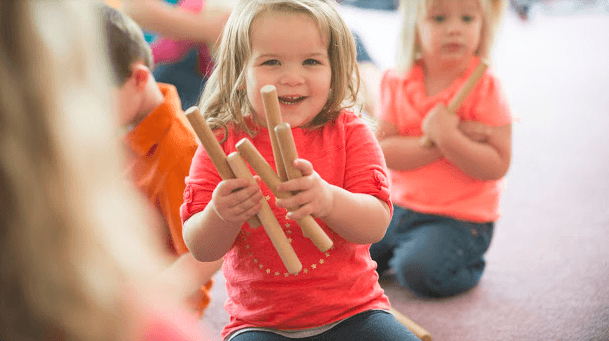
What the researchers found was interesting.  How the concepts were presented and labeled had a significant impact on how well the children understood and applied the concepts. 

Something minor, which in this study was giving the mathematical patterns an abstract label (i.e., A, B, A, B) instead of a concrete label (i.e., naming the colors in the pattern), was actually very major.  The children in the study who worked with the abstract levels solved more problems correctly than the children who worked with the concrete labels.

More than abstract or concrete labeling, the key finding in this study was this:

…[E]ven differences in relatively specific, microlevel factors can affect how children understand certain concepts. I think this means that we need to be very purposeful about structuring lessons and our instructional input to ensure that we are setting children up to construct an understanding of the most important concepts.

A small change in planning and presentation, but a giant leap indeed for children’s understanding and success in learning.

Want to learn more about learning and teaching math through music?  Take a look at our free e-books.

To the Mom Who Showed Up Late to Music Class

early childhood music

I saw you today.

Yes. You!

Did you really think that you could slip in unnoticed after class already started? We had finished all the rounds of the “Hello” song and just transitioned into rhythm sticks when you and your child walked into the classroom. You held your head down trying to avoid eye contact, but your little one didn’t even think about feeling embarrassed for arriving late. Instead, she burst through the door ready to make music with her friends.Rhythm sticks

But I saw you.

Did you see me?

I smiled. Big Time. Could you guess that behind my smile I said a cheer for you: “You made it! Woo-Hoo! Good for you!”

It doesn’t matter what time the clock reads. It matters that you came. After all, time takes on a different meaning when a child enters your life. Every parent learns that lesson sooner or later. We’ve all experienced one or two (or all of these!) reasons for being late somewhere:

A Few Reasons Kids Make Us Late

  • As soon as you dress your infant and strap her in the carrier she experiences her first diaper explosion—the kind your BFF warned you about—and the one you didn’t believe because she tends to exaggerate. After the shock wears off, you spend the next 30 minutes cleaning up your baby, your car, and yourself.
  • Your child refuses to get dressed in anything other than his Buzz Lightyear pajamas, except said PJs are stained with who knows what and two sizes too small. After 20 minutes of intense negotiations, you arrive at a compromise of last year’s Scooby Doo Halloween costume, which is only a slightly better option.
  • It takes your toddler 13 minutes to walk 10 steps to the car. She keeps stopping to investigate something spectacular—a rock, an old piece of chalk left in the rain, an ant. When you attempt to spur her on down the path, it sparks an epic meltdown on full display of the elderly couple next door. After 8 minutes, your child forgets the root of her despair and happily gets in the car.
  • Ten minutes before you need to leave for class your child FINALLY decides to take a nap. You debate letting him sleep to help ward off the evening drama guaranteed to happen on “no nap” days. You opt to shorten the nap by letting him sleep 20 minutes instead of his usual 30 minutes…which means you are 10 minutes later for class. You hope a short nap is better than no nap, but only time will tell.
  • YOU take a nap. Hey! Parenting is EXHAUSTING…as in “will-I-ever-sleep-again exhausting.” You needed that nap because you know you will be up three times between your child’s bedtime and 630am.

So, while your reason for arriving late may not be listed above, it’s okay. You are welcomed whether you show up early, on time, late, or not at all on some days. We understand. It’s why I wasn’t the only one who noticed you arriving late. The other parents did, too. We all widened the circle to include you. After all, we are a family and that’s what family does.

Kindermusik Class Toddler

Do you want to join a community of other families who understand what it’s like to be a parent today? Find a class near you!

Contributed by Lisa Camino Rowell, a freelance writer in the Atlanta area. Through the years, she arrived late countless times to Kindermusik class (for all of the reasons listed above).

The 8 Best Kindermusik Activities to Do at Home

Music activities at home with young children

From class to home and back again!  The value and impact of a music class increases exponentially when the music, concepts, and activities enjoyed in class are also incorporated into everyday family life.  It’s easier than you might think to make the connection between class and home even stronger.

The 8 Best Kindermusik Activities to Do at Home

#1 – Sing Hello and Goodbye (Good Night).
Sing the Hello song each morning when your child wakes up.  Change the word “goodbye” to “good night” and the goodbye song becomes part of a sweet, soothing bedtime ritual.

#2 – Dance together.
After a diaper change, on a rainy day when you’re stuck inside, or while you’re waiting on supper to cook, turn on your Kindermusik songs and dance together.  You can also do a slow, cuddly waltz together just before nap time or bedtime as a way to connect and relax before putting your child to sleep.

#3 – Try an indoor hammock.
Save out one big towel from the clean laundry you’re folding and before putting it away, rock your child in a towel hammock (two adults required) as you play some gentle music or sing a loving lullaby.  For more about hammocking, click here.

#4 – Take your child on a hayride.
That same towel you hammocked with easily transforms into a swervy-curvy, silly-willy kind of indoor hayride.  Simply have your child sit or lay on the towel, then pick up the end closest to his/her head.  Then pull them down the hall and around the room.  Add some music for a little extra fun and movement inspiration.

#5 – Sing in the car together.
If you want your child to love being in the car or running errands, turn car time into singing time.  Your child can teach you songs he/she learned in music class, or you can both enjoy a sing-a-long with your music download or CD from class.

#6 – Do the “Johnny & Katie” fingerplay.
This one is fun!  Starting with the pinky, say “Johnny, Johnny…” while tapping each finger.  Say whoops as you slide down from the pointer to the thumb, tap the thumb (saying “Johnny”), then head back to the pinky saying “Johnny” every time you tap a finger.  Next say “Katie” on each finger.  The fingerplay can go on from there with Daddy, sister, brother, Grandma, Grandpa, aunt, cousin, and more!

#7 – Start a family band.
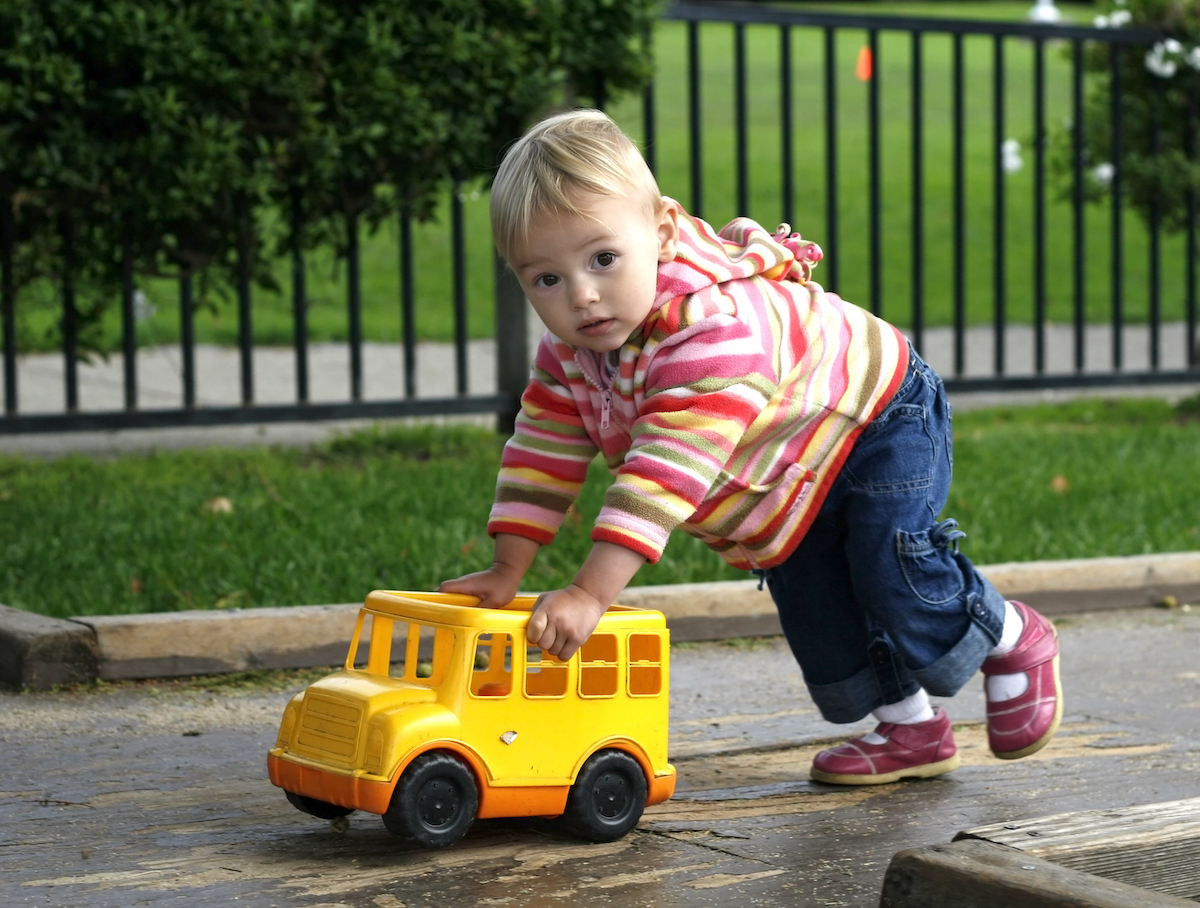
Pots, pans, bowls, wooden utensils, cups, and spoons can all be the instruments for an impromptu band.  Accompany yourselves as you sing, or do a play-along with the recordings your favorite Kindermusik songs from class.

#8 – Read together.
The Kindermusik library stories your child hears in class during Story Time are available when you login to your @Home Materials.  You’ll enjoy the common shared experience, having something new to read, and knowing that you’re doing a world of good for your child’s literacy,

#9 – Rock together.
Nothing says “I love you” quite like being cuddled and sung to, and those lullaby-laced memories will put an emotional bond around your child’s heart that they will remember forever.  We highly recommend a lullaby and some rocking before bedtime every night!  (And if it’s hard for your child to get going in the morning, singing and rocking together can ease that transition too.)

These are 8 simple ideas with big emotional impact – ideas that also connect class to home and make the learning that much more powerful too.

friends around the world - cartoon illustrationKindermusik teachers all around the world love helping families make the class-to-home connections every week.  But did you know that Kindermusik also offers a curriculum for schools that intentionally includes parent materials to easily connect the classroom to the living room? Find out more.

– Shared by Theresa Case whose award-winning Kindermusik program is located at Piano Central Studios in Greenville, SC.

4 Lesser Known Young Toddler Milestones Worth Celebrating

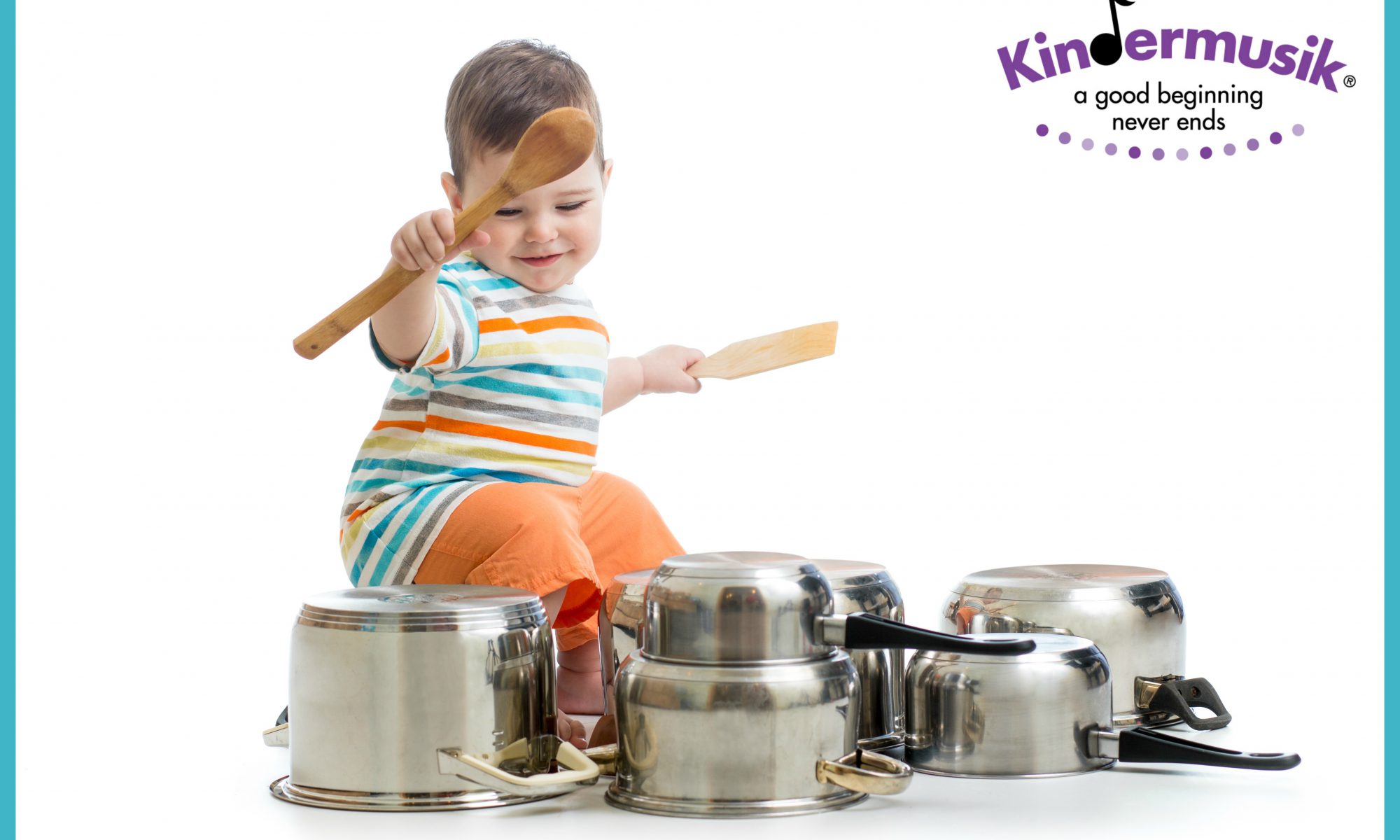
Young toddler pushes toy school bus outside.

Developmental milestones exist for good reason and help with everything from growth tracking to early prevention, but constant focus on checking off every item on the pediatric checklist only causes stress for everyone. When it comes to young toddlers (or really any age), there are some key positive behaviors that you might not realize are already happening.

4 “Minor” Young Toddler Behaviors that = Major Growth

Your child…

Pretends to have a snack with their teddy bear.

What it means: Exhibiting pretend behaviors may seem like no big deal, but they’re actually early signs that your child has acquired symbolic reasoning (e.g., putting an empty spoon to your mouth is not eating, but represents eating.)

Deliberately turns a bowl of cereal upside down.

What it means: Your child is developing wrist control, which is necessary for just about everything we do with our hands.

Is obsessed with pop-up toys.

What it means: Your child has figured out, When I push that button, something will pop up! In other words, cause-and-effect, or I can make something happen.

Follows commands (like “Don’t touch!” And they actually don’t touch.)

What it means: Your child is learning self-control! At long last, they understand that they are in charge of their own wants and actions, and can exercise (some) control over their impulses.

Is obsessed with pushing, pulling, and throwing.

Young toddler throws a Kindermusik chime ball in class.

What it means: Your child is discovering the properties of weight, size, force, and mass. They are investigating questions of science, including which things do what and how.

Search for a Kindermusik class near you or check out our early learning kits to learn more about how to spot, celebrate, and encourage these important young toddler behaviors!

Happy Hammock Day!

baby boy in hammock blanketToday is a special day… it’s Happy Hammock Day!  A time to celebrate the feel-good joy of hammocking. No hammock, you say? We have a simple solution. A solution if you’re under the age of 5, that is. Two adults holding a beach towel or thick blanket makes for the perfect kid-sized hammock.
But why exactly would you choose to celebrate Happy Hammock Day today or any day? That’s because there are all kinds of benefits to hammocking, which is actually just a type of rocking.

There are many reasons why it’s good to rock, and by rocking, to stimulate the vestibular system. We talk a lot about the vestibular system’s function in controlling balance and coordination. But the vestibular system also coordinates information in the ear, eyes, muscles, hands, feet, and skin. It also helps adjust heart rate, blood pressure, and immune responses… just to name a few! And when the vestibular system is activated, it helps the brain make new learning connections.  Who knew rocking – and the vestibular system – could accomplish all that??!!

Happy Hammock Day to all, and to all some good rocking!

We’d love to see how your family celebrates Hammock Day! Post a photo on social media with the tag: #KindermusikHammockDay

baby boy in a hammock

It’s 6 o’clock. Cue the meltdown.

Talk to any parent of a young child, and they’ll tell you. Young children often save their biggest meltdown moments for the early evening time (around dinner). Reasons: They are tired. They’ve spent most of the day trying their best to “behave” at daycare, preschool, or at home. So, by the time the clock strikes 6pm, they are exhausted (although, of course, they would NEVER admit it!)

music helps toddler meltdowns

We have a solution to offer… Use music to head off, smooth over, or maybe even eliminate, those late day meltdowns. 

Here are a few ways you can use music to ease the evening angst and transition more smoothly into the nighttime routine.

  • Keep them busy (and near you!) while you’re busy. Pots, pans, and wooden spoons can turn into musical exploration and play time. Some lively, happy music can invite lots of musical play and keep a smile on everyone’s faces.
  • While the pasta is boiling, dance around the kitchen with your child. When your child is tired and cranky, what they often crave most is a little extra attention from you. Hold them tight or make intentional eye contact as you dance together.
  • Listen to relaxing music routinely every evening. Consider setting up a playlist of you and your child’s favorite music for calming and unwinding.
  • Use music as a timer. For example, “It will be time to eat after four more songs.”
  • Use the timer on your smart phone to cue your child. Pick a specific song that is only played when your timer goes off. Your child will become accustomed to knowing that when the timer goes off, it’s time to transition to something else such as dinner, bath, reading time, snuggles, or lights out.
  • Make a special habit out of singing (or listening to) a lullaby or two after tucking your child into bed.  The quiet, loving ritual will calm them – and you – and also have them quietly settling down before you know it.

And when a meltdown does happen, take a deep breath and stay calm.  Focus on what you want your child TO DO (take deep breaths, go to a quiet place to “get themselves together”) instead of focusing on what you DON’T want them to do (cry, scream, kick, hit).  And afterwards, take a little time to cuddle up together, rock quietly, and hum a little lullaby.

What’s your favorite Parenting Tip to control the evening chaos at home? Share on our Facebook page.

Two Simple Ideas for Supporting Children’s Vocabulary Development

Up, down, in, out, under… Those relational prepositions mean something very specific to us as adults.  But when toddlers hear a phrase like, “Put the block under the cup,” they’ll probably put the block in the cup, because it’s the obvious thing to do. Toddlers understand that they are supposed to do something with the block and the cup, but just what all those relationships are, and what they’re called, can take years to master. Typically, toddlers tune in to the words they know, like “block” and “cup”—and then make a good guess about what you’ve got in mind with the rest.

Language development, like all other developmental domains, is a process which can be nurtured in surprisingly simple, everyday interactions and activities.  Here are two ideas that will help support children’s vocabulary development:

#1 – Label and move.

There is a powerful connection between movement and learning that has an impact on language development too.  That’s because a child’s developing brain makes a connection based on what they experience.  The more you label the movements, the more your child will understand and be able to make the connection between the word and the movement or object.  Here’s a great example of moving and labeling:

Kindermusik bird song - using movment and labeling to improve vocabulary development
#2 – Practice and play.

Learning should be fun!  And here at Kindermusik, we like to make it hands-on, interactive, and engaging, particularly with our @Home Materials.  Here’s a playful way to help your child with their vocabulary development:

Way Up High - Toddler TalkLooking for more parenting ideas on how to support your child’s development? Visit a Kindermusik class.  Your first one is on us.