
Turtle Dove: Music and Memories

Fare thee well, my dear, my own turtle dove, I must leave thee for a while. For though I go I will come back again, if I go ten thousand miles my dear, if I go ten thousand miles.

When this song comes back through my rotation, every two years, I am slammed with overwhelming emotions as the memories of past littles and their families breach the surface. I haven’t always been able to hide the affect this song has on me and, years ago, stopped trying. Music evokes emotion. There is no shame in that.

My first time teaching Away We Go, I had a young family who was expecting their second child. I became especially close with them and still consider them friends to this day, sharing hugs, coffee, and stories of their kids. Shortly after their second baby was born, they were told of a devastating heart defect, the little chance of survival thru surgery, and lack of quality of life if the baby boy survived. They choose to hold him close till he took his last little breath at 20 days old. They never missed a class with their oldest. They wanted something to be consistent, and they choose my class to be the one constant thing. So every week, dad brought big brother and during that time we rocked to “Turtle Dove.”   Including the day that they buried that little baby boy. They came to class that night, held their first born tight, and rocked him. Fare thee well, my dear, my own turtle dove, I must leave thee for a while.

Two years later, my very good friend was about to leave for his first deployment. He wanted to bring his youngest to class as often as he could before he left. Again, it was Away We Go and again, it was “Turtle Dove.” I vividly remember him holding that little boy, squeezing him tight, not knowing how long he’d be gone and what he would endure to come home. And the little boy being held in his arms, oblivious, to the heartache surrounding him. For though I may go, I will come back again, if I go ten thousand miles, my dear, if I go ten thousand miles.

Another two years passed, another group of littles and another heartbreaking story that played out in my studio with “Turtle Dove” as the soundtrack. A father passed away from cancer. The little girl, much like the big brother mentioned before, never missed a class, I saw almost a different family member every week, a family determined to provide something consistent for the child they loved. Again, music was the choice and I was greatly humbled. Fare thee well, my dear, my own turtle dove, I must leave thee for a while.

A few years ago, when I taught Away We Go, I had a beautiful little boy with big blues eyes. Those eyes would fill with tears that would quietly fall down his face every time I played “Turtle Dove.” His mother told me that he doesn’t know why the song makes him weep and she didn’t understand it. I understand, my friend, I truly, truly do.

“Turtle Dove” will be coming back to my rotation before too long. The memories of those families are still so vivid, I can tell you exactly where each of their spots were in my singing circle. These are things I never expected to carry from teaching Kindermusik. I knew I would cheer and laugh and dance with them. I didn’t know that I would cry and hurt and carry their memories of loss with me. I never expected my heart to re-break in the first measure of a song. I never expected the privilege of being the one constant thing in a child’s life during a heartbreaking time. So very humbling.

Music moves us and creates memories we hold in our hearts forever. Create your own musical memories with “Turtle Dove.” Download the song for free. Be sure to sing it with your own little turtle dove!

Leigh Levine lives in Allendale, Michigan where she teaches Kindermusik. Leigh loves to perform in community theater when time allows, is an avid tap dancer and is the deliriously proud mother of two girls.  She and her husband, Jon, recently celebrated 23 years of marriage.

Want to Teach Toddlers Math Skills? Better Get Moving!

Early intervention matters in all areas of child development…from speech and language, motor skills, early literacy skills, positive behavior, and more. The sooner a child receives help the greater the impact. As educators, therapists, doctors, and researchers learn more and more how to identify early markers for intervention needs, children at risk for delays receive early intervention strategies, well, earlier. Some of the indicators may seem unrelated at first. For example, new research gives guidance in identifying young children who may need extra mathematical help…all by looking at their motor skills!

Motor Skills as Early Predictor of Math Skills

A Norwegian study shows that two-year-olds with poor motor skills also exhibit poor mathematical skills. Teachers can use this information to identify children who may need extra help.

“It is important that teachers of small children are aware of these findings. It will be easier for them to identify children who may be at risk of having difficulties in understanding mathematics. This knowledge can ensure that teachers and staff are quicker to help and support such children with mathematics,” said Associate Professor Elin Reikerås of the Norwegian Reading Centre in a University of Stavanger press release.

In the study, the research team evaluated the motor skills of two-year-old children by assessing their abilities to complete jigsaw puzzles, eat with utensils, use scissors, walk around a room without bumping into things, playing on the playground, and throwing and catching balls. Based on their motor skills abilities, the team divided the children into three groups: poor, average, and strong.

Then, the team examined various mathematical abilities of the children, such as if the children were able to use their fingers to show how old they were, if they could use the shape sorter box, play picture lotto, sort toys or objects by color or size, demonstrate the difference between big and small through the use of body language or words, and use numerals.

“Children create experiences when they use their bodies. This is also important within mathematics. When children play, climb, crawl and hide outdoors, this contributes to the development of spatial awareness. Shapes and sizes are explored through drawing, painting and playing with blocks. Putting on clothes in the right order or sorting and tidying toys requires both logical reasoning and motor skills. Dealing with numbers, such as giving a cup to everyone and then pointing and saying the numbers, also involves connections with motor function,” Reikerås explains in the press release.

How Early Childhood Music Puts into Play this Research

In early childhood classrooms around the world, many teachers use music and movement to support the development of both gross and fine motor skills and early mathematical concepts, such as counting and spatial awareness. Take a look at how music and movement can teach children mathematical concepts by using their whole bodies.

What Do Music & Math Have to Do with One Another?

Contributed by Lisa Camino Rowell, a freelance writer in the Atlanta area.

The Importance of Intentional Play & Loving Connections in the Early Years

Nurture your baby with Kindermusik

It’s hard not to goo and coo and tickle and cuddle and play peek-a-boo with a cute little baby.  But science is now discovering just exactly how important those goos, coos, tickles, cuddles, and peek-a-boos are, demonstrating that while Nature has a hand in how the brain is pre-wired, the brain depends very heavily on environmental input, or nurture – those tickles, cuddles, and peek-a-boos we keep talking about – in order to wire itself further.  (Read more here.)  How intricately the brain gets wired has long-term impact on all seven areas of intelligence, how well a child does in school, and how they function socially and emotionally.

So how can a parent be intentional about the play and loving connections that are so crucial in the early years?  Here are some simple suggestions:

  • Make time for play.  It’s easy to get caught up in the busyness of daily life.  So maybe your playtime with your child is just before leaving for work or just after supper before bath time.  Whatever time is best for you, make it a non-negotiable part of your day.
  • Get down on the floor with your child.  You can’t help but be a lot more engaged when you’re at their level.  The play and interaction will come more and more naturally as you spend more and more time in play with your child.
  • Be silly!  No one else is watching, so go ahead, and just take delight in what delights your child.  YouTube is full of silly parent-child videos that have gone viral.  You know the ones where the parent does something silly and unexpected only to be rewarded with the best belly laugh ever.
  • Talk to your child.  Tell her about your day.  Describe what you’re doing, even if it’s a mundane activity.  Or just try some nonsense baby talk.  Even if they can’t talk back, they’ll still be enthralled with hearing your voice.  And if you take a few conversational pauses, you might even get some goos and coos in response.
  • Dance with your child.  Your music or theirs.  It doesn’t really matter.  What does matter is the eye contact, the full attention, the love, and the joy of moving together.
  • Cuddle and sing lullabies.  There’s nothing that invites more loving connections than cuddling and singing to your child.  And don’t worry… to your child, your voice is the most beautiful sound in the whole wide world.

Need some inspiration for playing, singing, and interacting with your child?  Try a Kindermusik class.  We have tons of ideas and resources to share!

Moments Worth Waiting For: Music & the Child with Special Needs

First smile. First time sitting up. First steps. First time saying “mama” or “dada.” Oh yes. Every parent can create a list of enduring moments worth waiting for and savoring.

In the Kindermusik community, we concoct our own lists, too, and our collective heart for children and families overflows with the memories of how music reaches children of all abilities.

Take Filomena. Music helped to create so many moments worth waiting for:

Kindermusik Children with Special Needs Video

Then there are Meghan and John, whose stories remain rooted in the heart of Kindermusik Maestro educator, Christa Beck, who has a passion for incorporating children with special needs into Kindermusik classes:

Meghan’s Moment Worth Waiting For: Early in my Kindermusik career, Meghan a little girl with Down syndrome was working so hard to walk. She was approaching age 2.  During class one evening, Meghan walked across the room for the first time. The entire class began to applaud and cheer. Her Mom was in tears and still talks about that moment to this day.

John’s Moment Worth Waiting For: During a preschool age class, I had a mostly non-verbal preschool boy with autism.  After two weeks of repeating an activity, the third week again we were passing around a rooster puppet and singing “Kukuriku.” John sang those notes clear and on pitch. It was the most he had sung (or spoken) around other children.


Every child impacts us in profound ways because every child is profoundly beautiful, including a little boy named Lucas with brittle bone disease, whose story Kindermusik educator Betsy Gurske shares:


Kindermusik Children with special needs

5 benefits of music for children with special needs

Yes! These moments serve as reminders about the personal power of music on a child’s everyday life. However, scientists, music therapists, and Kindermusik educators also know how the research backs up the moments.

  1. Playing instruments supports fine motor skill development
  2. Moving to a steady beat encourages gross motor skills development.
  3. Playing music in a group increases empathy and teaches other key social-emotional skills, such as turn-taking, listening, and responding.
  4. Music can relieve stress, decrease blood pressure, and even shows to help with the reduction of pain.
  5. Music gives verbal and non-verbal children a way to express thoughts, feelings, and ideas.

Do you have a child with special needs? Come visit a Kindermusik class together and experience your own musical moments worth the wait!

12 Song Lyrics Perfect for Kid’s Room (FREE PRINTABLES INCLUDED)

You don’t need to be a singer-songwriter to recognize that lyrics somehow perfectly capture an emotion or a moment in time. So, we put together a few of our favorite song lyrics that, well, perfectly capture parents’ dreams, wishes, hopes, and prayers for their young children. Plus, you can download them and use in your home or classroom or office!

Nursery 8


Nursery 4


Nursery 5


Nursery 6


Nursery 7


Nursery 9


Nursery 3


Nursery 1


Nursery 2


Nursery 11


Nursery 10


Nursery 12


Download all 12 musical printables here for a child’s nursery, playroom, or even your kitchen or living room!

You Hear Beeping. We Hear Phonological Awareness

Kindermusik@Home

Young children love to listen to and imitate sounds! Parents should encourage this natural inclination as often as possible, because this vocal play is actually helping children develop early phonological awareness skills. Phonological awareness is the ability to hear and manipulate words, syllables, and sounds in oral language. It is one of the strongest predictors of later reading ability.

Children develop phonological awareness through deliberate and explicit instruction, with plenty of opportunity for repetition and practice. Instruction should be just like the game below from Kindermusik@Home: brief, focused, playful, and active to keep children engaged. For young children, it’s best to incorporate images to help make a connection between an object and its sound.

Let’s Be Vehicles: A Phonological Awareness Game for Young Children

This adorable vocal play game wants you to come along on a chugga-chugga, vreeeooooooom, putt-a-putt-putt, beeeeeep-beeeeeep, bringg-bringg ride, and be ready to make some noises along the way. Play the “Let’s Be Vehicles” game.

Let's Be Vehicles

For an added challenge, after playing this game with a young child a few times, try practicing the auditory discrimination game away from the computer. Ask: “What sound does a motor boat make?” Make the sound of the airplane and ask, “What makes this sound?”

Looking for more fun, musical learning ideas? Follow us on Pinterest.

When It Comes to Baby Talk, Moms Matter

from Birth

Sometimes it seems that a mother knows what a child is thinking and feeling even before that little one can verbally communicate.  That’s because even brand-new moms are somehow inexplicably endowed with this special ability to be tuned in to their little one’s thoughts and feelings.  Some may call it maternal instinct.  It might be better called the “mom thermometer.”  Dr. Elizabeth Kirk, from the University of York, called it “maternal mind-mindedness” or “tuning in.”

What kind of “reading” a mom gets on her “mom thermometer” then often translates into not only she cares for her baby, but more importantly to Dr. Elizabeth Kirk and her research team, this instinctive tuning in is the basis for how a mom interacts and talks to her little one.  Dr. Kirk’s study found that a “…a mother’s ability to tune-in to her baby’s thoughts and feelings early on helps her child to learn to empathise with the mental lives of other people. This has important consequences for the child’s social development, equipping children to understand what other people might be thinking or feeling.”  Pretty amazing!

mom talking with her baby

Well since we here at Kindermusik are all about using music, movement, and the weekly Kindermusik class to help make great parenting a little easier, we have some “talking points” for all parents as you are interacting with, tuning into, and bonding with your babies and young toddlers by identifying and labeling their emotions.

Emotional Talking Points

When Mommy sings your favorite lullaby, you feel all better.

You love cuddling with Daddy, don’t you?!

I can tell when you smile that you are happy.

Are you feeling frustrated because you can’t fit that into the box?

Does it make you feel upset when your beans fall off your spoon before you get them in your mouth?

Emotional Activity Ideas

  • Listen and/or dance to “emotional” music.  (You can define what “emotional” means at any given moment.)  Talk to your child about how the music makes them feel.
  • Use simple songs or rhymes at routine points throughout the day – waking up, getting dressed, going down for nap, bath time, or bed time.  The songs or rhymes can not only help the transitions go more smoothly, but you can talk to your baby about their reaction.  Upset?  Happy?  Sad?  Frustrated?  Contented?
  • Deliberate eye contact will help you tune-in more to your baby and his/her emotions.  Look into their eyes as you talk to them and love on them.
  • Take time for some gentle baby massage.  This is a great time to “converse” with baby and make that all-important eye contact.
  • Sing or hum a lullaby as you rock your child.  You might use rocking as a nap time or bed time ritual.  But rocking is also a great time to really focus on your child, saying “I love you,” and getting a good “read” with your “mom (or dad) thermometer.”

We get that some of these examples might sound just slightly cheesy when written out, but don’t worry – they won’t come across as cheesy when it’s just you and your little sweetie one-on-one.  And later on, when your child is growing to be happy, self-confident, thoughtful, and sensitive towards others, you can give yourself a big pat on the back.  It was your intuitive connection, tuning in, verbalization, and yes at times, one-sided conversations, that made all the difference.

Want more insight into your child’s social-emotional development?  Follow us on Pinterest!

Shared by Theresa Case who has loved every minute of helping parents connect with their children through music at Piano Central Studios in Greenville, SC, for over 20 years now.

How Music Class Helps Parents Nurture a Child’s Development

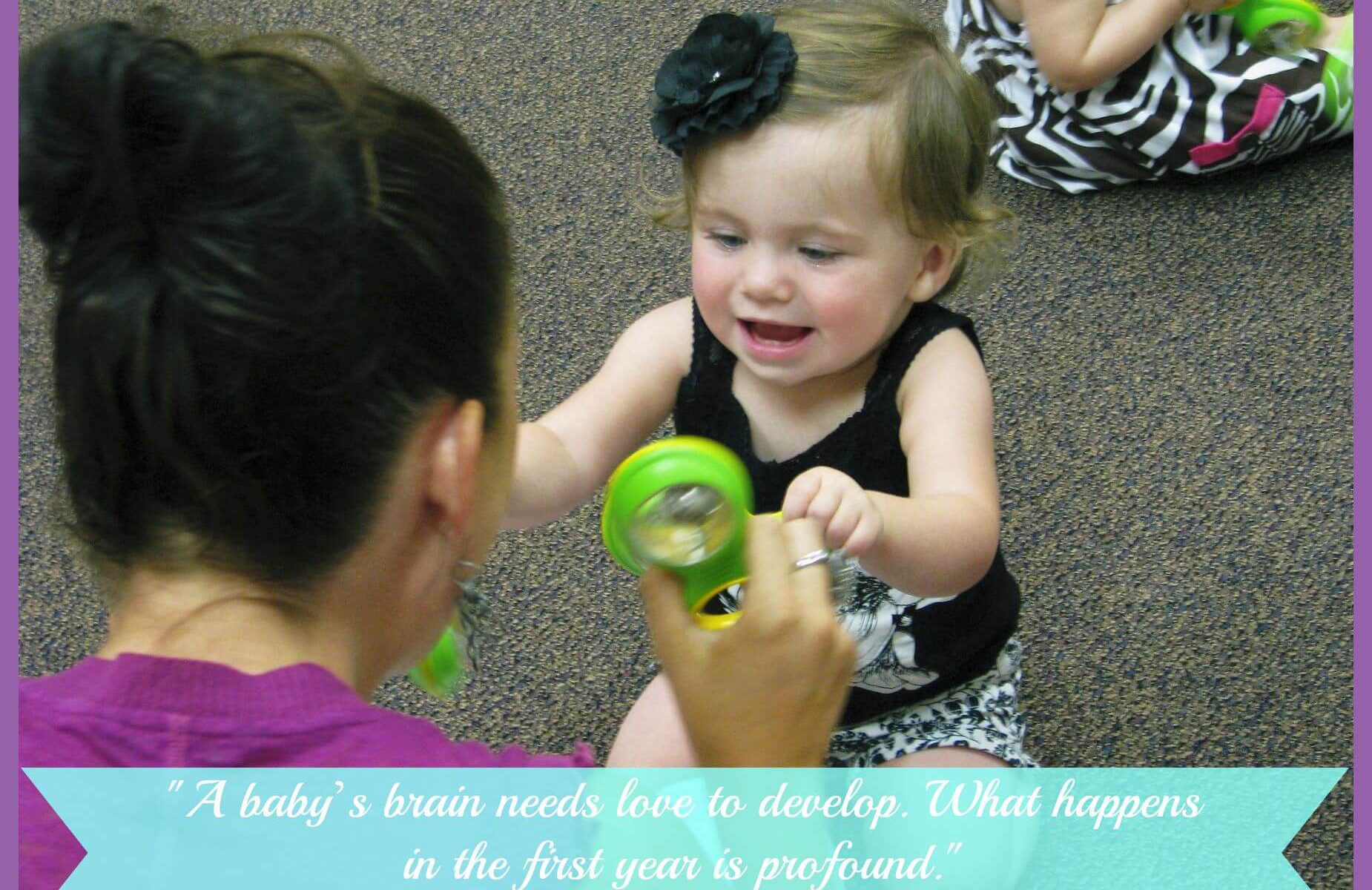
A Baby's Brain Needs Love to Develop

Turns out that nature does need a little nurturing after all, especially when it comes to the development of the brain.  The “Philadelphia study,” as it’s been called, was the first to establish a clear connection between childhood experience and how the brain develops.

Despite coming prewired with mind-boggling capacities, the brain depends heavily on environmental input to wire itself further. Scientists are now discovering precisely how that development is molded by the interplay between nature and nurture.

In the early years, much of the “environmental input” that’s so critical for brain development is directly facilitated by a child’s parents and the kind of interactions and experiences they provide for a child.  That’s why Kindermusik has always asserted that parents are a child’s first, and best, teacher.  One of the best kinds of early experiences a parent can provide is in a music class, especially one that offers a rich, multi-sensory and developmentally appropriate experience, supported by Home Materials that take the joy, learning, and bonding into the home and throughout the week in between classes.

Five ways a music class like Kindermusik helps parents nurture a child’s development

  • A music class gives parents the time and inspiration for the kind of one-on-one attention and nurturing that can result in higher IQs.
  • A music class helps parents give their child an opportunity for social development in a warm and welcoming environment.
  • A music class strengthens emotional bonds through lots of cuddling, dancing, loving touch, and playful connection.
  • A music class encourages language development through singing, rhyming, vocal play, and conversation.
  • A music class supplies parents with ideas and resources for play and together time at home.

The more scientists find out about how children acquire the capacity for language, numbers, and emotional understanding during this period, the more they realize that the baby brain is an incredible learning machine. Its future—to a great extent—is in our hands.

Find a local Kindermusik class and experience firsthand how music classes can support your parenting and your child’s development.

*Quotes taken from this National Geographic article.

Give Kids’ Brains a Break with Music

teach kindermusik

The Electric Slide, The Cha-Cha Slide, and The Macarena can impact kids’ brains in a powerful way…and probably not in the way you may think. Music and movement “brain breaks” can actually improve attentiveness, concentration, and focus. (Yes! Even The Macarena.) Brain breaks can also help kids discover new solutions—or THE solution—to a problem.

So, the next time the kids in your life need a break, try one of these at home or in the classroom!

4 Quick and Easy Music and Movement Brain Breaks

  • 5-4-3-2-1. In this game, children perform 5 different movements in descending order. For example, a teacher or parent says: Clap your hands five times. Hop four times. Spin around three times. Stomp two times. Jump one time. Pause between each number to allow time for every child to process the instruction and do it.
  • Sing “Head, Shoulders, Knees, and Toes.” This gets kids moving and stretching. Plus, movement paired with the word also supports vocabulary development!
  • Play Freeze Dance. Put on a favorite song and tell children to dance or move around until the music stops. When the music stops, they must stop, too. This brain break game also gives children the opportunity to practice inhibitory control.
  • Look at pictures of cute baby animals. This one isn’t a musical brain break, but kids love looking at baby animals. (Who doesn’t?!) A Japanese research study showed that looking at all of those cute baby animals actually increases concentration and attentiveness! To make it musical, listen to music while you gaze at the cuteness.

Want more musical brain break ideas for your family? Visit a local Kindermusik class and we’ll give you enough to last throughout the week!

Contributed by Lisa Camino Rowell a freelance writer in the Atlanta, Georgia, area.

How Kindermusik Prepares Kids for Piano Lessons

Kindermusik prepares kids for music lessons

What’s the best preparation for piano lessons?  Any piano teacher who’s ever taught a Kindermusik graduate will tell you without hesitation that piano students who have had Kindermusik progress more quickly, have a solid grasp of music fundamentals, and stick with their lessons longer.  Many will even go so far as to say that a former Kindermusik student is a dream piano student.

I make those bold claims after 20+ years of watching Kindermusik kids graduate and not only do well, but absolutely flourish and thrive in our music program.  As director of a large music school, Kindermusik educator, and former piano teacher, I’ve seen, heard, and celebrated success after success that could only be attributed to Kindermusik.  In fact, I’ve conducted my own non-scientific “research” several times throughout the year when I’ve waited to tell my piano teacher that her new student was a Kindermusik grad.  And the experiment never fails to produce the expected result.  Within just a few weeks of working with that student, I always get a text or a phone call from the piano teacher, “Has this child been in Kindermusik?!”

In celebration of September being “National Piano Month,” I’d like to celebrate just some of the ways that Kindermusik prepares kids for piano lessons.

Kindermusik kids learn musical terms and concepts in the most perfectly beautiful and natural of ways.  These concepts are happily experienced and curiously explored in the kind of rich, multi-sensory environment that supports optimal learning and connection.

Kindermusik kids have an ear for all types of music.  This is because the Kindermusik library is so vast and varied, introducing these young musicians to music from all different cultures, different centuries, different genres, and different traditions.

Kindermusik kids develop an ingrained sense of steady beat.  From bouncing to rocking to dancing to marching, a sense of rhythm has been instilled from the time they were infants.  First in mama or daddy’s arms, and then on their own two feet.  They can feel it in their whole bodies.  And nothing is more central to music than steady beat.

Kindermusik kids know how to make music together, in groups both big and small.  They first learn to interact with mom and dad.  Then with others, in side-by-side play and exploration.  Their ensemble skills come into full bloom as the children successfully play their instrumental part with the rest of the class, on cue and in rhythm.

Kindermusik kids learn to read, write, and compose music at a young age, between 4.5 and 7 years.  What they grew to love in their hearts as babies, toddlers, and preschoolers becomes what they delight in understanding and creating as big kids.  The Kindermusik formula stays the same – singing, moving, exploring, listening, playing – all gently leading a child to a level of understanding that could only be the product of such a joyful, process-based approach.

Kindermusik kids are confident musicians.  From their very first classes, they’ve been encouraged to explore, to try new things, to think outside the box, and to use their imaginations – not because they were trying to find the one right way, but because there are oh-so-many ways to participate in Kindermusik class where process is always emphasized over performance.  This process-based approach develops a unique kind of self-confidence, not just at the piano, but also in the classroom and later, in the workplace.

Kindermusik kids love music, from the top of their heads to the tips of their toes.  This is the deepest kind of love that grows the strongest as it is lovingly nurtured and encouraged from an early age.  It’s the kind of love that opens the door to reaching the fullest potential in musical study.

Many Kindermusik kids have come through our doors over the years.  They have all left with a song in their heart that will stay there forever.  Many also left with another incredible gift – the ability to play the piano and enjoy making music the rest of their lives.

Do you want to prepare your child for piano lessons? Find a local Kindermusik class and see for yourself how Kindermusik prepares kids for formal music lessons later on.

Shared by Theresa Case who has been the Director of Piano Central Studios in Greenville, South Carolina for over 20 years now.