
5 Things Not to Do in a Music Class

We’re not too shy to say that we’re the experts when it comes to creating a one-of-a-kind experience in our music classes for kids.  In fact, Kindermusik has been the world’s leader in music education programs for young children for over 30 years now.

In all that time and with the help of thousands of licensed Kindermusik educators all around the world, we’ve learned a few tips of what NOT to do in a music class, but especially in a Kindermusik class. We are happy to share five of those “what not to do” tips with you here.

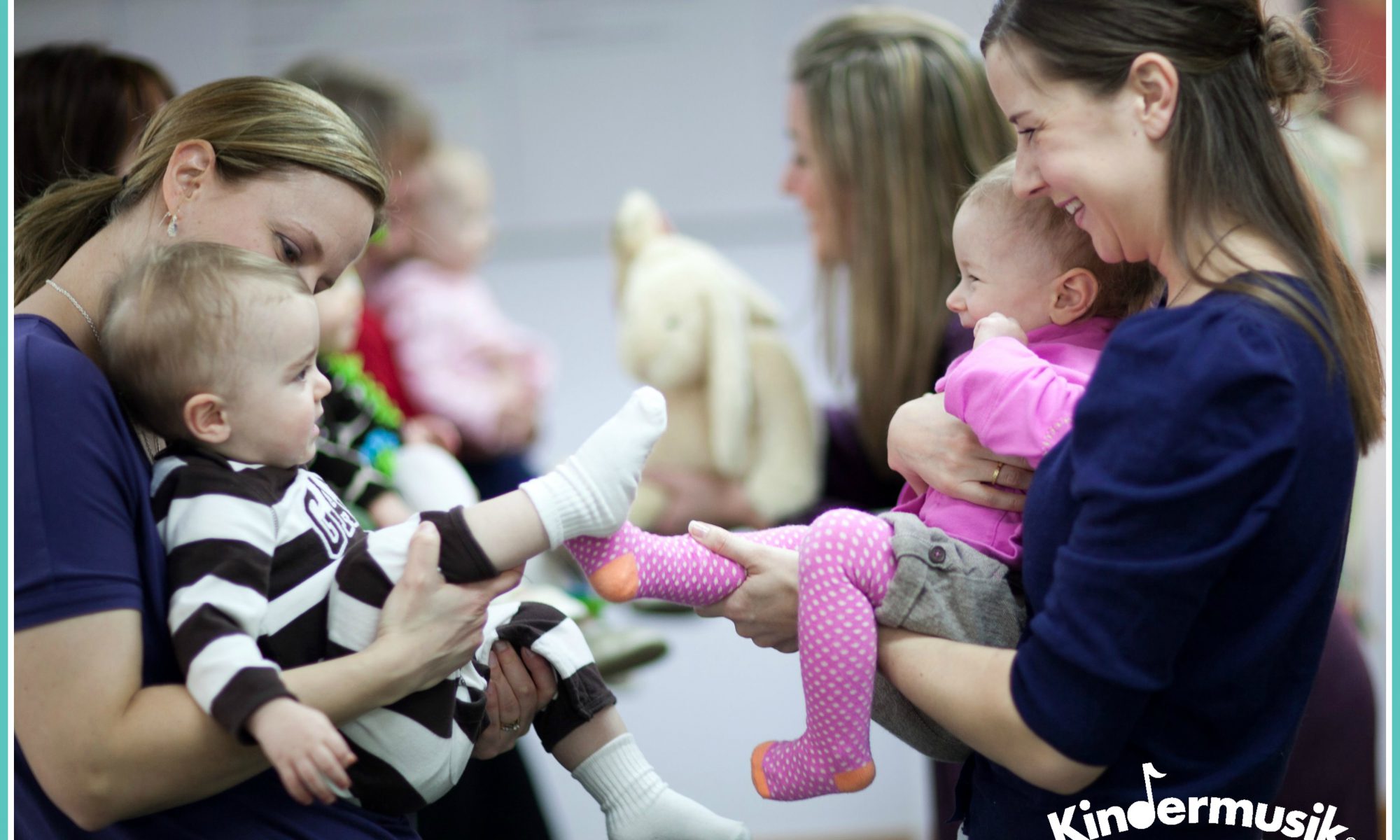
Kindermusik_92 - babies making friends

5 Things Not to Do in a Music Class

Stand off to the side.
All of the fun and memories come from your active and joyful participation, so yes, please do join right in. You’ll be surprised just how much you enjoy letting your inner child come out—both in class and at home when you and your child “play” Kindermusik!

Look at, but don’t touch, the instruments.
(Remember we’re talking about what NOT to do in music class with your child. Those double negatives can mess with your mind.) Seriously, you are your child’s first and best teacher, and when it comes to Kindermusik class, the one who can really help them explore and enjoy the instrument play to its fullest.

Leave your singing in the shower.
There’s no more beautiful sound to your child than your voice, even if you’d never make it on stage. And there will be nothing more special to your child than hearing you sing along in class. You might even find that singing in the car together will become a new favorite pastime!

Sit out any of the dances.
In class, we keep things moving – literally – with happy dances interwoven throughout many other delightful activities in each weekly class.  You’ll love the endorphin rush of dancing with your child and the joy of doing so in a group where everyone else is simply enjoying just being with their children like you are.

Limit your music time to just the class time. 
The real value of your Kindermusik enrollment is that you get to enjoy the music, the moments, and the memories throughout the week at home.  So go ahead, stream your class music or pop in that CD.  Sing out loud with your child in the car or dance around the kitchen while supper’s cooking.  You’ll be glad you did!

make your heart singFind a local Kindermusik class so you can practice NOT doing these things with your child!

Shared by Theresa Case who has spent the last 20 years sharing the joy of Kindermusik at Piano Central Studios in beautiful upstate South Carolina.

How to Raise a Child Who Cares for the Environment

children around the worldToday officially marks Earth Day! However, for young children, every day is Earth Day. After all, they discover something new and wonderful about the outside world each time they encounter it. It’s one of the reasons a walk with a toddler takes 30 minutes just to make it from the front door to the sidewalk. Flowers, leaves, rocks, grass, worms, butterflies, birds, clouds….there are so many beautiful parts of the environment that cause children to pause and investigate further!
While on this Earth Day it may be too early to introduce concepts of pollution, habitat, or species protection, it’s NOT too early to talk to children about the amazing things that the Earth can do. Children must first learn to understand and to love nature and the environment before they can be weighted with the challenge of trying to “save” it. At this age, just concentrate on establishing an emotional connection, awe, understanding, and respect for what nature is and how it works when its systems are working properly. Young children will naturally respond to nature this way!

Earth Day Activity: Composting with Kids

Composting is an ideal and child-friendly place to start teaching children about the environment! It involves dirt, digging, and water–three things children already love! And the idea that, left to their own devices, recyclable food and plant materials can turn back into dirt, and then grow more food and plant materials, is an ideal first lesson about why the Earth is incredible. Try this step-by-step composting guide specifically created with young children in mind:

Composting with Kids

Looking for more ideas on living green with kids? Check out our Pinterest Board.

Contributed by Lisa Camino Rowell, a freelance writer living green with kids (or trying her best!) in the Atlanta, Georgia, area.

Scooby-Dooby-Doo-Wap Your Way Through Jazz Appreciation Month

Throughout the Kindermusik experience, we deliberately introduce children to a wide variety of musical genres to give them a greater understanding of what is possible through music. This month we celebrate Jazz Appreciation Month! We wanted to make it easy for you to celebrate it, too, so the children in your life can experience the value of improvisation and emotional expression and gain an appreciation of this musical genre that traces its roots to the Southern (United States) African-American music of the early 20th century. Try this Kindermusik@Home activity to give children a taste of jazz and to support early language development.

Scat Cat Is Where It’s At

Listening to and mimicking (or echoing) language is the earliest phonological awareness skill. (Being able to hear, identify, discriminate, and mimic sounds is a precursor to matching initial and final sounds and to blending phonemes, all things that stack up to eventually enable reading.) Scat is a kind of singing found in jazz that uses nonsense syllables instead of words. Try this together:

Scat Cat Kindermusik@Home activity


4 Ways to Extend this Jazz Activity for Kids

  • Explore the senses by talking with children about their sense of hearing. Explain that we use our ears to hear, listen, and to learn about the world. By listening closely, we know how to imitate the sounds we hear.
  • Use this game as a model for teaching children how to imitate sounds and language. Find something in your home or classroom that makes an interesting sound. Have children listen to the sound. Then model for children how to mimic that sound. Practice, practice, practice!
  • Play a call-and-response game at home, in the classroom, in the car, or outside: say a phrase, sentence, or simple pattern of sounds and children to repeat it back to you. For an added challenge, see if children can repeat it back with the same pace/speed, rhythm, and with the same expression as you. For instance, can they raise their voice at the end of a sentence to denote a question?
  • Do you speak more than one language? Say some words, phrases, or sentences in another language (even if you only studied it in high school!) and have children repeat them back to you as accurately as possible.

Learn more about Kindermusik@Home activities.

Contributed by Lisa Camino Rowell a freelance writing in the Atlanta area.

Music is a Laughing Matter

Children can easily find a reason to laugh—throwing a spoon on the floor, jumping into puddles, saying a made-up word, a dog eating popcorn. Hil-ar-ious!

[youtube]https://www.youtube.com/watch?v=BTOeuH-iEJ8[/youtube]

You couldn’t help but laugh, right? Children literally bring more laughter into our lives by laughing 10x more each day than the average grown-up. (No wonder Peter Pan never wants to grow up!) All this laughter and silliness is actually teaching children what’s funny—and what isn’t. Support an older child’s growing sense of humor with these musical jokes. You might try the popcorn trick, too!

Musical Jokes to Put Kids on the Right Laugh Track

Why was the piano invented?
So the pianist would have a place to put her coffee.

What do you call a cow that can play a musical instrument?
A moo-sician

Music Joke What type of music are balloons scared of?
Pop music!

What makes music on your head?
A headband!

What part of the chicken is musical?
The drumstick!

Knock knock!
Who’s there?
Little old lady?
Little old lady who?
Wow! I didn’t know you could yodel!

Why did the singer climb a ladder?
She wanted to reach the high notes!

Looking for more ways to evoke laughter from kids? Try these silly Kindermusik songs! 

Put on Your Listening Ears!

Did you know the ear needs training in order to hear all of the different sounds? Auditory discrimination skills develop and sharpen through practice. It’s why in a Kindermusik class we may encourage children to listen intently to a certain sound and try to identify it. It’s one way to sharpen those listening skills!

Listening Game Exercises the Ear

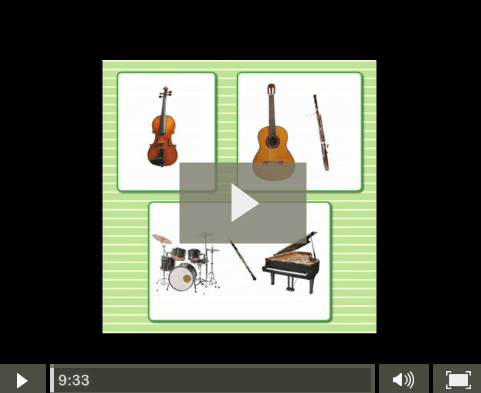
This Listening Game activity from Kindermusik@Home will put those listening ears to the test…or at least give them a good workout! Get your listening ears ready—you’re going to need them! Listen to these short music clips and decide…are you hearing a solo, a duet, or a trio? By the way, the most challenging aspect of this activity isn’t understanding the concept of solo, duet, and trio. It’s actually hearing the different instruments within the musical piece.

Kindermusik@Home Listening Game

You can try this idea with other solo and duet musical pieces, too. First, identify whether you think one or two instruments are playing. Once you’ve strengthened that skill, it can be fun to try to identify the two different sounds in a duet. When choosing music for this extension activity, make selections that have very different instruments playing together. For example, a piano and a flute will be easier for your ear to separate than a cello and violin will be. The visual support provided by pictures (you can point at the piano while it plays, then point to the flute while it plays) will help a lot, too.

Kindermusik@HomeAll Kindermusik classes include activities and resources to extend the learning outside the classroom. Learn more about the educational activities created specifically for families to do together.
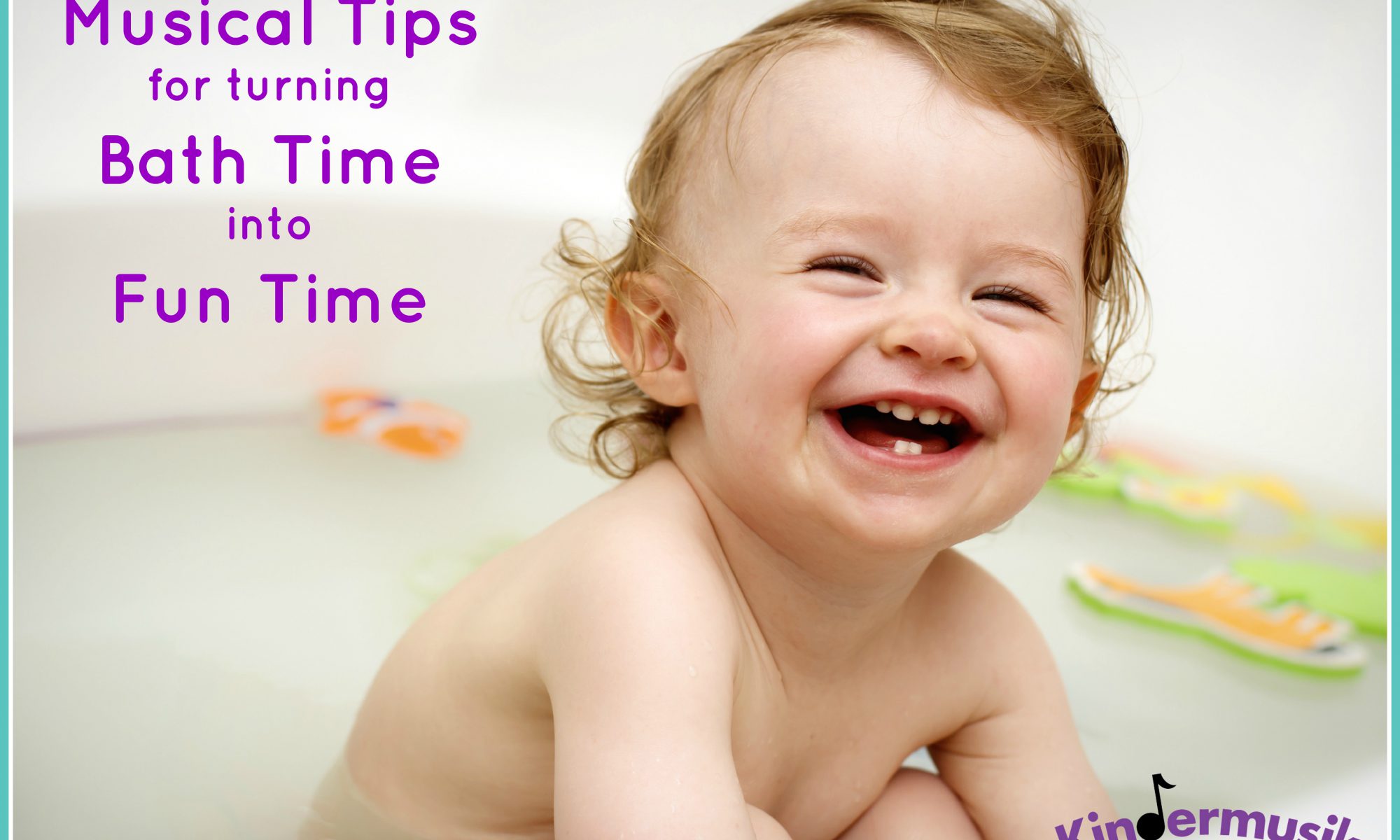
Turn Bath Time Battles into Happy Tub Tunes

As if we parents needed any more guilt trips about experiences we’re not giving our kids… thanks for raising the bar on bath time, Pinterest!  Despite how you may feel after perusing Pinterest, you really don’t need frozen ice cubes in different colors, glow-in-the-dark sticks, colorful bath paints, or epic construction or princess themed bath times. All you need is your voice and an “instrument” or two! 

Dollarphotoclub_49610785 - musical tips for turning bath time into fun timeHere are a few musical tips for turning bath time into fun time – all minus the tears and tantrums.

Who says you only sing in the shower?  Singing in the tub can be even better.

Sing “Head, Shoulders, Knees, and Toes,” “Looby Loo,” or “The Hokey Pokey” as you bathe your child. For older children, mix up the words for extra giggles. So, while you sing about putting “your left leg in” wash the “right arm instead.”

Establish your own BTSO – Bath Time Symphony Orchestra!

Create a water symphony with all of the bath sounds (splashing water, water pouring out of and into cups, rubber duck squeaks, etc.). Help your little one practice active listening by talking about what the different sounds are and asking your little one to identify the sounds, too.

Try a little back-and-forth play, vocal play, that is!

You make a sound, and wait for baby to imitate. Say a short little rhythm, like “ta – ta – ti-ti – ta,” and have your toddler echo back. Or sing a phrase of a song, and see if your preschooler will sing the next phrase.

Bubbles make everything about bath time even better.

Sing the “Bubbles” song from Kindermusik as you bathe your child. Notice how this Kindermusik educator pauses the bubbles and encourages young children to communicate that they “want more, please.” Consider making a bubble bath or blowing bubbles, too.

BubblesCreate a sweet little bath time lullaby routine.

Listen to lullaby music in the bathroom to signal to your child that bedtime is near, and soon it will be time to start settling down for the day – once your little one has had her after-bath massage.  (This is a great time to rub in that baby lotion and connect in a special way with your child by singing softly and making lots of intentional eye contact.)

Looking for more practical parenting tips?  Visit a local Kindermusik class and discover even more ways to make great parenting just a little bit easier with music.

Contributed by Theresa Case whose award-winning Kindermusik program at Piano Central Studios is located in beautiful upstate South Carolina.


You Make My Heart Sing DIY Valentine’s Day Frame

As a parent or an early childhood teacher, we encounter so many moments we want to hold in our hearts forever. We hope to always remember the way our baby felt snuggled in our arms or those chunky little toddler legs or the sounds of a roomful of little music makers.

At Kindermusik, we are in the memory-making business and we want to capture them all! Like this #KindermusikMovesMe moment of music-making on the stairs:

[youtube]https://www.youtube.com/watch?v=NdhkmKqooJU[/youtube]

Capture the Memories in a “You Make My Heart Sing” Frame

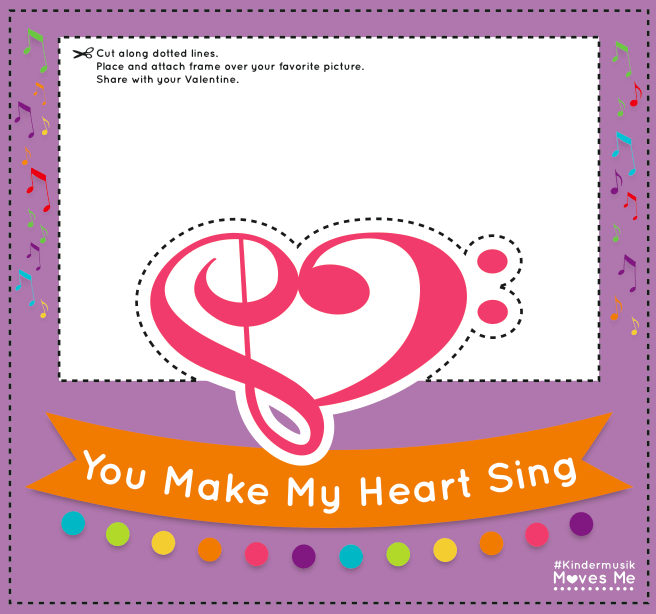
During We Love Kindermusik Week, our hearts seem to overflow with love and memory-making moments. So, go ahead. Download, print, cut, and place this frame over your favorite picture. While this day will never come again, you can indeed hold it in your heart forever…and maybe even on your refrigerator, too!

You Make My Heart Sing Frame

We Love Kindermusik – Free Music & Coloring Page Giveaway

What’s the best way to start off “We Love Kindermusik” week? With free music, an audio book, and a coloring sheet, of course!

We Love Kindermusik – Album Download (with audio story!)

TLC album coverTo help celebrate We Love Kindermusik week, we are giving away a free download of the entire album “TLC: Grow with Me” at play.Kindermusik.com. To download, click the link and then select the orange download button. If you’re new to the site, you may need to register to receive the free album, as all our song downloads do require a login. (Don’t worry, we don’t use your information on anything. This login feature is designed for those enrolled in Kindermusik classes to access their digital materials). Upon login, you should be able to quickly download the album to your computer. Extra bonus: The album also includes an audio story!

#KindermusikMovesMe – Coloring Page and Traceable

After you download the “TLC: Grow with Me” album, download the #KindermusikMovesMe coloring page and traceable. Then, listen to the music together while creating some art!

Download Kindermusik Makes My Heart Sing Coloring Sheet

#KindermusikMovesMe Coloring Sheet

Download the Kindermusik Makes My Heart Sing Traceable Sheet.

#KindermusikMovesMe Traceable Sheet

Check with your local Kindermusik Educator to see if they are hosting a coloring page giveaway or contest. You can also post to social media with the hashtag #KindermusikMovesMe!

How to Throw a Music-themed Birthday Party

Looking for a unique way to celebrate your child’s birthday?  Whether your child is turning 1 or going on 7, we have the perfect solution – a customized musical birthday party!

Birthday Party with Kindermusik

Kids LOVE music, and there’s no better way to involve the whole crowd than to throw a musical birthday party.  And it’s EASIER than you might think!  Here’s how:

Step 1 – Contact your local Kindermusik educator.

Kindermusik educators are the experts when it comes to making music and making children smile, and they know how to put together the perfect blend of music, dancing, instruments, and singing to celebrate your child’s special day in the most memorable of ways.

Step 2 – Choose your theme.

Your Kindermusik educator is one of the most creative people on the planet!  She can plan a general music-themed party, or she can customize the music and activities to the theme of your choice – themes like 1st birthday, princess, teddy bear picnic, under the sea, bubbles and balloon, on the farm, monster trucks, and more!

Step 3 – Plan your guest list.

Consult with your Kindermusik teacher, but usually about 10 – 12 children is a good size for a Kindermusik birthday party.  If the children are 3 years or younger, you’ll want to be sure that the children’s parents know that they get to participate too!

Step 4 – Put together your party favors.

Carry the musical theme right on through to the favors.  Your Kindermusik teacher can help you plan some musical party favors, or you can put together your own with age-appropriate instruments available from the Kindermusik store.

Or you can do a “Make it, Take it” party favor and make your own homemade instruments at the party.

Kindermusik Birthday CheerStep 5 – Plan your decorations.

As with most things involving young children, the simpler, the better.  Colorful balloons make for a nice table decoration.  Make your own banner using these free printable banner letters or frame this Kindermusik Birthday Cheer printable to put on the table by the cake or gifts.

Step 6 – Relax and enjoy!

The smile on your child’s face will be worth it all.  You’ll love not having to do much more than show up.  And the memories?  Well, they’ll be priceless.  That’s the beauty of Kindermusik!

Contributed by Theresa Case whose award-winning Kindermusik program is located in beautiful upstate South Carolina at Piano Central Studios.


It’s Rhyme Time!

Jack and Jill, Humpty Dumpty, and the Itsy Bitsy Spider may not have the most compelling storylines (it’s mostly lots of falling down, right?), but these beloved nursery rhyme characters have entertained generations of children with their antics. Why? Well, nursery rhymes are silly, catchy, and memorable. They also happen to be a fantastic pre-reading tool. In fact, exposing young children to rhymes even before they can understand the principle behind rhyming is as important as introducing children to music before they can create it, or to books before they can read them.

Being able to hear and identify words that rhyme is the earliest phonemic awareness task. Phonemic awareness is the understanding that a word is made up of a sequence of discrete sounds, or phonemes, and it is an essential skill for learning to read. Plus, rhyming is the precursor skill to identifying syllables within words.

3 Tips for Playing Rhyming Games with Young Children:

  1. Ask children to listen for the “words that sound alike.”
  2. Try to use rhyming words that have only one syllable, such as cat, sat, and mat.
  3. When first introducing the concept of rhyming, use words that can be associated with pictures, such as bat and hat. Later, progress to playing rhyming games without visual support.


Looking for more activities that support a young child’s development? Find a local Kindermusik educator at www.kindermusik.com and visit a class.