Answer that Baby Babble to Speed Up Language Development

Hang around babies long enough and you start hearing things. From soft sweet coos to long monologues of “dadadadadada,” babies talk a lot—even though we have no idea what they are really saying! That’s okay. We don’t need to understand all the words (or non-words!) to join in the conversation.

How Parents Respond to All that Baby Babble Matters

VocalPlay_Boosts_Early_Language_Development_KindermusikNew early childhood research from the University of Iowa and Indiana University found that how parents respond to all that baby talk can speed up a baby’s vocalizing and language development. That’s great news for those of us no longer fluent in Baby talk.
“It’s not that we found responsiveness matters,” explained co-author Julie Gros-Louis in a press release, “It’s how a mother responds that matters.”
In this six-month-long study, the research team watched the interactions between a dozen mothers and their 8-month-old babies two times a month for 30 minutes. During this free playtime, the researchers monitored how mothers responded to their babies’ positive vocalizations when directed toward them.
Researchers learned that how the mothers respond makes a big difference in the language development of their babies:

  • Babies with mothers who responded to what they thought their babies were saying showed an increase in developmentally advanced, consonant-vowel vocalizations.
  • The babbling of these babies became sophisticated enough to sound more like words.
  • Over time these babies also began directing more of their babbling toward their mothers.
  • Babies whose mothers did not try as much to understand them and instead directed their infants’ attention to something else did not show the same rate of growth in their language and communication skills.

Bottom line: Respond to all that baby babble!

How to Answer that Baby Babble with Music

Babies love the sound of their parents’ voices. Parents can feed that love and grow their babies’ use of language at the same time by singing, listening, moving, and dancing to music. After all, music is a language parents and babies both understand.  Musical activities, such as those included in every Kindermusik class, help parents engage with their children and be responsive to them. Here are ways for parent-baby pairs and other caregivers and teachers to use music to support the early language development of babies.
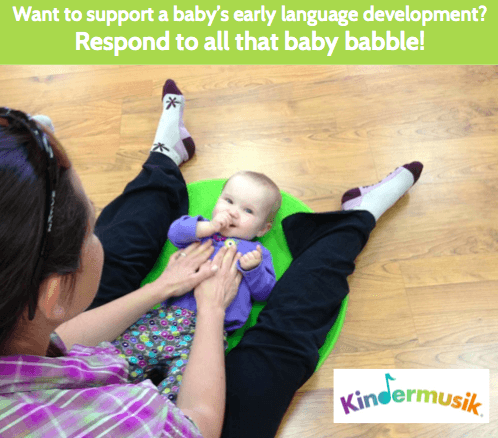
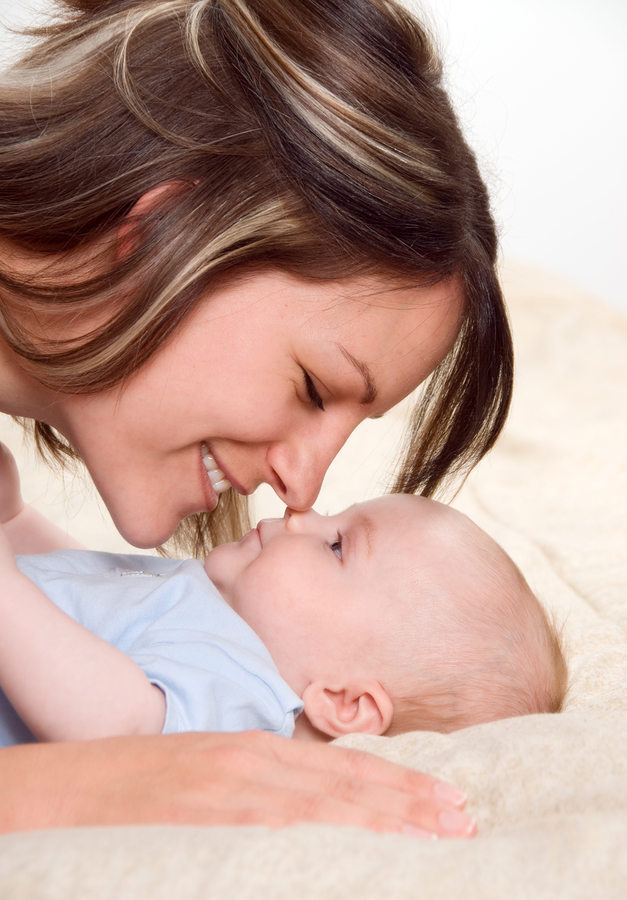
1. Engage in vocal play—one of the earliest stages of language development. Vocal play is how babies’ learn to use the tongue, gums, and jaw muscles needed to produce vowels and consonants. When caregivers participate, too, they expose babies to the sounds that make up our language and encourage them to practice taking turns communicating. Vocal play works best when a parent and baby can see each other’s faces, making it easier for a child to mimic mouth movements. Plus, this eye contact also helps parents and babies bond.
Parenting Tip: Sing “Old MacDonald Had a Farm” with your little one. Pause after key parts of the song, such as “E-I-E-I-O” and wait for your baby to respond. You can also explore the different sounds the animals on the farm make like these families did in Kindermusik class:
[youtube]https://www.youtube.com/watch?v=lsLil1s_wbE[/youtube]
2. Let babies experience steady beat by bouncing to music. The brain processes music in a similar way to how it processes language. Research even shows that children who can repeat and create a steady beat show increased neural responses to speech sounds when compared to other children. Steady beat competency relates to a child’s ability to speak and read fluidly during the school year.
Parenting Tip: Put on some music and bounce to the beat with your baby on your lap or on your hip. This lets babies experience steady beat with their whole bodies. Try one of our favorite lap bounces: Pizza, Pickle, Pumpernickel.
3. Rocking the way to language development. Gently rocking babies throughout those quiet moments of each day gives parents the opportunity to combine vocal play and steady beat—and receive 2x the benefits!
Parenting tip: At the end of the day or after a feeding, hum “Hush Little Baby” (or another favorite lullaby) while you gently rock or sway your little one to the beat. As with “Old MacDonald,” pause during key phrases and wait for your baby to respond. Before too long, your baby will grow into your toddler and be able to “rock” in a new way, like this Kindermusik toddler does at home while listening to music from class!
[youtube]https://www.youtube.com/watch?v=dFP_DVDKezA[/youtube]
Throughout the Kindermusik experience, we use music to help parents engage with their children, be responsive to them, and gain developmental insights and practical tips along the way. After all, a parent is a child’s first and best teacher.

Learn more about using music to support early language development at www.kindermusik.com.

Contributed by Lisa Camino Rowell, a freelance writer living in the Atlanta area.

Put More Jingle in Universal Music Day with Homemade DIY Instrument Crafts for Kids

make a homemade drum

make a homemade drumWhat better way to celebrate Universal Music Day than with some homemade DIY instrument crafts that don’t cost a lot of money, but will mean lots of together time, happy smiles, special memories, and joyful music-making! Instrument crafts are the perfect way to get young children engaged in hands-on learning, exploring their creative side, and even practicing some early science skills as together you investigate and experiment using different materials to create different sounds.
 

Homemade Instruments for Kids

Making your own homemade instruments doesn’t have to be complicated or expensive. To get you started, here are two simple ideas from Kindermusik@Home:
Homemade Ankle Bells and a Homemade Guiro.
homemade ankle bells - Kindermusik@Home  making a guiro - homemade instruments from Kindermusik@Home
And if you want to add to your collection of homemade musical instruments or you want to play some musical games with the instruments you have made, check out these 20 Fabulous DIY Musical Games and Instruments. Though these ideas are geared for toddlers, they’re actually fun musical games and great homemade music instrument ideas for preschoolers and big kids too!

Kindermusik Giveaway

Families can enter for their chance to win a Kindermusik Gift Package ($50 value).
Facebook.com/KindermusikAll families who submit a photo or video of their child making or playing a homemade instrument to the Kindermusik Facebook page from October 5, 2014 (12:00PM EST)  – October 12, 2014 (12:00PM EST) are automatically entered for a chance to win a Kindermusik gift package ($50 retail value), filled with Kindermusik instruments, music, and books.
We encourage everyone to participate in our celebration of Universal Music Day! Check out the Kindermusik Pinterest page for more ideas!

Get the wiggles out and keep the learning in

thinking and learning are anchored by movementA recent article in the Washington Post highlighted a growing concern for parents and educators:  more and more kids are having trouble sitting still in school. The root of the problem is that kids are being expected to sit still for longer periods of time. Recesses are shorter, and often kids aren’t running, jumping, and playing outside even once they get home.
Our bodies are wired to move. In fact, it is through movement that the brain becomes activated for learning. This is often why kids get wiggly and fidgety – their bodies are trying to wake up their brains! It is also through movement that kids develop core strength, increase their coordination and balance, stimulate their vestibular systems, and improve gross motor skills – among other things.
In this Kindermusik video, expressive movement is helping these young children gain a greater understanding of a poem about a train as they visualize and act out the words through movement. Notice how the children hear the words (aural), see the words represented in the movement (visual), and act them out (kinesthetic). Even though the children are doing the movements while seated, they are working out some of their wiggles and sealing in the learning – all at the same time!
[youtube]https://www.youtube.com/watch?v=saygYVHlPII[/youtube]
Learn more about how children benefit from the powerful combination of music and movement at www.Kindermusik.com.
 

10 Reasons to Give Babies a Daily Dose of Music

bigstockphoto_Happy_Mom_1646790We like to tell parents that they are their child’s first and best teacher because it’s true! Sure, parents may not always know all the answers—like that initial night home from the hospital (now what?!) or when a baby experiences a growth spurt and wakes up every two hours (why?!).
But, thankfully parenting is not about personally knowing all of the answers all of the time. It doesn’t change the fact that parents ARE the early childhood experts when it comes to their own children.
Of course, everyone needs a little help and affirmation now and again…even the experts. Music can be the go-to resource to help make parenting just a little bit easier and support a parents’ unique role in a young child’s life. In fact, we think music gives parents super powers! Music can provide moments throughout the day (or night) to pause and celebrate the parent-child bond and reinforce a young baby’s development. Here are a few ways babies benefit when parents add music to their parenting toolkit.

10 Reasons for Parents to Give Babies a Daily Dose of Music

1. Rocking, swaying, bouncing, and dancing to music develop babies’ vestibular system. This system is responsible for helping the brain understand gravity, gain balance, and develop spatial awareness.
Parenting tip: Put on some music. Pick up your baby and dance. Dancing together will also release endorphins for a mood boost! Who doesn’t need that?
Mom and baby bonding through music2. Steady beat gives children the ability to walk effortlessly, speak expressively, read fluidly, and even ultimately regulate repeated motions such as riding a bicycle or brushing teeth. While young infants are learning how to control their movements, lap bounces allow them to feel a steady beat with their whole bodies. Older babies benefit from lap bounces as they work to keep their bodies upright while in motion, strengthening the core muscles.
Parenting tip: Try this lap bounce from Kindermusik@Home or make up one of your own. Bounce together when waiting at the doctor’s office or at a restaurant to help pass the time.
3. Playing instruments develops fine motor skills. Grasping instruments between the thumb
 and index finger or with a fisted grasp pattern encourages the development of fine motor skills, which babies will later use to hold a pencil or spoon, use scissors, or maybe even play the piano!
Parenting tip: Provide baby-safe instruments for your child to play with in the car. Put on some favorite music and sing along!
Vocal Play - Teaching Babies with Kindermusik@Home4. Vocal play exposes babies to the sounds of language and teaches them the structure of communication as a parent-child pair take turns “talking.” The ideal time to engage in vocal play is when faces are close together so a baby can mimic facial expressions and watch an adult’s mouth move.
Parenting tip: Try this vocal play activity from Kindermusik@Home during diaper changes or when sitting quietly together.
5. Music develops babies’ growing discriminatory listening skills by hearing the various sounds of instruments and the voices of adults singing and humming. This ability to detect and attend to sounds—and to distinguish between them—sets babies on the path to fine-tuned listening and receptive language.
Parenting tip: Go on a listening walk to hear the musical sounds found in nature. Point out the different sounds you hear together: birds, leaves moving in the breeze, dogs barking, etc.
ways to hold baby poster6. Dancing and moving to music supports cross-lateral movement, spatial awareness, eye-hand coordination, and eye tracking—foundational skills for reading.
Parenting tip: Try holding your baby in different ways while you dance together. Our “Ways to Hold Baby” graphic will get you started!
7. Participating in music activities in a group supports social and emotional development. When we sing, clap, bounce, or dance to a steady beat in a group with babies, these shared experiences of synchronous movement help form social bonds.
Parenting tip: Invite friends and their children over for a musical play date. Not sure where to begin?
Visit a Kindermusik class for free or ask about our new solutions for Parents as Teachers (PAT), home-based programs and socialization groups.

8. Listening to soothing music can help teach young children how to relax. In fact, our heartbeats actually synchronize with the music we hear. Added bonus: Children who know how to relax and self-soothe can be better sleepers.
Parenting tip: Make a playlist of lullabies and add to the nightly routine to signal bedtime. 
Kindermusik@Home Songs and Activities for Babies9. Pairing a word with a movement increases children’s understanding of the concept even before they can speak.
Parenting tip: Try this activity from Kindermusik@Home. Make up your own verses to mirror what you and your baby are doing.
10. The benefits of music enables a child’s brain to more quickly process and retain information, regulate behaviors, make good choices, solve problems, plan, and adjust to changing mental demands.
Parenting tip: Sing, dance, and make music with your child throughout the day!

Learn more about the importance of music in a young child’s life at www.kindermusik.com.

Contributed by Lisa Camino Rowell, a freelance writer living in the Atlanta area.

9 Ways Music Gives Us Something to Smile about on World Smile Day

Happy World Smile Day! Today is the day to smile…and pass it on. Mother Theresa said: “Let us always meet each other with a smile, for the smile is the beginning of love.” Remember the first time a baby smiled at you? Your heart melted just a little bit didn’t it? Afterwards, you probably did everything you could to coax another smile!
Well, it should come as no surprise that we use music to bring smiles to children, families, teachers, and everyone else we can. So, we wanted to start World Smile Day off with a little music, of course. Take a listen…and try NOT to smile.
[youtube]https://www.youtube.com/watch?v=to7uIG8KYhg[/youtube]
You smiled didn’t you? It’s hard not to smile when watching young children engaged in music. It’s an undeniable truth: Music gives us so many reasons to smile. Here are just a few.

9 Ways Music Gives Us Something to Smile About

1. Music causes children to move and dance and react in amazing ways. It really is impossible not to smile when seeing young children naturally respond to music. After all, you couldn’t help but smile when watching those babies’ faces light up and their bodies begin to dance when their dad started playing his guitar.
2. Music is a gateway to family fun. When families listen to music and then dance around in the living room, smiles and bursts of laughter blend in with the beat. Or  when families sing together in the car, they transform even the most mundane errands—or the longest road trip—into memories that last a lifetime. In the daily routines of family life, music brings fun.
One Kindermusik parent put it this way:
Kindermusik - Smile“Kindermusik started out as a way for our family to bond and a place for my daughters to express themselves long before they had words to communicate. Now it is a place for us to be silly, meet new families, and make lots of music together. We love Kindermusik!” ~Kindermusik Parent, Emily R
 
3. Music provides many health benefits. Listening to music makes us feel better, boosts the immune system, reduces blood pressure, encourages relaxation, and even releases pain-fighting endorphins.
baby mom smile4. Participating in musical activities supports cognitive development in children, including language and literacy, spatial-temporal reasoning, and mathematical abilities.
5. Playing music with others makes the world a better place by promoting a sense of community and belonging and fostering cooperation and helpful behavior.
6. Playing instruments or singing provides a creative outlet and opportunity to express thoughts and feelings in a unique way.
7. Music connects us to our past and creates new memories in the present. Hearing the music of our parents and grandparents helps us understand them just a little bit better and provides a bridge between the generations. This also happens when we sing the same lullaby to our children that our parents sang to us.
Kenyan children playing egg shakers8. Music is the one language in the world every single person speaks. We see this the world over. Bring in a basket of instruments to children in Ohio, South Africa, Italy, Australia, The Philippines, Mexico—and everywhere in between—and they will shake, scrape, tap, beat, and create beautiful music. No translation needed.
9. When our favorite song comes on, we can’t help but sing all the words, loudly. This phenomenon can happen in the grocery store, in an elevator, at the doctor’s office, in the car, anywhere. And, yes, it can happen even when the “kids’ music” unexpectedly comes on and you find yourself singing along…even when you are by yourself.
See, music gives us all something to smile about on World Smile Day. Now pass the love on!

Find more reasons why music gives us something to smile about at www.kindermusik.com.

Contributed by Lisa Camino Rowell a freelance writer living (and smiling!) in the Atlanta area.

Hokey-Pokey Your Way through Everyday Parenting

Everyone speaks music – young, old, all nationalities – through lyrics and through movement.  Music truly is the universal language.  As such, music is the one thing that parents all around the world can use to help them get through their day.
music is the universal language for kids and parents

5 Ways You Can Hokey-Pokey Your Way through Everyday Parenting

In the car
It’s easy to stream music on your phone, pop in a CD, or turn on the radio.  In fact, there’s really no better place than the family car to develop listening skills, expose your child to a variety of musical styles, and best of all, create memories.
Need a good starting point for turning your family taxi into a happening, happy music experience?  Click here for your free “family taxi” playlist!
At naptime and bedtime
Gentle, quiet music can calm and soothe a child to sleep, even when he thinks he’s not tire.  Plus it helps block out the noise when your neighbor decides to mow the lawn in the middle of nap time.  Sleep time can also be a great time to expose your child to a little Bach or Mozart as well as those beloved lullabies.
On a rainy day
Music is like indoor sunshine on a rainy, dreary day.  Depending on what kind of music you choose, music can be a quiet accompaniment for play time, inspiration for a parade around the house, or a giggly, happy way to dance the rainy day blues away.  (Dance long enough, and they’ll be more than ready for a nice long nap too!)
You can also take a video field trip without leaving the house.  You’ll love this “Big Back Yard” field trip that takes you and your child to see some beautiful butterflies, up close and personal!
Before dinner
It can be really tough to juggle making dinner and keeping a little one happy, especially towards the end of the day.  Turn on some bright, happy music, get out some wooden spoons and plastic bowls, and let the concert begin!  And while you’re waiting for that pasta to boil, why not take a spin around the kitchen with your child as your dance partner?
For family together time
Whether you have some child-friendly instruments or you improvise, there’s nothing that bonds a family more than making music together in a family jam session.  Or maybe you decide to establish a little ritual to welcome Dad home each day by doing a little dance together – like the Jungle Hokey-Pokey!  No matter how you choose to speak the language, music is the delightful common thread that binds hearts together, making memories that truly will last forever.

The Jungle Hokey-Pokey

Why Kindermusik?  With an expansive music library, Home Materials, and rich resources for parents (Did you grab your family taxi playlist or try the Jungle Hokey-Pokey yet?), Kindermusik classes provide plenty of musical inspiration for singing, dancing, and playing your way through the daily childhood routines that can be made happier and a whole lot easier with music!
Find out more about Kindermusik at www.Kindermusik.com!

This post was adapted from an article originally written by Theresa Case for Macaroni Kid Greenville.  Theresa has an award-winning Kindermusik program at Piano Central Studios in the beautiful upstate of South Carolina.

3 Ways to Use Music to Take Children Around the World

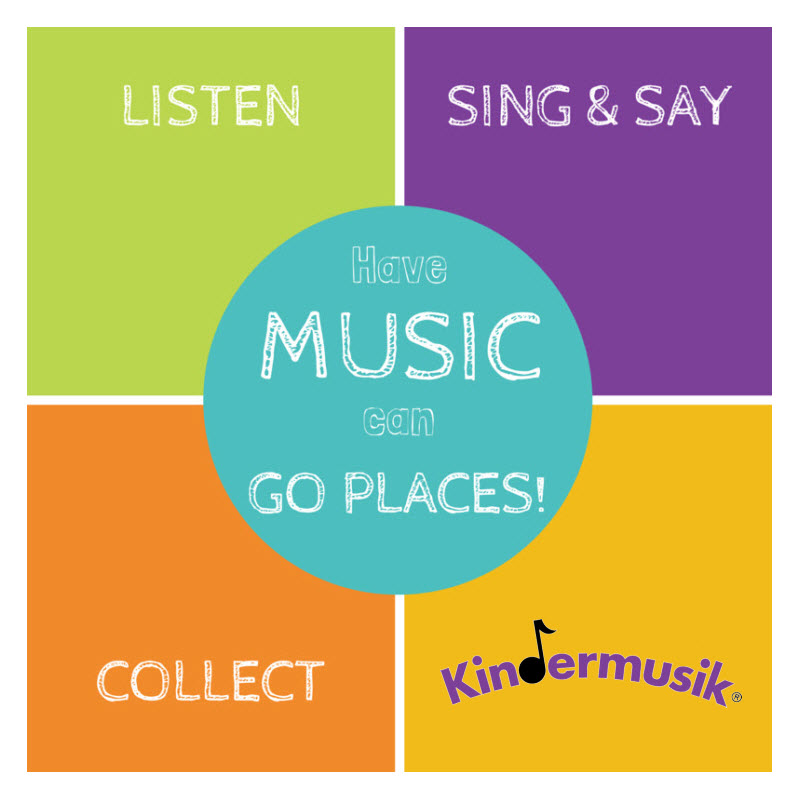
Listen - Sing & Say - Collect - Music Around the World for Kids

Listen - Sing & Say - Collect - Music Around the World for KidsWant to take your children around the world? It’s easy with music! No passport required. No suitcases to pack. Just three simple things you can enjoy almost any time, any where, and you’re off of a grand, musical travel adventure!

Listen to music from around the world.

Every culture has its own beautiful repertoire of rich folk songs, soothing lullabies, and happy dances that can be very appealing to young children. With internet radio stations, streaming music apps, and downloadable song tracks, it’s easier than ever to listen your way around the world. Try searching on “world music for children” or “multicultural music for kids.”

Use your voice to enjoy music from around the world.

There are simple songs and chants that even young children can enjoy learning or hearing from you. In fact, our Kindermusik music library is full of these songs, rhymes, and chants from various countries and cultures. The more exposure a very young child has to other languages, both spoken and sung, the more receptive he or she will be to learning and speaking another language.

Collect instruments from around the world.

Whether someone else demonstrates the instrument or the child can explore and play it themselves, there’s nothing better than seeing, hearing, and touching the real thing. Nearly every culture has some kind of a drum, shaker, or flute-like instrument, and most are easily curated. Give your little world travelers a sense of having gone around the world simply by introducing them to some of the instruments from around the world.
Travel the world with Kindermusik
BONUS reading! How Music Helps Children Expand their Cultural Horizons
Learn more about how Kindermusik can take children around the world and give the music learning adventure of a lifetime at www.Kindermusik.com.
 

Contributed by Theresa Case who has an award-winning Kindermusik program at Piano Central Studios in beautiful upstate South Carolina.

New Music Standards – Focus on Preparing Children for Success

National Core Arts Standards 2014

New National Core Music Standards

The arts have always served as the distinctive vehicle for discovering who we are. Providing methods of thinking as disciplined as science or math, and as disparate as philosophy or literature, the arts are used by and have shaped every culture and individual on earth. The arts continue to infuse our lives on nearly all levels—generating a significant part of the creative and intellectual capital that drives our economy. The arts also impart our lives with meaning every time we experience: the joy of a well-remembered song, the flash of inspiration that comes with immersing ourselves in an artist’s sculpture, participating in a sublime dance, learning from an exciting animation, or being moved by a captivating play. (From: National Core Arts Standards, Custom Handbook).
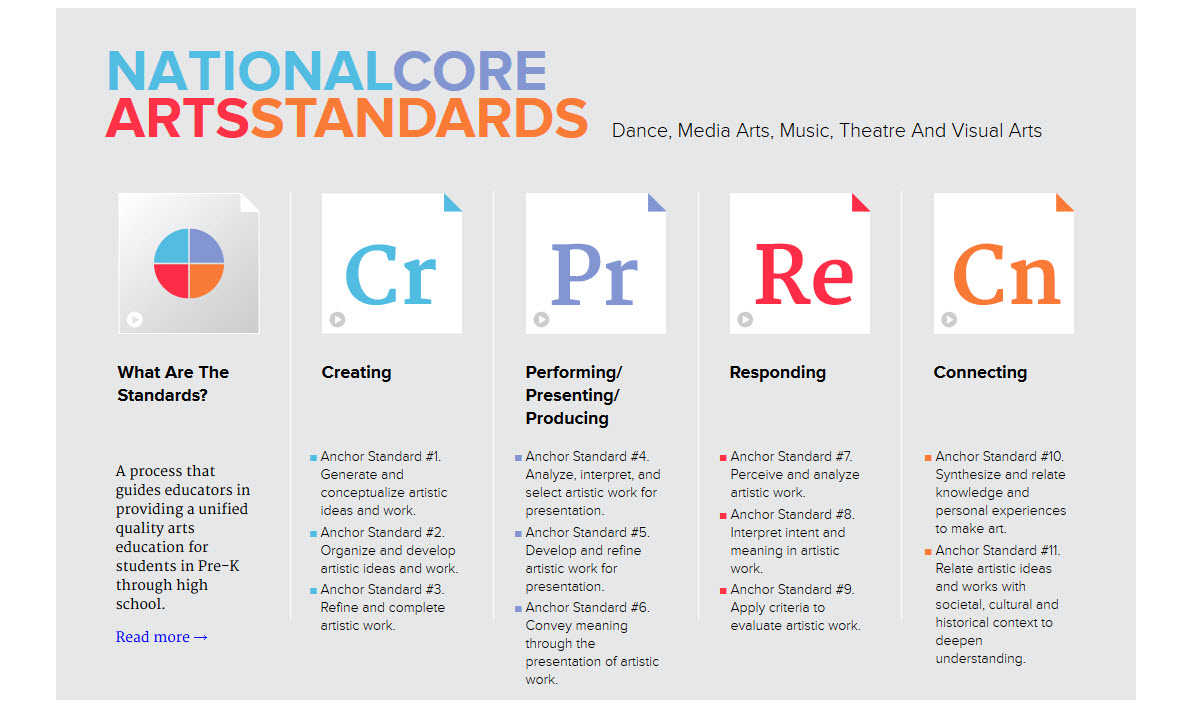
National Core Arts Standards 2014As of June 2014, new music standards were created by the National Coalition for Core Arts Standards (NCCAS), and based on artistic processes; these include music standards prepared by the National Association for Music Education (NAfME).

Overview of Standards:

The new National Standards focus on improving each child’s music education experience, supporting educators with enhanced instructional strategies, and emphasizing the benefits of music education. You can visit their site to create your own Custom Handbook, based on discipline, process, and grade level.

Who the Standards are for:

Decision-makers from teachers, to superintendents, to parents, and policy makers, all will be able to utilize these standards as guidelines to improving music education and ultimately future success for our children.

Goals of the Standards are to enhance…

Music Literacy – meaning the ability to communicate through a medium and understand what is communicated. In our multimedia society, we need to prepare children to communicate visually, through sound, video, etc. and have literacy for each media.
Artistic Processes – there are 3-4 core areas these new music standards focus on:

  1. Creating (new music)
  2. Performing (also referred to as Presenting or Producing existing music)
  3. Responding (interpreting the performance/music and developing own opinions)
  4. Connecting (various art forms – this is embedded throughout the standards)

This 5 minute video from the NAfME Deputy Executive Director & COO provides an overview.
[youtube]https://www.youtube.com/watch?v=RlSF56tkueA[/youtube]
 

Kindermusik Programs Align with the New Music Standards

How Kindermusik Supports Music Literacy

Kindermusik_EarlyChildhoodMusicEducation_OnlinePortal_OutsideMyWindowAn important part of our curricula are the Family Engagement materials. Through real instruments, books, CDs, family activity guides – AND – video field trips, songs, math games, logic games, craft ideas and more within our online learning portal (Kindermusik@Home); we support hands-on learning and emerging technology. We provide families with a useful way to be involved in their children’s educations and expose them to various types of media and arts. This helps Kindermusik reach our mission of instilling a lifelong love of music and learning in children around the world.

How Kindermusik Supports Artistic Processes

EarlyChildhood_InstrumentSet_ABCMusic&Me_Wiggle&Grow_KindermusikInternationalCreating music is what we do in each class. We provide enough instruments for each child in the class to participate and make their own music. Through a variety of age-appropriate and kid-safe instruments, like egg shakers, jingle bells, chime balls, sand blocks, rhythm sticks, and many more, we allow children to be creative and come up with their own way of playing the instrument. We guide them with ideas, and allow kids to express themselves through music.
KindermusikClass_RhythmSticks_TeachChildrenImportantSkillsPerforming, presenting or producing music is also integrated into our classes. Although Kindermusik curriculum is based on process not performance, we do encourage children to present their ideas to class. For example, a teacher may ask, “Johnny, how do you want play your rhythm sticks; fast, slow, loud, or soft?” This allows each child to determine their own preferences and encourages them to play music to a group of their peers, boosting self-esteem and confidence.
ListeningGame_IHearASound_Kindermusik@HomeResponding to music is embedded into the Kindermusik curricula, and we encourage children to be effective audience members. For example, in the song “I Hear a Sound” from our Wiggle & Grow curriculum (for ages 2-3) children hear various instruments, and then have time to guess what instrument they just heard. This aligns with the new standards as we give children the opportunity to listen, analyze, and interpret what they hear.  Follow-up questions from the teacher such as, “Kaylee, what instrument did you like best?” allows children to evaluate what they’ve heard and make decisions based on their preferences – expressing themselves through music.
Connecting various art forms is actually a great way to describe a Kindermusik class. We incorporate: music; movement; dance; visuals; literature including children’s books, poems, and rhymes from many cultures around the world; opportunities for ensemble experiences; and so much more.
Kindermusik_SupportsAllLearningDomainsWe too recognize the importance of technology in education and so, we developed the Kindermusik@Home portal. Parents can login and enjoy with their children; fun educational games, activities, eBooks, videos, crafts and more, along with ideas for taking the learning offline. We include parenting resources to help them understand the importance behind these educational activities.
And we keep on top of the growing body of research on the benefits of music for children. The Kindermusik curriculum is more than a music class, it’s designed to promote school-readiness and stimulate development across all learning domains, supporting the future success of each child…and in turn…our world.
Other components, like the Opportunity-to-Learn Standards, are part of these new music standards and are still being developed. One call-out the Executive Director & COO of NAfME mentioned is the standards will likely include guidance that students should receive WEEKLY INSTRUCTION. Again, another way Kindermusik aligns. Our weekly lessons are flexible and provide concepts teachers can use throughout the day.
To learn more about the new music standards, please reference:
nafme.org/standards
NationalArtsStandards.org
 
To learn more about Kindermusik, please visit:
www.kindermusik.com
Give It a Rest. Kids Will Love these 2 Musical Math Games.

Patterns surround us and recognizing and understanding patterns is a foundational math skill. Music gives children the opportunity to experience patterns through movement, listening, and playing instruments. When children step, step, step, stop responding to the music or ta, ta, ta, rest with rhythm sticks, children are learning rhythm patterns (quarter note, quarter note, quarter note, rest), a basic musical concept. Rhythm patterns are combinations of long and short sounds and silences.
Try these two math games for kids from Kindermusik@Home that combine music and math!

Kindermusik@Home Pattern GameHomemade Ti-Ti Ta 

This activity for kids introduces the concept of visual and auditory patterns created simultaneously (e.g. the sounds of with the visual representation of).
Patterns are incredibly important, both to music and math. Children first notice and recognize patterns, then develop the ability to complete partial patterns, duplicate patterns, and eventually to extend and create patterns. The patterns also go from simple (ABAB) to more complex (AAB, ABB, AABB, AAABB, AABC, and so on).
The Ti-Ti Ta pattern includes another layer of complexity: duration. Rather than a simple red-red-green pattern in which all components are equal, a Ti-Ti Ta pattern contains the concept of short-short-long within it. When the pieces are rearranged, the “notes” are rearranged as well. Ta, ta, ti-ti, ta is more complex than green, green, red, red, green because the concept of a pair of eighth notes (each of which is half as long as a “ta,” or quarter note) is embedded in the ti-ti.

Pattern GameQuarter Notes and Quarter Rests

This game for kids introduces them to the sound of the quarter note and the “no-sound” of a quarter rest. Children test their ears on how well they recognize them when they’re assembled in patterns.

Find out more about the connections between music and math in Kindermusik at www.kindermusik.com.