What Kids Want: Quality Time

Quality Time

[vc_row][vc_column][vc_column_text]I’m a sucker for a well-made advertisement, specifically an ad that does the following: makes me think, and as my students say, “gives me ALL the feels.” As an educator, I am constantly evaluating those students’ needs. As a parent, I do the same thing with my kids. I’ll admit, occasionally my job as professor causes me to over-analyze my job as dad in the quest to earn my parenting cape. As silly as it sounds, something as trivial as an ad from an Australian food company can put things into perspective and show us what might be going on in our kids’ minds:[/vc_column_text][vc_video link=”https://www.youtube.com/watch?v=2wfbY3i4FY0″][/vc_column][/vc_row][vc_row][vc_column][vc_column_text]

What Kids Want: Quality Time with Us

Yep…it’s an ad, but research bears the premise out. And it’s not just time; it’s quality time. Through her research, Dr. Amy Hsin, a sociologist at Queens College in NYC, highlights what most of us already knew deep down: spending time with kids in front of the TV not only lacks real quality of interaction, but may be “detrimental” to child development. Mealtime  – when the family sits and shares a basic human need – this is quality time. This is a chance to ask each other what we learned during the course of the day. We show interest in our kids, in each other. We make eye contact. We laugh. We share exciting stories. We learn about who our kids are becoming…and we do this with no distractions from glowing screens (shut those phones off at mealtime!).[/vc_column_text][/vc_column][/vc_row][vc_row][vc_column][vc_column_text]

Quality Moments of Connection, not Quantity

In a recent article in the Washington Post, University of Maryland Professor Melissa Milkie encourages parents to find moments of quality connection rather than simple quantity to build strong parent/child relationships.

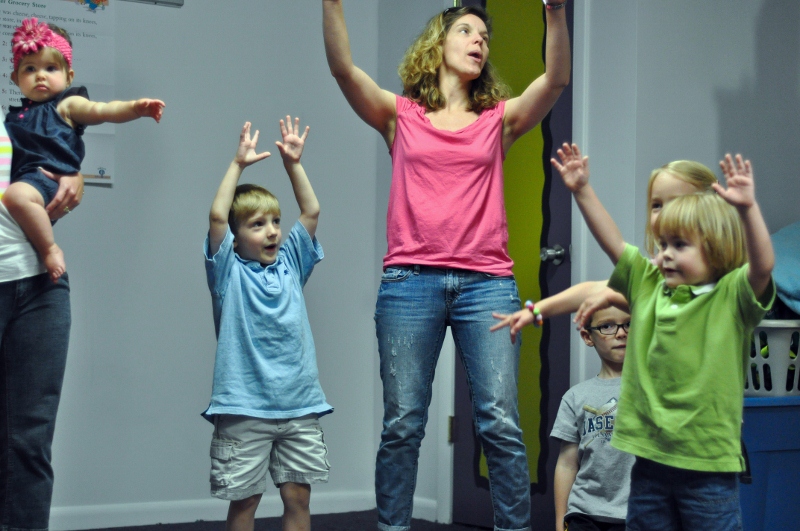
So, think about the special moments that occur between child and parent in Kindermusik classes: physical connection, singing and moving together, and all of this happening through a time-tested curriculum designed to do exactly what research suggests – provide quality moments between parent and child.

It is these moments that our kids remember – laughing at a silly song, seeing Mom smile, hearing Dad roar like a lion. They are precious images that get filed and called up on the big screen in our kids’ minds. And when we sneak in to check on them as they fall asleep, those smiles we see as the little ones drift off, very well could be due to giggling at dinner time or a replay of “You are my sunshine.”[/vc_column_text][/vc_column][/vc_row]

Our Favorite “I Love You Rituals” from Dr. Becky Bailey

At the heart of Dr. Becky Bailey’s transformative Conscious Discipline approach are her “I Love You Rituals.” When used with intention and consistency, Dr. Bailey’s poems and songs are powerful tools that help children connect, calm, and make good choices. Best of all, these “I Love You Rituals” work beautifully not just in the classroom but also at home.  Here are a few of our favorites from Dr. Becky Bailey that have been successfully incorporated into many Kindermusik classrooms and routines:

Continue reading “Our Favorite “I Love You Rituals” from Dr. Becky Bailey”

Risk and Growth: A Balancing Act

taking risk risks

[vc_row][vc_column][vc_column_text]

IMG_3923
Elizabeth Mesick – Educator, Philosopher, Mom, and Blogger

[/vc_column_text][vc_column_text]As a parent, finding the balance between protecting your child and allowing for safe risks is a constant struggle. If we don’t allow risks, we logically know that it will not end well for our little ones, but still, all we want to do is scoop them up and snoodled them and keep them safe from bullies, kidnappers and even scarier criminals, mean teachers, friends who only play with them when no one else is around, those playground moms who judge your child, etc. You know what I mean! Growing up can be a nightmare, and it’s not just the other kids to worry about.

I have a perfect (for me) family trio of Husband, Daughter, and me. I chose to work and mom at the same time and continued my career as an elementary school teacher while Daughter was in day care. Then came the day when she was finally old enough to be a part of my school community. Oddly, I was more nervous with her right down the hall than before when she was miles away from me. She wasn’t in the cozy confines of the sweet little 6 to 1 ration preschool room anymore, and I knew what was out there. Now please understand, the school in which I taught was pretty dang fabulous. Really amazing teachers and kids, a supportive administration, small class size, the works. School’s scary and hard and different. There are new challenges and opportunities that just made me nervous for my little peanut. She did (and does) a great job navigating all of it with minimal help from home. All was going fine – and then – she wanted to be in the talent show.[/vc_column_text][/vc_column][/vc_row][vc_row][vc_column][vc_column_text]

Opportunity: The Talent Show

[/vc_column_text][vc_column_text]Every year at our amazing school we had a talent show mid-winter. It was a long and cold winter in Colorado and testing season was upon us, so we all needed a great break. I ran the show for many years and, though it was exhausting and at times quite aggravating, I adored it. One year I realized I would be at a reading conference during the show’s scheduled date, so I passed the leadership off to another. After ten years it was time anyway.  When Daughter was in first grade, she decided that it was time for her to be in the show alongside the dancers and singers and comedians. She would sing, she told me, all alone. It was the height of the phenomenon of Disney’s “Frozen” and Daughter was, as were most other little ones that year, obsessed. “I’m going to sing ‘Let it Go’ with the music only- no words on the CD,” she said. “I’m going to do it all by myself, I’m going to do a dance, and it’s going to be great.” My heart sank into my feet. I felt nauseated. How terrible, you’re thinking. Support her! Ok, ok. I hear you. But let me explain…[/vc_column_text][/vc_column][/vc_row][vc_row][vc_column][vc_single_image image=”7933″ img_size=”medium” alignment=”center”][vc_column_text]Daughter is amazing at a lot of things. Quite a lot of them, in fact. She can read like you wouldn’t believe. She is ridiculously smart when it comes to most school subjects, especially science, because she remembers everything. She can act like very few children I’ve ever seen, and I have been leading children in theater clubs my entire teaching career. But like most people, she has her things she is not so good at. Topping the list are her fine and gross motor skills (read: dancing) and singing. Oh, does she want to be a singer! Those days, as now, she sang all the time; showers, baths, car, walking, riding a bike, on the swings, you name it this kid was singing. (There’s a great story about her kindergarten teacher needing to talk to us about the constant singing in the bathroom, actually, but that’s for another day.) Even with all that practice, the poor child could not, as the saying goes, carry a tune in a bucket. Cool abilities and cool mom teacher aside, Daughter was not doing great in the friend and peer likeability department, either. She’s unique, some even say weird, and gets picked on. Some days it bothers her, some days less so, and it seems to be an undercurrent to all that happens to her. That’s why my belly hurt. All I could see was Daughter up on that stage, singing and dancing her heart out, only to be made fun of by her peers when she finished. Would they even clap for her? What if they openly laugh at her? What if this ruins the stage for her entirely, when I know she has some serious acting chops? I didn’t know what to do. [/vc_column_text][vc_column_text]

A ship is safe in harbor, but that’s not what ships are for.

― William G.T. Shedd

[/vc_column_text][/vc_column][/vc_row][vc_row][vc_column][vc_column_text]

Finding Appropriate Risks

[/vc_column_text][vc_column_text]I think a lot of parents have these types of situations with their sweet little ones. Many people call their parents, siblings, fellow parent friends, and ask for advice. I did a lot of those things, but I also did what I often do when confronted with a conundrum; I researched. I was directed to several amazing resources, and let me sum up what they are saying for you: allowing your child an opportunity to take safe, calculated risks is important for them as a developing human. Allowing (again, safe and calculated) risks helps your child to be a better decision-making adult. One of my favorite nuggets of research-based wisdom is from clinical psychologists Dr. Susan Davis and Dr. Nancy Eppler-Wolff. “Risk is inevitable, and without learning the skills of good risk-taking, our children will be more apt to take impulsive and poor risks.” (Read the full article here)  They’re going to take risks anyway, so why not give them a safe environment and controlled setting? I always told the parents of my elementary students that making mistakes in my classroom was a perfect time because the consequences were small. This was really no different. Or was it? Were the consequences really small? So I continued with researching adding the idea of not only risk, but failure or mistake. Yet another nugget which summed up what I was reading fell into my lap:

It is worth reminding ourselves of two truths about how children grow up to be confident, resilient, responsible people. First, they have to be given the chance to learn from their mistakes. Second, the best classroom for learning about everyday life is indisputably the real world, beyond home and school.

 – Tim Gill, author of No Fear: Growing Up in a Risk-averse Society

I can’t think of a single parent who would not want their child to be confident, resilient, or responsible. [/vc_column_text][/vc_column][/vc_row][vc_row][vc_column][vc_column_text]So I decided to let her go for it. Daughter was to be on that stage alone and singing and dancing to the smash hit “Let it Go” without even my face in the audience. I had to be at a reading conference if you recall, and I was a hundred miles away. Luckily, when you’ve been teaching at a small school in a small town, you get great friends among your fellow staff members, and a wonderful teacher gave Daughter a pep talk beforehand, FaceTime-d me in for the performance, and even bought her a flower for afterwards. Even more luckily, Husband was able to be there having walked in the door from his demanding job the act before Daughter was to go on stage. All was in place. Take your places, ready, set, go! [/vc_column_text][vc_column_text]

A bend in the road is not the end of the road…Unless you fail to make the turn.

― Helen Keller

[/vc_column_text][/vc_column][/vc_row][vc_row][vc_column][vc_column_text]

A Risk Rewarded

[/vc_column_text][vc_column_text]She sang her little heart out. She was super nervous and forgot to do her dance, which is probably for the best anyway. She was singing all her words right on time and didn’t sound half bad. Then my teacher friend panned the audience. Every kid there was swaying and had a smile on his or her face. Every kid was supporting her. Every. Single. One. When she finished, they applauded like Idina Menzel herself had been there. It was spectacular. She had been so confident with only a touch of stage fright, and she took so much more from that performance than can be measured or written or examined here. She’s not afraid to take a reasonable risk. She’s not afraid to do something her heart tells her is right, and she has a love of music and sharing it with others that can never be extinguished.[/vc_column_text][vc_column_text]

..they applauded like Idina Menzel herself had been there.

[/vc_column_text][/vc_column][/vc_row][vc_row][vc_column][vc_column_text]She’s a little older now and has started taking piano lessons. Her first homework assignment is to write a song with the few notes she has learned. She’s up to the task. She will write and perform that song for her teacher with confidence and love. She will sing every day to anyone who will listen. She’s practicing to be Willy Wonka in a musical, too. When I asked her what gave her the confidence to audition for such a big part, she answered, “Mom, if I can sing in front of the whole school all by myself, what can’t I do?” That’s what it’s all about, isn’t it? What can’t she do? [/vc_column_text][vc_separator][vc_column_text]

Elizabeth Mesick is a former elementary school teacher who now gets to teach and write from her cozy home office. She lives in Pennsylvania with her amazing husband, lovely daughter, and wonderful zoo of furry beasts: Mabel, Merlin, and Rose Tyler. Lizzie loves to write, read, play, and drink ridiculous amounts of tea. She also really loves to hear from her readers. 
You can find her at:
Or follow her on twitter @BlogElephants 

[/vc_column_text][/vc_column][/vc_row]

Parenting Playlist: Music To Help Children Focus

Prenting Playlist Mom and Son

[vc_row][vc_column][vc_column_text]Ok. Put on your seat belts. I’m going to take us back in time to the 1990s. Remember everyone’s favorite purple dinosaur? Perhaps not everyone’s favorite, but I bet you remember his Clean Up song! I used that song constantly with my two sons as they were growing up. It was magic. MAGIC, I tell you! No fussing, no arguing (most of the time!). As soon as I starting singing, they started helping and toys were put away. Don’t be fooled friends – the real magic when Mary Poppins had the Banks children clean their room wasn’t a spoon full of sugar…it was a song about a spoon full of sugar.[/vc_column_text][/vc_column][/vc_row][vc_row][vc_column][vc_video link=”https://youtu.be/MOOxpT9q2mo?t=58s”][vc_column_text]A doctor singing to his infant patient to help distract him…after delivering some shots. The Clean Up Song![/vc_column_text][vc_column_text]So I was thinking…why not have a playlist…a parenting playlist that helped a child mark the various parts of the day? We use lullabies for bed time…why not use music to focus other important daily events? Once upon a time, that would have been very difficult, as our music was less portable. But now? You could actually create a playlist on your phone and have it with you at all times! Connecting music with certain daily activities provides an aural signal that goes beyond words. You can easily create a playlist that would focus a child and involve them in an aspect of preparation for any activity. Think of the music as an overture. As mentioned in a previous post, you hear Take Me Out to the Ball Game at the ball park and you stand up to stretch. You tell me…when you here this – you start looking around for sharks, don’t you? I’d probably not use that in my playlist for the kiddos.

Here are some more appropriate suggestions from our collection of music used in Kindermusik classes worldwide – all available at the Play Kindermusik site.[/vc_column_text][vc_column_text]

The Parenting Playlist

Now…having a playlist is great, but it’s made even greater if you sing along. If you sing (and trust me, you can sing) you child will imitate.

Time to wake up

What could be better than a classic like You are my Sunshine? Here it is from our Rise and Shine collection:

What about the Beatles Here Comes the Sun, or perhaps a piece of classic music, like Mozart’s Eine kleine Nacht Musik (A Little Night Music – which I always thought was a bit bright for nighttime).

It’s time to eat

Let’s get some food in that belly. I’ve been humming this one around the house, causing questioning smiles from my wife. What can I say – it’s catchy! Here’s Food is Good from our Yum album:

You can be creative with this one. There’s a great Bare Naked Ladies tune from their children’s album, Snacktime! Take a listen to Food Party. And can we take a minute to mention how awesome it is that BNL recorded a kids album?


Travel

Need to get in the car? Gotta make a stop at the pharmacy or pick up the older sibling? How about This Little Car from Zoom!

There are countless songs and pieces of music that can work here. Use your imagination. What about the William Tell Overture? You can make it a game – race (safely) to see who can get ready to go first!

Playtime

Time to move, friends. Maybe time to go outside and run, dance, and jump! Well…I think another classic ought to do it…Ring Around the Rosey from our Playtime collection.

Remember, just about anything will work. I actually would use the Gloria movement from Ariel Ramirez’s Missa Criolla to get my oldest ready for bed, despite the fact that it is uptempo. He loved being swung around the room to the latin rhythms and when the slow section came up, we’d head back to his bedroom. he was ready. Once you associate a song with an activity, your child will pick up the association very quickly.[/vc_column_text][/vc_column][/vc_row][vc_row][vc_column][vc_column_text]

Creativity is Key

I hope this has provided you with some ideas. Go crazy. Try different songs until you find the mix that works well for your child. Everyone responds differently. Maybe there is a song from your Kindermusik classes that rings true with your kiddo; maybe you haven’t tried out a class to find out! Regardless, I want to know how this works for you! Tell us about your playlists! Email me at dr.boyle@markaboyle.com. Share your parenting playlist with the Kindermusik family.[/vc_column_text][/vc_column][/vc_row]

Calm Your Baby by Singing

If there was something that could keep your baby calm for twice as long as anything else, would you use it?  New research from the University of Montreal has discovered the secret… singing to your baby!
Sing Your Heart Out

At Kindermusik, we could be considered something of an expert on not just what to sing to your baby, but also how to sing to your baby.  (And don’t panic.  Our suggestions have nothing to do with voice lessons or singing in public.)  Since we’re also all about making parenting a little easier and a whole lot more musical, here are some of our best tips for what and how to sing to your little one.  You can thank us later for being able to enjoy twice the amount of calm!

What to sing to your baby

You Are My Sunshine*
Love Somebody*
Everybody Loves Baby*
Skinnamarink
May There Always Be Sunshine
Golden Slumbers
Tell Me Why

FREEBIE! Download the songs marked with an asterisk (*) for free here.  Other songs are available for purchase here.

How to sing to your baby

  • Even if you’d never sing a solo in public, remember that your voice is the most beautiful sound in the world to your child.
  • Forgot the words?  No problem.  Humming works too!
  • While standing, gently sway to the steady beat as you sing.  The combination of your singing and the side-to-side pendulum-like motion is very soothing.
  • Use both the power of music and intentional touch.  After bath time, incorporate a little infant massage as you sing to your baby.
  • Sing in the car.  No one will ever know that it’s the third time around singing “Skinnamarink” because it’s your favorite song too!
  • Cuddle your baby close and rock together.  Your little one will love feeling the reassuring vibration of your vocal chords and the gentle thump of your heartbeat.

Looking for other ways to calm your baby?  Come visit a Kindermusik class and learn from an early childhood expert.

Shared by Kindermusik educator and award-winning program owner Theresa Case, who has loved every opportunity she’s had over the past 20-plus years to encourage parents to sing and bond with their babies.

What to Do When It’s a Rough Day in Kindermusik

Baby crying

Although it is not any more difficult to be a Kindermusik parent than it is to just be a parent, sometimes things happen in class that make it difficult to be a parent in Kindermusik class. So what to do when your child runs around, gets extra clingy, or acts out?

First, just find your breath for second. Nothing will get worse in the time it takes you to pause, and everything stands to get better for your having done it.

Next, realize that most parents are not judging you, and neither is your Kindermusik teacher. They are most likely feeling a great deal of empathy for you at the moment!  And even if they were judging, this isn’t about them. It’s about the fact that your child is either hungry, tired, or just plain trying to exercise some control over his or her world.

So here’s what to do.  Try engaging with your child at a level that is best at the moment.  You can also feel free to disengage for a minute by sitting away from the group or even stepping out in the lobby for a bit if necessary. Perhaps your little one is just a bit too over-stimulated and needs some calm and quiet. A snack and a drink out in the lobby may be all it takes to resurrect that happy little person you normally live with and enjoy in class.

If your child isn’t quite ready to relinquish an instrument or object, that’s okay. Give it a minute. Some kids need more time than others to transition. Once we’ve moved on to a different activity, most kids aren’t so interested in that particular instrument anymore and will be happy to put it where it goes.

It may be that your little one didn’t get enough sleep or is starting to get sick and just doesn’t feel well.  If you need to leave, send us an e-mail and we can reschedule!  We happily offer unlimited make-up classes.  [Note: Contact your local educator for options for rescheduling or makeup classes.]

And, finally, check out Becky Bailey’s work for additional discipline resources—there are lots of free ideas on her website.

Remember that it can take several time for your child to adjust to Kindermusik, whether it’s his first classes ever or she’s just getting used to being with back in the routine or with some new friends.  Kids are kids.  We wouldn’t have been in the business of Kindermusik for so many years now if we didn’t accept and love them just the same!

Connect with other parents who can relate to your parenting stage.  Visit a local Kindermusik class today!

Shared by Theresa Case who has an award-winning Kindermusik program at Piano Central Studios in the beautiful upstate of South Carolina.  This post first appeared on the Piano Central Studios blog.

How Music + Emotion Bridging Helps Toddlers Navigate BIG Feelings Early On

Toddler has tantrum at playground. How music plus emotional bridging can help pacify this situation.

Toddlers can be gloriously happy one minute and extremely upset the next.  Their little brains are undergoing so much growth in those early years, and they don’t yet have the vocabulary, context, or life experience to identify and process all of those emotions.

Helping toddlers understand and articulate their feelings can ease the chaos, but how?

Researchers at Michigan State University found that a simple strategy, called “emotion bridging,” can do just that, with the end result of fewer behavioral problems.

Emotion bridging is a straightforward, three-step process:

  1. Labeling the emotion: sad, happy, upset, mad, etc.
  2. Putting it into context: feeling this because of that
  3. Making a relevant connection: “Remember when you felt [emotion] because of [situation/experience]?”

One way to help the learning stick? The connective, transformative power of shared musical experiences.

Continue reading “How Music + Emotion Bridging Helps Toddlers Navigate BIG Feelings Early On”

The Importance of Intentional Play & Loving Connections in the Early Years

Nurture your baby with Kindermusik

It’s hard not to goo and coo and tickle and cuddle and play peek-a-boo with a cute little baby.  But science is now discovering just exactly how important those goos, coos, tickles, cuddles, and peek-a-boos are, demonstrating that while Nature has a hand in how the brain is pre-wired, the brain depends very heavily on environmental input, or nurture – those tickles, cuddles, and peek-a-boos we keep talking about – in order to wire itself further.  (Read more here.)  How intricately the brain gets wired has long-term impact on all seven areas of intelligence, how well a child does in school, and how they function socially and emotionally.

So how can a parent be intentional about the play and loving connections that are so crucial in the early years?  Here are some simple suggestions:

  • Make time for play.  It’s easy to get caught up in the busyness of daily life.  So maybe your playtime with your child is just before leaving for work or just after supper before bath time.  Whatever time is best for you, make it a non-negotiable part of your day.
  • Get down on the floor with your child.  You can’t help but be a lot more engaged when you’re at their level.  The play and interaction will come more and more naturally as you spend more and more time in play with your child.
  • Be silly!  No one else is watching, so go ahead, and just take delight in what delights your child.  YouTube is full of silly parent-child videos that have gone viral.  You know the ones where the parent does something silly and unexpected only to be rewarded with the best belly laugh ever.
  • Talk to your child.  Tell her about your day.  Describe what you’re doing, even if it’s a mundane activity.  Or just try some nonsense baby talk.  Even if they can’t talk back, they’ll still be enthralled with hearing your voice.  And if you take a few conversational pauses, you might even get some goos and coos in response.
  • Dance with your child.  Your music or theirs.  It doesn’t really matter.  What does matter is the eye contact, the full attention, the love, and the joy of moving together.
  • Cuddle and sing lullabies.  There’s nothing that invites more loving connections than cuddling and singing to your child.  And don’t worry… to your child, your voice is the most beautiful sound in the whole wide world.

Need some inspiration for playing, singing, and interacting with your child?  Try a Kindermusik class.  We have tons of ideas and resources to share!

When It Comes to Baby Talk, Moms Matter

from Birth

Sometimes it seems that a mother knows what a child is thinking and feeling even before that little one can verbally communicate.  That’s because even brand-new moms are somehow inexplicably endowed with this special ability to be tuned in to their little one’s thoughts and feelings.  Some may call it maternal instinct.  It might be better called the “mom thermometer.”  Dr. Elizabeth Kirk, from the University of York, called it “maternal mind-mindedness” or “tuning in.”

What kind of “reading” a mom gets on her “mom thermometer” then often translates into not only she cares for her baby, but more importantly to Dr. Elizabeth Kirk and her research team, this instinctive tuning in is the basis for how a mom interacts and talks to her little one.  Dr. Kirk’s study found that a “…a mother’s ability to tune-in to her baby’s thoughts and feelings early on helps her child to learn to empathise with the mental lives of other people. This has important consequences for the child’s social development, equipping children to understand what other people might be thinking or feeling.”  Pretty amazing!

mom talking with her baby

Well since we here at Kindermusik are all about using music, movement, and the weekly Kindermusik class to help make great parenting a little easier, we have some “talking points” for all parents as you are interacting with, tuning into, and bonding with your babies and young toddlers by identifying and labeling their emotions.

Emotional Talking Points

When Mommy sings your favorite lullaby, you feel all better.

You love cuddling with Daddy, don’t you?!

I can tell when you smile that you are happy.

Are you feeling frustrated because you can’t fit that into the box?

Does it make you feel upset when your beans fall off your spoon before you get them in your mouth?

Emotional Activity Ideas

  • Listen and/or dance to “emotional” music.  (You can define what “emotional” means at any given moment.)  Talk to your child about how the music makes them feel.
  • Use simple songs or rhymes at routine points throughout the day – waking up, getting dressed, going down for nap, bath time, or bed time.  The songs or rhymes can not only help the transitions go more smoothly, but you can talk to your baby about their reaction.  Upset?  Happy?  Sad?  Frustrated?  Contented?
  • Deliberate eye contact will help you tune-in more to your baby and his/her emotions.  Look into their eyes as you talk to them and love on them.
  • Take time for some gentle baby massage.  This is a great time to “converse” with baby and make that all-important eye contact.
  • Sing or hum a lullaby as you rock your child.  You might use rocking as a nap time or bed time ritual.  But rocking is also a great time to really focus on your child, saying “I love you,” and getting a good “read” with your “mom (or dad) thermometer.”

We get that some of these examples might sound just slightly cheesy when written out, but don’t worry – they won’t come across as cheesy when it’s just you and your little sweetie one-on-one.  And later on, when your child is growing to be happy, self-confident, thoughtful, and sensitive towards others, you can give yourself a big pat on the back.  It was your intuitive connection, tuning in, verbalization, and yes at times, one-sided conversations, that made all the difference.

Want more insight into your child’s social-emotional development?  Follow us on Pinterest!

Shared by Theresa Case who has loved every minute of helping parents connect with their children through music at Piano Central Studios in Greenville, SC, for over 20 years now.

School Readiness Begins at Birth

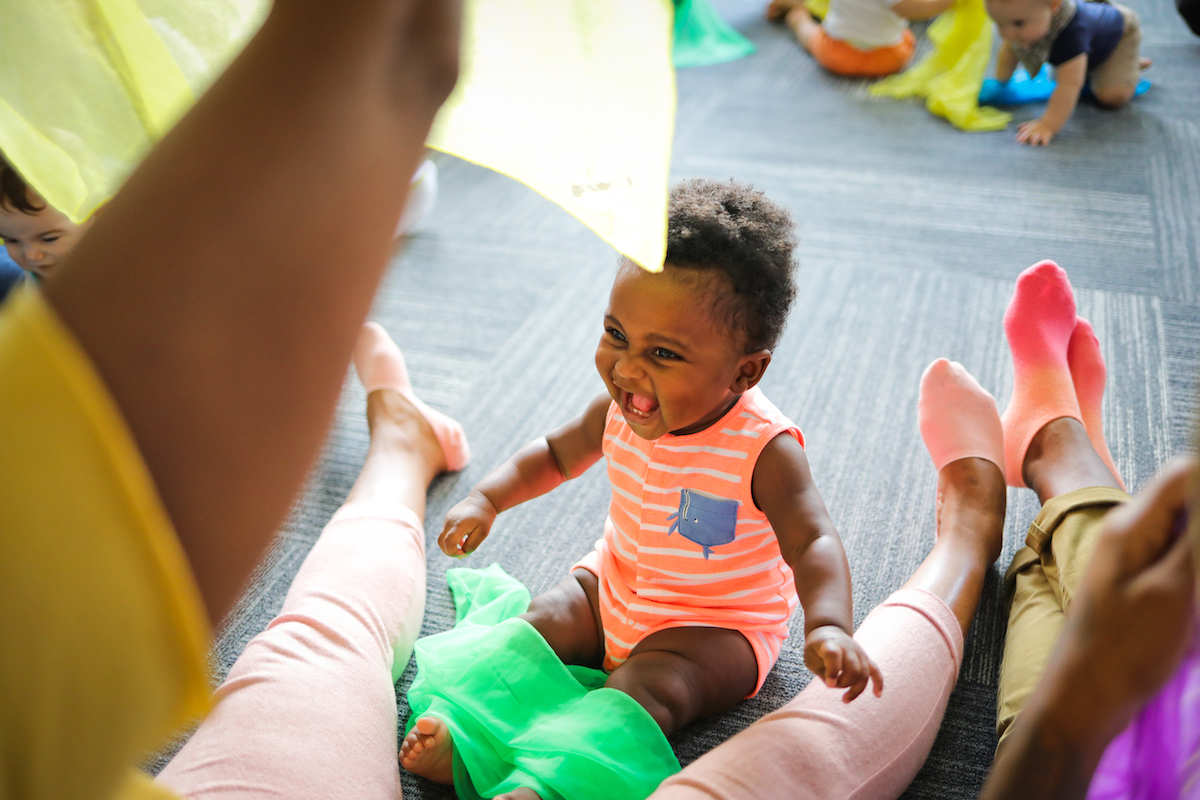
9-month-old baby engages in scarf play with mom during a Kindermusik class designed to support early school readiness.

School readiness for babies? Sounds a little extreme, but did you know an infant’s brain doubles in size during the first year? This window of learning opens wide in those first 12 months, and the easiest way to boost school readiness is to amplify bonding moments, joyful age-appropriate play, and rich multisensory activities that support those critical brain leaps. 

Shared musical play is the perfect tool.

Continue reading “School Readiness Begins at Birth”