
Turn Bath Time Battles into Happy Tub Tunes

As if we parents needed any more guilt trips about experiences we’re not giving our kids… thanks for raising the bar on bath time, Pinterest!  Despite how you may feel after perusing Pinterest, you really don’t need frozen ice cubes in different colors, glow-in-the-dark sticks, colorful bath paints, or epic construction or princess themed bath times. All you need is your voice and an “instrument” or two! 

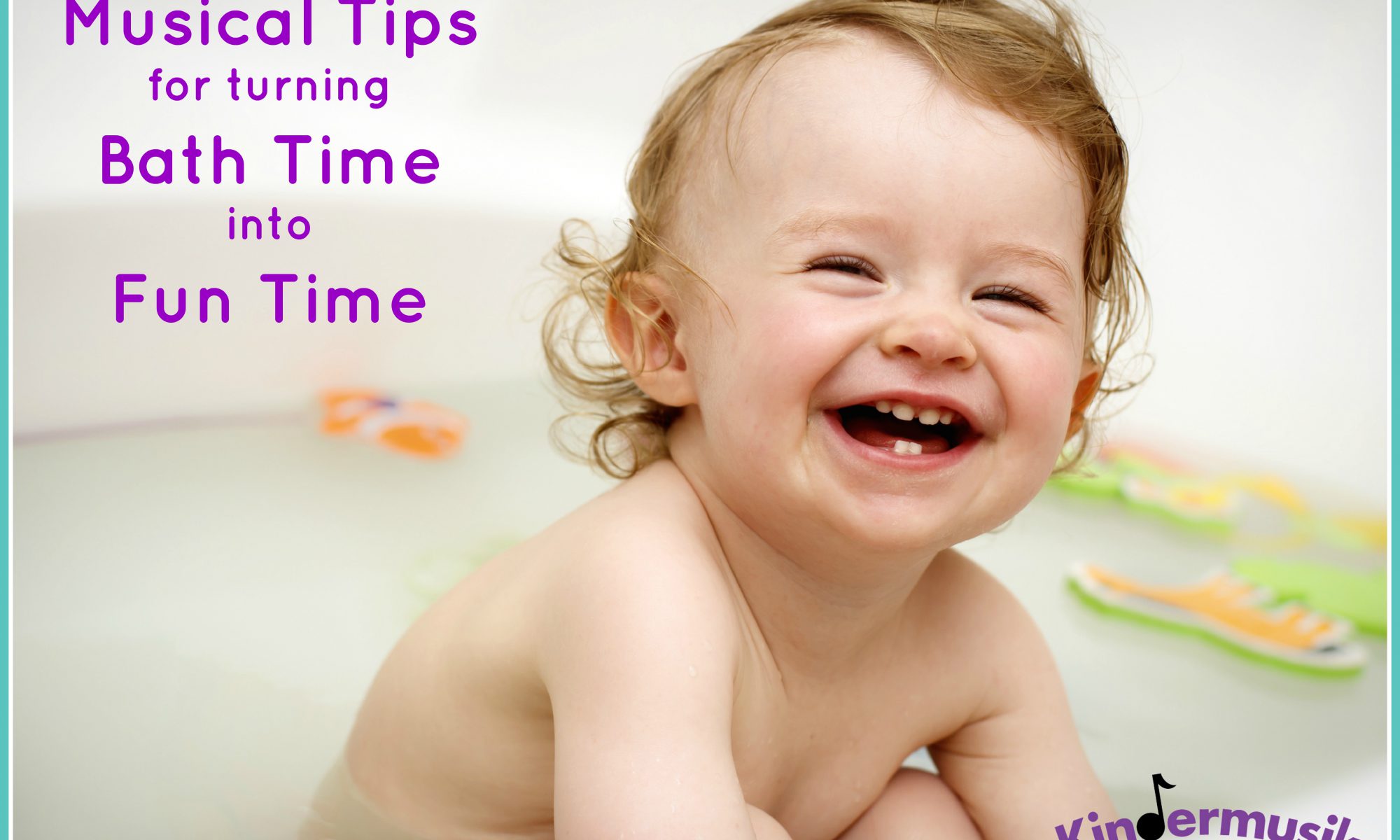
Dollarphotoclub_49610785 - musical tips for turning bath time into fun timeHere are a few musical tips for turning bath time into fun time – all minus the tears and tantrums.

Who says you only sing in the shower?  Singing in the tub can be even better.

Sing “Head, Shoulders, Knees, and Toes,” “Looby Loo,” or “The Hokey Pokey” as you bathe your child. For older children, mix up the words for extra giggles. So, while you sing about putting “your left leg in” wash the “right arm instead.”

Establish your own BTSO – Bath Time Symphony Orchestra!

Create a water symphony with all of the bath sounds (splashing water, water pouring out of and into cups, rubber duck squeaks, etc.). Help your little one practice active listening by talking about what the different sounds are and asking your little one to identify the sounds, too.

Try a little back-and-forth play, vocal play, that is!

You make a sound, and wait for baby to imitate. Say a short little rhythm, like “ta – ta – ti-ti – ta,” and have your toddler echo back. Or sing a phrase of a song, and see if your preschooler will sing the next phrase.

Bubbles make everything about bath time even better.

Sing the “Bubbles” song from Kindermusik as you bathe your child. Notice how this Kindermusik educator pauses the bubbles and encourages young children to communicate that they “want more, please.” Consider making a bubble bath or blowing bubbles, too.

BubblesCreate a sweet little bath time lullaby routine.

Listen to lullaby music in the bathroom to signal to your child that bedtime is near, and soon it will be time to start settling down for the day – once your little one has had her after-bath massage.  (This is a great time to rub in that baby lotion and connect in a special way with your child by singing softly and making lots of intentional eye contact.)

Looking for more practical parenting tips?  Visit a local Kindermusik class and discover even more ways to make great parenting just a little bit easier with music.

Contributed by Theresa Case whose award-winning Kindermusik program at Piano Central Studios is located in beautiful upstate South Carolina.
 

5 Musical Ways to Manage Holiday Meltdowns

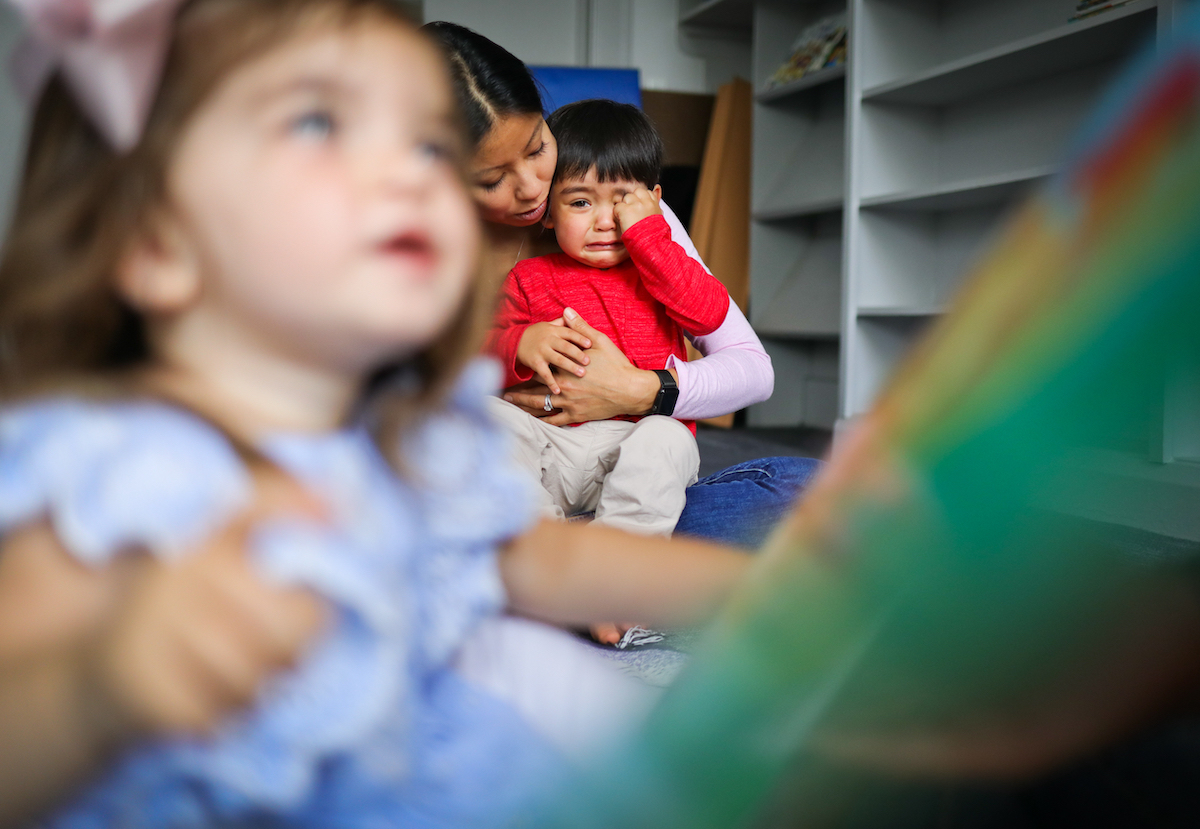
A mom uses gentle rocking to comfort her toddler during a meltdown.

Ah, the holidays—a time of rest, joyous family gatherings, and the harmonious sound of…meltdowns.

The reality is that this season often adds stress to families, especially for its youngest members.

Different schedules, new places, travel times, rich foods, family photos, and general overstimulation affect everything from mealtime to bedtime, which can contribute to not-so-merry meltdowns.

While grownups have the ability to command self-control faster, the brain’s pre-frontal cortex (where this function is typically associated) is not fully developed until adulthood. Additionally, relaxation is a learned behavior, which is why trying to reason with a toddler during a tantrum doesn’t usually work.

So, in the midst of holiday chaos, it’s important to gently teach children how to relax. Music and movement are some of the best tools out there to help little ones reset, recoup, and get ready for the next event.

Continue reading “5 Musical Ways to Manage Holiday Meltdowns”

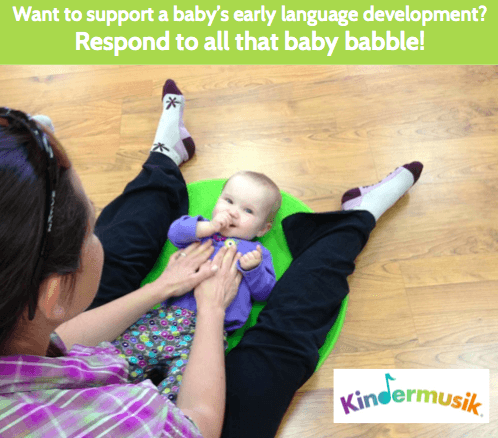
Answer that Baby Babble to Speed Up Language Development

Hang around babies long enough and you start hearing things. From soft sweet coos to long monologues of “dadadadadada,” babies talk a lot—even though we have no idea what they are really saying! That’s okay. We don’t need to understand all the words (or non-words!) to join in the conversation.

How Parents Respond to All that Baby Babble Matters

VocalPlay_Boosts_Early_Language_Development_KindermusikNew early childhood research from the University of Iowa and Indiana University found that how parents respond to all that baby talk can speed up a baby’s vocalizing and language development. That’s great news for those of us no longer fluent in Baby talk.
“It’s not that we found responsiveness matters,” explained co-author Julie Gros-Louis in a press release, “It’s how a mother responds that matters.”
In this six-month-long study, the research team watched the interactions between a dozen mothers and their 8-month-old babies two times a month for 30 minutes. During this free playtime, the researchers monitored how mothers responded to their babies’ positive vocalizations when directed toward them.
Researchers learned that how the mothers respond makes a big difference in the language development of their babies:

  • Babies with mothers who responded to what they thought their babies were saying showed an increase in developmentally advanced, consonant-vowel vocalizations.
  • The babbling of these babies became sophisticated enough to sound more like words.
  • Over time these babies also began directing more of their babbling toward their mothers.
  • Babies whose mothers did not try as much to understand them and instead directed their infants’ attention to something else did not show the same rate of growth in their language and communication skills.

Bottom line: Respond to all that baby babble!

How to Answer that Baby Babble with Music

Babies love the sound of their parents’ voices. Parents can feed that love and grow their babies’ use of language at the same time by singing, listening, moving, and dancing to music. After all, music is a language parents and babies both understand.  Musical activities, such as those included in every Kindermusik class, help parents engage with their children and be responsive to them. Here are ways for parent-baby pairs and other caregivers and teachers to use music to support the early language development of babies.
1. Engage in vocal play—one of the earliest stages of language development. Vocal play is how babies’ learn to use the tongue, gums, and jaw muscles needed to produce vowels and consonants. When caregivers participate, too, they expose babies to the sounds that make up our language and encourage them to practice taking turns communicating. Vocal play works best when a parent and baby can see each other’s faces, making it easier for a child to mimic mouth movements. Plus, this eye contact also helps parents and babies bond.
Parenting Tip: Sing “Old MacDonald Had a Farm” with your little one. Pause after key parts of the song, such as “E-I-E-I-O” and wait for your baby to respond. You can also explore the different sounds the animals on the farm make like these families did in Kindermusik class:
[youtube]https://www.youtube.com/watch?v=lsLil1s_wbE[/youtube]
2. Let babies experience steady beat by bouncing to music. The brain processes music in a similar way to how it processes language. Research even shows that children who can repeat and create a steady beat show increased neural responses to speech sounds when compared to other children. Steady beat competency relates to a child’s ability to speak and read fluidly during the school year.
Parenting Tip: Put on some music and bounce to the beat with your baby on your lap or on your hip. This lets babies experience steady beat with their whole bodies. Try one of our favorite lap bounces: Pizza, Pickle, Pumpernickel.
3. Rocking the way to language development. Gently rocking babies throughout those quiet moments of each day gives parents the opportunity to combine vocal play and steady beat—and receive 2x the benefits!
Parenting tip: At the end of the day or after a feeding, hum “Hush Little Baby” (or another favorite lullaby) while you gently rock or sway your little one to the beat. As with “Old MacDonald,” pause during key phrases and wait for your baby to respond. Before too long, your baby will grow into your toddler and be able to “rock” in a new way, like this Kindermusik toddler does at home while listening to music from class!
[youtube]https://www.youtube.com/watch?v=dFP_DVDKezA[/youtube]
Throughout the Kindermusik experience, we use music to help parents engage with their children, be responsive to them, and gain developmental insights and practical tips along the way. After all, a parent is a child’s first and best teacher.

Learn more about using music to support early language development at www.kindermusik.com.

Contributed by Lisa Camino Rowell, a freelance writer living in the Atlanta area.

Hokey-Pokey Your Way through Everyday Parenting

Everyone speaks music – young, old, all nationalities – through lyrics and through movement.  Music truly is the universal language.  As such, music is the one thing that parents all around the world can use to help them get through their day.
music is the universal language for kids and parents

5 Ways You Can Hokey-Pokey Your Way through Everyday Parenting

In the car
It’s easy to stream music on your phone, pop in a CD, or turn on the radio.  In fact, there’s really no better place than the family car to develop listening skills, expose your child to a variety of musical styles, and best of all, create memories.
Need a good starting point for turning your family taxi into a happening, happy music experience?  Click here for your free “family taxi” playlist!
At naptime and bedtime
Gentle, quiet music can calm and soothe a child to sleep, even when he thinks he’s not tire.  Plus it helps block out the noise when your neighbor decides to mow the lawn in the middle of nap time.  Sleep time can also be a great time to expose your child to a little Bach or Mozart as well as those beloved lullabies.
On a rainy day
Music is like indoor sunshine on a rainy, dreary day.  Depending on what kind of music you choose, music can be a quiet accompaniment for play time, inspiration for a parade around the house, or a giggly, happy way to dance the rainy day blues away.  (Dance long enough, and they’ll be more than ready for a nice long nap too!)
You can also take a video field trip without leaving the house.  You’ll love this “Big Back Yard” field trip that takes you and your child to see some beautiful butterflies, up close and personal!
Before dinner
It can be really tough to juggle making dinner and keeping a little one happy, especially towards the end of the day.  Turn on some bright, happy music, get out some wooden spoons and plastic bowls, and let the concert begin!  And while you’re waiting for that pasta to boil, why not take a spin around the kitchen with your child as your dance partner?
For family together time
Whether you have some child-friendly instruments or you improvise, there’s nothing that bonds a family more than making music together in a family jam session.  Or maybe you decide to establish a little ritual to welcome Dad home each day by doing a little dance together – like the Jungle Hokey-Pokey!  No matter how you choose to speak the language, music is the delightful common thread that binds hearts together, making memories that truly will last forever.

The Jungle Hokey-Pokey

Why Kindermusik?  With an expansive music library, Home Materials, and rich resources for parents (Did you grab your family taxi playlist or try the Jungle Hokey-Pokey yet?), Kindermusik classes provide plenty of musical inspiration for singing, dancing, and playing your way through the daily childhood routines that can be made happier and a whole lot easier with music!
Find out more about Kindermusik at www.Kindermusik.com!

This post was adapted from an article originally written by Theresa Case for Macaroni Kid Greenville.  Theresa has an award-winning Kindermusik program at Piano Central Studios in the beautiful upstate of South Carolina.

Give It a Rest. Kids Will Love these 2 Musical Math Games.

Patterns surround us and recognizing and understanding patterns is a foundational math skill. Music gives children the opportunity to experience patterns through movement, listening, and playing instruments. When children step, step, step, stop responding to the music or ta, ta, ta, rest with rhythm sticks, children are learning rhythm patterns (quarter note, quarter note, quarter note, rest), a basic musical concept. Rhythm patterns are combinations of long and short sounds and silences.
Try these two math games for kids from Kindermusik@Home that combine music and math!

Kindermusik@Home Pattern GameHomemade Ti-Ti Ta 

This activity for kids introduces the concept of visual and auditory patterns created simultaneously (e.g. the sounds of with the visual representation of).
Patterns are incredibly important, both to music and math. Children first notice and recognize patterns, then develop the ability to complete partial patterns, duplicate patterns, and eventually to extend and create patterns. The patterns also go from simple (ABAB) to more complex (AAB, ABB, AABB, AAABB, AABC, and so on).
The Ti-Ti Ta pattern includes another layer of complexity: duration. Rather than a simple red-red-green pattern in which all components are equal, a Ti-Ti Ta pattern contains the concept of short-short-long within it. When the pieces are rearranged, the “notes” are rearranged as well. Ta, ta, ti-ti, ta is more complex than green, green, red, red, green because the concept of a pair of eighth notes (each of which is half as long as a “ta,” or quarter note) is embedded in the ti-ti.

Pattern GameQuarter Notes and Quarter Rests

This game for kids introduces them to the sound of the quarter note and the “no-sound” of a quarter rest. Children test their ears on how well they recognize them when they’re assembled in patterns.

Find out more about the connections between music and math in Kindermusik at www.kindermusik.com.

3 Ways Music Enhances Auditory Processing

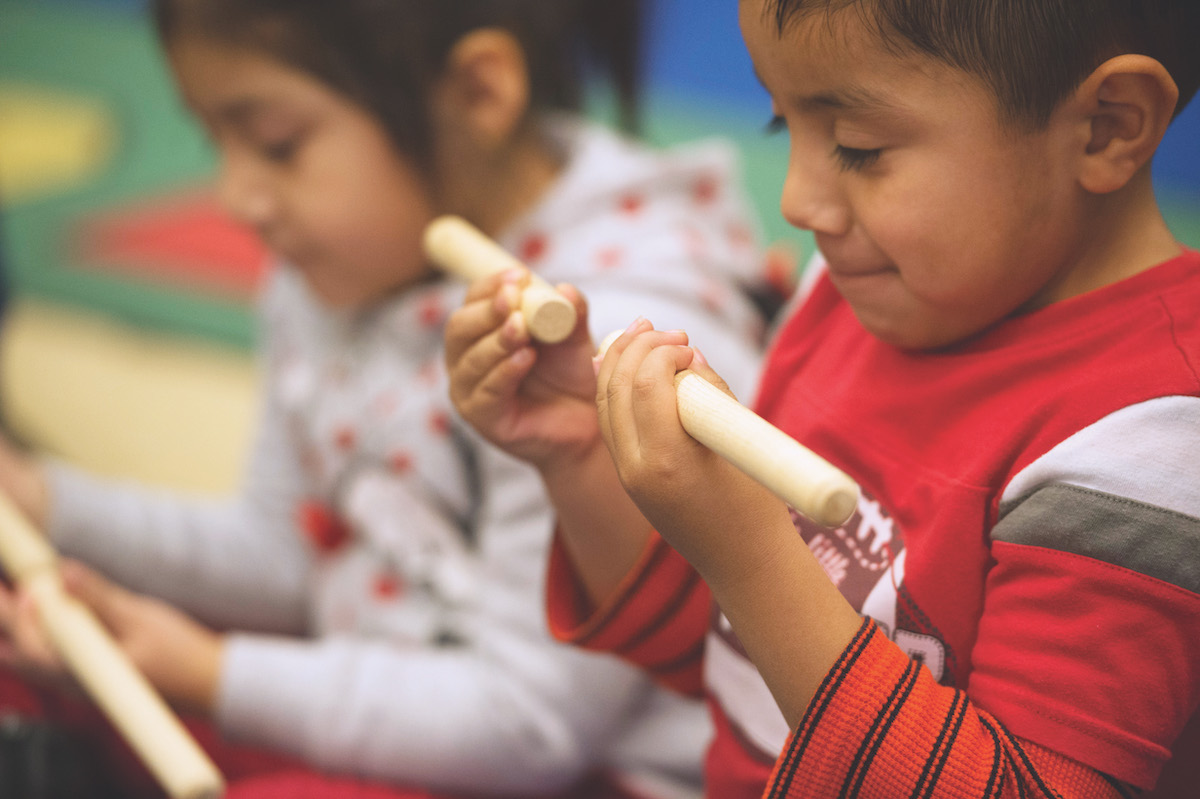
A 2-year-old boy prepares to play the fiddle sticks in a Kindermusik class.

The pressure to establish strong pre-readers can be overwhelming. Early literacy development (the foundations needed for reading and writing) depends greatly on auditory processing skills, which includes auditory identification, discrimination, and sequencing. It’s hard to imagine the time it would take to focus on all of those skill sets individually. But there’s a one-stop-shop. 

Continue reading “3 Ways Music Enhances Auditory Processing”

How to Talk to Babies When They Can’t Talk Back…Or Can They?

Caring for an infant can be a bit like visiting a foreign country, especially considering the language barrier. After all, most grown-ups—from first-time parents to experienced early childhood educators—are no longer fluent in Baby. Take a look: Do you know what these babies are talking about? They certainly seem to understand each other!
[youtube]https://www.youtube.com/watch?v=_UfFY6PSVu0[/youtube]

How to talk to babies

Even though we may not know exactly what those sweet babies are saying, parents and caregivers around the world naturally speak “parentese” when talking with babies. Common features of this baby-friendly language include:

  • Using a high pitch to get a baby’s attention
  • Repeating words (e.g. Who is the cutest baby in the world? You are! Yes, you are!)
  • Keeping sentences short
  • Exaggerating syllables and words

New research from the University of Washington indicates that using parentese with babies actually encourages them to try and imitate what they hear! In the study of fifty-seven 7- and 11- or 12-month old babies each child listened to a series of native and foreign language syllables while the researchers observed their brain activity. As expected, the researchers noted brain activity in an auditory area of the brain, however, they also observed activity in the parts of the brain responsible for planning the motor movements required for producing speech.
“Most babies babble by 7 months, but don’t utter their first words until after their first birthdays,” said lead author Patricia Kuhl, in a press release. “Finding activation in motor areas of the brain when infants are simply listening is significant, because it means the baby brain is engaged in trying to talk back right from the start and suggests that 7-month-olds’ brains are already trying to figure out how to make the right movements that will produce words.”
These findings suggest that the exaggerated characteristics of parentese makes it easier for babies to model the motor movements required to speak. Bottom line: Keep talking to babies!

Babytalk Tips from Your Mother Goose

Kindermusik@Home Nursery RhymesAs the mother of all nursery rhymes, Mother Goose knows a thing or two about talking to babies. With their rhymes and rhythms, nursery rhymes “wire” the brain for communication before speech even begins. It’s one of the reasons we include nursery rhymes in our early childhood curriculum.
Try these tips from Kindermusik@Home to talk to the babies in your life! Repeating these activities helps increase language acquisition and retention.

Find out more about Kindermusik at www.Kindermusik.com.

Contributed by Lisa Camino Rowell, a freelance writer living in the Atlanta area.

Music & Movement Benefits: Language Development

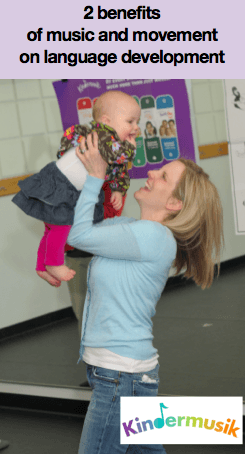
Lifting. Squatting. Twirling. Bending. Whew! Sometimes Kindermusik class feels more like a workout than, well, a workout. Okay, maybe not P90x, but still! While a parent works out muscles each week, young children build early language skills through music and movement activities.

2 benefits of music and movement on language development

  1. Pairing the word with the movement helps babies and young children understand the concept. Pre-readers rely 2 benefits of music and movement on language developmentalmost exclusively on what they hear in order to acquire language. Children’s brains make a connection based on what they experience (being lifted high or twirling around) and hear (“up” or “twirl”). So, when a parent of caregiver lifts a child high “up, up in the sky” or “twirls around like a leaf” while singing the songs in Kindermusik class, young children learn the word and understand the concept. Later, children will discover those words correspond to marks on a page which eventually leads to letter recognition and reading.
  2. Signing with hearing children boosts their communication skills. We use sign language throughout our music classes for babies. Using signs for words such as HELLO, GOODBYE, MORE, and STOP throughout class—and then later at home—supports communication and language development and even improves confidence and self-esteem. Plus, new research shows encouraging babies and toddlers to use gestures, such as sign language, helps in speech and cognitive development.

Parenting Tip: Play that fun-key music! Listen and move to music that combines key vocabulary with a movement or activity. Try favorite Kindermusik songs from class. Also use sign language for key words throughout the day. For example, sign MORE to ask if your child wants MORE fruit or HELLO when your little one wakes up from a nap.

Village baby with new logoCome experience for yourself the benefits of music! Contact a local Kindermusik educator and visit a class.
Contributed by Lisa Camino Rowell, a freelance writer living in the Atlanta area.

3,600+ ways to build a healthy parent-child bond in a baby's first year

mom and baby engage in conversation3,600. That’s the approximate number of times a baby needs a diaper change in the first year alone. (Yowser! That’s a lot of diapers.) Of course, every diaper change satisfies the physical needs of a baby, but it also meets a baby’s developing social and emotional needs. Every time a baby cries and a parent responds to the need, it strengthens the vital parent-child connection. Building an attachment and a sense of trust not only lays a solid foundation of social and emotional development but also primes a baby’s brain for learning.

Strong healthy parent-child bonds as infants help children make friends

Researchers from the University of Illinois recently published a study in the journal of Developmental Psychology that showed young children with strong parent-child bonds tend to be more responsive and adaptable when meeting—and playing with—other children. They also tend to be more sympathetic to the needs and moods of other children.
In the study, the team measured the security of child-mother bonds for 114 children who were 33 months old. As part of the study, the parents reported on their child’s temperament, such as propensity towards anger or social fearfulness. Then when the children reached 39 months old, the researchers paired same-gender children and observed them playing together over three laboratory visits in the course of a month.
“Securely attached kids were more responsive to a new peer partner the first time they met,” explained Dr. Nancy McElwain in a press release. “A more securely attached child was also likely to use suggestions and requests rather than commands and intrusive behavior (such as grabbing toys away) during play with an anger-prone peer during the first two visits.”
The researchers believe that toddlers and preschoolers who develop strong bonds with their parents learn early on that their needs matter and confidently express themselves.

Kindermusik supports strong parent-child bonds from birth

Building healthy parent-child bonds starts in infancy. In our music classes Kindermusik@Home Holding Babyfor babies (for all ages actually!), we create many moments to strengthen and celebrate this vital parent-child connection. Every time a parent sings lovingly to a wee one, the bond grows stronger. With each intentional and gentle touch, rock, or lap bounce, the bond grows stronger.  And every time a caregiver gazes into a child’s eyes and smiles during tummy time, the bond grows stronger. As babies grow, this sense of security—and trust—gives little ones the confidence to explore new environments, try new things, and make new friends.
 
Enjoy this free activity from Kindermusik@Home that supports parent-child bonds.

Contact your local Kindermusik educator to experience for yourself how music creates healthy parent-child bonds.

Contributed by Lisa Camino Rowell, a freelance writer living in the Atlanta area.