
5 Ways to Boost Early Literacy for Toddlers and Pre-Schoolers

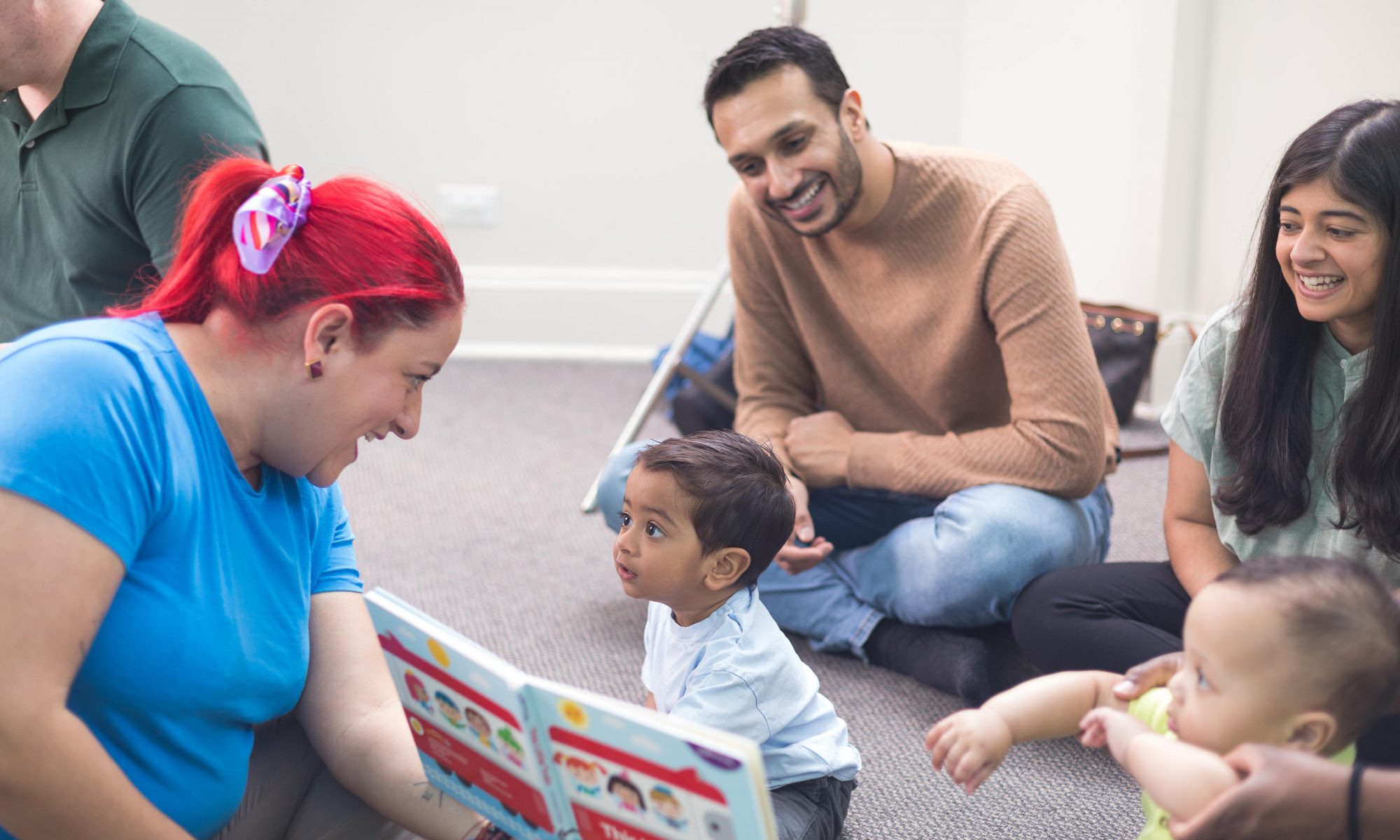
When you hear “early literacy” and your little one is nowhere near reading-ready, don’t panic. They’re probably further along than you think. Early literacy consists of the building blocks needed to become a reader, including phonemic awareness, comprehension, vocabulary, and more.

Helping them build up early literacy skills has more to do with your interactions with them during storytime. With a few easy guidelines, these reading moments will become more enjoyable and rewarding than you can imagine, and they don’t cost a thing.

Continue reading “5 Ways to Boost Early Literacy for Toddlers and Pre-Schoolers”

14 ways to celebrate 2014 with early childhood music and early literacy

(Source: She Knows Canada)

At Kindermusik, we celebrate new beginnings throughout the year—from new babies being born to new families discovering our early childhood music classes to even launching new curriculum for babies and toddlers. However, whenever a new calendar year rolls around, we look for even more ways to celebrate! We invite all of our Kindermusik families to help ring in—or shake or sing or dance in—the new year with one of these ideas.

Welcome the New Year through early childhood music and early literacy

  1. Make a musical time capsule of your family’s current favorite music with a 2014 playlist. Include your child’s favorite lullabies, get-up-and-go songs, or theme songs from beloved television shows or movies. Expand the playlist beyond early childhood music, too. Be sure to include your own favorite songs that you share together.
  2. Read musical storybooks together. Try some of these Kindermusik favorites to support early childhood music and early literacy development.
  3. Go on a letter sound treasure hunt. Show your child a letter. Make the sound of the letter together and then go on a treasure hunt around your house to find an object that starts with that same sound.
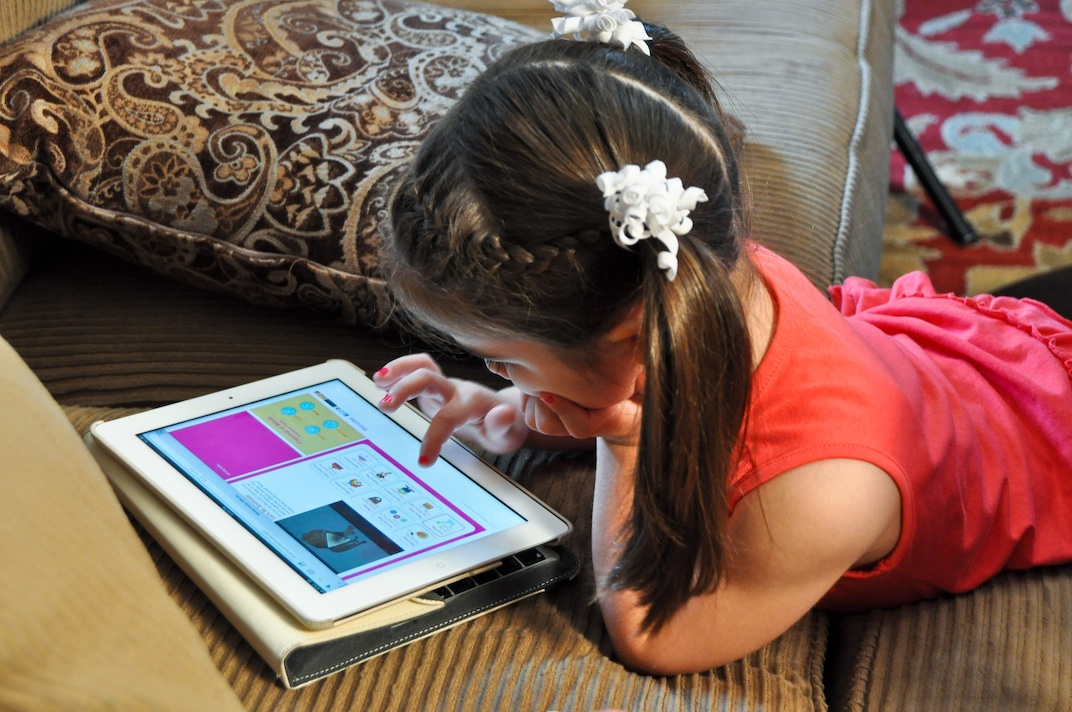
  4. Make a personalized alphabet eBook. During your letter sound treasure hunt, take a photo of each object: M for Mommy; S for stuffed animal; K for Kindermusik. Then support your child’s early literacy development by creating a personalized alphabet eBook with the photos.
  5. Try one of these websites or mobile apps for kids that support early literacy development. The Reading Rainbow app will soon include a music-themed “Kindermusik” island. Stay tuned to hear more!
  6. Read (and memorize!) a favorite nursery rhyme. Nursery rhymes build phonemic awareness as your child begins to hear the differences between rhyming words like “Humpty” and “Dumpty” or “wall” and “fall.”
  7. Play alphabet musical chairs. Here’s one way to combine early childhood music and early literacy skills with a familiar childhood game.
  8. Sing together. One study says talking (or singing) to your young child is the most critical aspect of parenting a baby or toddler. Learn more about the child development benefits, including vocabulary development and early literacy development.
  9. Dance together. The ability to move to a steady beat is linked to language skills. Plus, it’s fun and great exercise for the whole family and gives your child the opportunity to practice all those growing gross motor skills!
  10. Make music and reading part of your daily routine. Routines and rituals help young children make sense of their world and predict what comes next. Each day signal to your child the end of the day by listening to (or singing!) lullabies and reading books together after bath.
  11. Hold a Freeze Dance party. Children love freeze dance. However, as creators of early childhood music classes and early literacy curriculum, we know there is more behind a game of Freeze Dance than giggles and silly moves. Children practice inhibitory control by learning how to tell their bodies when to dance and when to stop. Inhibitory control prepares a child to sit still and pay attention during the school years.
  12. Get out some instruments (or pots and pans) and hold a family jam session. Your child will practice steady beat and rhythmic abilities. Rhythmical abilities show a strong positive correlation with decoding skills, both in reading accuracy and reading prosody. Plus, being able to keep a steady beat helps a child feel the cadence (rhythm) of language.
  13. Play “Name that Sound.” Gather different instruments or objects that make sounds. Take turns closing your eyes and naming the instrument or object. That same sound discrimination helps your child hear the minute differences between letter sounds or phonemes, which supports early literacy and language development.
  14. Enroll in Kindermusik classes! Our classes for babies, toddlers, big kids, and families are loved by more than 2 million families in over 70 countries.

    Contact a local Kindermusik educator today! Ask to visit a class and see for yourself why parents and children around the world love our early childhood music classes.


4 Simple Ideas for Indoor Musical Fun

When the weather keeps you indoors or you just need something to relieve a certain little someone’s boredom, here are a few fun and easy suggestions for keeping your child occupied and making a few memories along the way too!  These are just a few simple, tried-and-true things to do with kids – at home and out and about.
Suggestion 1:  Try a Kindermusik class!
Of course we couldn’t resist a small plug here!  But we happen to think that Kindermusik classes are one of the very best things you can do with – and for! – your child newborn to 7 years.  Not only do you get to enjoy a weekly class together, but you also receive Home Materials (now available digitally!) that help you enjoy and extend your Kindermusik experience at home throughout the week.  With Kindermusik @Home, you can take your Kindermusik with you wherever you go!
Sign up for a free Preview Class here.
If you’re already enrolled in Kindermusik and need a little extra inspiration, take some time to explore the myriad of downloadable activities and music at play.Kindermusik.com – a great music app for kids AND their parents!
Suggestion 2:  Sing a song and play along.
For example, remember the song “Hickory, Dickory, Dock” from your childhood?  With a simple song like “Hickory, Dickory” as your inspiration, you can explore the sounds that different materials make when struck together.  Try familiar materials such as wooden blocks, pots and pans, and cardboard tubes.  Which sounds most closely mimic the ticking of a clock?  Kids of all ages will also enjoy accompanying themselves with simple rhythm instruments while they sing.
Suggestion 3:  Create some cool art.
Here’s a three-ingredient recipe for Pretty Puffy Snow.  You will need 1 cup flour, 1 cup salt, and 1 cup water.  Mix all ingredients and place the mixture in a squeeze bottle (try recycling an empty honey bottle or mustard container).  Draw a wintery scene on a piece of stiff paper, then squeeze on your puffy “snow” for some really cool 3-D highlights.
By the way, art projects are always more enriching and more inspired when you’re playing a little music in the background… or when you choose this for one of your family activities!
Suggestion 4:  Try these learning games for kids. (And get a sneak peek at one of the fabulous ideas available exclusively through Kindermusik @Home!)

Here’s a free music learning game that’s perfect for toddlers, but fun for all ages too:  Finding Family

This adorable “get up and move” activity from Kindermusik provides opportunities for toddlers to be active, to engage in looking-and-finding, to follow directional cues (e.g. ‘under’, ‘behind’, ‘up’), and to identify (and open conversation-opportunities about) family members.

Shared by Theresa Case, whose Kindermusik program at Piano Central Studios in Greenville, SC, is proudly among the top 1% of Kindermusik programs worldwide.

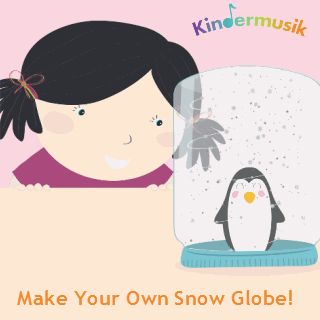
Make Your Own Snow Globe!

Kindermusik - Make Your Own Snow Globe!

Let it Snow this Holiday Season with this Fun Kindermusik Activity.
Kindermusik - Make Your Own Snow Globe!Follow these simple, kid-tested steps for making your own sparkling snow globe. You choose the decorations!
Great for the classroom – or, if you’re looking for fun things to do with your kids this holiday season, this can be a memorable family activity.
 

Where Music and Learning Play!

To make this activity even more fun, we are giving away a FREE Music Download of Winter Wonderland. Login or Register at play.kindermusik.com.
 
Enjoy the music! We know it’s a great vehicle for learning. We encourage you to listen to the album Winter Wonderland while making this craft and use the tips below for extending the learning.

5 Steps for Making Your Own Snow Globe

Kindermusik - Make Your Own Snow Globe Activity Sheet

Tips for Extending the Learning

This fun activity from Kindermusik@Home is great for developing basic science skills, including investigating materials, observing the seasons, and making scientific predictions. As you progress through the steps outlined, you can extend the learning by trying some of the following:

  • Investigate the materials needed. What does the glitter look like? How does the oil or syrup feel? Is the glass jar smooth or rough?
  • Talk about the season of winter. You can discuss cold weather, snow, ice, birds flying south, etc.
  • Predict what might happen when you turn your snow globe over. What will happen to the glitter? Will it make any sound?

Enjoy the music and this fun Kindermusik activity!

For more information on bringing Kindermusik to children around the world:

Teach Kindermusik     Try A Free Kindermusik Class     Learn About Kindermusik at School
 

FOL Fridays: Body Management

Discovering and exploring movement provides young children with profound learning experiences.  They are delighted to practice and show off their emerging skills, and they will seek out opportunities to practice these skills frequently.  It is during this time that the foundation is laid for body-management activities needed in childhood games, recreational activities, and eventually sports (Carson 2001).
Ideas for parents:  One fun way to explore movement ideas together is to play a simple “Copy Me” game.  The first person moves and the partner copies.  Take turnings being the one moving and the one copying.  This game is likely to become quite hilarious with preschoolers and big kids who will have fun coming up with the silliest ideas ever!  Add a little music, and you’ve got the inspiration for some happy, fun music and movement activities that will keep you entertained and physically active!

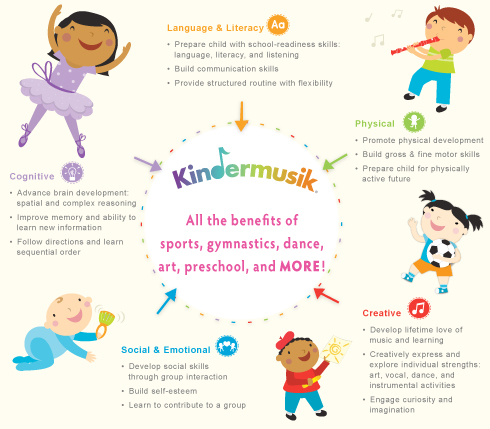
Kindermusik… It's all in here!

Kindermusik - all the benefits of sports, gymnastics, dance, art, preschool, and moreLooking to meet other moms and kids?
Kindermusik is like having you with your very own weekly playgroup with music and more!
Looking for ways to keep your child active?
Kindermusik develops your child’s motor skills, rhythm, and coordination.  It’s a great way to provide physical activities for kids.
Looking to enhance your child’s creativity?Kindermusik is a place where your child’s imagination, curiosity, and love for learning is encouraged and expanded.
Looking for tips on childhood development?
Kindermusik supports you, in class and at home, with expert research and helpful ideas in the middle of all the fun.
Looking for memories to last a lifetime?
Kindermusik inspires cuddles, giggles, imagination, and learning in class and at home.
Looking for great group activities for kids?
Look no further than your local Kindermusik program.  In fact, we invite you to try a class for FREE on us!

Kindermusik gives your child so much more than just music.  Backed by more than 30 years of experience, Kindermusik is a carefully planned curriculum and a delightfully enjoyable experience that also offers the benefits of sports, gymnastics, dance, art, preschool… and then some!

– Special thanks to Kindermusik educators Theresa Case and Cathy Huser for their contributions to this post.


ELL students learn through movement

Children are the real movers and shakers of this world. Watch a toddler practice walking, supervise group activities for kids, or even catch your young children in your arms as they run to welcome you home, and you will see there is a whole lot of moving happening! From birth, children learn to move and move to learn.
Head Shoulders Knees & ToesIn the world of ESL curriculum development, we understand that English language learning is best acquired when closely linked to a gross- or fine-motor skill activity. Learning through actions or through Total Physical Response (TPR) reinforces new and old language. Research shows that TPR positively impacts memory and recall in language learning. Plus, physical activities for kids makes the learning all the more fun—whether learning how to roll a ball or how to say “ball” in English while learning how to dribble it!

Music and movement and ELL students

ABC English & Me - Teaching English to Children through MusicIn our ESL curriculum, ABC English & Me, we use English songs for kids, Total Physical Response, puppets, and story time to teach ELL students. English songs for kids that include miming of the songs provide children with the opportunity to sing and do—or Total Physical Response. For example, moving and hearing the vocabulary in “Head, Shoulders, Knees, and Toes” encourages ELL students to then use the new vocabulary as they move. Familiar English nursery rhymes and finger plays, pair English Language Learning with a fine motor activity.
ABC English & Me, our ELL/ESL curriculum for ages 2 to 6, aligns with international standards, including the Common European Framework of References for Languages (CEFR). Plus, we incorporate the latest research on how music and Total Physical Response boosts language learning and increases phonological awareness.

Learn more about bringing ABC English & Me to your school!


FOL Fridays: Have a Ball!

To a child with imagination and a parent who hasn’t forgotten the simple joys

of childlike playfulness, every object has unlimited possibilities. Ball play enables children to investigate rolling, bouncing, passing, and tossing, exercising their imaginations as well as their gross-motor skills.

Tips for parents: You can enjoy ball play indoors or out with a Gertie® ball. Gerties are squishy, catchable balls perfect for the child just learning ball skills. Add a little fun ball play music – it’s easy to put together a favorite playlist from play.kindermusik.com just by searching on the word “ball.”

Contributed by Theresa Case, whose Greenville, SC program, Kindermusik at Piano Central Studios, is proudly among the top 1% of Kindermusik programs worldwide.

Why Kindermusik Parents Make Great Kindermusik Teachers

mom and child bond in KindermusikAs a Kindermusik program owner, some of the very best teachers I’ve ever hired were Kindermusik parents first. So I am a firm believer that Kindermusik parents make great Kindermusik teachers!

Kindermusik parents who become Kindermusik teachers…

  • have seen first-hand what teaching children in Kindermusik means for the educator, for the parents, and for the children.
  • have hearts big enough to love other people’s children almost as much as they love their own.
  • bring a unique perspective to their teaching because they understand how a Kindermusik parent thinks and feels.
  • relate well to other parents because they all have something in common – they have kids in Kindermusik!
  • have a leg up because they’ve had the opportunity to learn by actively observing and participating in many Kindermusik classes.
  • are familiar with how a Kindermusik program runs and have a vested interest in the program they have enrolled their child in.
  • have the passion and appreciation of both parent and educator for the value of musical learning and the power of Kindermusik.
  • understand what it means to benefit from the Kindermusik experience in class and from the Kindermusik Home Materials all week in between at home.
  • know and love Kindermusik because they’ve seen it through their own child’s eyes.

Are you a Kindermusik parent who’s Interested in becoming a Kindermusik educator? Talk to your local Kindermusik educator today and take a look at some helpful information on KI’s website. You’ll be glad you did!

Shared by Theresa Case who has an award-winning Kindermusik program at Piano Central Studios in Greenville, SC, and is always happy when one of her Kindermusik parents expresses interest in teaching Kindermusik for her!

4 musical learning tips that make parenting a little bit easier

It doesn’t take a parent long to figure it out. No baby or toddler or preschooler—or teenager for that matter!—comes with an owner’s manual. Sure, parents can Google, look to books and blogs, talk with other parents, and even ask Siri but there is no one-size-fits-all answer to parenting.
At Kindermusik, we don’t have all the parenting answers either. We do, however, have one thing that makes parenting just a little bit easier and unlocks a child’s potential: Musical learning! Here are just a few ways to use musical learning throughout the week in your everyday routines and rituals.

4 musical learning tips that make parenting a little bit easier

  1. Music helps children, even babies, learn how to relax. Relaxing is a learned sleeping babybehavior. A child’s world can be full of stimulating experiences, from practicing new skills like standing or walking to all the sights, sounds, and smells of a trip to the grocery store. Teaching children how to relax after a period of activity gives them time to recoup and get ready for what’s next. Listening to some quiet music, snuggling together, or gentle rocking can show children how to relax. By the way, children who know how to relax and self-soothe can be better sleepers!
  2. Singing or humming a comforting song can soothe a child or ease anxiety and fears. From 2am feedings to boo-boos to thunderstorms to visits to the doctor, singing a soothing song can calm fears and comfort little ones in many different situations. The world’s most famous and revered nanny, Mary Poppins agrees. After all, she sang, “A spoonful of sugar helps the medicine go down.”
  3. Music can signal to your child it’s time to transition to something else. In our music classes for babies, toddlers, big kids, and families, we sing “instruments away, instruments away. It’s time to put our instruments away.” That tells every child that the instrument playing time is over and we are moving on to another activity. After a few times, children begin to understand and will put the instruments away (most of the time!).  Try using that little song throughout the week to signal the end of bathtime, playtime, or even time to leave the park.
  4. Make a playlist of your child’s favorite music for your next road trip. Few children enjoy being strapped in their car seats for long periods of time. Music makes it easier. Create a playlist of your child’s favorite Kindermusik songs for the trip. Here are some of our favorites. Mix in your own favorites, too, for a family musical playlist.

New benefits of music on the cognitive development of children continue to be discovered by researchers. However, throughout the years generations upon generations of parents have used musical learning to help make parenting just a little bit easier. We invite you to come visit a Kindermusik class and discover for yourself a loving, welcoming community of families who are discovering the power of musical learning!

Find a local Kindermusik educator in your area today.