
Early education experts in the Kindermusik community

Kindermusik’s top program in the world, Studio 3 Music, is run by a talented and dynamic trio of educators that includes Analiisa Reichlin. If you read Minds on Music regularly you may recognize Analiisa’s name as she often contribute posts to this blog.

Analiisa will soon be adding another entry to her long string of accomplishments when she’s featured as a regular commentator on BAM Radio program called “Music and the Brain.” BAM Radio is the largest education radio network in the World. And BAM couldn’t have made a better selection – Analiisa is a wealth of knowledge on this topic.

Analiisa, and educators throughout the Kindermusik network, are recognized as experts in the field of early education and childhood development. We’re proud to be represented by each and everyone one of them.

To keep up with Analiisa and her contributions to BAM, she will be blogging about her experiences at the Studio 3 Music blog.

About BAM Radio Network
The BAM Radio Network is an online, education-focused, radio network for parents, teachers, administrators, advocates, journalists, legislators and all people interested in education-related topics. The site offers 20 channels of education programming available on demand and hosted by leading educators. The network is a joint venture between privately held New Hampshire-based Moving & Learning and Los Angeles-based Jackstreet Media Ventures LLC. The programming is produced by Emmy-winning broadcaster Errol St. Clair Smith and distributed through the Affiliate Nanocasting Network.

Musical activity ideas for some physical contact

Several years ago at the Kindermusik Educator Convention in San Antonio, TX, Dr. Carla Hannaford, Ph.D., talked about the absence of touch in many early childhood care environments. Young children today will often be reprimanded for touching, holding hands, hugging, and being given the freedom to wrestle and topple over each other. Dr. Hannaford asserted that all of these actions are actually essential for spatial awareness and strengthening neural wires in the brain.

In the spirit of Dr. Hannaford’s ideas, we wanted to share two musical activities that involve touch and physical contact. These activities were pulled from the Huggies Happy Baby site under an article called Toddlers Express Themselves through Dance.

Activity 1: Musical Hugs
To play, put on some music and dance around with your little one(s). Dance any way you want. At a random moment, pause the music and hug! Then start the music back up and get dancing again.

If you have lots of family members or kids playing, everyone hugs whoever is closest to them. If you’re having a birthday party with lots of kids attending, consider playing this game instead of Musical Chairs. Musical hugs allows everyone to play and doesn’t result in any “losers” like Musical Chairs does. This game also promotes listening skills and practice with starting and stopping. The added bonus is the positive physical contact, which strengthens the bond between you and your toddler.

Activity 2: Musical Partners
A variation on the above game, this requires players to find each other, hold hands and sit down until the music starts again! If you have several players, the game also can be played in two circles, one inside the other (one partner in the inside circle and one in the outside). When the music starts, the circles move in opposite directions. When it stops, the children run to their partners, hold hands and sit down.

Try one of these activities today, or make up your own game. Either way, don’t be afraid of squeezing those little ones tight!

Want more musical activity ideas? Try a free Kindermusik class near you.

Kindermusik educators in the (well deserved) spotlight

At Kindermusik International, nothing makes us happier than to see our super talented Kindermusik educators spotlighted in news stories or with awards. When you put a Kindermusik educator in the spotlight, her passion for music, love of children, and dedication always shine.

  • In the UK, educator Suzanne Dunn’s Tuneful Tots studio was recently recognized with three What’s On 4 Little Ones awards.
  • Michigan educator Laura Blanchard’s Kindermusik program was called a Best Kept Secret in the Tri-County Times. With stories like this, her program won’t be a secret for much longer!

Congrats to both Suzanne and Laura on this well deserved recognition!


Thanks to Kindermusik educator Theresa Case for contributing to this post. Theresa’s Kindermusik program, Kindermusik at Piano Central Studios, is in the top 1% of all programs in the world.

Sing your baby talk

Even before your baby is born, she responds to the sound of your voice. Researchers have observed that a baby in the womb can respond to the sound of a mother’s voice as early as 5 months into pregnancy.

After your baby is born, you’ll naturally talk to him or her in a cooing, sing-song-y language formally called infant-directed talk (IDT) or child-directed speech (CDS). Some also refer to it as “motherese” or “parentese.” But we know it more commonly as baby talk.

Research shows that these are the first sounds that your baby will try to imitate with cooing and babbling. Studies have also shown that children can recognize and even imitate certain musical notes. So, mix up your language-building parentese with singing, talking, and rhyhming. This will help expose your baby to a variety of sounds to aid her singing and language development.

Kindermusik Tips:
Your Baby: In the first year, your baby will be especially interested in listening to the sound of you singing. So, choose songs that you love, hold her close, and sing and dance together.
Your Toddler: Simple songs that go back and forth between two notes are easiest for toddlers to repeat. Songs with this interval include, “Rain, Rain, Go Away” and “Star Light, Star Bright.”
Your Preschooler: Expand your preschooler’s musical vocabulary by adding more notes with songs like, “Twinkle, Twinkle, Little Star,” “Baa Baa, Black Sheep,” and “The Alphabet Song.”

Want to discover even more great techniques to use with your baby? Try a free Kindermusik Village class today. Village is for caretakers and babies from newborn to 18 months. Visit our Kindermusik Class Locator to find a class.

Music helps stroke victims communicate

We all know music can be a powerful thing. But the beauty of music is that we learn new things about it every day. Research has really just begun to scratch the surface of how powerful music can be.

A great example of this is an article we recently came across in the Wall Street Journal. The article’s headline is Music Helps Stroke Victims Communicate, Study Finds.” It’s pretty astounding stuff.

The article describes a small research study that “produced often dramatic results in 12 patients whose speech was impaired after a stroke to the left hemisphere of the brain.” This was accomplished using a method called melodic intonation therapy, which teaches the patients “to speak in a more ‘sing-songy’ way than a person with normal speech.” The audience at the American Association for the Advancement of Science greeted the results “with enthusiastic applause.” Further studies are currently being planned.

This could really change lives. And it’s just another example of the power of music. At Kindermusik, we firmly believe that music can change lives, including very young ones. The research proves this as well. You can learn more about our baby, toddler, and big kid music and movement classes.

There are certain to be even more fantastic discoveries about music in the coming years. We can’t wait!


What goes up, must come down

Did you know that children learn concepts best in opposites? It’s why in your Kindermusik class, you’ll learn fast/slow, smooth/bumpy, high/low, among many other pairs. It’s why in school, addition and subtraction are taught back to back. It’s why when you begin to drive, your teacher makes sure you know where both the brake and the gas pedals are!

Learning opposites enhances vocabulary and word association, encourages sensory and motor development, develops discrimination and classification skills, and provides plenty of opportunity for fun games. The farther apart the opposite (black and white, hard and soft), the easier it is for children to master the concept. When you add an interactive approach, this learning becomes highly enjoyable.

Here’s a few “opposite” activities:

When doing these, be sure to label the opposite words. (It’s pretty easy to forget to do that, as we adults already know the vocabulary!)

· Try tasting some opposite things like sweet sugar and sour lemon.
· Sort round cans and square boxes when putting away the groceries.
· Music is full of opposites. Put on your favorite piece of Kindermusik (or music with pitch or tempo variation), and move high and low, or fast and slow.
Sing a song silly! (High and then low, or fast and then slow.)
· Move. Go and stop. Take big steps, and little steps. Go under, go over.
· Open and shut the doors. Or cupboards. Cause seriously, if they don’t learn both opening and shutting in a pair now, your fridge is going to constantly be left open when they are a bit older!
· Identify back or front. Left or right. Short and tall. Boy or girl. Young or old. Dirty or clean. Empty or full.
· Feel the objects around you. Hard or soft? Rough or smooth? Hot or cold?
· Read some opposite books, and talk about what you see. Here’s some favorites: “Dinosaur Roar,” by Paul and Henrietta Stickland. “Big Dog, Little Dog,” by P.D. Eastman. “The Foot Book,” by Dr. Seuss.

Even babies learn opposites. Talk to your baby as you go throughout the day, and emphasize the opposite words with your vocal inflection. “I’m going to pick you up.” “We are going down the stairs.”Really, the possibilities are endless. Just have fun with it!
-posted by Miss Analiisa, whose two oldest children are oil and water.

Special thanks to Analiisa Reichlin for allowing us to share such this post from the Studio 3 Music Blog. Analiisa is Director of Studio 3 Music in Seattle, Washington, the world’s largest Kindermusik program.

Do you TUNE IN?


Did you know Kindermusik has a monthly newsletter called "Tune In"? It contains the latest news, activities ideas for home, and some amazing deals on products. Want to check it out? Click here.

If you want to sign up for Tune In, you'll find a link near the bottom of the page.

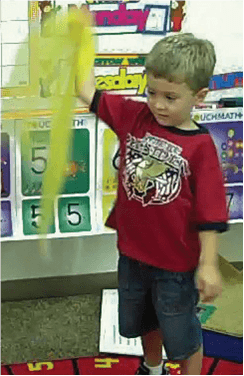
Freeze Dance!


We've all seen energy build up in toddlers, preschoolers, or big kids. But you can usually redirect this energy with a fun little game. At the same time, you'll be helping to develop your child's physical control and something called "inhibitory control," or his or her ability to start and stop behaviors. Sometimes, all you need to do is turn on some music and play Freeze Dance!

All you need to do is:
• Get some lively music going.
• Dance around with your child or encourage him or her to dance — let your child burn off some of that energy!
• Every so often, quickly pause the recording — everyone (including you) should immediately freeze!
• To spice things up, after each freeze you can call out a new dance word like twirl, twist, leap, wiggle, or turn.
• Now start dancing like that until it's time to pause the music and freeze again.

Don't have any music handy? No problem! Sing a song or bang a funky rhythm on something you have lying around the house. Stop at random times, just like you were pausing the music.

Redirecting your child's energy into a fun game or activity can work like a charm. Try it next time you see your little one developing a case of ants in the pants!

Spring means baseball . . . musical baseball!


Bowling Green, KY, educator Mary Anne Kell recently sent us this fun little note and picture. With spring and baseball season around the corner, we thought it was a good time to share it.

"Just wanted you to know about another exciting Kindermusik activity. Our Young Child classes have always enjoyed playing musical baseball. However, this year was special! The class was thrilled to be GIVEN baseball caps by our new professional baseball team — the Bowling Green Hot Rods — to wear while playing musical baseball. We are working with the Hot Rods office to attend a game in the spring so the girls can throw out the first ball.

Kindermusik is so much fun! (…and that is clearly evident on the girls cute smiling faces!)
-Mary Anne Kell"


No doubt about it, Mary Anne!

Being part of the Kindermusik family


Kindermusik has over 5000 super-talented, super-dedicated Kindermusik educators around the globe. But at Kindermusik International, or (to use a term we never use) “Corporate Headquarters,” we’re a small, tight-knit group of employee-owners – KI is 100% employee owned. KI is a second family to many of the folks who work here. So when someone leaves, it’s always a very sad event.

Last year one of our favorites, Lisa Rowell, left the ranks and moved to Atlanta with her husband and two girls. Lisa, Ellery, and Emmy are pictured to the right, enjoying the oh-so-common Atlanta snow (it sure has been a strange winter in many places). While at KI, Lisa worked in marketing and, as anyone who knows her would agree, was one of the most funny, smart, silly, and engaging people you could hope to share an office space or conference call with.

We all hated to see Lisa go.

So we were delighted when we recently learned Lisa was still part of the Kindermusik family, although in a slightly different way. Below is a note she sent to our CEO, Michael Dougherty. With Lisa’s permission, we’d like to share it here. It was so nice for us to hear from Lisa, and the note also touches on so many of the fantastic aspects of Kindermusik – the sense of community, the time spent focused on family (both in the classroom and at home), the head start on learning, and of course the unbridled fun!

Thanks, Lisa, for keeping in touch and for being part of the Kindermusik family.

March 2, 2010

Michael,

Thank you.

Those two words are not written as a former Employee-Owner, although they certainly could be. During my seven-year tenure, I experienced a remarkable culture composed of talented, driven, and focused individuals, who made the decision to bring music into the lives of thousands of families.

Instead, these words are written as a Kindermusik parent. It has taken me 13 months to write this letter, because frankly, it took me that long to be “just a parent” in the classroom. I am no longer privy to strategy and budgets and marketing campaigns. The daily challenges and opportunities of being an Employee-Owner finally feel more distant than present. Now when I enter the classroom, I no longer think of it as market research or worry that my daughters won’t act “Kindermusik enough” for the other parents. Instead, I enter the classroom as just Emerson’s and Ellery’s mom.

In the fall, we took a Kindermusik hiatus, partly so we could settle into our new community and partly because the closest Kindermusik educator just had a baby. However, like other parents in the Kindermusik bulls eye, Clay and I want the best for our girls so we enrolled in Jane Hendrix’s program in Dunwoody (Our Time and Imagine That!). It was like coming home.

Our Imagine That! class includes other Atlanta transplants, who like us, sought out the familiarity of Kindermusik. We meet at 12:30 on Wednesdays for lunch in the classroom before the class begins at 1pm. These parents and children bring with them the experiences of other Kindermusik educators. Educators from California, Texas, and even Australian are represented. This is the type of Imagine That! class that we dreamed about: parents, children, and educator forming connections with each other that extends well beyond the classroom.

The joy my daughters’ experience in the classroom and at home is unique to Kindermusik. Our daily lives are filled with hayrides, bumpy rides on red wagons, Johnny and Katie finger plays, family jams, imaginary trips to toy stores, multiple readings of Shiny Dinah or Noodles from Scratch, and even puppet shows courtesy of Wags, Hopper, and Rascal. There are moments when my extremely verbal four-year-old becomes so excited to be in Jane’s class that she loses her ability to speak clearly.

As an infant, “My Bonnie” from You Are My Sunshine calmed Ellery unlike any other song. This became the final song I sing to them at night. Initially a solo act, my voice is joined now by both my girls. To the outside listener, our voices sound more “Tarzan, Frankenstein, and Tonto” than “Emmy, Ellery, and Lisa” but to me it is pure beauty. This is a moment that only the heart will ultimately catalog.

Kindermusik helped create these moments in our family. Thank you, Michael. I know these words will not reach every person who contributed to the wonder of Kindermusik. Through the years, the names and faces change, but the mission remains the same: To put a song in the heart of every child.

Thank you, Kindermusik, for putting an entire symphony in the hearts of my girls.
Warmly,
Lisa Rowell