

5 Ways to Celebrate Spring with Music and Movement

5 Ways to Celebrate Spring with Music and Movement

At Kindermusik, we’re all about great ideas and helpful tips that make parenting just a little bit easier and a whole lot more musical.  And now that Spring is just around the corner, we thought we’d share some music and movement ideas for celebrating spring… and creating some very happy memories!

5 Ways to Celebrate Spring with Music and Movement

Cute child in puddle1. Go for a listening walk.
There are all kinds of sounds to be discovered outside, especially in the Spring time.  Listen for, imitate, and then talk about the sounds that are all around.
2.  Take advantage of springtime showers.
Those brief, light spring showers do more than bring May flowers… they also leave perfectly sized puddles that are great for jumping, stomping, splashing, and giggling!
3.  Blow bubbles on the porch.
There’s nothing more delightful than bubbles.  But bubbles aren’t just for fun, they also help little eyes learn to track and follow moving objects and little eyes and hands to improve eye-hand coordination.
4.  Do a happy dance in the house.
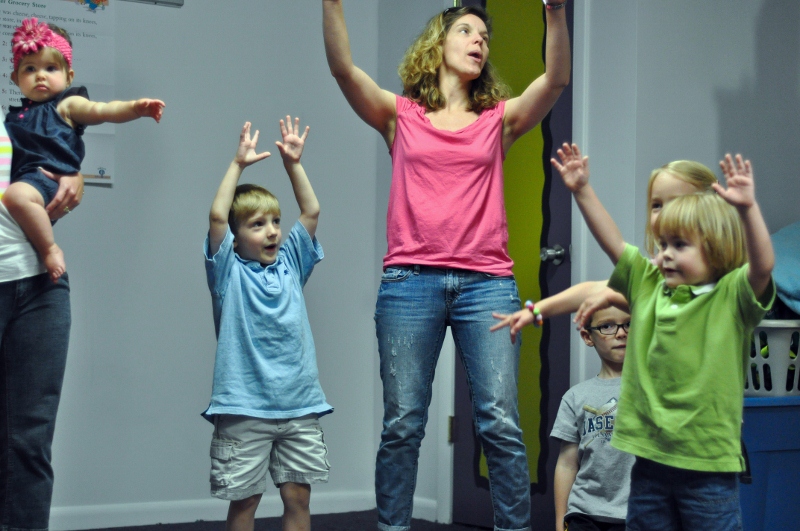
Turn on your favorite music and float like a cloud, sway like a tree, fly like a bird, or wiggle like a worm.  (This would be a great follow up to your Listening Walk, and it’s a fun thing for the whole family to enjoy!)
5.  Work on some spring cleaning together.
We think music makes everything better, and that includes spring cleaning.  Give your child a soft cloth or small duster and let them help.  Sing and dance the chores away!

And for more fun ways to celebrate Spring and all things new…


Putting the Arts in Science, Technology, Engineering & Mathematics

Music and Math share more in common than just the letter M. In an earlier post, we highlighted three of the ways music supports math learning—counting, spatial awareness, and pattern recognition. Learning the building blocks of math—such as size, measurement, pattern recognition, and counting by rote—start at birth–and the arts naturally engage young children in the learning.

From STEM to STEAM

In recent years, many teachers, schools, and entire districts began focusing on STEM (Science, Technology, Engineering, and Mathematics) classes to help prepare children for living and working in our increasingly technology-centered world. However, many educators see the need to add the “Arts” into the equation. (Of course, we absolutely agree!) STEAM integrates and uses the arts in the STEM curriculum to help children express—and understand—STEM concepts. Children naturally learn by using their whole bodies and all of their senses. Experiencing concepts such as size by pretending to move like an elephant, mouse, or giraffe makes a complicated concept three-dimensional. So, children can feel it, relate to it, and understand it!
The National Park for the Performing Arts, Wolf Trap, recently launched an Early Childhood STEM Learning Through the Arts initiative. Through teacher training and research, Wolf Trap is helping to strengthen the understanding of how the arts can (and should) be used in early childhood education to teach science, technology, engineering, and mathematics.
[youtube]https://www.youtube.com/watch?v=wFdiLWfbVSA[/youtube]

Using music to express STEM concepts

Music’s proven connections to math can support young children’s math development. For example, children hear, feel, and experience the patterns in music when swaying to a legato section or bouncing to a staccato section or when they dance and sing a song with a verse then a chorus then a verse then a chorus. Try these Kindermusik@Home activities for kids that use music to help them experience patterns.

For babies:

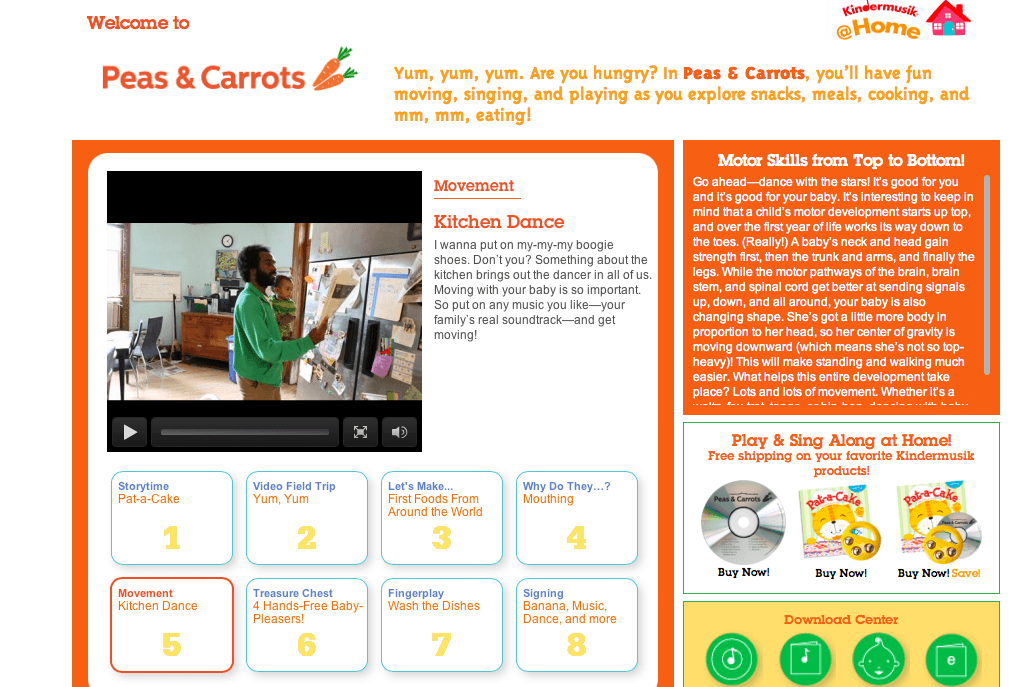
Peas & Carrots Kindermusik@HomeKitchen Dance: Something about the kitchen brings out the dancer in all of us. Moving with a baby is so important. So put on any music you like and get moving! Plus, dancing to music can help even babies hear, feel, and experience patterns.
 
 
For toddlers:
Kindermusik@Home Jelly in the BowlThe Jelly in the Bowl:

A kid-favorite, “Jelly in the Bowl” is easy to remember, easy to do, and hard to resist. After a few times, children will understand the pattern of the song and start giggling right before favorite parts.


For preschoolers:
Jumping beans Kindermusik@HomeQuarter Notes & Quarter Rests:  Get your listening ears on, because this game will introduce children to the sound of a quarter note and the “no-sound” of a quarter rest . . . then test children’s ears on how well they recognize them when they’re assembled in patterns!

ABCMMEINTL_LOGO_LiteracyLanguage_OneLineOur early childhood curriculum, ABC Music & Me, uses music and movement as a fun, engaging, and natural way for children to learn. Want to learn more about using music to support STEM learning (and early literacy and language!) in early childhood education? Email us info@abcmusicandme.com. 

Contributed by Lisa Camino Rowell, long-time supporter and believer in the power of the arts.

Music & Movement Benefits: Why We Rock, Bounce, Jump & Dance

taking risk risks

music and movementKindermusik is as much about movement as it is about music.  Ask any educator or parent – there’s no need to go to the gym on Kindermusik day!  That’s because we know that children learn best by doing – it’s called experiential learning.  And now a new study highlighted in Science Daily demonstrates just how powerful the doing-learning-remembering connection really is.  There really is such a thing as “motor memory!”
Multiple research studies prove what Kindermusik has capitalized on for a long time – movement is KEY to learning.  In fact, the movement we do in our Kindermusik classes is essential for the children in many ways.

The powerful, but happy, combination of movement and music develops:

  • The Vestibular System.

A well-developed vestibular system provides emotional security, good muscle tone, develops auditory language processing, and visual-spatial processing. All this while you’re having fun dancing!

  • Neural Pathways.

Moving in a variety of ways gives your child a chance to ‘see the world’ from many perspectives, thus strengthening neural pathways, which carry messages from your child’s mind, guiding her senses and motor skills.

  • Fine Motor Skills.

During the first part of life, we’re learning to walk, so gross motor activities dominate the child’s movement. Now she can focus on activities that encourage the development of fine muscles, so she can increase skills that require finger and hand movements such as putting together a simple puzzle, painting with a paintbrush, turning a page of a book or stringing beads.

  • Physical Confidence.

Body awareness is important in the development of the child’s physical confidence. This developmental goal may be met by engaging in movement activities which focus on body part movement, whole body movement in one place, and whole body movement while traveling in space.

  • Creativity and Imagination.

Listening and responding to music and movement activities helps develop pretend play skills while also helping your child assimilate music and movement concepts such as fast, slow, loud, quiet, bumpy, smooth, straight and curvy.

  • Thinking Skills.

While in motion, the brain acts like a flight simulator, constantly inventing, moving mental models to project onto a changing world. This is an extraordinary mentally complex operation which builds thinking skills.

Movement is truly the key to the kind of learning that sticks and to the kind of joyful interaction that leads to a lifelong love of music and a lifetime of benefiting from the rich foundation of an early childhood music and movement program like Kindermusik.

Try A Free Kindermusik Class
Come move, sing, dance, play, and learn with us!  Try a FREE Kindermusik class today and see how music will move you… and your child.

Quick Access to My.Kindermusik.com…Add an icon to your iPhone!

My.Kindermusik.com icon

Here’s a great tip for Kindermusik parents and educators. You can add the My.Kindermusik.com icon to your iPhone for easy access to Kindermusik@Home.
My.Kindermusik.com iconIn less than a minute, you can be 1 tap away from accessing wonderful educational activities, including music, eBooks, games, crafts, video field trips, parenting resources and more within Kindermusik@Home.
Don’t have a My.Kindermusik.com account yet?
Find a class near you and contact your local Kindermusik educator.

Step 1

Open browser (Safari). Login to My.Kindermusik.com and tap the “Share” icon.
Create iPhone Shortcut for My.Kindermusik.com

Step 2

Tap “Add to Home Screen.”
Add iPhone icon for My.Kindermusik.com

Step 3

Type the description for the icon (MyKinder…) and tap the “Add” button.
Shortcut Description for My.Kindermusik.com icon

Step 4

Icon is now added to your home screen for My.Kindermusik.com.
(Note: if your home screen is full, swipe finger to the left to get to next screen.)
My.Kindermusik.com shortcut icon
You can add a shortcut to the full-site, and/or the mobile site m.my.kindermusik.com (see the Kindermusik icon with a house).
Many smartphones and tablets have this functionality. The iPhone example can be a guide for other devices. Look for the “Share” feature when visiting a website to save the icon to your home screen as a shortcut.
And…enjoy Kindermusik@Home…anytime, anywhere!

Want to Learn More about the Benefits of Music for Children?

Kindermusik's Facebook Page

Like us on Facebook!

Stay current with the latest research on music and child development – and discover more ways to integrate musical learning into your daily lives.
 

10 Reasons Why You'll Love Kindermusik this Summer

Follow Me to KindermusikBased on what parents have shared with us over the years and all the hugs and smiles we’ve gotten from our Kindermusik kids, we could probably list 100 reasons why you’ll love Kindermusik this Summer, but here are our top 10.

10 reasons to take a Kindermusik music class for kids this summer!

  1. Fun summery themes
  2. give you plenty of ways to create special memories and capture the carefree, feel-good joys of summertime.

  3. Music, movement, stories, instruments, dancing, and creative play – your child will enjoy a stimulating class experience that fosters early learning, provides an outlet for energetic activity, and inspires a lifelong love for music.
  4. Kindermusik fits your child perfectly with age-appropriate activities that enhance every area of your child’s physical, cognitive, and musical development.
  5. Summer Kindermusik classes give your child the security of a comfortable, predictable routine.  You’ll both be delighted to have such a special activity to look forward to during the summer.
  6. It’s more than just a weekly class.  With Kindermusik, you also receive Home Materials that allow you to extend the class experience and the benefits of music into your every day family life.
  7. No other single activity you could choose this summer offers the integrated, creative, child-centered, musical experience that Kindermusik does.
  8. When the temperatures outside soar, Kindermusik is the ideal indoor activity, keeping little minds and bodies happily engaged – in class and at home.
  9. Summer time is the perfect time to try something new at Kindermusik – a Family Class, a new curriculum level, a new schedule – or just to try Kindermusik out for the first time.
  10. A child’s love of learning, interest in music, and need for quality time doesn’t have an off switch… and that’s why Kindermusik is there for you, even in the summer!
  11. Even though summer is a busy time for many families, your child still deserves the very best… and there’s no better choice than Kindermusik for helping your child blossom and grow.

Kindermusik, Summer, and you… SO happy together!

social
Never tried Kindermusik before?
Get started with a Free Preview class.  Ready for a summer with Kindermusik?  Contact your local Kindermusik educator.

Where are the future scientists? In a music class for kids!

Future scientist?
Future scientist?

At first glance, music classes for kids might not seem like the best place to look for future scientists, technology experts, engineers, or mathematicians. Well, look again! New research indicates that an early childhood music class is exactly where we should look.
Researchers from Michigan State University recently published a study that found that 93 percent of STEM graduates (college students who majored in Science, Technology, Engineering, or Mathematics) reported musical training as a child compared to only 34 percent of the average adult. STEM graduates also showed an increased involvement in the visual arts, acting, dance, and creative writing.

Benefits of music for children continue through adulthood

“The most interesting finding was the importance of sustained participation in those activities,” said Rex LaMore, director of MSU’s Center for Community and Economic Development, in a press release. “If you started as a young child and continued in your adult years, you’re more likely to be an inventor as measured by the number of patents generated, businesses formed or articles published. And that was something we were surprised to discover.”
According to the research team, participation in the arts, such as music classes for kids, encourages “out-of-the-box thinking.” The STEM graduates reported using those skills they learned in music or art classes—such as analogies, playing, and imagination—to solve complex scientific problems.

Music and learning in early childhood education

3_why_music_rectangle_yellowIn Kindermusik, we know children also use exploration and problem solving to learn what an object does and how it works. We call that process epistemic play. In our early childhood curriculum, we provide many opportunities for children to explore objects in order to better understand how they work. While trying out all the ways to tap, shake, or roll an instrument or stomp, tap, tiptoe our feet, children gain a foundational understanding of how things work. Plus, all this epistemic play supports a child’s overall cognitive development.

Learn more about using music in the early childhood classroom to support the cognitive development in children, including early math, science, literacy, and language skills.

To experience the benefits of music with your child, find a local Kindermusik educator in your area. 

It’s Math Awareness Month!

More reasons to celebrate the benefits of music

BenefitsOfMusicMath_Kindermusik_655x204
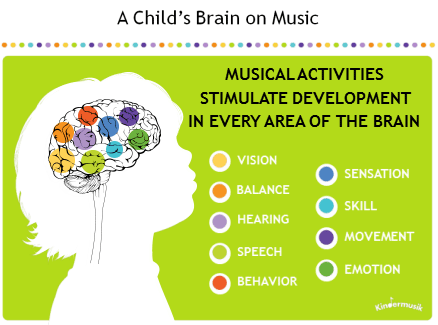
Last month, we celebrated Music in Our Schools Month. Truth be told, though, we celebrate the benefits of music every month (every day actually). After all musical activities stimulate development in every area of the brain! April brings us Math Awareness Month and—you guessed it—one more reason to celebrate the benefits of music!
Music and Math quoteThe known connections between music and math go way back. The 17th century German mathematician, Gottfried Leibniz, explained it this way: “Music is the sensation of counting without being aware you were counting.” Centuries later we understand more about the benefits of music on learning, including on the cognitive development in children.

A quick experiment about the benefits of music

Try this experiment: One, two buckle my shoe. Three, four shut the door. Five, six pick up sticks. Seven, eight lay them straight. Nine, ten begin again. You did it, didn’t you? Before you finished reading that nursery rhyme, you found yourself singing it, instead. It’s okay. You probably do that with the ABCs, too. It’s how many of us learned those building blocks of reading and math—through nursery rhymes, songs, and maybe a few dance moves!
The National Association for the Education of Young Children (NAEYC) recently published a report: The Patterns of Music: Young Children Learning Mathematics through Beat, Rhythm, and Melody. This report highlights some of the links between music and math and concludes by saying:

“With new understanding about the nature of everyday learning experiences, the key role of patterns in the development of literacy and mathematics, and the need for a stimulating environment in the very early years, the importance of music in the home and in the classroom is becoming clear. Music is children’s first patterning experience and helps engage them in mathematics even when they don’t recognize the activities as mathematics. Music is a highly social, natural, and developmentally appropriate way to engage even the youngest child in math learning.”

3 benefits of music on early math skills

1. Music helps young children learn to count by rote. Young children learn to count by rote—a memorizing process using routine and repetition. Learning to count by rote helps children develop number vocabulary, memory, patterning, and sequence—all foundational skills for math. Music gives children many opportunities to practice counting. For example, in our early childhood education curriculum, ABC Music & Me, when we “roll, roll, roll…1, 2, 3” an instrument, count to three and jump up during the circle dance, recite the numbers playing with balls, or count the beats in a nursery rhyme, children practice counting in a fun, engaging way, which reinforces the beginning stages of learning numbers.
Try this music and movement activity: 1, 2, 3, Count with Me! Tap into young children’s love of games by playing a game of “1, 2, 3, Count with Me!” Count together how many crayons to put away, how many steps it takes to get from the rug to a chair, or even how many people need a coat for outside.
2. Music and movement activities teach children about spatial awareness.
Kindermusik_EarlyChildhoodMusicClass_MiddleEastMusic supports young children’s spatial awareness development through movement, songs, poems, and props. So, for example, in our early childhood music education classes, when we explore the directions up and down during a fingerplay, dance forwards and backwards based on the cues heard in a song, or go on a swervy-curvy blanket ride, young children gain a greater understanding of spatial awareness. Exploring spatial awareness through whole body movement eventually helps children to safely navigate around a room, tell the difference between letters and group them together on a page to recognize words, and understand geometry! 
Try this music and movement activity: Do the Hokey-Pokey! Yes, that Hokey-Pokey from our own childhoods. Using the directional words throughout the day, makes personal connections and helps children gain a better understanding of the concept and boosts overall spatial awareness.
3. Music leads children to experience patterns through movement, listening, and playing instruments. Rhythm patterns are combinations of long and short sounds and silences. For example, in a Kindermusik preschool or toddler curriculum, educators may lead the class to “step, step, step, stop” or “ta, ta, ta, rest” with rhythm sticks. This helps children learn rhythm patterns (quarter note, quarter note, quarter note, rest), a basic musical concept. Plus, whole body involvement with patterning lays an early foundation for math.
Try this music and movement activity: Hold it steady. Repeating the steady beat heard in a musical piece helps children identify and repeat a simple pattern. While listening to music together, tap or clap a steady beat to the music.

The benefits of music set a child up for early math success and more

Benefits Of Music for ChildrenThe New York Post published an article, “The essay that got 1 student into all 8 Ivies,” about High School student, Kwasi Enin. Enin was accepted into all 8 Ivy League colleges, earned a 2250 on his SATs, and hopes to become a medical doctor. In the article, Enin said: “I directly developed my capacity to think creatively around problems due to the infinite possibilities of music.” His love of music sparked his “intellectual curiousity” and “helped him play a role in his community and learn leadership values.”
We know that those skills he learned playing the viola for nine years probably also contributed to his high SAT score and will continue to help him as he strives towards his goal of becoming a physician.
And the reasons to celebrate music continue…

Learn more about using music in the early childhood classroom to support the cognitive development in children, including early math, literacy, and language skills.

To experience the benefits of music with your child, find a local Kindermusik educator in your area. 

In Celebration of International Children’s Book Day

International Childrens Book DayInternational Children’s Book Day has been celebrated annually since 1967 as a way not only to inspire a love for books and reading, but also to draw attention to great books for children.  At Kindermusik, we celebrate – and foster! – a love of reading and wonderful books in class and at home with our exclusive Kindermusik Home Materials all throughout the year.
In honor of International Children’s book Day, here is a short list of books we love to read in the Kindermusik classroom… PLUS a few of favorite books found in the Reading Rainbow app:
Big Red Barn by Margaret Wise Brown
The Doorbell Rang by Pat Hutchins
Dancing Feet by Lindsey Craig
Zin! Zin! A Violin by Lloyd Moss
If You Give a Mouse a Cookie by Laura Joffe Numeroff
On Mother’s Lap by Ann Herbert Scott
Jamberry by Bruce Degen
From Head to Toe by Eric Carle
Clap Your Hands by Lorinda Bryan Cauley
And as a bonus, we also wanted to highlight a few of our favorite Kindermusik books now available on the Reading Rainbow app for free on iPad or Kindle Fire:

  • A Quieter Instrument
  • Flip-Flap, Sugar Snap!
  • Henry’s Parade
  • I Went to Visit a Farm One Day
  • Jenny Jenkins

We also invite you to learn more about the music-literacy connection by downloading our Music and Reading guide  and by trying a free Kindermusik class.  Most of all, we hope you’ll cuddle with your child and a good book and enjoy celebrating International Children’s Book Day together!

Why we celebrate Music in Our Schools and National Reading Month throughout the year

Today officially marks the last day to celebrate both Music in Our Schools month and National Reading Month. However, in Kindermusik classrooms (and homes!) around the world, we celebrate the benefits of music on early literacy skills every single day. After all, children actively involved in music classes experience the benefits of music throughout the year. It’s one of the many reasons we know that music belongs in our schools.

Earlier this month, we asked the Kindermusik Facebook community why music belongs in our schools and they responded with some of the immeasurable benefits of music:

Why Music belongs in our schools

New partnership with Reading Rainbow gives us more reasons to celebrate Music in Our Schools and National Reading Month

Of course, the benefits of music on early literacy skills offer measurable reasons why music belongs in our schools, too! So, we loved celebrating both Music in Our Schools Month and National Reading Month by officially announcing and kicking off a new partnership with Reading Rainbow. Here are some of the highlights from this month:

  1. Music Mountain Reading RainbowWe announced the partnership between Reading Rainbow and Kindermusik International that will build early literacy skills in children. This partnership brings Kindermusik’s more than 35 years of experience in early childhood curriculum development with the #1 children’s reading adventure app!
  2. We celebrated National Read Across America Day with LeVar Burton and Reading Rainbow at a live event at Thomas Edison Elementary School in Burbank, CA featuring a live reading by LeVar Burton of a beloved Kindermusik book, The Drum Circle, and Kindermusik activities led by Educator Kelsey Springsted with Jamie Sterling. (Be sure to read how music in schools impacted Kelsey Springsted in Music: A prescription for healing.)
  3. The Kindermusik “Music Mountain” island goes live on the Reading Rainbow mobile app for kids. The Music Mountain island features Kindermusik’s music-themed content, including children’s books, music, and video field trips alongside other newly produced content from Reading Rainbow. Free to try, the educational app is available on the iPad and Kindle Fire.
  4. Kindermusik provides a guest post, “Music Makes Kids Hungry for Learning (and Reading!), on the Reading Rainbow blog.
  5. LeVar Burton and Reading Rainbow posted, Reading and Music…Hitting All the Right Notes,” on the Minds on Music blog.

Did you miss these studies and presentation announcements that show even more benefits of music on early literacy skills?

ThePathToReading_PuzzleGraphic_KindermusikIn our early literacy curriculum, ABC Music & Me, we know that the benefits of music on early literacy include the development of active listening, vocabulary, print awareness, comprehension skills, auditory discrimination, and phonological awareness. We wanted to make sure that you did not miss these new research studies and presentations that we mentioned this month.

  1. New study shows that if children memorize eight nursery rhymes by the age of 4 years old, they are usually among the best readers by the time they are 8 years old. Read more.
  2. Talking and singing with babies promotes more that just bonding. It also supports vital brain development in young children. Read more.
  3. The independent 2013 research study on our early literacy curriculum and its’ positive effect on early literacy development was recently presented at the SITE (Society for Information Technology and Teacher Education) 2014 Event.
  4. Kindermusik will present at the Head Start’s 12th National Research Conference on Early Childhood – Collaboration and Coordination in July!

Keep reading our Minds on Music blog for all of the latest research and news on early childhood education. You can also follow us on Facebook, Twitter, Google+, and Pinterest!

Reading and Music…Hitting All the Right Notes

By LeVar Burton
LeVar Burton, Reading RainbowIn March, the Reading Rainbow APP launched its newest Island, MUSIC MOUNTAIN, in partnership with Kindermusik, the world’s largest provider of musical movement and learning classes for youngsters.  Why did we choose to work together?  It’s very simple.  Reading and Music go hand in hand as an integral part of early childhood education and enrichment. Research shows us that when kids engage in music, they gain the phonological processing, spoken language, and comprehension skills that are the foundations of reading.
However, there are other reasons I felt it was a great addition to Reading Rainbow’s mission of developing a passion for reading in our kids.  For those of us with more than one child, we immediately recognize that no two children are alike, even when they share parents and a home environment. Almost from birth they develop their own individuality. Some kids like sports, some like music, some like comics and others like science.  The combinations are endless.  Study after study shows us that when kids like the subject they read about, they read more.  Seems like a no brainer, but it’s an important tool that parents can use with kids who struggle or are reluctant readers.  When I was a kid, I loved comic books and would read them voraciously. My mother, an English teacher no less, had no problem with this.  She knew that developing a passion for reading comes from reading, no matter what it is.  And if I liked the subject or the format, I read.  Later in life I made the transition to more complex and varied styles of literature.
Many of our younger kids are obsessed with music. They love listening to it, singing along with their favorite movie soundtracks, or dancing to whatever is on the iPod.  Many take up playing instruments in elementary school. So if your child is excited about music, introduce them to books ABOUT music.  It can be sing-a-long books for the younger ones, or biographies about great musicians and composers for the older ones. In the Reading Rainbow APP, there are stories like “The Music in Derrick’s Heart,” a tale about a beloved uncle teaching his young nephew how to play the harmonica while really teaching him about family togetherness and the power music has to bring people together.  “The Drum Circle,” from Kindermusik, takes kids on an adventure through cultures that use different drums in varied ways that bring out their own uniqueness and cultural heritage. We even have a book called “Pythagoras and the Ratios” that uses adventure to demonstrate both math skills and music as the hero learns how to tune instruments to sound their best.
Kids who like to read become better readers.  Kids who like music can use that passion to improve their reading skills and help make that transition to a “reader for life” by exposing them to literature about something they love.
But you don’t have to take my word for it.
– – – – – – – – – – – – – – –
About LeVar Burton:
Best known for his Reading Rainbow stewardship as well as his other distinguished TV roles (most notably Kunta Kinte on Roots and Geordi La Forge on Star Trek: The Next Generation), LeVar Burton comes from a family of educators and is widely recognized for his lifelong advocacy of children’s literacy. He speaks passionately on the topics of early learning and technology and has been a keynote speaker at Apple’s Worldwide Developers Conference, South by Southwest (SXSW) Edu and received the Eliot-Pearson Award for Excellence in Children’s Media from Tufts University as well as The 2013 Children’s Media Award from Common Sense Media.
About Reading Rainbow: 
Respected by millions and one of the most watched children’s television series in PBS history, Reading Rainbow has been connecting families to the joy of reading for over 30 years. In 2011, famed actor/producer/educational advocate LeVar Burton and his business partner, Mark Wolfe, formed RRKidz. They hold the global rights to the Reading Rainbow brand through a partnership with series creator, WNED/Buffalo. RRKidz’s flagship product, the award-winning Reading Rainbow app, is a reading subscription service filled with a library of quality ebooks, kids videos, and educational games. New children’s books and reading activities are added every week encouraging children to “Go Anywhere, Be Anything.”

Free to try, the educational app is available on the iPad and Kindle Fire.

(Kindermusik thanks LeVar Burton for contributing this guest post on the Kindermusik Blog. We also thank LeVar and the Reading Rainbow Team for incorporating Kindermusik International into the Reading Rainbow mobile reading service and continuing to promote the benefits of music and literacy.)