

What You Need for Your Child When Your Child Needs It Most

Every stage, or “season,” of early childhood has its triumphs and its challenges.  At Kindermusik, we believe that music and movement should be a huge part of both the celebrations and the everyday moments of each stage of childhood.
That’s why Kindermusik classes are not just filled with happy music and delightful activities for kids, but are also full of practical tips and musical helps for parents.  And it all comes packaged in such a way as to also give you invaluable insights into the way your child will grow and develop into the special individual he/she is meant to be.
Village baby with new logo
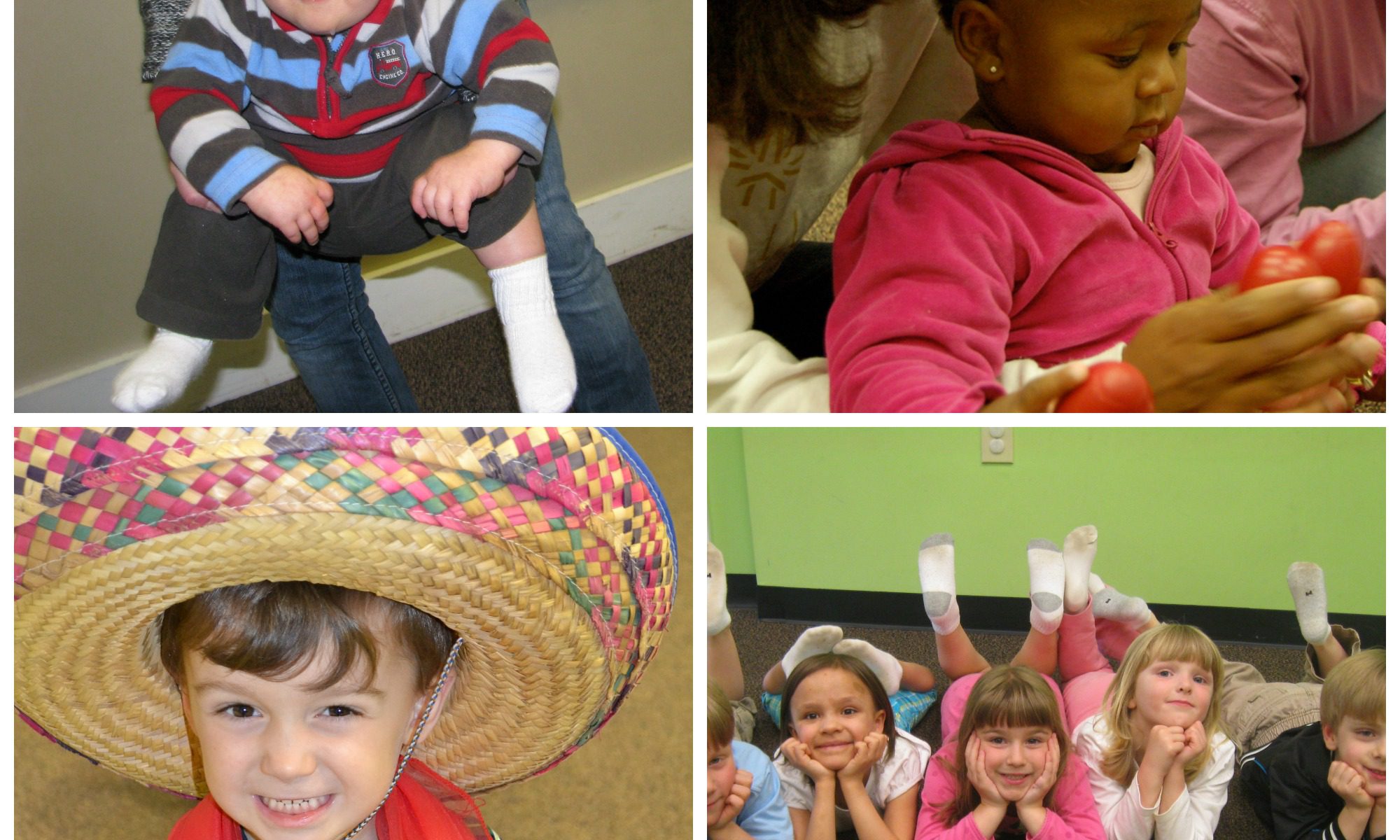
Babies need nurture.
The first years are all about connections and learning.  A lullaby will become a beautiful ritual before nap time.  A sweet little finger play makes bath time extra fun.  A quick dance around the kitchen provides a needed distraction around supper time.
In Kindermusik, we’ll teach you all of the songs, fingerplays, and dances you need, but we’ll also give you the time to settle in and savor these precious early years.  The window for learning is open the widest right now, and there’s nothing more powerful than music and movement.
Our Time girl with new logoToddlers need engagement.
Busy brains and busy little bodies need something to keep them active. And yet they thrive on predictability and routine.  Despite attempts to be fiercely independent, these busy little people still need you and they still need lots of cuddles.  And they do love their music!
We’ll help you add plenty of activity to your week – in class and at home.  And we’ll give you the music to dance to, the songs to sing, and the lullabies to hum, along with the insights you need to better understand this beautiful little person that is your child.
IT girl with new logoPreschoolers need adventure.
More than at any other stage, play is your preschool child’s work.  Play is how they’ll learn best.  The preschooler enjoys action and adventure, and he/she is eager for the kinds of rich experiences and interactions that will best help get him/her be ready for school, for music lessons, and for life.
Pretend play, big imaginations, socializing, and new musical concepts – all of these and more are how this stage of Kindermusik helps your child thrive and flourish.  Best of all, Kindermusik allows you to be part of the grand adventure of preparing for some very exciting transitions.
YC boy with new logoBig Kids need opportunity.
Your child seems so grown up all of the sudden, but he/she is not as grown up as you might think.  Now more than ever, your child needs to move, to explore, and to have fun even while being challenged with new ideas and ways to learn.  Your child is more than capable of learning the more specific musical concepts that will continue to foster a love for music and prepare him/her for that next step to formal music instruction.
As we capitalize on your child’s love of learning and making music with friends, we’ll also keep you involved through pressure-free music-making and simple activities at home.  You’ll learn right along with your child, and you’ll have the resources you need to make time for music and enjoy time with your child.
Try A Free Kindermusik Class
We’d love for you to come see for yourself how Kindermusik meets your child’s musical and developmental needs at every stage in early childhood, from newborn to age 7.  Try a free class today!
 

Shared by Kindermusik educator Theresa Case who has an award-winning Kindermusik program at Piano Central Studios in beautiful Upstate South Carolina

Professional development for teachers helps preschoolers, too

Kindermusik Music Teacher

Kindermusik Music TeacherMary Kay Ash, the founder of Mary Kay, wrote: “If you think you can, you can. And if you think you can’t, you’re right.” Undoubtedly, she knew more about building a cosmetics business than early childhood education, but she understood the power of believing in your abilities. Now, early childhood research shows that when teachers believe in their abilities it impacts more than just them. Teachers who believe in their abilities also help preschoolers more with language and literacy skills than those who are less confident.

Confident preschool teachers boost preschoolers’ early literacy skills

As published in the journal of Teaching and Teacher Education, a research study followed 67 teachers and 328 of their students for 30 weeks. During the study, preschool teachers rated their own self-efficacy or belief in their ability to succeed in certain situations, such as keeping students on task for difficult assignments. Teachers and students were also observed interacting together in the classroom. Researchers rated the quality of emotional support as low, mid, or high. The team also evaluated the language and literacy abilities of children at the beginning and end of the 30 weeks. The researchers found that teachers who believed in their abilities as an educator positively impacted their students’ early literacy and language abilities.

2 ways teacher confidence impacts students’ abilities

1. Children whose teachers had high self-efficacy showed greater gains in print awareness
2. Children increased vocabulary knowledge skills when they had a classroom that offered emotional support in addition to having a teacher with high self-efficacy
One surprising finding indicated that preschool teachers with more experience had less confidence in their own abilities. “Fresh teachers who are straight out of training think that they can change the world. Then, when they get into the work place they realize how serious and difficult their jobs really are. This is why we think self-efficacy may decline among some preschool teachers through the years,” explained Laura Justice, co-author of the study, in a press release.

Professional development for teachers increases job satisfaction and abilities

One key way to both increase self-efficacy and job satisfaction is professional development for teachers. According to the most recent MetLife Survey of the American Teacher, only 39 percent of teachers say they are very satisfied with their jobs. Budget cuts, teacher and school support staff layoffs, job insecurity, and increased class sizes, probably contribute to the drop in teacher satisfaction rates. The survey did identify, however, three areas that significantly increase teachers’ job satisfaction.

3 ways to increase job satisfaction among teachers

  1. Adequate opportunities for professional development
  2. Time to collaborate with other teachers
  3. Support from principal, other teachers, and parents to help engage and communicate with students’ parents effectively

Increase self-efficacy and job satisfaction of teachers AND literacy and language abilities of preschoolers KindermusikMovesMe-Logo-Hashtag-2331x869-2331x869

Training, collaboration, and connecting with parents are key components of Kindermusik. Our half-day trainings include a hands-on demonstration and provide early childhood educators with a clear understanding of the research behind the method and how it works on different skills and within different learning domains. However, we know the learning doesn’t stop after the training ends. Each unit includes an Activity Demonstration DVD that shows every activity being modeled in a real classroom setting.
Kindermusik even makes connecting with parents easier. Forget about creating and photocopying take-home sheets week after week. Each month every child receives take-home materials, including a Family Activity Guide and CD, which reinforce the classroom learning with reading, writing, and listening activities.

Learn more about bringing Kindermusik to your childcare center, preschool, or school! Email us at info@abcmusicandme.com.

4 Cool Music Facts

4 Cool Music FactsWhen young children are consistently engaged by music in an age-appropriate, socially accepting environment, they benefit at so many levels. Learning through music literally lights up every area of a child’s brain and teaches little ones to love learning. So, in our music education classes for babies, big kids, toddlers, preschoolers, and families when we recite a nursery rhyme, participate in a circle dance or movement activity, play a vocal game, and explore instruments, children develop skills in early literacy and language, spatial-temporal and reasoning skills, physical development, and creativity.
4 Cool Music Facts

1. Making music together connects brains.

Researchers in Germany conducted a study with trained guitarists in which they attached electrodes to their heads while they played a duet. During the study, they found that the brain waves coordinated between the two guitarists while they played the duet together. This also applies to choral groups, orchestras, small ensembles, and yes, even music education classes for kids.

2. Singing (and dancing) the Hokey Pokey helps children learn to read, walk around the room, and understand geometry.

When young children explore the directions up and down during a fingerplay or put their left hands in and take their left hands out, they gain a greater understanding of spatial awareness. Spatial awareness is the ability to be mindful of where you are in space and to see two or more objects in relation to each other and to yourself. This eventually helps young children to safely navigate around a room, tell the difference between letters and group them together on a page to recognize words, and understand geometry.

3. Music and movement experiences in a group teach children how to be a good friend.

Actively participating in a music class class for babies, toddlers, big kids or families, impacts all seven areas of social-emotional development, including confidence, curiosity, intentionality, self-control, relatedness, capacity to communicate, cooperativeness. All key skills needed to be a good friend.

4. Steady beat gives children the ability to walk effortlessly, speak expressively, and even regulate repeated motions such as riding a bicycle, brushing teeth, or dribbling a ball.

Through music, children experience and respond to steady beat during lap bounces, instrument play, and by dancing. While children move to the beat with their bodies instinctively, learning to control those movements, and to follow—or create—is an essential component of a child’s early development.


Need more? Join a Kindermusik class near you! We’ve been making music together with families all around the world for 40 years, and we’d love to sing, dance, and refine those critical skills with you. 


Contributed by Lisa Camino Rowell, a freelance writer and former Kindermusik parent, who loves seeing the long-term impact of Kindermusik classes on her children.

Celebrate Inventors Month with the benefits of music

Benefits of Play for Children

Happy Inventors Month! In 1998, the United Inventors Association of the USA (UIA-USA), the Academy of Applied Science, and Inventors’ Digest magazine started Inventor’s Month as a way to celebrate the various contributions of inventors. Inventors make our lives easier from electricity to indoor plumbing to modern medicine to peanut better.
The list of top inventors probably includes Thomas Edison, Benjamin Franklin, Albert Einstein, George Washington Carver, Marie Curie, every childBenefits of Play for Children. Wait. “Every child?” Yes! Children make great inventors. Think about it. An inventor is someone who creates some new process, appliance, machine, or thing. To a child, everything is a new process—from learning how to eat, roll over, stand, walk, talk, roll a ball, and more. Children also discover new uses for everyday objects. A laundry basket becomes a turtle shell, a stack of pillows turns into a mountain worth exploring,  a baby spoon makes a great instrument, and blocks become, well, just about anything!

3 ways to encourage children as inventors

  1. Participate in the arts. Research indicates that STEM graduates (those majoring in Science, Technology, Engineering, or Mathematics fields) showed an increased involvement in visual arts, acting, dance, and creative writing. Even better, 93 percent of those graduates participated in music classes as a child.
  2. Combine music and learning. Music is more than, well, music. The benefits of music include supporting the social-emotional, physical, and the cognitive development of children. New research found that science-themed music videos boost scientific learning. We already learn our ABCs through song, so why not learn about gravity, phases of the moon, the life cycles of frogs, and all about magnets, too?
  3. Play together. Children learn through play. Provide the children in your life with hands-on playtime with caring, loving adults. Playing together helps children learn about their world and their place in it.  One of the greatest inventors of all time, Albert Einstein, understood the benefits of play. After all, he said, “Play is the highest form of research.”

4 musical activities to celebrate Inventor’s Month

Kindermusik@HomeFor Babies: (From Cuddle & Bounce, “Bluebird, Bluebird”—Crinkly, Furry, Bumpy, Strange)
Touch, squeeze, feel, pat. Babies explore their worlds with their hands (and sometimes mouths). With an adult there to exercise diligent supervision, of course, there are plenty of ways to introduce new and interesting textures and sensations to a baby.
For Young Toddlers: (From Sing & Play “Family All Around Me”—Fill & Empty)
Fill it up, dump it out. Fill it up, dump it out. Sound familiar? Fill and empty is an enduring ‘play scheme’ among toddlers, and there are so many variations on the theme! Here are a few fresh ideas that will engage toddlers.
For Older Toddlers: (From Wiggle & Grow “Beach Days”—Let’s Make…A Beach in a Bottle! 
Kindermusik@HomeYou know that feeling, when you’ve spent a great day at the beach and you just wish you could bottle it and bring it home with you…?
For Preschoolers: (From Laugh & Learn “Outside My Window”—Be a Sound Inventor: Weather Sounds)
You won’t believe how easy it is to make these weather sound effects! This friendly tutorial teaches you how to imitate the sounds of light rain, heavy rain, thunder, and wind.

Do you want to bring the power of music to your child and family? Find a local Kindermusik educator today! 

Contributed by Lisa Camino Rowell, whose oldest daughter learned about the phases of the moon through song.  


Music and Movement Benefits: The Power of the Vestibular System

The vestibular system controls the sense of movement and balance.  From birth to about 15 months, the vestibular system is very active as the child gains a sense of gravity and knowledge of the physical environment through movement.  Rocking, swaying, and movement which rotates the head stimulates the vestibular system, stimulating the brain for new learning.”  – Smart Moves, by Carla Hannaford.

Activating learning through movement

The vestibular system is the “vestibule” or “entryway” for learning into the brain.  By stimulating the vestibular system, we are helping your child’s brain get ready to learn.  By intentionally stimulating the vestibular system during your baby’s early years, your child becomes even more aware of the physical environment through movement.  Research shows that vestibular stimulation is not only tied to “alertness” but also to a child’s language development.

A parent’s insights can give a child an academic advantage

Understanding how children learn in the early years and what activates that learning is vital to understanding how children will learn and progress through school later on, according to developmental psychologist Dr. Katherine Towney.  This is precisely the reason that Kindermusik educators are so fond of sharing the benefits and the reasons for what we do in class.  We believe that parents are children’s first and best teacher, and the more you know and understand about your child, the better learner you can help him/her become.

Why we move, rock, dance, and sway in a Kindermusik class

Here’s a brief of overview of just how we activate the vestibular system – and a child’s learning – in our Kindermusik classes:
Babies:  Using and labeling movements like twisting, swaying, turning, and rocking.
Toddlers:  Helping the children learn to move confidently and creatively on their own – with mom, dad, grandma, or nanny near by, of course.
Preschoolers:  Introducing a whole new vocabulary of movement and joyfully exploring all of those new words and ways to learn.
Big Kids:  Keeping the movement in our feet and whole bodies inspires the children as they are also learning to read, write, and compose music.

12 Fun Ways to Use Music to Inspire Learning in the Summer

[vc_row][vc_column][vc_column_text]We’re excited that we can let you in on the secret.  Your secret resource is music!  You could even think of music as your secret super power
Well, maybe that wasn’t such a surprise, but here are some ideas for utilizing music as your secret super power – your way to banish boredom and inspire learning.

12 Fun Ways to Use Music to Inspire Learning in the Summer

1. Read together. 
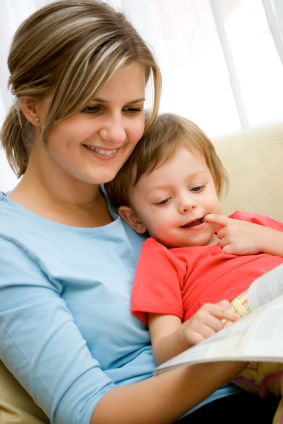
There’s a strong connection between the skills required for reading books and reading music, and you can enhance both reading literacy and music literacy by reading with your child.  It’s a great way to sneak in some calming snuggle time too!
2. Take a listening walk.
Listening is a huge part of music and music appreciation.  And there’s nothing like a listening walk to captivate your child’s imagination, hone their listening skills, and develop an appreciation for the world around us.  (By the way, we highly recommend the book for children by Paul Showers called The Listening Walk.)
3. Turn on some gentle music and blow bubbles.
Blowing bubbles is one of the cheapest forms of childhood entertainment, and you can even sneak in some music appreciation benefit by playing some classical music during the activity. We suggest selections by J.S. Bach or Mozart.  By the way, a bubble wand with more than one hole is the secret to a better bubble-blowing experience.
4. Color to music with sidewalk chalk.
Want a no-mess activity that also gets your child’s creative juices flowing?  Give your child some sidewalk chalk and offer the canvas of your driveway.  Add a variety of music for fresh inspiration and enjoy watching your little artist go to work.
5. Use painter’s tape to create roads and movement pathways.
Hum along as you drive small cars around tape-defined roads or dance and move around paths marked by painter’s tape. The fun will be in deciding where to put the tape down, and the learning comes as you sing and label with movement words.
6. Use a hula hoop as a prop for dancing.
Hula hoops are great for helping children develop spatial awareness and refine large motor skills.  The joy comes in exploring all the different ways to dance with, around, and through the hoop!
7. Make a homemade instrument… or two!
Here are ideas for a coffee can drum, tubular bells, cardboard guitar, simple shakers, homemade maracas, and castanets.
8. Start your own marching band. 
Grab your homemade instrument, turn on some marching music, and have a parade through the house… and back around again!
9. Make your own musical water classes.
What a great way to learn about what makes a high sound and what makes a low sound!  A delightful experiment in sound, logic, and listening skills.
10. Play a Musical Alphabet Chairs Game.
This is a fun educational twist on a classic childhood game that combines moving, listening to music, stopping on cue, and identifying letters of the alphabet.  Perfect for when it’s too hot or yucky to be outside!
11. Dance like nobody’s watching!
Put on some homemade ankle bells and dance, dance, dance!  This is a great activity for indoors or outdoors.  You can even help your child experiment with different kinds of music for all kinds of creative movement ideas.  (Tip for the ankle bells:  If you don’t crochet, simply cut of the top of an old pair of socks and sew the bells on them.)

Not only will you have the weekly class to look forward to, but you’ll have Home Materials to use and enjoy throughout the week, including lots of great music to listen, sing along, and dance around to!  Find a class nearby.[/vc_column_text][/vc_column][/vc_row]

From a cowboy community to the Kindermusik community

Music can both bring an existing community together and create a new community. Director, Musician, and Kindermusik Educator Amy Munsell understands the power of Amy Munsell 2music to make connections between people of all ages and all backgrounds.
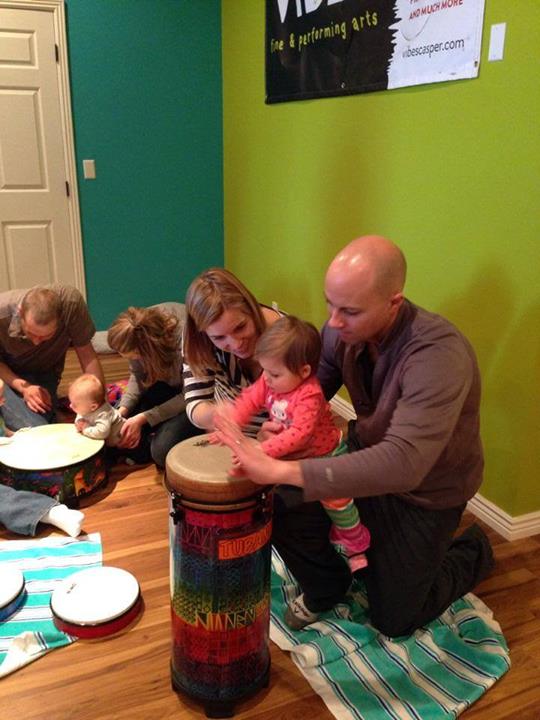
When she opened her studio in Casper, Wyoming, late last year, many people in her area questioned the need for music classes for babies, toddlers, preschoolers, and families. Now after growing from 20 families to over 200 (and still growing!), people no longer question it. Well, local pediatricians do. They contact her to find out what she teaches in Kindermusik class, because they can tell the developmental difference during well-child checkups!
“My studio, VIBES, is about putting good and positive vibes out into our community, allowing students to excel in music and the arts, and to expose students and families to new opportunities in the world,” explains Amy.
With a Bachelor of Arts in Music Education, a seasoned saxophone performer, and more than 10 years of music teaching experience, Amy researched various early childhood music programs before deciding to teach Kindermusik. “With my background, I looked for specific things in a curricula. I love how Kindermusik supports the educator as the guide and the parent a the most important teacher in a child’s life. Also, Kindermusik starts with newborns through 7, such as critical time in early childhood development,” Amy explains. “Plus, I immediately loved the sense of community Kindermusik portrays—from the training to the curriculum development to the classroom.”

Building community in the everyday moments with music

Amy Munsell 3Of course, music makes those big life occasions all the more memorable. What is a wedding without music to walk down the aisle or a graduation without a little “Pomp and Circumstance”? But, music also celebrates those everyday (and just as important!) moments.
“I was working so hard as a performer to share one big moment with an audience, but in teaching Kindermusik, I get to share so many little moments every day in the classroom,” confesses Amy. “And with babies and toddlers—especially—this is such an important time in their lives. Every moment is important.”
Each week in Kindermusik, Amy gets really silly in class.  “We have a little party every time,” explains Amy. “The parents, children, and I get to have so much fun through music and we secretly teach kids all at the same time. The magic of what I get to do and the moments that we share together is magical!” concludes Amy.

From the cowboy community to the Kindermusik community

Amy Munsell 3Casper, Wyoming, may be known as “cowboy country” but thanks to Amy Munsell—with the support of her husband, Lukas—it’s also now Kindermusik country. We know that the sense of community she and her Kindermusik families create is making a profound difference in the lives of children in Casper.

Are you interested in joining the Kindermusik community as a licensed Kindermusik educator or by enrolling your family in a class? Learn more!

Contributed by Lisa Camino Rowell, a freelance writer and believer in the power of Kindermusik to create community.

6 educational activities for kids to celebrate International Museum Day

Every child is an artist
(Source: Discoverymoments.com)

Every May 18th marks International Museum Day. As a community of early childhood educators and families, we know—as Pablo Picasso pointed out—“All children are artists. The problem is how to remain an artist once they grow up.” Introducing children to new experiences, such as various genres of music or art, can be one of the ways to help them hold onto their artistic and creative side…and reminding all of us grownups about our own creative side!
While in our Kindermusik classes for babies, toddlers, big kids, and families, we introduce children to a variety of musical styles from around the world, a trip to a local museum can show children the various contributions found in the art world. However, for those not able to travel to a museum, we put together 6 educational activities for kids that help celebrate International Museum Day at home or at school.

6 ways to celebrate International Museum Day with young children

  1. Visit the Musical Instrument Museum for a virtual listening tour.  Go on a listening tour of featured instruments found at the only museum dedicated to global instruments. From the Octobasse to the Cajun Accordion and metal clarinet to the differences between the Irish Bouzouki and the Greek Bouzouki, children (and adults) will enjoy discovering new musical instruments!
  2. Plan a virtual visit to one of the world’s most famous museums. Choose from The Louvre in Paris, The Frick Collection  in New York, or The British Museum in London. These museums house some of the most-loved and well-known masterpieces.
  3. Take a virtual self-guided tour of the Smithsonian National Museum of Natural History. Children find art in the smallest details, including a ladybug on a leaf, dewdrops, or a rainbow after a storm. This museum is dedicated to inspiring curiosity, discovery, and learning about the natural world.
  4. Create a museum in your home or classroom. Set aside one room or area in your house or early childhood classroom to display children’s creations. Invite family members and friends to come over for a tour.
  5. Create art!  Need inspiration? Here’s a collection of art projects and crafts for Kindermusik@Homeyoung children from Kindermusik@Home, using their hands as shapes, tools, and mementos.
  6. Read children’s picture books together and celebrate the art of illustration. Visit your local library or download the Reading Rainbow app, featuring hundreds of books and videos, including new music-themed content by Kindermusik.

Contributed by Lisa Camino Rowell, who plans to celebrate International Museum Day by creating handprint art with her two girls.
 

The Surprising Movement-Literacy Connection

taking risk risks

At Kindermusik, we’ve said it for years…

Movement and learning go hand in hand.

music and movementThat’s why we found it fascinating that a recent study done in Australian schools identified a direct correlation between young children who engaged in a movement program as they were also being taught to read.  The findings were astounding.  The combination of consistent movement and exercise while being taught to read resulted in the students becoming better learners.  Reading, writing, and fine motor skills improved, and the students were much more focused.  In fact the program was such a huge success that it was implemented in all K5 and 1st grades at Applecross Primary School.
If you want your child to be a better reader, you don’t have to be one of the lucky students who attends Applecross Primary School in Melville, Australia.  You can simply find your local Kindermusik educator and enroll in a Kindermusik class!

“Thinking and learning are anchored by movement.”*

Here are a few of the ways we move in Kindermusik that help our Kindermusik kids be ready – ready for school, ready to read, ready for music lessons, and ready to succeed in life!

  • Expressive movement:  Whether it’s dancing in Daddy’s arms as a baby or learning the steps of a minuet as a big kid, dancing is an important part of self-expression and developing creativity.
  • Synchronized movement:  Bouncing, clapping, stomping, or playing an instrument to a steady beat – first with and then later without Mom’s help.
  • Fingerplays, songs, and chants:  Moving little fingers, hands, and arms is a big part of how we learn through labeling and how fine motor skills – essential for holding a pencil, cutting with scissors, and playing the first notes on a piano – begin to develop.
  • Group dances and circle songs: Simple choreography or moving together as a group provides vital social interactions that also facilitate a sense of community and belonging.
  • Spatial exploration: Exploring the “where” and “how” of movement as it relates to one’s sense of self and relationship to personal and general space is a how the all-important skill of spatial awareness is developed.
* Dr. Carla Hannaford, Smart Moves: Why Learning Is Not All in Your Head


Let’s call the whole thing early language development!

Are you familiar with the old George and Ira Gershwin song, “Let’s Call the Whole Thing Off”? They wrote it for the 1937 film Shall We Dance, starring Fred Astaire and Ginger Rogers. Sing with us:

You like potato and I like potahto

You like tomato and I like tomahto

Potato, potahto, Tomato, tomahto.

Let’s call the whole thing off.”

 [youtube]https://www.youtube.com/watch?v=zZ3fjQa5Hls[/youtube]
In the song, the two characters sing about their differences, primarily around the way they pronounce certain words. We love that song (and movie clip) even more after reading a new early language development study from the University of Toronto.

Toddlers and early language development

In the early language development study, researchers set out to investigate if and how children in the early stages of learning their first language come to understand words spoken in different regional variants of their native language. (You like potato and I like potahto!”) For example, English spoken in England sounds different from English spoken in Australia or the United States, not to mention the multiple dialects found within regions of countries.
The team found that toddlers are remarkably good at comprehending speakers who talk with regional accents, even if the accent is new to the children. Although initially in the study, children as young as 15 months old could not comprehend unfamiliar accents, they quickly learned to understand after hearing the speaker for a short time.
“Fifteen-month-olds typically say relatively few words, yet they can learn to understand someone with a completely unfamiliar accent,” explained Elizabeth K. Johnson, associate professor with the University of Toronto’s Psychology department in a press release.  “This shows that infants’ language comprehension abilities are surprisingly sophisticated.”

ELL students and early language development

While the University of Toronto study focused on a toddler’s first language, it highlighted the incredible language-learning abilities of very young children. Children under the age of 8 who learn a second language are more likely to speak like a native speaker and also show marked improvements in their first language. Our ESL curriculum, ABC English & Me, uses English songs for kids in an immersion environment filled with music and movement.  In addition to the ESL curriculum in the classroom, ABC English & Me includes materials for families to use together at home to support a parent’s role as a child’s first teacher and further develop English language skills. Try this ESL activity for kids:

Find & Count: Where’s the Frog? 

Kindermusik@HomeYoung children love to search for hidden or missing items. Following the English language directions in the video, and then finding (and saying hello to!) the frogs, fish, and ducks, provides young ELL students much-needed feelings of mastery and success in English.

Learn more about bringing ABC English & Me and the power of music to your school!


Contributed by Lisa Camino Rowell who prefers tomatoes but will eat a tomahto or two on occasion.