

Music & Movement Benefits: Reading with Babies

mom reading to her baby“You may have tangible wealth untold: caskets of jewels and coffers of gold.  Richer than I you can never be… I had a mother read to me.”  – Strickland Gillilan, The Reading Mother
Reading aloud to a child is the most powerful way to prepare her for success in reading.  .  In her book, Reading Magic, author Mem Fox explains that “…the more language a child experiences through books and conversation with others, the more advantaged socially, educationally, and in every way that child will be for the rest of his or her life.”  That’s some pretty powerful motivation for reading aloud – plus you get the cuddles and the memories too!

Tips for reading with babies

Begin introducing books at about 4 months of age.
This is about the age when babies become interested in objects – like books!  At first vinyl and cloth books will be best since babies learn by putting things in their mouths.  Your little one will be ready for board books at about 6 months of age.
Have realistic expectations. 
Even a few minutes in your lap engaged with a book should be considered a success!  Don’t worry… As your child grows, so does their attention span.  And when it comes to early reading experiences, it’s okay to let your child take the lead.  At this age, it still counts as “reading” if they are opening/closing the book, stacking books, or even just looking at a few of the pictures on a page.
Establish a routine.
By around 1 year of age, you can establish a regular reading routine – after breakfast, before nap time, after bath time – whatever is best for your child.  By now, your child may even have a favorite book that they like to read over, and over, and over…. and over again.  That’s okay – repetition strengthens the brain!
Music Makes My Day - Reading with Baby
BONUS!  For more great ideas for reading with your baby, check out this free activity from Kindermusik @Home: “Reading” with Baby
Musical Parenting in the Four Seasons of Early Childhood

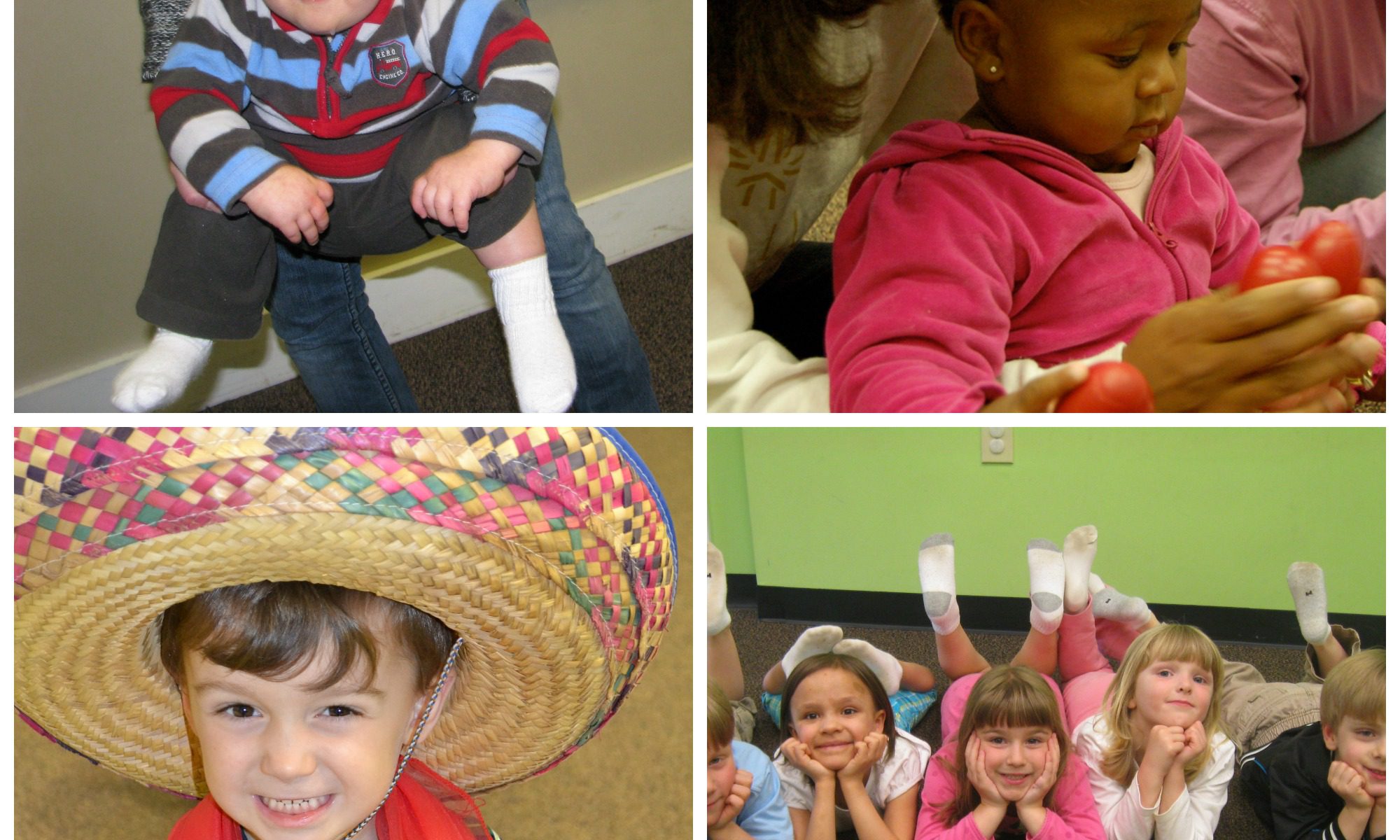
baby - toddler- preschooler - big kidWe’ve all heard that there are seasons of life, but it can be particularly insightful for parents of young children to think of the seasons (or stages) of early childhood, each with its own unique joys and challenges – joys and challenges that also have the potential to give way to some of the greatest rewards of parenting.  Kindermusik classes not only meet the needs of children at the various stages of development, but Kindermusik also meets the needs of parents at these different seasons.

Babies… When change is the only constant

There is so much that happens that first year or two – so many “firsts” to treasure, memories to capture, and sweet cuddly baby-sized little people to hold on to, for forever if you could!  Your weekly Kindermusik class gives you the time (and the excuse!) to slow down, hum a lullaby, cuddle a little longer, and share a few more smiles.  All along the way, you’ll gain precious developmental insights into the wonderful little person your baby is quickly growing to be!

Toddlers… When it’s life in the fast lane!

From when they wake up until they fall fast asleep, it’s all about go-go-GO! in the world of a toddler. (Just ask their exhausted parents!!)  There’s a lot of cuteness, curiosity, and personality emerging – some of it you laugh at, some of it you scratch your head about.  Kindermusik gives you and your child the perfect opportunity to laugh together, play together, engage and connect in new ways, socialize, and even sneak in a few extra hugs.  Plus we’ll teach you a song to get you through nearly every routine in your day!

Preschoolers… When it’s time to get ready

Preschoolers are on the verge of becoming more independent, bigger thinkers, social butterflies, and more curious learners.  But don’t let those big changes fool you.  Your preschooler still needs you to spend time with him and be a part of his world.  Kindermusik can be the highlight of the week – the one thing that is predictable, familiar, and yet challenging all at the same time.  Time by himself with his friends in class and time with you too – even the structure of the class supports your child at this crucial time.  We’ll help you hang on to those fleeting childhood years just a little bit longer!

Big Kids… When they’re poised for new adventure

Your big kid is so much more capable and independent, and they are eager for new challenges that still keep the fun, pressure-free adventure in the learning process.  Kindermusik comes alongside you and your child at this special time, giving you a special weekly activity that is a choice, not a requirement.  Kindermusik is all about partnering with you to unfold the unique miracle that is your child, without pressure, performance, or state standards – all while inspiring a love for music that will stay with her the rest of her life.

Parents… How to Stop, Pause, and Celebrate each Season

In a world where the pressure on parents can be immense, we here at Kindermusik invite you to let us help you stop, pause, and celebrate each season of childhood – from baby to toddler to preschooler to big kid – by taking time together in a Kindermusik class.  We’ll be right there beside you cheering you on and encouraging you to relish the little moments of life that make such a big difference in your child’s life.
Come See Kindermusik
See for yourself the difference that time together in Kindermusik can make.  Schedule your free preview class today!

Shared by Theresa Case who has an award-winning Kindermusik program at Piano Central Studios in beautiful Upstate South Carolina.


Celebrate Inventors Month with the benefits of music

Benefits of Play for Children

Happy Inventors Month! In 1998, the United Inventors Association of the USA (UIA-USA), the Academy of Applied Science, and Inventors’ Digest magazine started Inventor’s Month as a way to celebrate the various contributions of inventors. Inventors make our lives easier from electricity to indoor plumbing to modern medicine to peanut better.
The list of top inventors probably includes Thomas Edison, Benjamin Franklin, Albert Einstein, George Washington Carver, Marie Curie, every childBenefits of Play for Children. Wait. “Every child?” Yes! Children make great inventors. Think about it. An inventor is someone who creates some new process, appliance, machine, or thing. To a child, everything is a new process—from learning how to eat, roll over, stand, walk, talk, roll a ball, and more. Children also discover new uses for everyday objects. A laundry basket becomes a turtle shell, a stack of pillows turns into a mountain worth exploring,  a baby spoon makes a great instrument, and blocks become, well, just about anything!

3 ways to encourage children as inventors

  1. Participate in the arts. Research indicates that STEM graduates (those majoring in Science, Technology, Engineering, or Mathematics fields) showed an increased involvement in visual arts, acting, dance, and creative writing. Even better, 93 percent of those graduates participated in music classes as a child.
  2. Combine music and learning. Music is more than, well, music. The benefits of music include supporting the social-emotional, physical, and the cognitive development of children. New research found that science-themed music videos boost scientific learning. We already learn our ABCs through song, so why not learn about gravity, phases of the moon, the life cycles of frogs, and all about magnets, too?
  3. Play together. Children learn through play. Provide the children in your life with hands-on playtime with caring, loving adults. Playing together helps children learn about their world and their place in it.  One of the greatest inventors of all time, Albert Einstein, understood the benefits of play. After all, he said, “Play is the highest form of research.”

4 musical activities to celebrate Inventor’s Month

Kindermusik@HomeFor Babies: (From Cuddle & Bounce, “Bluebird, Bluebird”—Crinkly, Furry, Bumpy, Strange)
Touch, squeeze, feel, pat. Babies explore their worlds with their hands (and sometimes mouths). With an adult there to exercise diligent supervision, of course, there are plenty of ways to introduce new and interesting textures and sensations to a baby.
For Young Toddlers: (From Sing & Play “Family All Around Me”—Fill & Empty)
Fill it up, dump it out. Fill it up, dump it out. Sound familiar? Fill and empty is an enduring ‘play scheme’ among toddlers, and there are so many variations on the theme! Here are a few fresh ideas that will engage toddlers.
For Older Toddlers: (From Wiggle & Grow “Beach Days”—Let’s Make…A Beach in a Bottle! 
Kindermusik@HomeYou know that feeling, when you’ve spent a great day at the beach and you just wish you could bottle it and bring it home with you…?
For Preschoolers: (From Laugh & Learn “Outside My Window”—Be a Sound Inventor: Weather Sounds)
You won’t believe how easy it is to make these weather sound effects! This friendly tutorial teaches you how to imitate the sounds of light rain, heavy rain, thunder, and wind.

Do you want to bring the power of music to your child and family? Find a local Kindermusik educator today! 

Contributed by Lisa Camino Rowell, whose oldest daughter learned about the phases of the moon through song.  


12 Fun Ways to Use Music to Inspire Learning in the Summer

[vc_row][vc_column][vc_column_text]We’re excited that we can let you in on the secret.  Your secret resource is music!  You could even think of music as your secret super power
Well, maybe that wasn’t such a surprise, but here are some ideas for utilizing music as your secret super power – your way to banish boredom and inspire learning.

12 Fun Ways to Use Music to Inspire Learning in the Summer

1. Read together. 
There’s a strong connection between the skills required for reading books and reading music, and you can enhance both reading literacy and music literacy by reading with your child.  It’s a great way to sneak in some calming snuggle time too!
2. Take a listening walk.
Listening is a huge part of music and music appreciation.  And there’s nothing like a listening walk to captivate your child’s imagination, hone their listening skills, and develop an appreciation for the world around us.  (By the way, we highly recommend the book for children by Paul Showers called The Listening Walk.)
3. Turn on some gentle music and blow bubbles.
Blowing bubbles is one of the cheapest forms of childhood entertainment, and you can even sneak in some music appreciation benefit by playing some classical music during the activity. We suggest selections by J.S. Bach or Mozart.  By the way, a bubble wand with more than one hole is the secret to a better bubble-blowing experience.
4. Color to music with sidewalk chalk.
Want a no-mess activity that also gets your child’s creative juices flowing?  Give your child some sidewalk chalk and offer the canvas of your driveway.  Add a variety of music for fresh inspiration and enjoy watching your little artist go to work.
5. Use painter’s tape to create roads and movement pathways.
Hum along as you drive small cars around tape-defined roads or dance and move around paths marked by painter’s tape. The fun will be in deciding where to put the tape down, and the learning comes as you sing and label with movement words.
6. Use a hula hoop as a prop for dancing.
Hula hoops are great for helping children develop spatial awareness and refine large motor skills.  The joy comes in exploring all the different ways to dance with, around, and through the hoop!
7. Make a homemade instrument… or two!
Here are ideas for a coffee can drum, tubular bells, cardboard guitar, simple shakers, homemade maracas, and castanets.
8. Start your own marching band. 
Grab your homemade instrument, turn on some marching music, and have a parade through the house… and back around again!
9. Make your own musical water classes.
What a great way to learn about what makes a high sound and what makes a low sound!  A delightful experiment in sound, logic, and listening skills.
10. Play a Musical Alphabet Chairs Game.
This is a fun educational twist on a classic childhood game that combines moving, listening to music, stopping on cue, and identifying letters of the alphabet.  Perfect for when it’s too hot or yucky to be outside!
11. Dance like nobody’s watching!
Put on some homemade ankle bells and dance, dance, dance!  This is a great activity for indoors or outdoors.  You can even help your child experiment with different kinds of music for all kinds of creative movement ideas.  (Tip for the ankle bells:  If you don’t crochet, simply cut of the top of an old pair of socks and sew the bells on them.)

Not only will you have the weekly class to look forward to, but you’ll have Home Materials to use and enjoy throughout the week, including lots of great music to listen, sing along, and dance around to!  Find a class nearby.[/vc_column_text][/vc_column][/vc_row]

6 educational activities for kids to celebrate International Museum Day

Every child is an artist
(Source: Discoverymoments.com)

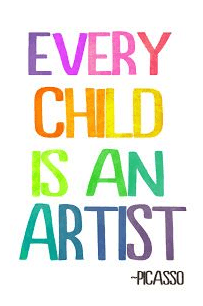
Every May 18th marks International Museum Day. As a community of early childhood educators and families, we know—as Pablo Picasso pointed out—“All children are artists. The problem is how to remain an artist once they grow up.” Introducing children to new experiences, such as various genres of music or art, can be one of the ways to help them hold onto their artistic and creative side…and reminding all of us grownups about our own creative side!
While in our Kindermusik classes for babies, toddlers, big kids, and families, we introduce children to a variety of musical styles from around the world, a trip to a local museum can show children the various contributions found in the art world. However, for those not able to travel to a museum, we put together 6 educational activities for kids that help celebrate International Museum Day at home or at school.

6 ways to celebrate International Museum Day with young children

  1. Visit the Musical Instrument Museum for a virtual listening tour.  Go on a listening tour of featured instruments found at the only museum dedicated to global instruments. From the Octobasse to the Cajun Accordion and metal clarinet to the differences between the Irish Bouzouki and the Greek Bouzouki, children (and adults) will enjoy discovering new musical instruments!
  2. Plan a virtual visit to one of the world’s most famous museums. Choose from The Louvre in Paris, The Frick Collection  in New York, or The British Museum in London. These museums house some of the most-loved and well-known masterpieces.
  3. Take a virtual self-guided tour of the Smithsonian National Museum of Natural History. Children find art in the smallest details, including a ladybug on a leaf, dewdrops, or a rainbow after a storm. This museum is dedicated to inspiring curiosity, discovery, and learning about the natural world.
  4. Create a museum in your home or classroom. Set aside one room or area in your house or early childhood classroom to display children’s creations. Invite family members and friends to come over for a tour.
  5. Create art!  Need inspiration? Here’s a collection of art projects and crafts for Kindermusik@Homeyoung children from Kindermusik@Home, using their hands as shapes, tools, and mementos.

  6. Read children’s picture books together and celebrate the art of illustration. Visit your local library or download the Reading Rainbow app, featuring hundreds of books and videos, including new music-themed content by Kindermusik.

Contributed by Lisa Camino Rowell, who plans to celebrate International Museum Day by creating handprint art with her two girls.
 

The Family Taxi: A Great Place for Music!

small toddler in carBusy mom and music educator, Lisa Huisman Koops, has found the perfect solution for finding the time in her family’s very busy schedule to develop her child’s awareness and interest in music… the family car. And then she did a study to prove her theory that the family car, or family “taxi,” was indeed an excellent music space for fostering musical development and family togetherness. After all, the family car is one place where families are regularly together a lot!
Here’s what Koops discovered about utilizing the family car for enhancing music appreciation and development:

  • “It is distraction-free from home activities, such as cooking, cleaning and phone calls.
  • Minimal eye contact by parents gave the children a sense of freedom to experiment.
  • Confined space in the car helped parents focus on their children, play games and reflect about what music the child listened to or composed on his or her own.
  • The divided front and back seats provided a close space where siblings could interact with each other through music making.
  • Families also found siblings interacted in singing and playing musical games together.”

Read this recap of the study from Case Western music educator, Lisa Huisman Koops:

Family “taxi” may be the ideal place to develop child’s interest in music

the musical family carAt Kindermusik, we’re all about helping to make great parenting just a little bit easier… and a whole lot more musical.  So we’ve put together some helpful resources and ideas that help you put the music, love, and happy times in your own family taxi.
As our gift to you, we want you to have this free download which includes ten easy ways to make your “Family Taxi” a more musical place that inspires learning and creates lifelong memories. Don’t feel you have to try them all at once, by the way! Even one or two at a time will go a long way towards creating a happy, musical, learning environment while you’re on the go.

Free Download:  Make your “Family Taxi” a more musical place

BONUS!  Includes a Road Trip Playlist and 5 Free Song Downloads from Kindermusik.
10 Ways to Be Musical in the Family Car - Kindermusik
Try A Free Kindermusik Class
Kindermusik International is also happy to extend an invitation for you to try a free Kindermusik class since Kindermusik is the ideal place for being inspired with music and child development tips that help you put a song in your child’s heart… and in the family car!

5 Ways to Celebrate Spring with Music and Movement

5 Ways to Celebrate Spring with Music and Movement

At Kindermusik, we’re all about great ideas and helpful tips that make parenting just a little bit easier and a whole lot more musical.  And now that Spring is just around the corner, we thought we’d share some music and movement ideas for celebrating spring… and creating some very happy memories!

5 Ways to Celebrate Spring with Music and Movement

Cute child in puddle1. Go for a listening walk.
There are all kinds of sounds to be discovered outside, especially in the Spring time.  Listen for, imitate, and then talk about the sounds that are all around.
2.  Take advantage of springtime showers.
Those brief, light spring showers do more than bring May flowers… they also leave perfectly sized puddles that are great for jumping, stomping, splashing, and giggling!
3.  Blow bubbles on the porch.
There’s nothing more delightful than bubbles.  But bubbles aren’t just for fun, they also help little eyes learn to track and follow moving objects and little eyes and hands to improve eye-hand coordination.
4.  Do a happy dance in the house.
Turn on your favorite music and float like a cloud, sway like a tree, fly like a bird, or wiggle like a worm.  (This would be a great follow up to your Listening Walk, and it’s a fun thing for the whole family to enjoy!)
5.  Work on some spring cleaning together.
We think music makes everything better, and that includes spring cleaning.  Give your child a soft cloth or small duster and let them help.  Sing and dance the chores away!

And for more fun ways to celebrate Spring and all things new…


Putting the Arts in Science, Technology, Engineering & Mathematics

Music and Math share more in common than just the letter M. In an earlier post, we highlighted three of the ways music supports math learning—counting, spatial awareness, and pattern recognition. Learning the building blocks of math—such as size, measurement, pattern recognition, and counting by rote—start at birth–and the arts naturally engage young children in the learning.

From STEM to STEAM

In recent years, many teachers, schools, and entire districts began focusing on STEM (Science, Technology, Engineering, and Mathematics) classes to help prepare children for living and working in our increasingly technology-centered world. However, many educators see the need to add the “Arts” into the equation. (Of course, we absolutely agree!) STEAM integrates and uses the arts in the STEM curriculum to help children express—and understand—STEM concepts. Children naturally learn by using their whole bodies and all of their senses. Experiencing concepts such as size by pretending to move like an elephant, mouse, or giraffe makes a complicated concept three-dimensional. So, children can feel it, relate to it, and understand it!
The National Park for the Performing Arts, Wolf Trap, recently launched an Early Childhood STEM Learning Through the Arts initiative. Through teacher training and research, Wolf Trap is helping to strengthen the understanding of how the arts can (and should) be used in early childhood education to teach science, technology, engineering, and mathematics.
[youtube]https://www.youtube.com/watch?v=wFdiLWfbVSA[/youtube]

Using music to express STEM concepts

Music’s proven connections to math can support young children’s math development. For example, children hear, feel, and experience the patterns in music when swaying to a legato section or bouncing to a staccato section or when they dance and sing a song with a verse then a chorus then a verse then a chorus. Try these Kindermusik@Home activities for kids that use music to help them experience patterns.

For babies:

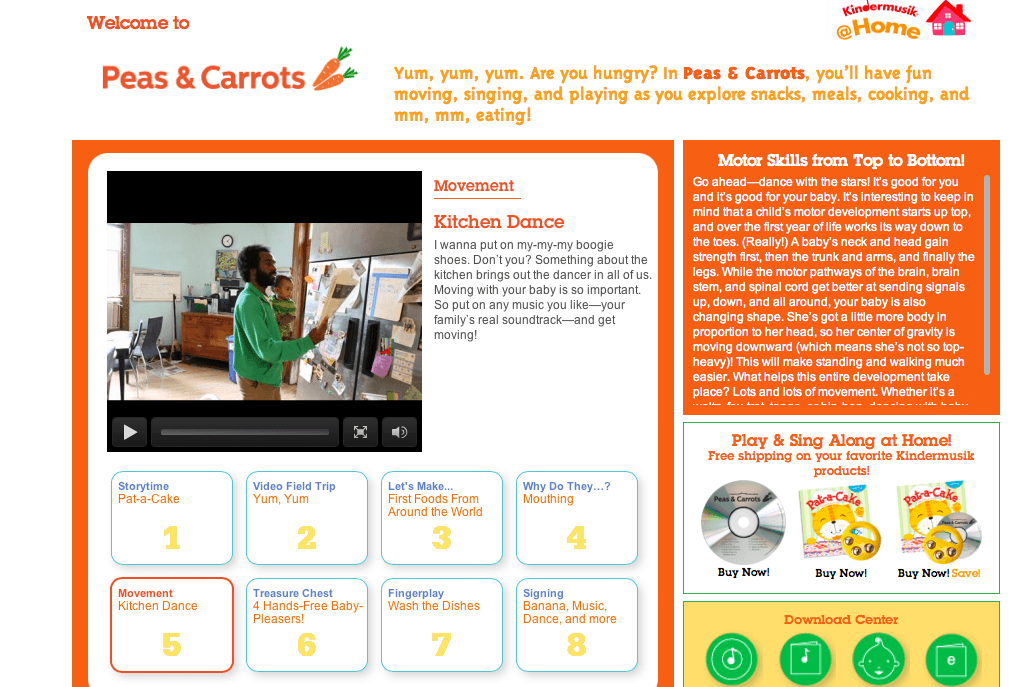
Peas & Carrots Kindermusik@HomeKitchen Dance: Something about the kitchen brings out the dancer in all of us. Moving with a baby is so important. So put on any music you like and get moving! Plus, dancing to music can help even babies hear, feel, and experience patterns.
 
 
For toddlers:
Kindermusik@Home Jelly in the BowlThe Jelly in the Bowl:

A kid-favorite, “Jelly in the Bowl” is easy to remember, easy to do, and hard to resist. After a few times, children will understand the pattern of the song and start giggling right before favorite parts.


For preschoolers:
Jumping beans Kindermusik@HomeQuarter Notes & Quarter Rests:  Get your listening ears on, because this game will introduce children to the sound of a quarter note and the “no-sound” of a quarter rest . . . then test children’s ears on how well they recognize them when they’re assembled in patterns!

ABCMMEINTL_LOGO_LiteracyLanguage_OneLineOur early childhood curriculum, ABC Music & Me, uses music and movement as a fun, engaging, and natural way for children to learn. Want to learn more about using music to support STEM learning (and early literacy and language!) in early childhood education? Email us info@abcmusicandme.com. 

Contributed by Lisa Camino Rowell, long-time supporter and believer in the power of the arts.

Quick Access to My.Kindermusik.com…Add an icon to your iPhone!

My.Kindermusik.com icon

Here’s a great tip for Kindermusik parents and educators. You can add the My.Kindermusik.com icon to your iPhone for easy access to Kindermusik@Home.
My.Kindermusik.com iconIn less than a minute, you can be 1 tap away from accessing wonderful educational activities, including music, eBooks, games, crafts, video field trips, parenting resources and more within Kindermusik@Home.
Don’t have a My.Kindermusik.com account yet?
Find a class near you and contact your local Kindermusik educator.

Step 1

Open browser (Safari). Login to My.Kindermusik.com and tap the “Share” icon.
Create iPhone Shortcut for My.Kindermusik.com

Step 2

Tap “Add to Home Screen.”
Add iPhone icon for My.Kindermusik.com

Step 3

Type the description for the icon (MyKinder…) and tap the “Add” button.
Shortcut Description for My.Kindermusik.com icon

Step 4

Icon is now added to your home screen for My.Kindermusik.com.
(Note: if your home screen is full, swipe finger to the left to get to next screen.)
My.Kindermusik.com shortcut icon
You can add a shortcut to the full-site, and/or the mobile site m.my.kindermusik.com (see the Kindermusik icon with a house).
Many smartphones and tablets have this functionality. The iPhone example can be a guide for other devices. Look for the “Share” feature when visiting a website to save the icon to your home screen as a shortcut.
And…enjoy Kindermusik@Home…anytime, anywhere!

Want to Learn More about the Benefits of Music for Children?

Kindermusik's Facebook Page

Like us on Facebook!

Stay current with the latest research on music and child development – and discover more ways to integrate musical learning into your daily lives.
 

10 Reasons Why You'll Love Kindermusik this Summer

Follow Me to KindermusikBased on what parents have shared with us over the years and all the hugs and smiles we’ve gotten from our Kindermusik kids, we could probably list 100 reasons why you’ll love Kindermusik this Summer, but here are our top 10.

10 reasons to take a Kindermusik music class for kids this summer!

  1. Fun summery themes
  2. give you plenty of ways to create special memories and capture the carefree, feel-good joys of summertime.

  3. Music, movement, stories, instruments, dancing, and creative play – your child will enjoy a stimulating class experience that fosters early learning, provides an outlet for energetic activity, and inspires a lifelong love for music.
  4. Kindermusik fits your child perfectly with age-appropriate activities that enhance every area of your child’s physical, cognitive, and musical development.
  5. Summer Kindermusik classes give your child the security of a comfortable, predictable routine.  You’ll both be delighted to have such a special activity to look forward to during the summer.
  6. It’s more than just a weekly class.  With Kindermusik, you also receive Home Materials that allow you to extend the class experience and the benefits of music into your every day family life.
  7. No other single activity you could choose this summer offers the integrated, creative, child-centered, musical experience that Kindermusik does.
  8. When the temperatures outside soar, Kindermusik is the ideal indoor activity, keeping little minds and bodies happily engaged – in class and at home.
  9. Summer time is the perfect time to try something new at Kindermusik – a Family Class, a new curriculum level, a new schedule – or just to try Kindermusik out for the first time.
  10. A child’s love of learning, interest in music, and need for quality time doesn’t have an off switch… and that’s why Kindermusik is there for you, even in the summer!
  11. Even though summer is a busy time for many families, your child still deserves the very best… and there’s no better choice than Kindermusik for helping your child blossom and grow.

Kindermusik, Summer, and you… SO happy together!

social
Never tried Kindermusik before?
Get started with a Free Preview class.  Ready for a summer with Kindermusik?  Contact your local Kindermusik educator.