Put More Jingle in Universal Music Day with Homemade DIY Instrument Crafts for Kids

make a homemade drum

make a homemade drumWhat better way to celebrate Universal Music Day than with some homemade DIY instrument crafts that don’t cost a lot of money, but will mean lots of together time, happy smiles, special memories, and joyful music-making! Instrument crafts are the perfect way to get young children engaged in hands-on learning, exploring their creative side, and even practicing some early science skills as together you investigate and experiment using different materials to create different sounds.
 

Homemade Instruments for Kids

Making your own homemade instruments doesn’t have to be complicated or expensive. To get you started, here are two simple ideas from Kindermusik@Home:
Homemade Ankle Bells and a Homemade Guiro.
homemade ankle bells - Kindermusik@Home  making a guiro - homemade instruments from Kindermusik@Home
And if you want to add to your collection of homemade musical instruments or you want to play some musical games with the instruments you have made, check out these 20 Fabulous DIY Musical Games and Instruments. Though these ideas are geared for toddlers, they’re actually fun musical games and great homemade music instrument ideas for preschoolers and big kids too!

Kindermusik Giveaway

Families can enter for their chance to win a Kindermusik Gift Package ($50 value).
Facebook.com/KindermusikAll families who submit a photo or video of their child making or playing a homemade instrument to the Kindermusik Facebook page from October 5, 2014 (12:00PM EST)  – October 12, 2014 (12:00PM EST) are automatically entered for a chance to win a Kindermusik gift package ($50 retail value), filled with Kindermusik instruments, music, and books.
We encourage everyone to participate in our celebration of Universal Music Day! Check out the Kindermusik Pinterest page for more ideas!

10 Reasons to Give Babies a Daily Dose of Music

bigstockphoto_Happy_Mom_1646790We like to tell parents that they are their child’s first and best teacher because it’s true! Sure, parents may not always know all the answers—like that initial night home from the hospital (now what?!) or when a baby experiences a growth spurt and wakes up every two hours (why?!).
But, thankfully parenting is not about personally knowing all of the answers all of the time. It doesn’t change the fact that parents ARE the early childhood experts when it comes to their own children.
Of course, everyone needs a little help and affirmation now and again…even the experts. Music can be the go-to resource to help make parenting just a little bit easier and support a parents’ unique role in a young child’s life. In fact, we think music gives parents super powers! Music can provide moments throughout the day (or night) to pause and celebrate the parent-child bond and reinforce a young baby’s development. Here are a few ways babies benefit when parents add music to their parenting toolkit.

10 Reasons for Parents to Give Babies a Daily Dose of Music

1. Rocking, swaying, bouncing, and dancing to music develop babies’ vestibular system. This system is responsible for helping the brain understand gravity, gain balance, and develop spatial awareness.
Parenting tip: Put on some music. Pick up your baby and dance. Dancing together will also release endorphins for a mood boost! Who doesn’t need that?
Mom and baby bonding through music2. Steady beat gives children the ability to walk effortlessly, speak expressively, read fluidly, and even ultimately regulate repeated motions such as riding a bicycle or brushing teeth. While young infants are learning how to control their movements, lap bounces allow them to feel a steady beat with their whole bodies. Older babies benefit from lap bounces as they work to keep their bodies upright while in motion, strengthening the core muscles.
Parenting tip: Try this lap bounce from Kindermusik@Home or make up one of your own. Bounce together when waiting at the doctor’s office or at a restaurant to help pass the time.
3. Playing instruments develops fine motor skills. Grasping instruments between the thumb
 and index finger or with a fisted grasp pattern encourages the development of fine motor skills, which babies will later use to hold a pencil or spoon, use scissors, or maybe even play the piano!
Parenting tip: Provide baby-safe instruments for your child to play with in the car. Put on some favorite music and sing along!
Vocal Play - Teaching Babies with Kindermusik@Home4. Vocal play exposes babies to the sounds of language and teaches them the structure of communication as a parent-child pair take turns “talking.” The ideal time to engage in vocal play is when faces are close together so a baby can mimic facial expressions and watch an adult’s mouth move.
Parenting tip: Try this vocal play activity from Kindermusik@Home during diaper changes or when sitting quietly together.
5. Music develops babies’ growing discriminatory listening skills by hearing the various sounds of instruments and the voices of adults singing and humming. This ability to detect and attend to sounds—and to distinguish between them—sets babies on the path to fine-tuned listening and receptive language.
Parenting tip: Go on a listening walk to hear the musical sounds found in nature. Point out the different sounds you hear together: birds, leaves moving in the breeze, dogs barking, etc.
ways to hold baby poster6. Dancing and moving to music supports cross-lateral movement, spatial awareness, eye-hand coordination, and eye tracking—foundational skills for reading.
Parenting tip: Try holding your baby in different ways while you dance together. Our “Ways to Hold Baby” graphic will get you started!
7. Participating in music activities in a group supports social and emotional development. When we sing, clap, bounce, or dance to a steady beat in a group with babies, these shared experiences of synchronous movement help form social bonds.
Parenting tip: Invite friends and their children over for a musical play date. Not sure where to begin?
Visit a Kindermusik class for free or ask about our new solutions for Parents as Teachers (PAT), home-based programs and socialization groups.

8. Listening to soothing music can help teach young children how to relax. In fact, our heartbeats actually synchronize with the music we hear. Added bonus: Children who know how to relax and self-soothe can be better sleepers.
Parenting tip: Make a playlist of lullabies and add to the nightly routine to signal bedtime. 
Kindermusik@Home Songs and Activities for Babies9. Pairing a word with a movement increases children’s understanding of the concept even before they can speak.
Parenting tip: Try this activity from Kindermusik@Home. Make up your own verses to mirror what you and your baby are doing.
10. The benefits of music enables a child’s brain to more quickly process and retain information, regulate behaviors, make good choices, solve problems, plan, and adjust to changing mental demands.
Parenting tip: Sing, dance, and make music with your child throughout the day!

Learn more about the importance of music in a young child’s life at www.kindermusik.com.

Contributed by Lisa Camino Rowell, a freelance writer living in the Atlanta area.

Hokey-Pokey Your Way through Everyday Parenting

Everyone speaks music – young, old, all nationalities – through lyrics and through movement.  Music truly is the universal language.  As such, music is the one thing that parents all around the world can use to help them get through their day.
music is the universal language for kids and parents

5 Ways You Can Hokey-Pokey Your Way through Everyday Parenting

In the car
It’s easy to stream music on your phone, pop in a CD, or turn on the radio.  In fact, there’s really no better place than the family car to develop listening skills, expose your child to a variety of musical styles, and best of all, create memories.
Need a good starting point for turning your family taxi into a happening, happy music experience?  Click here for your free “family taxi” playlist!
At naptime and bedtime
Gentle, quiet music can calm and soothe a child to sleep, even when he thinks he’s not tire.  Plus it helps block out the noise when your neighbor decides to mow the lawn in the middle of nap time.  Sleep time can also be a great time to expose your child to a little Bach or Mozart as well as those beloved lullabies.
On a rainy day
Music is like indoor sunshine on a rainy, dreary day.  Depending on what kind of music you choose, music can be a quiet accompaniment for play time, inspiration for a parade around the house, or a giggly, happy way to dance the rainy day blues away.  (Dance long enough, and they’ll be more than ready for a nice long nap too!)
You can also take a video field trip without leaving the house.  You’ll love this “Big Back Yard” field trip that takes you and your child to see some beautiful butterflies, up close and personal!
Before dinner
It can be really tough to juggle making dinner and keeping a little one happy, especially towards the end of the day.  Turn on some bright, happy music, get out some wooden spoons and plastic bowls, and let the concert begin!  And while you’re waiting for that pasta to boil, why not take a spin around the kitchen with your child as your dance partner?
For family together time
Whether you have some child-friendly instruments or you improvise, there’s nothing that bonds a family more than making music together in a family jam session.  Or maybe you decide to establish a little ritual to welcome Dad home each day by doing a little dance together – like the Jungle Hokey-Pokey!  No matter how you choose to speak the language, music is the delightful common thread that binds hearts together, making memories that truly will last forever.

The Jungle Hokey-Pokey

Why Kindermusik?  With an expansive music library, Home Materials, and rich resources for parents (Did you grab your family taxi playlist or try the Jungle Hokey-Pokey yet?), Kindermusik classes provide plenty of musical inspiration for singing, dancing, and playing your way through the daily childhood routines that can be made happier and a whole lot easier with music!
Find out more about Kindermusik at www.Kindermusik.com!

This post was adapted from an article originally written by Theresa Case for Macaroni Kid Greenville.  Theresa has an award-winning Kindermusik program at Piano Central Studios in the beautiful upstate of South Carolina.

3 Ways to Use Music to Take Children Around the World

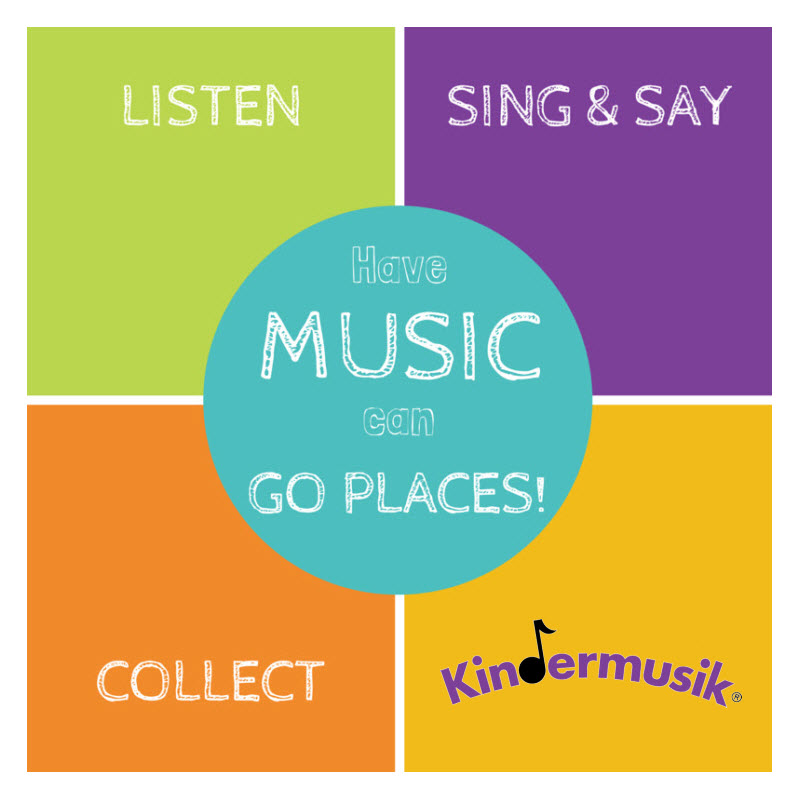
Listen - Sing & Say - Collect - Music Around the World for Kids

Listen - Sing & Say - Collect - Music Around the World for KidsWant to take your children around the world? It’s easy with music! No passport required. No suitcases to pack. Just three simple things you can enjoy almost any time, any where, and you’re off of a grand, musical travel adventure!

Listen to music from around the world.

Every culture has its own beautiful repertoire of rich folk songs, soothing lullabies, and happy dances that can be very appealing to young children. With internet radio stations, streaming music apps, and downloadable song tracks, it’s easier than ever to listen your way around the world. Try searching on “world music for children” or “multicultural music for kids.”

Use your voice to enjoy music from around the world.

There are simple songs and chants that even young children can enjoy learning or hearing from you. In fact, our Kindermusik music library is full of these songs, rhymes, and chants from various countries and cultures. The more exposure a very young child has to other languages, both spoken and sung, the more receptive he or she will be to learning and speaking another language.

Collect instruments from around the world.

Whether someone else demonstrates the instrument or the child can explore and play it themselves, there’s nothing better than seeing, hearing, and touching the real thing. Nearly every culture has some kind of a drum, shaker, or flute-like instrument, and most are easily curated. Give your little world travelers a sense of having gone around the world simply by introducing them to some of the instruments from around the world.
Travel the world with Kindermusik
BONUS reading! How Music Helps Children Expand their Cultural Horizons
Learn more about how Kindermusik can take children around the world and give the music learning adventure of a lifetime at www.Kindermusik.com.
 

Contributed by Theresa Case who has an award-winning Kindermusik program at Piano Central Studios in beautiful upstate South Carolina.

Give It a Rest. Kids Will Love these 2 Musical Math Games.

Patterns surround us and recognizing and understanding patterns is a foundational math skill. Music gives children the opportunity to experience patterns through movement, listening, and playing instruments. When children step, step, step, stop responding to the music or ta, ta, ta, rest with rhythm sticks, children are learning rhythm patterns (quarter note, quarter note, quarter note, rest), a basic musical concept. Rhythm patterns are combinations of long and short sounds and silences.
Try these two math games for kids from Kindermusik@Home that combine music and math!

Kindermusik@Home Pattern GameHomemade Ti-Ti Ta 

This activity for kids introduces the concept of visual and auditory patterns created simultaneously (e.g. the sounds of with the visual representation of).
Patterns are incredibly important, both to music and math. Children first notice and recognize patterns, then develop the ability to complete partial patterns, duplicate patterns, and eventually to extend and create patterns. The patterns also go from simple (ABAB) to more complex (AAB, ABB, AABB, AAABB, AABC, and so on).
The Ti-Ti Ta pattern includes another layer of complexity: duration. Rather than a simple red-red-green pattern in which all components are equal, a Ti-Ti Ta pattern contains the concept of short-short-long within it. When the pieces are rearranged, the “notes” are rearranged as well. Ta, ta, ti-ti, ta is more complex than green, green, red, red, green because the concept of a pair of eighth notes (each of which is half as long as a “ta,” or quarter note) is embedded in the ti-ti.

Pattern GameQuarter Notes and Quarter Rests

This game for kids introduces them to the sound of the quarter note and the “no-sound” of a quarter rest. Children test their ears on how well they recognize them when they’re assembled in patterns.

Find out more about the connections between music and math in Kindermusik at www.kindermusik.com.

Use These Musical Activities to Develop Children's Language Skills

bigstockphoto_Happy_Mom_1646790From hearing those heart-melting coo’s and goo’s to interpreting first words and celebrating full sentences, the adults in a child’s life play an important role in enhancing a child’s language development.  Music and music activities provide a simple and fun way not only to bond with your child and inspire a lifelong love of learning, but also to encourage and greatly enhance language development too.

Here are three music activities that you can use to develop children’s language skills:

Name (or label!) that Movement

This one’s easy, but maybe so obvious that we forget how important it is.  Whether moving to recorded music or singing a favorite song with movement, label the movement.  Many children’s songs include movement words right in them, but you can also repeat that word or emphasize that movement word.  For example, before singing a song about marching, introduce the song by saying, “March, march, march, march” as you march.
Dancing with a recording gives many opportunities for labeling movement words while also exploring a variety of movement.  Sliding, twirling, bouncing, tiptoeing, zig zagging, stomping, galloping… wonderful words to learn and oh-so-fun as a whole-body experience!

Back-and-Forth We Go!

This echo game is a great time-filler – in the car, waiting in line, transition times, etc.  It also works well with words or rhymes.  Simply say a word or phrase from a rhyme and wait for your child to repeat it.  You can even play with silly nonsense words.  Once you get into the back-and-forth rhythm, it can get really fun.  Simpler and slower for little ones; more complex and faster for older children.

Pick a Song and Sing-Along

There’s nothing much better for enhancing language development than singing.  The flow of the music helps the flow of words, and the powerful combination of melody and words, especially songs with repetitive phrases, gives children exposure to and practice with forming words.  Yes, they are the songs that get stuck in your head, but some favorite children’s songs that are especially good for language development include songs like:

  • The Wheels on the Bus
  • The Muffin Man
  • If You’re Happy and You Know It
  • I Like to Eat Apples and Bananas
  • Here We Go ‘Round the Mulberry Bush
  • Baa Baa Black Sheep
  • A Ram Sam Sam
Where Music and Learning Play
Find out more about how Kindermusik can fill a child’s heart – and vocabulary! – with music at www.Kindermusik.com.

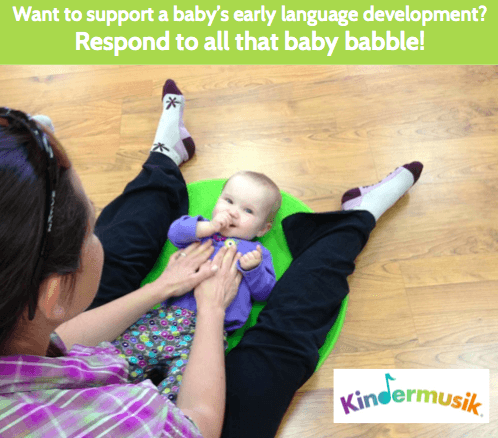
How to Talk to Babies When They Can’t Talk Back…Or Can They?

Caring for an infant can be a bit like visiting a foreign country, especially considering the language barrier. After all, most grown-ups—from first-time parents to experienced early childhood educators—are no longer fluent in Baby. Take a look: Do you know what these babies are talking about? They certainly seem to understand each other!
[youtube]https://www.youtube.com/watch?v=_UfFY6PSVu0[/youtube]

How to talk to babies

Even though we may not know exactly what those sweet babies are saying, parents and caregivers around the world naturally speak “parentese” when talking with babies. Common features of this baby-friendly language include:

  • Using a high pitch to get a baby’s attention
  • Repeating words (e.g. Who is the cutest baby in the world? You are! Yes, you are!)
  • Keeping sentences short
  • Exaggerating syllables and words

New research from the University of Washington indicates that using parentese with babies actually encourages them to try and imitate what they hear! In the study of fifty-seven 7- and 11- or 12-month old babies each child listened to a series of native and foreign language syllables while the researchers observed their brain activity. As expected, the researchers noted brain activity in an auditory area of the brain, however, they also observed activity in the parts of the brain responsible for planning the motor movements required for producing speech.
“Most babies babble by 7 months, but don’t utter their first words until after their first birthdays,” said lead author Patricia Kuhl, in a press release. “Finding activation in motor areas of the brain when infants are simply listening is significant, because it means the baby brain is engaged in trying to talk back right from the start and suggests that 7-month-olds’ brains are already trying to figure out how to make the right movements that will produce words.”
These findings suggest that the exaggerated characteristics of parentese makes it easier for babies to model the motor movements required to speak. Bottom line: Keep talking to babies!

Babytalk Tips from Your Mother Goose

Kindermusik@Home Nursery RhymesAs the mother of all nursery rhymes, Mother Goose knows a thing or two about talking to babies. With their rhymes and rhythms, nursery rhymes “wire” the brain for communication before speech even begins. It’s one of the reasons we include nursery rhymes in our early childhood curriculum.
Try these tips from Kindermusik@Home to talk to the babies in your life! Repeating these activities helps increase language acquisition and retention.

Find out more about Kindermusik at www.Kindermusik.com.

Contributed by Lisa Camino Rowell, a freelance writer living in the Atlanta area.

4 Benefits of Music for Preschoolers

Mom sings to and sways her baby during one of Kindermusik's baby music classes.

Kindermusik_SoundtrackForAnySeason_web-250x250-250x250Imaginative.  Adventurous.  Exuberant.  Brash.  Social.  Silly.  Musical.   Preschoolers are the living definition of all of these words… and more!  It’s what we love most about this delightful age.  Their energy, curiosity, and delight in living life out loud are fostered by an increasing sense of independence and self-confidence.  They are developing their individuality and want to be noticed and acknowledged.  Preschoolers are social butterflies, and their social skills are blossoming, as are their growing abilities to cooperate, problem-solve, share, and make friends.
Play is the preschooler’s work.  In fact, there is no better way for these eager and curious thinkers to learn, grow, and develop than through play – play alone and play with others – including mom and dad!  The expansiveness of the preschooler’s personality overflows into his vocabulary and self-expression.  Preschoolers love playing with words, and they like to talk. A lot.  And if you’ve heard it once, you’ve answered it a thousand times – this is the age of “why.”  It’s how they learn and interact.  Their movements become more expansive too, and the need to move is because of their boundless amounts of energy.  (And you thought you were tired chasing them as toddlers!)
But perhaps the best way to sum up the preschooler season of childhood is with the word “readiness.”  Preschoolers are on the verge of so much potential.  They are ready – ready to try new things, take turns, be challenged, and work cooperatively with others.  Simply put, they’re ready to get ready!
With music as the vehicle, Kindermusik helps your child be ready.  Ready to face life head on, ready for school, ready for new adventures, and ready for that next step in music.  Movement, imagination, play, creativity, exploration, interacting, and ensemble all set the stage for making sure your child has every advantage in a very critical season of childhood – that wonderful transition from baby to big kid that we call “preschooler”!
Here are four of the most powerful benefits of music for preschoolers:
1. Music encourages children to move. 
Movement and music are as closely connected as movement and learning.  At a time when there are increasing concerns about how long these young children are being required to sit still, being able to move to music is a gift.  Here’s how a Washington Post reporter summed it up in her recent article, “In order for children to learn, they need to be able to pay attention.  In order to pay attention, we need to let them move.”
2. Music fosters a sense of community and belonging.
At the core of every human being is a desire to belong.  When that need to belong is fulfilled, it contributes to healthy emotional development and well-being.  Self-confidence grows as a child learns to function within a group.  And there’s no happier group experience than making music together!
3. Music provides an outlet for self-expression.
With gifts, experiences, thoughts, and ideas that simply overflow, a music class offers a secure environment for each individual child to explore, learn, and contribute.  The value is in the experience itself with play, discovery, singing, story telling, and new challenges as the tools that open the door for self-expression, meaningful learning, and a lifelong love for music.
4. Music readiness and academic readiness go hand-in-hand.
The same skills and experiences necessary for a child to be ready for music lessons when they are older are the same skills and experiences that enhance and even accelerate academic readiness and success.  Listening, identifying patterns, problem-solving, creative thinking, and self-confidence are skills that music develops – skills that are also a measurable contributors to academic achievement.
For parents…
preschoolerYou want to give your child every advantage.  And yet, you don’t want to let him or her grow up too fast.  Childhood is meant to be savored and enjoyed, a time that you share experiences and create memories that stay in the heart for years to come.
Kindermusik helps you linger in those precious moments of childhood and make the most of the preschool season with your child.  With a class structure that includes time apart and time together, Kindermusik is perfect for the preschool season of childhood.  You’ll love watching your child blossom, and you’ll love the way your time together in class and your music-making at home brings you together in new and special ways.
And the icing on the cake is knowing that you’re giving your child a gift that truly lasts a lifetime – the gift of a musical foundation and love for music that uniquely prepares your child like no other single activity can.


Kindermusik is where music and learning playExperience the benefits of Kindermusik for yourself.  Contact a local Kindermusik educator and visit a free class today!

Music & Movement Benefits: Reading with Babies

mom reading to her baby“You may have tangible wealth untold: caskets of jewels and coffers of gold.  Richer than I you can never be… I had a mother read to me.”  – Strickland Gillilan, The Reading Mother
Reading aloud to a child is the most powerful way to prepare her for success in reading.  .  In her book, Reading Magic, author Mem Fox explains that “…the more language a child experiences through books and conversation with others, the more advantaged socially, educationally, and in every way that child will be for the rest of his or her life.”  That’s some pretty powerful motivation for reading aloud – plus you get the cuddles and the memories too!

Tips for reading with babies

Begin introducing books at about 4 months of age.
This is about the age when babies become interested in objects – like books!  At first vinyl and cloth books will be best since babies learn by putting things in their mouths.  Your little one will be ready for board books at about 6 months of age.
Have realistic expectations. 
Even a few minutes in your lap engaged with a book should be considered a success!  Don’t worry… As your child grows, so does their attention span.  And when it comes to early reading experiences, it’s okay to let your child take the lead.  At this age, it still counts as “reading” if they are opening/closing the book, stacking books, or even just looking at a few of the pictures on a page.
Establish a routine.
By around 1 year of age, you can establish a regular reading routine – after breakfast, before nap time, after bath time – whatever is best for your child.  By now, your child may even have a favorite book that they like to read over, and over, and over…. and over again.  That’s okay – repetition strengthens the brain!
Music Makes My Day - Reading with Baby
BONUS!  For more great ideas for reading with your baby, check out this free activity from Kindermusik @Home: “Reading” with Baby

Musical Parenting in the Four Seasons of Early Childhood

baby - toddler- preschooler - big kidWe’ve all heard that there are seasons of life, but it can be particularly insightful for parents of young children to think of the seasons (or stages) of early childhood, each with its own unique joys and challenges – joys and challenges that also have the potential to give way to some of the greatest rewards of parenting.  Kindermusik classes not only meet the needs of children at the various stages of development, but Kindermusik also meets the needs of parents at these different seasons.

Babies… When change is the only constant

There is so much that happens that first year or two – so many “firsts” to treasure, memories to capture, and sweet cuddly baby-sized little people to hold on to, for forever if you could!  Your weekly Kindermusik class gives you the time (and the excuse!) to slow down, hum a lullaby, cuddle a little longer, and share a few more smiles.  All along the way, you’ll gain precious developmental insights into the wonderful little person your baby is quickly growing to be!

Toddlers… When it’s life in the fast lane!

From when they wake up until they fall fast asleep, it’s all about go-go-GO! in the world of a toddler. (Just ask their exhausted parents!!)  There’s a lot of cuteness, curiosity, and personality emerging – some of it you laugh at, some of it you scratch your head about.  Kindermusik gives you and your child the perfect opportunity to laugh together, play together, engage and connect in new ways, socialize, and even sneak in a few extra hugs.  Plus we’ll teach you a song to get you through nearly every routine in your day!

Preschoolers… When it’s time to get ready

Preschoolers are on the verge of becoming more independent, bigger thinkers, social butterflies, and more curious learners.  But don’t let those big changes fool you.  Your preschooler still needs you to spend time with him and be a part of his world.  Kindermusik can be the highlight of the week – the one thing that is predictable, familiar, and yet challenging all at the same time.  Time by himself with his friends in class and time with you too – even the structure of the class supports your child at this crucial time.  We’ll help you hang on to those fleeting childhood years just a little bit longer!

Big Kids… When they’re poised for new adventure

Your big kid is so much more capable and independent, and they are eager for new challenges that still keep the fun, pressure-free adventure in the learning process.  Kindermusik comes alongside you and your child at this special time, giving you a special weekly activity that is a choice, not a requirement.  Kindermusik is all about partnering with you to unfold the unique miracle that is your child, without pressure, performance, or state standards – all while inspiring a love for music that will stay with her the rest of her life.

Parents… How to Stop, Pause, and Celebrate each Season

In a world where the pressure on parents can be immense, we here at Kindermusik invite you to let us help you stop, pause, and celebrate each season of childhood – from baby to toddler to preschooler to big kid – by taking time together in a Kindermusik class.  We’ll be right there beside you cheering you on and encouraging you to relish the little moments of life that make such a big difference in your child’s life.
Come See Kindermusik
See for yourself the difference that time together in Kindermusik can make.  Schedule your free preview class today!

Shared by Theresa Case who has an award-winning Kindermusik program at Piano Central Studios in beautiful Upstate South Carolina.