
10 Ways Music Gives Teachers Super Powers

MusicIsATeachersSecretSuperPower_Kindermusik_Square (2)For over 30 years now, we here at Kindermusik International have been empowering music teachers all around the world with a special kind of super power – the power of music.

10 Ways Music Gives Teachers Secret Super Powers

Secret Super Power #1: Engaging a child’s mind, as well as his heart.  Many studies over the past two decades have suggested that there is a strong connection between music, learning, and academic success.
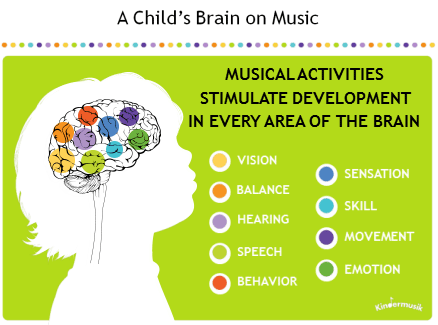
Secret Super Power #2:  Stimulating development in every area of the brain.  Music powerfully affects brain development including vision, balance, hearing, speech, behavior, sensation, skill, movement, and emotion.
Secret Super Power #3: Capitalizing on the close connections between music, movement, and learning.  It is movement, often in response to music, that “…integrates and anchors new information into our neural networks,” according to Dr. Carla Hannaford.
Secret Super Power #4: Making classroom routines and transitions easier.  Using a simple song or rhythmic chant  to transition from one activity to the next is often more effective – and more fun! – than verbal instructions.
Secret Super Power #5: Accessing a powerful tool that makes learning stick.  Ever met an adult who learned the state capitals of the United States by singing a song?  They can probably still sing all of those capitals!
Secret Super Power #6: Changing the energy level in the room at the touch of a button.  (The “play” button on your device, that is!)  Whether it’s a need for calm or a need for more focus, music can make the difference.
Secret Super Power #7: Music creates a positive atmosphere that enhances learning potential.  A classroom without music is like a teacher without a smile!  Music is one of the joys of life, and it can also result in more joyous and motivated learning.
Secret Super Power #8: Facilitating multi-sensory learning.  Children who learn through more than one sense tend to have the kinds of cognitive connections and associations that allow for more ways for information to be remembered, retained, and recalled.
Secret Super Power #9: Enhancing self-confidence and friendship through shared musical experiences.  Music has a way of bringing people together, and no where can this be more true than in a classroom.
Secret Super Power #10: Touching places in the heart that nothing else can.  Humans are innately musical beings, and we respond instinctively to the power of music.
For more ideas about integrating music into the classroom (and improving your super powers!), we recommend this article from the Johns Hopkins School of Education.  You can also learn more HERE about becoming a licensed Kindermusik educator.
 
And to all of the teachers who make such a difference in the hearts, minds, and lives of children every day… Happy National Teacher Day!  (Celebrated in the United States on May 7 and in Columbia/Mexico on May 15)
 

Music and Movement Benefits: What's Your Tempo?

What is TEMPO you ask?  Simply put, tempo is the speed of the music. Fast, slow, and everything in-between!

But why is TEMPO so important?

There is a tempo in every sport your child will play, in every speech, every talk, every meeting your child will hold, and of course, in music.  Here’s where being in a Kindermusik class is so valuable – your child’s Kindermusik classroom experiences with tempo will later translate into critical skills that cross into every aspect of your child’s life – music, sports, academics, dance, gymnastics, art, drama, and more!

Tempo at Home

And that’s not all! Even at home, you can use tempo to keep your child engaged in an activity, supporting both increased attention span and cognitive repetition. For example, you can repeat a song or rhyme many more times with your child if you vary the tempo, and each time we repeat the activity we strengthen the new neural connections in your child’s brain, helping to create retained learning.

How do kids learn about TEMPO?

First, little ones must FEEL it (baby music classes), then they can later PRODUCE it (toddler music classes).  Next, they can UTILIZE their sense of timing (preschooler music classes) so that by the time they are in our big kids classes they will be able to sense tempo as a group in ENSEMBLE play, and further develop their organizational skills for home, school, and beyond!
Follow Me to Kindermusik
Want to see how Kindermusik can benefit your child?  Try a free class today and see how your child will learn and grow with music.

The Family Taxi: A Great Place for Music!

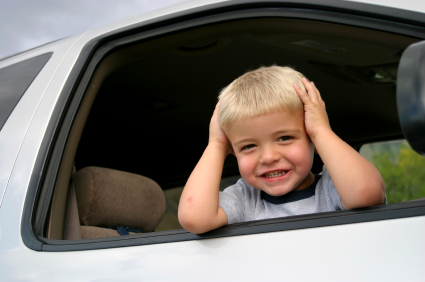
small toddler in carBusy mom and music educator, Lisa Huisman Koops, has found the perfect solution for finding the time in her family’s very busy schedule to develop her child’s awareness and interest in music… the family car. And then she did a study to prove her theory that the family car, or family “taxi,” was indeed an excellent music space for fostering musical development and family togetherness. After all, the family car is one place where families are regularly together a lot!
Here’s what Koops discovered about utilizing the family car for enhancing music appreciation and development:

  • “It is distraction-free from home activities, such as cooking, cleaning and phone calls.
  • Minimal eye contact by parents gave the children a sense of freedom to experiment.
  • Confined space in the car helped parents focus on their children, play games and reflect about what music the child listened to or composed on his or her own.
  • The divided front and back seats provided a close space where siblings could interact with each other through music making.
  • Families also found siblings interacted in singing and playing musical games together.”

Read this recap of the study from Case Western music educator, Lisa Huisman Koops:

Family “taxi” may be the ideal place to develop child’s interest in music

the musical family carAt Kindermusik, we’re all about helping to make great parenting just a little bit easier… and a whole lot more musical.  So we’ve put together some helpful resources and ideas that help you put the music, love, and happy times in your own family taxi.
As our gift to you, we want you to have this free download which includes ten easy ways to make your “Family Taxi” a more musical place that inspires learning and creates lifelong memories. Don’t feel you have to try them all at once, by the way! Even one or two at a time will go a long way towards creating a happy, musical, learning environment while you’re on the go.

Free Download:  Make your “Family Taxi” a more musical place

BONUS!  Includes a Road Trip Playlist and 5 Free Song Downloads from Kindermusik.
10 Ways to Be Musical in the Family Car - Kindermusik
Try A Free Kindermusik Class
Kindermusik International is also happy to extend an invitation for you to try a free Kindermusik class since Kindermusik is the ideal place for being inspired with music and child development tips that help you put a song in your child’s heart… and in the family car!

Increase parent involvement in early childhood education with a Breakfast Club

Looking for an easy and fun way to increase parent involvement in early childhood education? Start a Breakfast Club. In a recent issue of the NAEYC publication, Teaching Young Children, Lynn A. Manfredi shares her success at inviting parents to join the class during breakfast time. In the morning, parents eat with their children, connect with other parents and the teachers, and children start the day surrounded by people who love and care for them.
“In my family child care program, we start the day with a healthy breakfast. When I asked parents if they would like to join us while we eat, Breakfast Club was born,” Manfredi explains in the article, Building a Community through Breakfast. “My relationships with families and their relationships with each other have blossomed. It is family engagement at its best!”

Breakfast Club ideas to use as part of an early childhood program

In our early childhood curriculum, we include materials for families to use together at home that connect the classroom learning with the home environment. Here are a few Kindermusik@Home ideas to try at your Breakfast Club and share with parents!

For Newborn to 1 year

Kindermusik@HomeCuddle & Bounce: First Foods from Around the World
Opinions about what solids babies should eat, in what order, and at what intervals…well, they’re endless and ongoing!
Check out some recipes for “baby’s first foods” from around the world!
Tip for Parent Involvement in early childhood education: Share this activity with parents as they eat breakfast or use the link in an email to invite parents to attend.

For 1 to 2 years

Sing & Play: Let’s Make Toast
As simple as it seems, a piece of toast offers all kinds of opportunities to help young children develop fine-motor skills. Provide toast for families to eat during Breakfast Club as well as child-safe plastic knives.
Kindermusik@HomeTip for Parent Involvement in early childhood education: With the help of a parent, let children use a plastic knife to spread some butter, margarine, or cream cheese on a piece of toast. Use a spoon to scoop some jelly! Child will develop his or her grasp and practice wrist rotation. If children are not quite ready for the spreading action, line up a row of raisins or pieces of cereal and lead children to place them on the toast, one at a time. This gets the thumb and forefinger working together (a.k.a., pincer grasp) and develops hand-eye coordination (a.k.a., visual-motor integration).

For 2 to 3 years

Kindermusik@HomeWiggle & Grow: Fruit, Fruit Where Are You?

Memory is an excellent game that can encourage the development of numerous early childhood skills that go beyond simple visual processing.
Tip for Parent Involvement in early childhood education: At breakfast, extend the benefits of this game by using the images on the cards as oral language enhancers and fun conversation starters about color and preferences (e.g., “Which is your favorite food to eat?”, “What food did we see that was red?”).

For 4 to 5 years

Move & Groove: Let’s Make Fruit Rainbows
Kindermusik@HomeHealthy fruits come in a variety of shapes and colors, which makes them perfect (and fun!) for practicing patterns. Identifying, creating, and extending patterns is a critical early math skill that is also a prerequisite to more advanced math.
Tip for Parent Involvement in early childhood education: Provide fruit for parents and children to make patterns. Parents can start a pattern and encourage children to finish it and vice versa.

Looking for more ideas on increasing parent involvement?

Learn how using music in the early childhood classroom connects with parents and supports the cognitive development in children, including early math, science, literacy, and language skills.

Music and Movement Benefits: Routines and Social-Emotional Health

Quality Time

bigstock_Mother_And_Father_Giving_Child_13915643From breakfast to playtime to naptime.  That’s one routine. Bath time, story time, then bedtime.  That’s another. Cartoons or waffles on Saturday morning – that’s a routine, too! 
As unpredictable as life with young children can sometimes be, routines and rituals are the secret to creating a calmer, saner life, to helping your children feel secure, and to building loving family relationships.  As reported by Reuters Health, a recent study has also found that children with predictable family routines “tend to be emotionally healthier and better socially adjusted.”  And there’s a close connection between thriving at home and thriving in school.
Routines provide structure and predictability – they are a child’s time keeper, both internally and externally.  Zero to Three lists these ways that love, learning, and routines are all interconnected.

Love, Learning, and Routines (from ZeroToThree.org)

  • Routines help babies and toddlers learn self-control.
  • Routines can bring you and your child closer together and reduce power struggles.
  • Routines guide positive behavior and safety.
  • Routines support children’s social skills.
  • Routines help children cope with transitions.
  • Routines are satisfying for parents, too.
  • Routines are an important opportunity for learning.

These are some of the very reasons why a Kindermusik class has many happy routines that give your child a sense of belonging and security in the classroom: after a few weeks, just experiencing the hello song, goodbye song, and all of the beloved activities in-between reassure each child that he/she is in a safe and loving community.  Repeating some of these very same activities at home with the help of your @Home Materials helps parents create family routines that will be remembered for a lifetime.

Get started on the Kindermusik routine today!  Try a free class and see how music makes every part of the day even better.

Compiled and written by Theresa Case, who has an award-winning Kindermusik program at Piano Central Studios in Greenville, SC.

A whole new rhythm to English Language Learning

Brain on musicWe rock out in our early childhood music classes—literally and figuratively. From our classes for babies, toddlers, big kids or families to our early literacy and language program in preschools, Head Start programs, and daycares to our ELL curriculum, we use the benefits of music to engage children of all abilities in learning. And, we have a lot of fun in the process!
In the first several years of life, the cognitive development of children fires up. Connections in the brain are formed as children engage in new experiences—and repeated multi-sensory activities strengthen those connections. It’s one of the reasons research indicates that it is the critical period for teaching a child another language. Before age 8, children who learn another language are more likely to speak like a native speaker. In fact, young children who learn to speak another language, such as English as a second language, actually reshape the brain, and also strengthen their first language abilities (contrary to a previously debunked myth).

Take a peek inside the brain of bi-lingual children:

[youtube]https://www.youtube.com/watch?v=rhpVd30AJaY[/youtube]

3 reasons to use music and movement in a bilingual curriculum

Musical activities engage all of the senses and stimulate development in every area of the brain. Regardless of a child’s first language, every child speaks music and research shows it positively impacts English language learning, including these three ways:

  1. Music stimulates language learning, builds phonological awareness, and enhances language skills.
  2. Children who learn through movement show a marked improvement in memory.
  3. It’s fun! (Never underestimate the power of fun—and music—when it comes to engaging children!)

Try this activity for young ELL students 

ELL students will love hearing the rhythmic language ofThis Little Car”—over and over Kindermusik@Home ABC Englishagain. And doing so will help them learn to speak, and later read, in English, because this video is full of opportunities for them to increase their English language phonological awareness. Phonological awareness is the ability to hear and manipulate words, syllables, and sounds in oral language. Research has shown that phonological awareness is one of the strongest predictors of later reading success—in English as well as in many other languages.
ABC English & Me - Teaching English to Children through Music
 

Learn more about our bilingual curriculum…

that meets the EYFS framework in the UK, CEFR developed by the Council of Europe, and TESOL English Language Proficiency Standards for Pre-K.

10 ways to celebrate Earth Day with little kids

Kindermusik Green - Sustainability

Happy Earth Day! Today (and every day, truth be told) we celebrate the beautiful world Kindermusik Green - Sustainabilityaround us. After all, working (and playing, singing, and dancing!) with children brings out the best in us. They teach us to pause and notice the beauty in the tiniest of details. Through the eyes of a child, a puddle becomes a splashing adventure; a caterpillar provides a reason to giggle as it creeps up an arm; and a stick morphs into just about anything.
At Kindermusik, protecting the earth is a process. It doesn’t happen overnight—kind of like raising a child. It takes deliberate, consistent steps. (You can see how we actively seek ways to reduce our carbon footprint as a company.) Today, however, we celebrate Earth Day the best way we know how—by involving the youngest members of our world in the process! So, we hope you enjoy 10 of our favorite ways to celebrate Earth Day—and teach kids about sustainability—with these kid-friendly activities from Pinterest!

10 activities for kids to celebrate Earth Day!

  1. Fine Motor Play with Recyclable Materials. Use paper towel or toilet paper rolls, egg containers, and duct tape to create a fun “fine motor skills center” for toddlers and preschoolers. Young children will enjoy the playtime and you will model for them how to re-use and recycle materials!
  2. Recycled Outdoor Music Station. Make this with children and play with it all year! Young children will enjoy designing and decorating their own little musical symphony.
    (Source: http://mynearestanddearest.com/)
    (Source: http://mynearestanddearest.com/)
  3. Earth Day Hunt. Go on a nature treasure hunt with little ones. Provide them with a list of things to look for on your walk, such as “collect three rocks” or “make a leaf rubbing.” Consider taking a small bag to pick up trash along the way, too! 
  4. 20 Family-Friendly Books about the Environment. Looking for a good book about the environment to read with young children? This list will get you started! Plus, it will teach kids about sustainability and support early literacy skills.
  5. Go on a Virtual Field Trip to learn about and listen to the Landfill Harmonic. 
  6. Make a Recycling Bin with Children. Use a trashcan and some paint to decorate a recycling can for the entire family. Then talk about (and show) the different types of things you can recycle. Children love to contribute to the family or class, so give a child “the job” of recycling certain items, such as plastic water bottles or juice containers. 
  7. Go bird watching (and listening!). Bird watching celebrates key Kindermusik skills of listening and engaging and helps children notice the world right outside their window. After your bird walk, sing along with Kindermusik bird songs and use instruments to mimic birdcalls.
  8. Create a “plant pal” by planting grass seeds. Children learn best by engaging all of their senses. Planting seeds and watching them grow gives them the opportunity to learn more about a plant’s life cycle. Toddlers and preschoolers will especially love this fun twist! When the grass grows long enough, give the “plant pal” a trim!
  9. Host a Recycled Dance Party. This party has it all—music, movement, and a fun way to learn more about recycling for kids. 
  10. Follow our “Living Green with Kids” board on Pinterest! Need even more ideas? Be sure to follow Kindermusik on Pinterest!

Contributed by Lisa Camino Rowell with a little help from her 8-year-old daughter and former Kindermusik student, Emerson. After all, living green with kids takes input from every family member!

5 Ways to Celebrate Spring with Music and Movement

5 Ways to Celebrate Spring with Music and Movement

At Kindermusik, we’re all about great ideas and helpful tips that make parenting just a little bit easier and a whole lot more musical.  And now that Spring is just around the corner, we thought we’d share some music and movement ideas for celebrating spring… and creating some very happy memories!

5 Ways to Celebrate Spring with Music and Movement

Cute child in puddle1. Go for a listening walk.
There are all kinds of sounds to be discovered outside, especially in the Spring time.  Listen for, imitate, and then talk about the sounds that are all around.
2.  Take advantage of springtime showers.
Those brief, light spring showers do more than bring May flowers… they also leave perfectly sized puddles that are great for jumping, stomping, splashing, and giggling!
3.  Blow bubbles on the porch.
There’s nothing more delightful than bubbles.  But bubbles aren’t just for fun, they also help little eyes learn to track and follow moving objects and little eyes and hands to improve eye-hand coordination.
4.  Do a happy dance in the house.
Turn on your favorite music and float like a cloud, sway like a tree, fly like a bird, or wiggle like a worm.  (This would be a great follow up to your Listening Walk, and it’s a fun thing for the whole family to enjoy!)
5.  Work on some spring cleaning together.
We think music makes everything better, and that includes spring cleaning.  Give your child a soft cloth or small duster and let them help.  Sing and dance the chores away!

And for more fun ways to celebrate Spring and all things new…


Putting the Arts in Science, Technology, Engineering & Mathematics

Music and Math share more in common than just the letter M. In an earlier post, we highlighted three of the ways music supports math learning—counting, spatial awareness, and pattern recognition. Learning the building blocks of math—such as size, measurement, pattern recognition, and counting by rote—start at birth–and the arts naturally engage young children in the learning.

From STEM to STEAM

In recent years, many teachers, schools, and entire districts began focusing on STEM (Science, Technology, Engineering, and Mathematics) classes to help prepare children for living and working in our increasingly technology-centered world. However, many educators see the need to add the “Arts” into the equation. (Of course, we absolutely agree!) STEAM integrates and uses the arts in the STEM curriculum to help children express—and understand—STEM concepts. Children naturally learn by using their whole bodies and all of their senses. Experiencing concepts such as size by pretending to move like an elephant, mouse, or giraffe makes a complicated concept three-dimensional. So, children can feel it, relate to it, and understand it!
The National Park for the Performing Arts, Wolf Trap, recently launched an Early Childhood STEM Learning Through the Arts initiative. Through teacher training and research, Wolf Trap is helping to strengthen the understanding of how the arts can (and should) be used in early childhood education to teach science, technology, engineering, and mathematics.
[youtube]https://www.youtube.com/watch?v=wFdiLWfbVSA[/youtube]

Using music to express STEM concepts

Music’s proven connections to math can support young children’s math development. For example, children hear, feel, and experience the patterns in music when swaying to a legato section or bouncing to a staccato section or when they dance and sing a song with a verse then a chorus then a verse then a chorus. Try these Kindermusik@Home activities for kids that use music to help them experience patterns.

For babies:

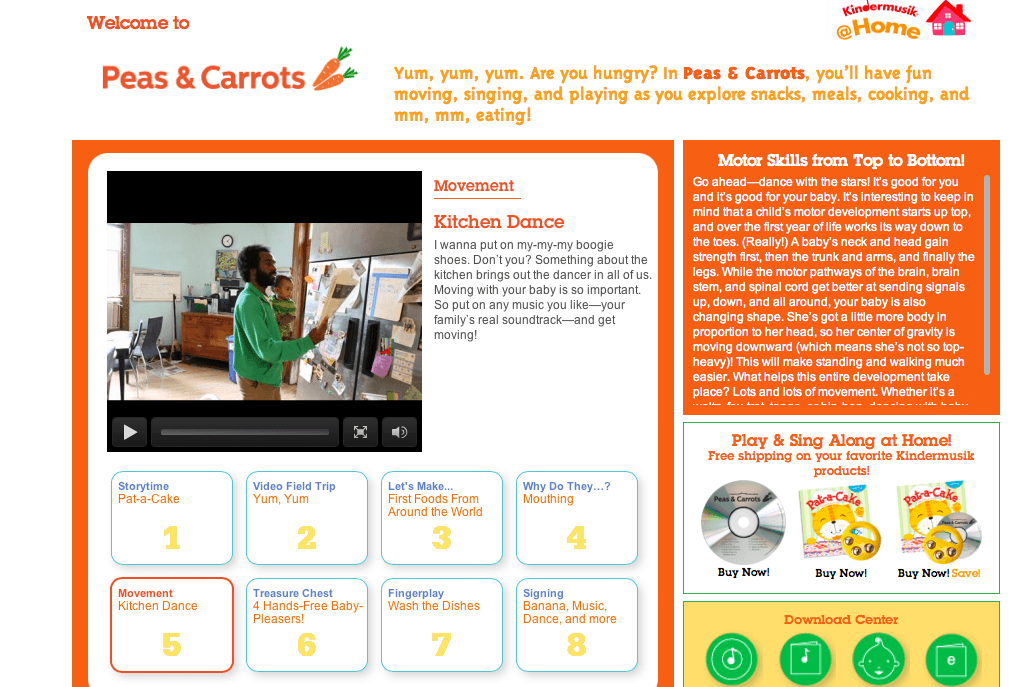
Peas & Carrots Kindermusik@HomeKitchen Dance: Something about the kitchen brings out the dancer in all of us. Moving with a baby is so important. So put on any music you like and get moving! Plus, dancing to music can help even babies hear, feel, and experience patterns.
 
 
For toddlers:
Kindermusik@Home Jelly in the BowlThe Jelly in the Bowl:

A kid-favorite, “Jelly in the Bowl” is easy to remember, easy to do, and hard to resist. After a few times, children will understand the pattern of the song and start giggling right before favorite parts.


For preschoolers:
Jumping beans Kindermusik@HomeQuarter Notes & Quarter Rests:  Get your listening ears on, because this game will introduce children to the sound of a quarter note and the “no-sound” of a quarter rest . . . then test children’s ears on how well they recognize them when they’re assembled in patterns!

ABCMMEINTL_LOGO_LiteracyLanguage_OneLineOur early childhood curriculum, ABC Music & Me, uses music and movement as a fun, engaging, and natural way for children to learn. Want to learn more about using music to support STEM learning (and early literacy and language!) in early childhood education? Email us info@abcmusicandme.com. 

Contributed by Lisa Camino Rowell, long-time supporter and believer in the power of the arts.

Music & Movement Benefits: Why We Rock, Bounce, Jump & Dance

taking risk risks

music and movementKindermusik is as much about movement as it is about music.  Ask any educator or parent – there’s no need to go to the gym on Kindermusik day!  That’s because we know that children learn best by doing – it’s called experiential learning.  And now a new study highlighted in Science Daily demonstrates just how powerful the doing-learning-remembering connection really is.  There really is such a thing as “motor memory!”
Multiple research studies prove what Kindermusik has capitalized on for a long time – movement is KEY to learning.  In fact, the movement we do in our Kindermusik classes is essential for the children in many ways.

The powerful, but happy, combination of movement and music develops:

  • The Vestibular System.

A well-developed vestibular system provides emotional security, good muscle tone, develops auditory language processing, and visual-spatial processing. All this while you’re having fun dancing!

  • Neural Pathways.

Moving in a variety of ways gives your child a chance to ‘see the world’ from many perspectives, thus strengthening neural pathways, which carry messages from your child’s mind, guiding her senses and motor skills.

  • Fine Motor Skills.

During the first part of life, we’re learning to walk, so gross motor activities dominate the child’s movement. Now she can focus on activities that encourage the development of fine muscles, so she can increase skills that require finger and hand movements such as putting together a simple puzzle, painting with a paintbrush, turning a page of a book or stringing beads.

  • Physical Confidence.

Body awareness is important in the development of the child’s physical confidence. This developmental goal may be met by engaging in movement activities which focus on body part movement, whole body movement in one place, and whole body movement while traveling in space.

  • Creativity and Imagination.

Listening and responding to music and movement activities helps develop pretend play skills while also helping your child assimilate music and movement concepts such as fast, slow, loud, quiet, bumpy, smooth, straight and curvy.

  • Thinking Skills.

While in motion, the brain acts like a flight simulator, constantly inventing, moving mental models to project onto a changing world. This is an extraordinary mentally complex operation which builds thinking skills.

Movement is truly the key to the kind of learning that sticks and to the kind of joyful interaction that leads to a lifelong love of music and a lifetime of benefiting from the rich foundation of an early childhood music and movement program like Kindermusik.

Try A Free Kindermusik Class
Come move, sing, dance, play, and learn with us!  Try a FREE Kindermusik class today and see how music will move you… and your child.