

Rainsticks, or Thirsty Diaguitas

Instruments are used to create. They embody the creative potential and spirit of the musician—something that will bring joy in the moment and in the future. The word “instrument” comes from the French verb, instruere, which means to “equip” or “construct.” Instruments require action.

But what about an instrument’s past? Instruments have been characters in wars, journeys, and voices in daily routines for centuries. Today, we learned that rainsticks probably originated with the Diaguita Indians of the Acatama Desert and Andes mountains of northern Chile. Why is this a topic for KI Green? In the days before modern agriculture, pesticides, and mass irrigation, nature’s voice rang a little louder. The sound of rain, potentially anticipated for months, could mean bounty or demolition—feast, flood, or famine. What would it feel like to suddenly hear the crack of thunder, followed by a crescendo of pitter patters, break through weeks of dry silence? The Diaguita, an agrarian society known for their cultivation of maize, pumpkins, and beans, lived in one of the driest places on earth. Desperation sparked creativity. They created rainsticks out of dried cactus stalks, used palm needles and beans or seeds, and created the rainstick to coax the sky to rain. Just another interesting reminder of the interconnectedness between man,

music, and nature!

ABC English & Me Unit 3: Good Morning, Good Night!

Introducing Unit 3, Good Morning, Good Night! Everyday rituals become a musical, English-learning game with our new unit, Good Morning, Good Night! Each class begins with a hello song, and with each lesson children learn the words for new greeting rituals such as “Good Day!” and “Good Night!”

Daily rituals become a musical, English-learning game.

Good Morning, Good Night! will be available in Digital Teacher’s Guides next week (October 15 – 19).

Favorite American Children’s Songs such as “Wheels on the Bus” take us to school, and the “Mulberry Bush” helps to introduce and reinforce new vocabulary words and concepts with additional verses about a child’s daily routine at home.

“This is the way we wash our hands,” … “brush our teeth,” …  “comb our hair,” … and “put on socks!”

In addition, children learn the English word and the animal sound to their favorite farm yard animals — sheep, cow, dog, rooster, and pig. And using movement games, concepts are explored with “Stand up!” “Sit down,” “Turn around,” and “Shake your hands!”

Children Learn English through Music and Rituals

Children can begin to speak English in a continuous flow using ABC English & Me’s simple songs and begin to apply English words to their everyday rituals at home, such as going to bed, washing faces, hands, and brushing teeth.

Make learning English a part of your daily routine with ABC English & Me!’s newest Unit, Good Morning, Good Night!

Kindermusik@Home - Online Learning Games for KidsUsing English @Home

When parents download the Home Audio Good Morning, Good Night! from the ABC English & Me @Home website, they can use the class songs about brushing teeth, getting dressed, and going to school to bring a rhythm and routine to busy mornings and evenings at home!

Speak in a continuous flow

Using the melody from the American song “Mulberry Bush,” children will sing “this is the way we wash our hands, wash our hands, wash our hands.” Additional verses adapt to describe more daily routines such as “brush our teeth,” “comb our hair,” and “put on jeans!”

Counting

Children play musical instruments, one for each hand, and as the teacher passes out the instruments, the children count with her, “1,” “2.” And during interactive puppet play, children help to “Wake Up!” puppet on the count of “1, 2, 3, … Wake Up!”

Movement concepts

Stand up, sit down, jump up, turn around, shake hands, tap your head, say good night, go to bed

Animals and animal sounds

cow, moo, sheep, baa, dog, woof, mouse, squeak, pig, oink, rooster, cock-a- doodle-doo

Talking about daily routines

go to school, wash our hands, wash our face, brush our teeth, comb our hair, put on our… clothes, shirt, jeans, socks, shoes

New vocabulary words

bus, wheels go round, people go up and down, driver says, “Move on back,” wipers go wash, horn goes beep, babies go “waa”, mommies go “shh”

Conversational terms

Where is he? Is he here? Yes, he is, No, he isn’t. He’s sleeping. Wake up. It’s time to get up. Good morning. How are you? I’m fine, thank you.

We are excited to bring this new curriculum to English Language Learners across the globe!

Visit the English Language Learning category or Subscribe to our blog for current news on ABC English & Me, ELL research, and Kindermusik programs around the world.

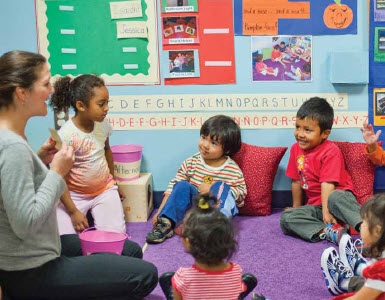
ABC English & Me - Teaching English to Children through Music

Professional development for teachers linked to ELL reading achievement

Source- Latino Briefs Digest
Source: Latino Briefs Digest

English Language Learners comprise an increasingly larger number of students enrolled in public schools in the United States. One study shows a 50 percent increase in the number of ELL students over the past 10 years. This changing face (and language) of the average student in the United States brings new challenges and opportunities for teachers as they balance the implementation of Common Core State Standards with the needs of English Language Learners.

While even veteran teachers receive on-the-job training each day in the classroom, an investment in professional development for teachers can better equip educators and students for measurable success. A study published in the Literacy Research and Instruction journal examined how professional development for teachers affected the reading abilities of ELLs in elementary school classrooms.

Link between professional development for teachers and the reading abilities of English Language Learners

In this study, the research team wanted to examine the correlation among professional development for teachers, classroom implementation of the training, and ELL students’ achievement in reading. Over the course of 18 months, 23 elementary classroom teachers participated in the study. The teachers ranged in experience from early career to veteran teachers. One group received on-going training on using the Sheltered Instruction Observation Protocol, an approach to teaching English Language Learners. The control group did not receive training in this model. The researchers found evidence that English Language Learners showed greater reading abilities when taught by teachers who received the professional development. The researchers suggest that additional studies be conducted to further unpack their initial findings.

Other research shows that teacher training can be key to classroom success for all students, not just English Language Learners, and can increase teacher job satisfaction.

Early childhood professional development for teachers of English Language Learners

ABC Music & Me uses music to teach early literacy and language development to young children and engage families in their children’s education. The research-based curriculum aligns with state standards, including the Common Core, and can be especially beneficial for English Language Learners.

At ABC Music & Me, our commitment to early childhood education extends beyond the creation of easy-to-teach literacy and language curriculum. Our ELL curriculum includes a combination of on-site training, DVD teaching models, and an online teacher resource website. In addition to our “English Language Learners Strategies Guide” that provides unit-by-unit, lesson-by-lesson tips, ABC Music & Me includes materials (available in English and Spanish) for families to use together at home.

To learn more about how ABC Music & Me can be used in your classroom, school, or district with English Language Learners, contact us at info@abcmusicandme.com.

Kindermusik Green – Official Star Steward Competition starts today!

Kindermusik Green - Sustainability

Kindermusik Green - SustainabilityAttention, stewards! Kindermusik is launching its first official Star Steward Competition to illuminate outstanding sustainability efforts in the Kindermusik community!

If you, your child, or someone close to you has taken on an active environmental leadership role, tell us for a chance to have your story and project shared on Minds on Music.

Winners will gain community support, visibility, and feedback from Kindermusik Green on ways to amplify your project…

50 FREE Songs from play.kindermusik.com! AND…

$100 donation to a “green” or “sustainable” charity of your choice from Kindermusik International.

Some award-winning efforts might include:

  • Community Building. Maybe you started a class project or club, community garden, fundraiser, or volunteer activity that got five, ten—or a hundred people involved.
  • Inventing. Musicians are also great innovators and inventors. Maybe you built a rain water retention system, using a barrel and gutter system, a compost bin, or a bird feeder.
  • Activism. With the elections around the corner, maybe you’ve gone grassroots! Have you canvassed, given a speech, or stood up for an environmental cause you support?

Feeling inspired by our list? It’s not too late to START a project, and tell us what you’ll finish.

Contest Submissions extended to December 7, 2012.

Submit your story (video, pictures, writing, art, etc.) by posting on the Kindermusik Facebook page.

Do something great!

Kindermusik Star Steward
This Kindermusik Star Steward from the Young Child program uses his kitchen scraps to create compost, an organic fertilizer free of chemicals and pesticides. This provides dirt and fertilizer for his family's garden plants to grow!
Green Sustainable Fun for Kids
After creating compost, this Steward goes green by growing his own food in his garden each summer! By having a garden and using natural organic fertilizer like compost, he helps his Mom & Dad save money on grocery bills and eliminates toxic chemicals and pesticides from his family's food. How fruitful!

Competition Rules

How to Be a Smart Organic Shopper

Organic Shopping Tips for Kids “KI Green,” the official sustainability blog for Kindermusik International, is excited to bring Sustainability to Minds on Music with an initiating post the great debate: Organic vs. Non-Organic shopping! We’re happy to get a leafy green start to feeding our families the right fall produce. From now on, you’ll be able to check Minds on Music for family-based sustainability solutions that keep sustainability active as a Kindermusik core value.
    Why Buy Organic Food for Kids?

    But let’s play devil’s advocate just for a minute. Buying organic doesn’t always make a difference, right? The average “dollar difference” per item isn’t worth the “so-so” benefits of USDA organic produce. Right?

    In this study from the Natural Resource Defense Counsel, scientists found that children age 5 and under ingest an average of 8 pesticides per day. Young children, whose internal organs are developing rapidly, are most susceptible to the harmful effects of pesticides.

    Let’s take a look at your shopping cart today, October 9. Almost everything you have is spring produce, which is out of season. Your asparagus was grown using nearly 22 different types of pesticides. Your grapefruit required about 10. Your mango, 13. Peas: 5, pineapple: 6, corn: 3, avocado: 2. It may be time to do the “reverse shopping cart…” the dance move you learned wherein non-organic produce is put BACK on the shelves, and fast!

    Tips for Buying Organic Produce

    When you consider the harmful effects of any one of these pesticides, especially for kids, the right choice is always the organic choice. Understandably, though, time and money can be an issue. Here are the NRDC’s helpful tips to make buying organic easier:

    • The best foods to buy organic are apples, bell peppers, carrots, celery, and strawberries.
    • If you buy produce in season, it is less likely have pesticides. Seasonal asparagus, avocado, sweet peas, grapefruit, onions, and cabbage, are far less likely to have pesticides when grown in season.
    • The five cleanest fruits and vegetables are onions, avocados, sweet corn, pineapple, and mango.
    • If you need an out of season item, buy it frozen.

    What’s in season now? Brussel sprouts, cabbage, carrots, celery, onions, leeks, potatoes, pumpkins, radishes, greens (spinach, arugula, lettuce, kale, Swiss chard, collards), turnips, winter squash, and apples!

    For more information, check out the NRDC’s helpful list of resources.

    Visit our Sustainability category often as we continue to add valuable and actionable tips!

    How Kindermusik Helps You Raise a Child Who Loves Music

    BabyCenter logo

    BabyCenter logoKindermusik , the leading name in music education for young children, was mentioned in a BabyCenter article about “How to Raise a Child who Loves Music!.”

    Here are the top 9 things you can do to raise your child with a lifelong appreciation for music:

    Benefits of Music for Children

    1. Sing songs to and with your child.
    2. Strike up the band.
    3. Play an assortment of music.
    4. Play “Finish that Tune”
    5. Attend concerts.
    6. Check out musically minded books.
    7. Enroll in children’s music programs, like Kindermusik.
    8. Dance to the music.
    9. Perform.

    If you do the above, your child will not only have a lifelong love for music, but early music exposure also provides many benefits. It helps develop young learners cognitively, physically, socially, and emotionally. So, try to incorporate music and movement into your child’s every day!

    Find a Kindermusik class near you and try a free class to give your child a good beginning!

    Kindermusik Community Updates

    For all our Kindermusik families…

    We are now making it easier for all Kindermusik communities to come together and learn from each other by combining our blog communities! Kindermusik has multiple brands across the globe. For better collaboration, we will now communicate through 1 blog:

    Minds on Music is the Official Blog of Kindermusik International.

    We welcome our communities from:

    ABC Music & Me - Early Literacy and Language CurriculumABC Music & Me – Kindermusik’s early childhood music curriculum. Staying current with research on early literacy and language development, we share these findings with our community and continue to incorporate into our curriculum. As many schools, childcare centers, head start programs, special needs programs, after-school programs, and others use ABC Music & Me, we continue to see positive results as we help children learn through music.

    ABC English & Me - Teaching English to Children through MusicABC English & Me – our ELL (English Language Learning) curriculum. We’ll continue to share exciting stories from around the world of children learning English through music. Our community of bilingual children and families continue to grow so we’ll keep sharing ELL resources, tips, research and inspiration!

    Kindermusik Green - SustainabilityKindermusik Green – our approach to Sustainability. We believe in making a better future for our children, not only by empowering children to learn through music, but also through sustainable practices. We’ll share tips, stories, and action items we take as a company to promote a Green future; teaching kids, families, and educators how to incorporate sustainability into their lives.

    Subscribe to our Minds on Music RSS feed today so you don’t miss out on all the valuable info.

    Thanks for being part of the Kindermusik Community!

    Using music to meet the Common Core State Standards

    As research continues to shed new light on how children learn best, standards and teaching methods evolve to both incorporate those latest insights and to meet the needs of today’s students. This year 45 US states and the District of Columbia implemented the Common Core State Standards to help prepare children for success in the classroom and beyond. When used in conjunction with a Common Core curriculum, music can be an effective vehicle for teaching children early literacy and language, including phonological awareness and vocabulary acquisition.

    How to use music in a standards based curriculum to teach phonological awareness and vocabulary acquisition

    1. Phonological Awareness: Songs with rhyming lyrics can help children build phonological awareness. Where spoken language is comprised of a stream of connected phonemes, music is comprised of a series of discrete musical notes or tones. Understanding a spoken sentence requires successfully auditory processing of the individual phonemes combined with the intonation communicated by pitch, and hearing music requires listening for the individual notes combined with their rhythmic values. Because of these fundamental similarities, the human brain processes music and language in some similar ways.
    2. Vocabulary Acquisition: According to educational researchers, there is substantial evidence that children acquire vocabulary incidentally by reading and listening to oral stories and song lyrics could provide a source of new vocabulary. With the addition of movement activities, children learn new vocabulary through hearing, singing, and doing.

    Common Core Curriculum uses music as the vehicle for learning

    ABC Music & Me, a standards-based curriculum, aligns with the Common Core State Standards as well as Pre-K national and state standards. Our Common Core curriculum uses music as the vehicle for teaching children early literacy and language. See how our Common Core curriculum aligns with state standards: 5 ways ABC Music & Me helps teachers meet the Common Core State Standards.

    For more information about using ABC Music & Me in your classroom or school to help meet the Common Core State Standards, email us at info@abcmusicandme.com.

    The Lifelong Benefits of Music – New Research

    Early Music Lessons Have Longtime Benefits

    Music is great, music is fantastic, music is social —

    let them enjoy it for what it really is.” said Ms. Parbery-Clark, a doctoral candidate in the Auditory Neuroscience Lab at Northwestern University. Even the NYTimes is giving attention to the benefits of music for kids in their recent post; Early Music Lessons Have Longtime Benefits.

    Early Music Lessons Have Longtime Benefits
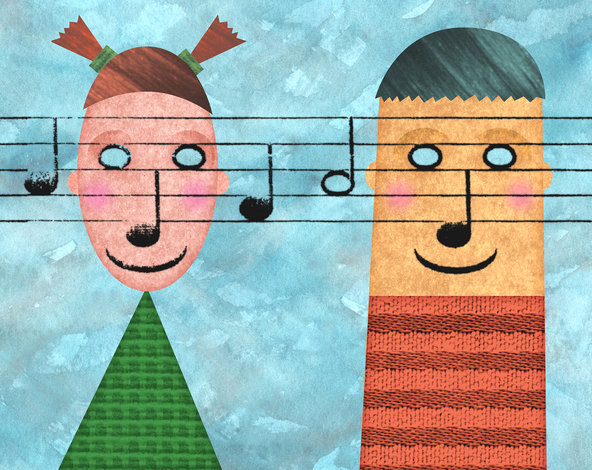
    Photo Credit: NYTimes | Joyce Hesselberth

    As mentioned in this NYTimes post…research studies continue to show the correlation between musical training in childhood and strengthened auditory skills and language-based learning.

    Researchers at Northwestern University recorded the auditory brainstem responses of college students — that is to say, their electrical brain waves — in response to complex sounds.

    The group of students who reported musical training in childhood had more robust responses — their brains were better able to pick out essential elements, like pitch, in the complex sounds when they were tested.

    And this was true even if the lessons had ended years ago.

    At Kindermusik, we know it’s important to incorporate music into children’s lives for many reasons, including early childhood development. We see developmental milestones happen every day with so many children. As new research and studies are conducted, we continue to learn the importance and understand the lifelong effects and benefits of music – and look forward to incorporating this into our curriculum and share this knowledge with our Kindermusik students, families, and educators around the world.

    Did you know Kindermusik is in over 70+ Countries?

    Find a Class Near You!