
CEO with a CSA

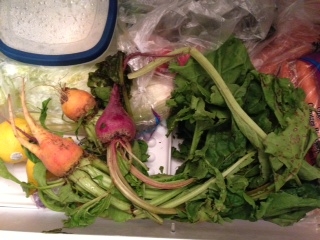
What’s in our CEO’s fridge, you ask? The short answer? Michael Dougherty (one of 35 employee owners) bought magnificent beets and carrots from his local CSA (Community Supported Agriculture) in Greensboro, North Carolina. Take a look at the picture he submitted for the Star Steward Contest!

And the long answer? Michael bought food that strengthens individual, community, and environmental health by being, well, just food. If you haven’t heard of a CSA, lettuce inform you! CSAs allow urban and suburban residents to purchase an entire season of fresh local produce. For $400-$600 a season (4-6 months), farmers deliver between 7-10 seasonal vegetables to your local pickup point each week. Each week, you’ll get what the farm has available; you could get carrots and beets one week, or potatoes and cauliflower the next. For a few extra dollars a week, you can tack on dairy, nuts, flowers, or swap the week’s vegetable for another.

How does this help farmers? Paying up front allows

farmers to plan and invest in new equipment. It also eliminates the corporate supply chain so farmers get what they deserve. Finally, eating seasonal produce reduces the need for pesticides, storage treatments, and overseas shipping, which has human health and environmental benefits.Kindermusik Green - Sustainability Food, when it’s really just food, tastes better. As Michael Dougherty says, "This was our first experience with a CSA, and our experience was so positive. We feel closer to our food. We know where it comes from. We understand the earth gives us certain foods at certain times – and, often, lots of it! We appreciate what it takes to grow, care for and pick food. We are gratified that farmers have pre-sold their food and, in turn, know their customers." Sounds like a Star Steward to me!

Don’t forget to submit your Star Steward Contest entries!

WIN 50 free Kindermusik songs & $100 donation to your favorite charity by sharing your family’s Green/Sustainability/Eco efforts by 12/07/12.

Submit your posts, pictures or videos to: Facebook.com/Kindermusik.

ABC English & Me proven classroom tips: Repetition with a twist increases learning

Kindermusik Educator Jane Denizot in France
Jane Denizot is an ABC English & Me Educator in Calvados, France. This week, she shares a few tips on how she incorporates repetition with a few activity twists in the ELL classroom for young children.

I find it is essential to have repetition and the proof is that they are learning fast. I just try to spice up things that are repeated to change it a little. I am on week two “1, 2, 3, GO!” and have followed the units as prescribed, just adding in an extra song when I thought we needed more movement.

Jane’s tips on giving repetition a twist in the ABC English & Me classroom

  • Add simple play props. At first we had no steering wheels for the Grandad’s farm activity, then later, we added coloured paper plates.
  • Repeat familiar movement and language concepts with a new song. I used the “Blue Danube” to follow on from “Clever Cows” repeating the “Up, Up” and “Down, Down” in time to the music with our scarves and they loved it.
  • Add in some silly moves for the “Hello” and “Goodbye” songs.
  • Play a new song. I also added in another activity, “The Morning Sun has Risen,” with instruments and lots of cock a doodles!

Visit the English Language Learning category or Subscribe to our blog for current news on ABC English & Me, ELL research, and Kindermusik programs around the world.

Cultural factors that may impact the self-regulation skills of ELL preschoolers

Source: She Knows Activity Center

Watch a classroom of preschoolers writing letters from that day’s preschool lesson plan and you will see children wiggling in their seats, looking longingly over at the art table, poking classmates with fingers, or talking to each other. Preschoolers are still learning how to self-regulate or how to control and direct their own actions, thoughts, and feelings. More and more research shows the importance of teaching self-regulation as part of a preschool or toddler curriculum. Studies indicate that self-regulation may even be a predictor of both early academic success and later adult health and wealth.

Latino English Language Learners and Self-Control

While the body of research on the importance of self-regulation continues to grow, little research exists that targets specific cultural factors that may affect self-control skills in ELL preschoolers. A professor from Loyola University Chicago recently published an article in the Child Development Perspectives journal that took initial steps towards identifying two aspects found specifically in the immigrant Latino culture—familism and acculturation—that may affect the self-regulation of preschooler English Language Learners. Familisim refers to a cultural aspect that puts the needs of the family as a whole above the needs of the individuals in the family. Acculturation is the process of change a person or family encounters when one culture begins to merge with another culture, such as changes in food, clothing, and language. The author stresses the need for additional research that will take into consideration these unique aspects of immigrant Latino English Language Learners.

Preschool curriculum develops self-control using music

Studies show that music can help develop self-control in young children, including English Language Learners. In fact, researchers recommend using music to engage the entire family in learning, including in cultures that place a high regard on the family.

Based on over 30 years of research detailing the ways music instruction boosts self-regulation, listening, early literacy and language, and more, Kindermusik created ABC Music & Me, a preschool and toddler curriculum. ABC Music & Me uses music to teach early literacy and language development to young children and engage families in their children’s education. The research-based curriculum aligns with state standards, including the Common Core, and can be especially beneficial for English Language Learners. In addition to our “English Language Learners Strategies Guide” that provides unit-by-unit, lesson-by-lesson tips, ABC Music & Me includes materials in English and Spanish to increase parent involvement and support the common language spoken in the home.

For more information about using ABC Music & Me as a preschool or toddler curriculum with English Language Learners, email us at info@abcmusicandme.com.

In one bilingual school, music supports the unique needs of dual language learners

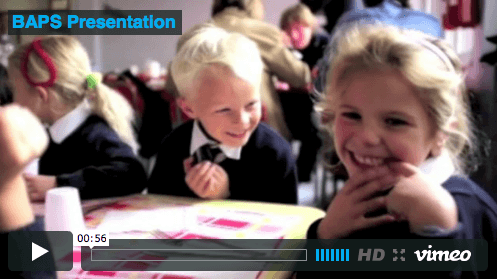
The British American Preschool is located in Milan, Italy and offers ABC English & Me. Take a look inside the Milan, Italy preschool devoted to the unique learning needs of bilingual children. Click the image above and scroll down to watch the video.
The British American Preschool in Milan, Italy is devoted to the unique learning needs of young bilingual children. In addition to meeting the child’s changing language needs, the school is focused on helping children develop a balance of interests and skills — from studies in science to the arts.

“Early childhood is a period of rapid mental growth and development,” according to the school’s Web site. “Young children need a rich foundation of stimulating experiences that will be essential for later learning, a strong sense of self-esteem, and excitement and curiosity for learning.”

The school incorporates the Jean Piaget theory that “play is a child’s work.” Based on the school’s mission to learn through play and to develop a variety of skills, ABC English & Me is one of the programs that the school offers its students.

Here, the school’s director, Debbie Chilver, talks about how the music based activities in ABC English & Me help to develop English language skills, as well as the child’s attention span (in Italian of course! Scroll down for the English translation).

Debbie Chilver, Director at the British American Preschool of Milan – Italy

English and Me è un programma che coinvolge molto i bambini. E’ sorprendente vedere come bambini così piccoli partecipano alle attività. Si può notare facilmente che la loro capacità di attenzione viene sviluppata durante le lezioni e che esse sono finalizzate al raggiungimento di obbiettivi tipici degli “early years”.

Possiamo prendere un semplice gesto come su e giù, per esempio. Lo si fa nel rituale dei saluti e poi si ripete in altre attività, come in una delle storie o con gli strumenti. La lezione è strutturata in maniera tale da promuorere la consapevolezza di tutto il corpo.

Si può anche vedere che le lezioni sono ben pensate. Non appena i bambini sono in procinto di distrarsi l’attività cambia e ci si muove. Si può notare che gli obbiettivi e la sequenzialità delle attività volte al loro raggiungimento sono state testate.

Sento che la musica è uno dei più grandi veicoli per l’insegnamento. La musica è un eccellente forma di comunicazione per l’insegnamento di una seconda lingua. Cominciare presto, sviluppa nei bambini un apprezzamento per la musica che li accompagnerà per il resto della loro vita. E’ come piantare questo seme in tenera età e poi vederlo crescere.

In English

ABC English and Me is a program that gets the children extremely involved.  It’s amazing how such small children participate in the activities.  You can see that their attention span is really being developed by this class.

After having looked at the scope you can see that it is very structured towards early years objectives.  We can take a simple movement like up and down for example. You do it in the ritual greating and then it is repeated in other activities like in one of the stories or with the instruments. The lesson is structured with full body awareness in mind.  You can also tell that the lessons are well thought out.

As soon as the children are about to get distracted the activity changes and they do a movement.  You can see that the scope and sequence of the lessons have been tested out also.

I feel that music is one the greatest vehicles for teaching. Music is a form of communication that is great for teaching language as a second language.  Starting children young will develop music appreciation for the rest of their lives.  You can lay this seed at an early age and then watch it grow.

Parents and children participate in ABC English & Me at the bilingual school in Milan, Italy
The British American Preschool focuses on the unique learning needs of bilingual children.

Visit the English Language Learning category or Subscribe to our blog for current news on ABC English & Me, ELL research, and Kindermusik programs around the world.

Environmental Debates

Kindermusik Green - Sustainability

Here’s some KI Green food for thought: Monday was the first U.S. presidential debate since 1988, when global climate change was first addressed in a presidential debate, to make no explicit mention of the global climate issue. Despite the fact that President Obama calls global warming the “biggest problem this generation faces,” and Romney acknowledges (albeit indirectly) the scope, calling it “global warming,” not “America warming.” The silence left our ears burning. That being said, it was clear that the environment was the backbone for nearly every foreign policy-related topic discussed. This proved the highly interdisciplinary nature of environmental issues—whether they are addressed through auto industry overhauls, foreign policy in Iran, tighter regulation of the Food and Drug Administration, or by achieving Romney’s idyllic “energy independence” to ensure national security. The environment was the major player in every topic of the presidential debates.

Learn more about the U.S. presidential election’s environmental, economic, and energy issues here!

What does this mean for KI Green?

Kindermusik Green - SustainabilityIt means that, in order to stay relevant as environmental activists, we need to provide news that impacts our readers’ daily lives. We need to show real life connections between what happens on page 6 of the New York Times, and how that manifests in our community.

Kindermusik Star Steward Competition

Make sure you tell us what YOU’RE doing to enact environmental change!

Tell us how you’ve given a speech, worked in a garden, or canvassed for this year’s election by submitting your post, picture or video to Facebook.com/Kindermusik.

As part of our official Star Steward Competition, enter to Win 50 Free Kindermusik song credits, promotion on our blog, and a $100 donation towards a charity of your choice!

Where did I read that? A wrap-up of bilingual stories and new studies online this week.

ABC English & Me - Teaching English to Children through Music
  • Bilingual learners are far better at processing sounds on BBC News Health
  • The Foreign-Language Effect: Thinking and writing in several different languages reduces bias in Psychological Science, and a fascinating summary of the study on tumblr.
  • If you consider music a second language, and even if you don’t, this was a great story about a parent who soothes a crying toddler on train with a simple song on mashable.com
ABC English & Me - Teaching English to Children through Music
To learn more about helping young children learn English, visit abcenglishandme.com

Singing to young children supports early language development

Singing a song or two (or 50!) a day to even the youngest child can help early language development. Hearing a parent or teacher sing a song requires a child to listen for the individual notes combined with their rhythmic values. In much the same way, early language development requires children to hear speech sounds and begin to divide them into individual sounds or phonemes.

Sally Goddard Blythe reiterates the importance of singing to young children for early language development in her book, The Genius of Natural Childhood. In an article published in The Guardian, Blythe said: “Song is a special type of speech. Lullabies, songs and rhymes of every culture carry the ‘signature’ melodies and inflections of a mother tongue, preparing a child’s ear, voice and brain for language.” In the same article, Blythe contends that singing to young children can help ward off later language development problems.

She goes on to say that “Children’s response to live music is different from recorded music. Babies are particularly responsive when the music comes directly from the parent. Singing along with a parent is for the development of reciprocal communication.”

You can read the entire article: Singing to Children May Help Development of Language Skills

Music classes support early language development

With more than 30 years of experience in using music as the vehicle for learning, we understand how to tap into the power of music to connect with children, families, and teachers around the world. In private studios, public schools, childcare centers, and at home, children, parents, and teachers enjoy participating in our fun, developmentally appropriate and research-based music education programs that support early language development, early literacy development, parent involvement in early childhood education, and more.

If you are a parent looking for a music class for toddlers, babies, or big kids at a local Kindermusik studio, try our Class Finder.

If you are a childcare center or school looking to increase your students’ early language and literacy skills using music, email us at info@abcmusicandme.com.

Rainsticks, or Thirsty Diaguitas

Instruments are used to create. They embody the creative potential and spirit of the musician—something that will bring joy in the moment and in the future. The word “instrument” comes from the French verb, instruere, which means to “equip” or “construct.” Instruments require action.

But what about an instrument’s past? Instruments have been characters in wars, journeys, and voices in daily routines for centuries. Today, we learned that rainsticks probably originated with the Diaguita Indians of the Acatama Desert and Andes mountains of northern Chile. Why is this a topic for KI Green? In the days before modern agriculture, pesticides, and mass irrigation, nature’s voice rang a little louder. The sound of rain, potentially anticipated for months, could mean bounty or demolition—feast, flood, or famine. What would it feel like to suddenly hear the crack of thunder, followed by a crescendo of pitter patters, break through weeks of dry silence? The Diaguita, an agrarian society known for their cultivation of maize, pumpkins, and beans, lived in one of the driest places on earth. Desperation sparked creativity. They created rainsticks out of dried cactus stalks, used palm needles and beans or seeds, and created the rainstick to coax the sky to rain. Just another interesting reminder of the interconnectedness between man,

music, and nature!

ABC English & Me Unit 3: Good Morning, Good Night!

Introducing Unit 3, Good Morning, Good Night! Everyday rituals become a musical, English-learning game with our new unit, Good Morning, Good Night! Each class begins with a hello song, and with each lesson children learn the words for new greeting rituals such as “Good Day!” and “Good Night!”

Daily rituals become a musical, English-learning game.

Good Morning, Good Night! will be available in Digital Teacher’s Guides next week (October 15 – 19).

Favorite American Children’s Songs such as “Wheels on the Bus” take us to school, and the “Mulberry Bush” helps to introduce and reinforce new vocabulary words and concepts with additional verses about a child’s daily routine at home.

“This is the way we wash our hands,” … “brush our teeth,” …  “comb our hair,” … and “put on socks!”

In addition, children learn the English word and the animal sound to their favorite farm yard animals — sheep, cow, dog, rooster, and pig. And using movement games, concepts are explored with “Stand up!” “Sit down,” “Turn around,” and “Shake your hands!”

Children Learn English through Music and Rituals

Children can begin to speak English in a continuous flow using ABC English & Me’s simple songs and begin to apply English words to their everyday rituals at home, such as going to bed, washing faces, hands, and brushing teeth.

Make learning English a part of your daily routine with ABC English & Me!’s newest Unit, Good Morning, Good Night!

Kindermusik@Home - Online Learning Games for KidsUsing English @Home

When parents download the Home Audio Good Morning, Good Night! from the ABC English & Me @Home website, they can use the class songs about brushing teeth, getting dressed, and going to school to bring a rhythm and routine to busy mornings and evenings at home!

Speak in a continuous flow

Using the melody from the American song “Mulberry Bush,” children will sing “this is the way we wash our hands, wash our hands, wash our hands.” Additional verses adapt to describe more daily routines such as “brush our teeth,” “comb our hair,” and “put on jeans!”

Counting

Children play musical instruments, one for each hand, and as the teacher passes out the instruments, the children count with her, “1,” “2.” And during interactive puppet play, children help to “Wake Up!” puppet on the count of “1, 2, 3, … Wake Up!”

Movement concepts

Stand up, sit down, jump up, turn around, shake hands, tap your head, say good night, go to bed

Animals and animal sounds

cow, moo, sheep, baa, dog, woof, mouse, squeak, pig, oink, rooster, cock-a- doodle-doo

Talking about daily routines

go to school, wash our hands, wash our face, brush our teeth, comb our hair, put on our… clothes, shirt, jeans, socks, shoes

New vocabulary words

bus, wheels go round, people go up and down, driver says, “Move on back,” wipers go wash, horn goes beep, babies go “waa”, mommies go “shh”

Conversational terms

Where is he? Is he here? Yes, he is, No, he isn’t. He’s sleeping. Wake up. It’s time to get up. Good morning. How are you? I’m fine, thank you.

We are excited to bring this new curriculum to English Language Learners across the globe!

Visit the English Language Learning category or Subscribe to our blog for current news on ABC English & Me, ELL research, and Kindermusik programs around the world.

ABC English & Me - Teaching English to Children through Music