Got Rhythm? Rhythm Skills Could Predict Reading Disabilities

Do you know the old jazz standard by George and Ira Gerswin: “I’ve Got Music. I’ve Got Rhythm…Who could ask for anything more?” Well, apparently all that music and rhythm brings even more than a really good dance number by Gene Kelly. New research implies that young children’s rhythm abilities before they can read may eventually help doctors predict future reading disorders.
KindermusikClass_RhythmSticks_TeachChildrenImportantSkillsAn ongoing study  by Nina Kraus indicates that a preschooler’s ability to follow a rhythm and keep a steady beat can accurately predict early language skills and reading skills. While this is only the beginning of a five-year study, the team plans to track the participants to determine whether these rhythmic and steady beat abilities (or lack thereof) can predict later reading disorders, even with children as young as newborns.
“Detection this early could lead to intervention strategies such as music games to improve at-risk children’s rhythmic perception when their brains are most malleable,” says neurologist Gottfried Schlaug of Harvard Medical School in Boston in a press release.

We already know that early childhood music instruction:

  • Improves phonological awareness
  • Refines auditory discrimination
  • Increases auditory sequencing ability
  • Strengthens listening and attention skills
  • Enhances speaking skills
  • Heightens oral language development
  • Enriches vocabulary

Take a peek inside a Kindermusik classroom to see young students reading and playing rhythm patterns:

[youtube]https://www.youtube.com/watch?v=-IEm17m3evI[/youtube]
 

Learn more about the connections between music and reading at www.Kindermusik.com.

Contributed by Lisa Camino Rowell, a freelance writer in the Atlanta area.


Babies Benefit from Learning Two Languages at the Same Time

Baby learning two languagesWe get fired up about the importance of early childhood education. The reason is simple. In the first seven years of a child’s life, their brains are firing up with learning—literally! Every new experience lights up the synapses in the brain and repetition makes those pathways stronger.
At the age of two, a child’s brain includes over a 100 trillion synapses. That’s 50 percent more than we have as adults. While these new connections form rapidly and are strengthened through repetition, the brain also prunes connections not used frequently. This strengthening and deleting that happens in young children’s brains ultimately helps them process thoughts and actions more quickly.

Babies’ brains ripe for learning more than one language

All that action in the brain makes children under the age of 7 the ideal age for engaging in new experiences, including learning more than one language. In fact, new research conducted with six-month-old infants in Singapore indicates a generalized cognitive advantage that emerges early in infants raised in a bilingual home and is not specific to a particular language.
“As adults, learning a second language can be painstaking and laborious,” explained co-author and Associate Professor Leher Singh in a press release. “We sometimes project that difficulty onto our young babies, imagining a state of enormous confusion as two languages jostle for space in their little heads. However, a large number of studies have shown us that babies are uniquely well positioned to take on the challenges of bilingual acquisition and in fact, may benefit from this journey.”
The study found that:

  • The infants raised in a bilingual home become bored with familiar images faster than children brought up in a monolingual home.
  • Those same infants paid more attention to new images when compared to babies living in a monolingual home.

So what does that all mean? According to the press release, previous studies show that a quicker response to familiar objects and interest in new objects can predict preschool developmental outcomes, including non-verbal cognition and expressive and receptive language. Think about it. Children learning two languages at the same time are exposed to the sounds of more than one language and must learn to distinguish between the two. This makes for more—and stronger—neural connections! See why we get fired up for early childhood education?

Rocking the bilingual brain

At Kindermusik, our ELL curriculum, ABC English & Me,  uses songs, story time, puppets, and Total Physical Response for English Language Learning. Research shows that music ABC English & Me - Teaching English to Children through Musichas a positive impact on learning a second language. For example, in class ELL students may hear and repeat the rhythmic language of a nursery rhyme or song multiple times. The repetition creates stronger connections in the brain and helps children learn to speak and later read in English as their English language phonological awareness increases.

Learn more about using music to learn English as a second language at www.Kindermusik.com.

Get the wiggles out and keep the learning in

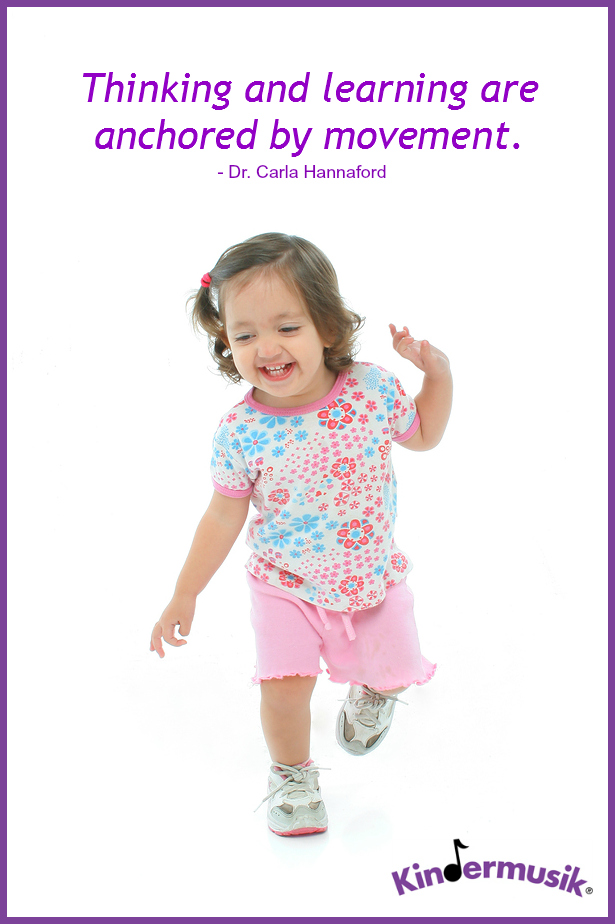
thinking and learning are anchored by movementA recent article in the Washington Post highlighted a growing concern for parents and educators:  more and more kids are having trouble sitting still in school. The root of the problem is that kids are being expected to sit still for longer periods of time. Recesses are shorter, and often kids aren’t running, jumping, and playing outside even once they get home.
Our bodies are wired to move. In fact, it is through movement that the brain becomes activated for learning. This is often why kids get wiggly and fidgety – their bodies are trying to wake up their brains! It is also through movement that kids develop core strength, increase their coordination and balance, stimulate their vestibular systems, and improve gross motor skills – among other things.
In this Kindermusik video, expressive movement is helping these young children gain a greater understanding of a poem about a train as they visualize and act out the words through movement. Notice how the children hear the words (aural), see the words represented in the movement (visual), and act them out (kinesthetic). Even though the children are doing the movements while seated, they are working out some of their wiggles and sealing in the learning – all at the same time!
[youtube]https://www.youtube.com/watch?v=saygYVHlPII[/youtube]
Learn more about how children benefit from the powerful combination of music and movement at www.Kindermusik.com.
 

9 Ways Music Gives Us Something to Smile about on World Smile Day

Happy World Smile Day! Today is the day to smile…and pass it on. Mother Theresa said: “Let us always meet each other with a smile, for the smile is the beginning of love.” Remember the first time a baby smiled at you? Your heart melted just a little bit didn’t it? Afterwards, you probably did everything you could to coax another smile!
Well, it should come as no surprise that we use music to bring smiles to children, families, teachers, and everyone else we can. So, we wanted to start World Smile Day off with a little music, of course. Take a listen…and try NOT to smile.
[youtube]https://www.youtube.com/watch?v=to7uIG8KYhg[/youtube]
You smiled didn’t you? It’s hard not to smile when watching young children engaged in music. It’s an undeniable truth: Music gives us so many reasons to smile. Here are just a few.

9 Ways Music Gives Us Something to Smile About

1. Music causes children to move and dance and react in amazing ways. It really is impossible not to smile when seeing young children naturally respond to music. After all, you couldn’t help but smile when watching those babies’ faces light up and their bodies begin to dance when their dad started playing his guitar.
2. Music is a gateway to family fun. When families listen to music and then dance around in the living room, smiles and bursts of laughter blend in with the beat. Or  when families sing together in the car, they transform even the most mundane errands—or the longest road trip—into memories that last a lifetime. In the daily routines of family life, music brings fun.
One Kindermusik parent put it this way:
Kindermusik - Smile“Kindermusik started out as a way for our family to bond and a place for my daughters to express themselves long before they had words to communicate. Now it is a place for us to be silly, meet new families, and make lots of music together. We love Kindermusik!” ~Kindermusik Parent, Emily R
 
3. Music provides many health benefits. Listening to music makes us feel better, boosts the immune system, reduces blood pressure, encourages relaxation, and even releases pain-fighting endorphins.
baby mom smile4. Participating in musical activities supports cognitive development in children, including language and literacy, spatial-temporal reasoning, and mathematical abilities.
5. Playing music with others makes the world a better place by promoting a sense of community and belonging and fostering cooperation and helpful behavior.
6. Playing instruments or singing provides a creative outlet and opportunity to express thoughts and feelings in a unique way.
7. Music connects us to our past and creates new memories in the present. Hearing the music of our parents and grandparents helps us understand them just a little bit better and provides a bridge between the generations. This also happens when we sing the same lullaby to our children that our parents sang to us.
Kenyan children playing egg shakers8. Music is the one language in the world every single person speaks. We see this the world over. Bring in a basket of instruments to children in Ohio, South Africa, Italy, Australia, The Philippines, Mexico—and everywhere in between—and they will shake, scrape, tap, beat, and create beautiful music. No translation needed.
9. When our favorite song comes on, we can’t help but sing all the words, loudly. This phenomenon can happen in the grocery store, in an elevator, at the doctor’s office, in the car, anywhere. And, yes, it can happen even when the “kids’ music” unexpectedly comes on and you find yourself singing along…even when you are by yourself.
See, music gives us all something to smile about on World Smile Day. Now pass the love on!

Find more reasons why music gives us something to smile about at www.kindermusik.com.

Contributed by Lisa Camino Rowell a freelance writer living (and smiling!) in the Atlanta area.

New Music Standards – Focus on Preparing Children for Success

National Core Arts Standards 2014

New National Core Music Standards

The arts have always served as the distinctive vehicle for discovering who we are. Providing methods of thinking as disciplined as science or math, and as disparate as philosophy or literature, the arts are used by and have shaped every culture and individual on earth. The arts continue to infuse our lives on nearly all levels—generating a significant part of the creative and intellectual capital that drives our economy. The arts also impart our lives with meaning every time we experience: the joy of a well-remembered song, the flash of inspiration that comes with immersing ourselves in an artist’s sculpture, participating in a sublime dance, learning from an exciting animation, or being moved by a captivating play. (From: National Core Arts Standards, Custom Handbook).
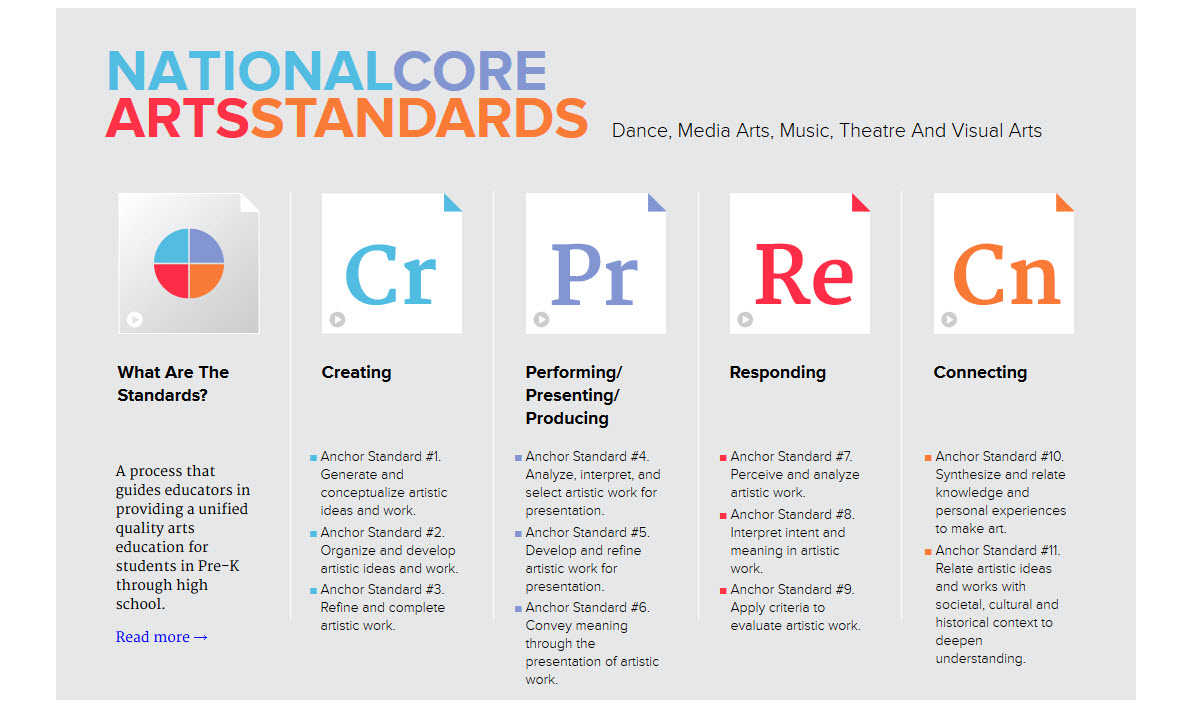
National Core Arts Standards 2014As of June 2014, new music standards were created by the National Coalition for Core Arts Standards (NCCAS), and based on artistic processes; these include music standards prepared by the National Association for Music Education (NAfME).

Overview of Standards:

The new National Standards focus on improving each child’s music education experience, supporting educators with enhanced instructional strategies, and emphasizing the benefits of music education. You can visit their site to create your own Custom Handbook, based on discipline, process, and grade level.

Who the Standards are for:

Decision-makers from teachers, to superintendents, to parents, and policy makers, all will be able to utilize these standards as guidelines to improving music education and ultimately future success for our children.

Goals of the Standards are to enhance…

Music Literacy – meaning the ability to communicate through a medium and understand what is communicated. In our multimedia society, we need to prepare children to communicate visually, through sound, video, etc. and have literacy for each media.
Artistic Processes – there are 3-4 core areas these new music standards focus on:

  1. Creating (new music)
  2. Performing (also referred to as Presenting or Producing existing music)
  3. Responding (interpreting the performance/music and developing own opinions)
  4. Connecting (various art forms – this is embedded throughout the standards)

This 5 minute video from the NAfME Deputy Executive Director & COO provides an overview.
[youtube]https://www.youtube.com/watch?v=RlSF56tkueA[/youtube]
 

Kindermusik Programs Align with the New Music Standards

How Kindermusik Supports Music Literacy

Kindermusik_EarlyChildhoodMusicEducation_OnlinePortal_OutsideMyWindowAn important part of our curricula are the Family Engagement materials. Through real instruments, books, CDs, family activity guides – AND – video field trips, songs, math games, logic games, craft ideas and more within our online learning portal (Kindermusik@Home); we support hands-on learning and emerging technology. We provide families with a useful way to be involved in their children’s educations and expose them to various types of media and arts. This helps Kindermusik reach our mission of instilling a lifelong love of music and learning in children around the world.

How Kindermusik Supports Artistic Processes

EarlyChildhood_InstrumentSet_ABCMusic&Me_Wiggle&Grow_KindermusikInternationalCreating music is what we do in each class. We provide enough instruments for each child in the class to participate and make their own music. Through a variety of age-appropriate and kid-safe instruments, like egg shakers, jingle bells, chime balls, sand blocks, rhythm sticks, and many more, we allow children to be creative and come up with their own way of playing the instrument. We guide them with ideas, and allow kids to express themselves through music.
KindermusikClass_RhythmSticks_TeachChildrenImportantSkillsPerforming, presenting or producing music is also integrated into our classes. Although Kindermusik curriculum is based on process not performance, we do encourage children to present their ideas to class. For example, a teacher may ask, “Johnny, how do you want play your rhythm sticks; fast, slow, loud, or soft?” This allows each child to determine their own preferences and encourages them to play music to a group of their peers, boosting self-esteem and confidence.
ListeningGame_IHearASound_Kindermusik@HomeResponding to music is embedded into the Kindermusik curricula, and we encourage children to be effective audience members. For example, in the song “I Hear a Sound” from our Wiggle & Grow curriculum (for ages 2-3) children hear various instruments, and then have time to guess what instrument they just heard. This aligns with the new standards as we give children the opportunity to listen, analyze, and interpret what they hear.  Follow-up questions from the teacher such as, “Kaylee, what instrument did you like best?” allows children to evaluate what they’ve heard and make decisions based on their preferences – expressing themselves through music.
Connecting various art forms is actually a great way to describe a Kindermusik class. We incorporate: music; movement; dance; visuals; literature including children’s books, poems, and rhymes from many cultures around the world; opportunities for ensemble experiences; and so much more.
Kindermusik_SupportsAllLearningDomainsWe too recognize the importance of technology in education and so, we developed the Kindermusik@Home portal. Parents can login and enjoy with their children; fun educational games, activities, eBooks, videos, crafts and more, along with ideas for taking the learning offline. We include parenting resources to help them understand the importance behind these educational activities.
And we keep on top of the growing body of research on the benefits of music for children. The Kindermusik curriculum is more than a music class, it’s designed to promote school-readiness and stimulate development across all learning domains, supporting the future success of each child…and in turn…our world.
Other components, like the Opportunity-to-Learn Standards, are part of these new music standards and are still being developed. One call-out the Executive Director & COO of NAfME mentioned is the standards will likely include guidance that students should receive WEEKLY INSTRUCTION. Again, another way Kindermusik aligns. Our weekly lessons are flexible and provide concepts teachers can use throughout the day.
To learn more about the new music standards, please reference:
nafme.org/standards
NationalArtsStandards.org
 
To learn more about Kindermusik, please visit:
www.kindermusik.com
Music Gets Kids into the Rhythm of Back-to-School

Baby with instrumentThere is nothing routine about a routine. In fact, we think routines get a bad rap. After all, people often refer to routines as being “stuck in a rut” or “same old, same old” or even boring with a capital B. However, from a child’s perspective, routines are anything but boring and can be especially beneficial during the back-to-school season.
Routines help children predict the future and feel safe and secure. Pair a routine with a ritual and children receive the added benefits of continuity and connectedness. For example, giving a child the same instruments to play with while you get a snack together each day, let’s the child know that it’s almost time to eat something yummy.
During the back-to-school periods of childhood, routines help ease children through transition periods, whether it’s adjusting to a new teacher, a new school, or even navigating through a growth spurt, which somehow always coincide with a new school year. The best time to introduce children to routines and rituals is NOW.
Turn up the music during routines and rituals and you will never use the word boring again when referring to routines! Try these tips for adding music into the back-to-school routine.

6 Ways to Add Music into the Routine and Get Kids into the Rhythm of Back-to-School

1. Wake children up or welcome them to the classroom by singing a favorite song or by listening to a playlist with songs about the morning time. “Morning Sun Has Risen” is one of our favorites. Take a listen (and look):
Morning Sun Has Risen
2. The rhythm of the morning routine naturally lends itself to a little musical play. Sing songs or chants about getting dressed, brushing teeth, eating breakfast, or even getting in the car to go to school.
3. On the drive to school, listen to music and sing along! Children will begin to look forward to this special ritual in the morning. Download this free Kindermusik road trip playlist.
4. For teachers, add music throughout the day to let children know it is time to clean up for recess, to mark the beginning of circle time, or even to get the class ready to walk down the hallway. We love how this teacher uses music to remind children how to be quiet in the hallway.
[youtube]https://www.youtube.com/watch?v=Tn-wGrhb5d4[/youtube]
5. Add music to the nightly routine to help children recognize that the day is over and it is time to settle down for bed. Make a “quiet music” playlist and start playing it right after dinner or just before bathtime. Helping children settle and fall asleep carries over into the morning routine. A well-rested child is easier to get moving than a sleepy one.
6. Reading to children 20 minutes a day makes a significant impact on their early language and literacy development. When added to the night time routine, the right book can help a child get the wiggles out or calmly relax a child. Need some reading suggestions? Add a few musical books from the Kindermusik Pinterest Board ~ Books for Kids We Love to the nightly reading routine.

7. Sing a lullaby while tucking a child into bed to signal the end of the routine. You can even rock and sway back and forth together for a little extra cuddle!

Find out more about Kindermusik at www.Kindermusik.com.

Why every baby should learn sign language

Sign language is one of the many ways in which adults can engage babies and young toddlers on their paths to learning language. Sign language is unique because, when paired with words, it makes language learning a multisensory experience. Signing comes naturally to babies and toddlers, and it comes with a host of other benefits as well.

8 reasons why every baby should learn sign language:

  1. Signing allows baby to engage as an active participant in the learning environment.
  2. Using signs can reduce or eliminate baby’s frustration at not being able to communicate.
  3. Signing makes learning to speak even easier.
  4. Learning to sign stimulates intellectual development.
  5. Success with signing nurtures baby’s self-esteem and self-confidence.
  6. Since signing often requires eye contact, it helps children focus, an important skill in cultures in which children are often overloaded with various stimuli.
  7. Signing strengthens the bond between parent and child.
  8. Using sign language empowers parents because they know they are providing their children with an invaluable additional communication tool.

Watch as this little communicator shows off some of the impressive sign language skills he learned in Kindermusik class!

little boy showing off signs learned at Kindermusik
Find out more about how Kindermusik can help your baby communicate earlier and easier at www.Kindermusik.com.

Why Kids Blur the Line between Work and Play

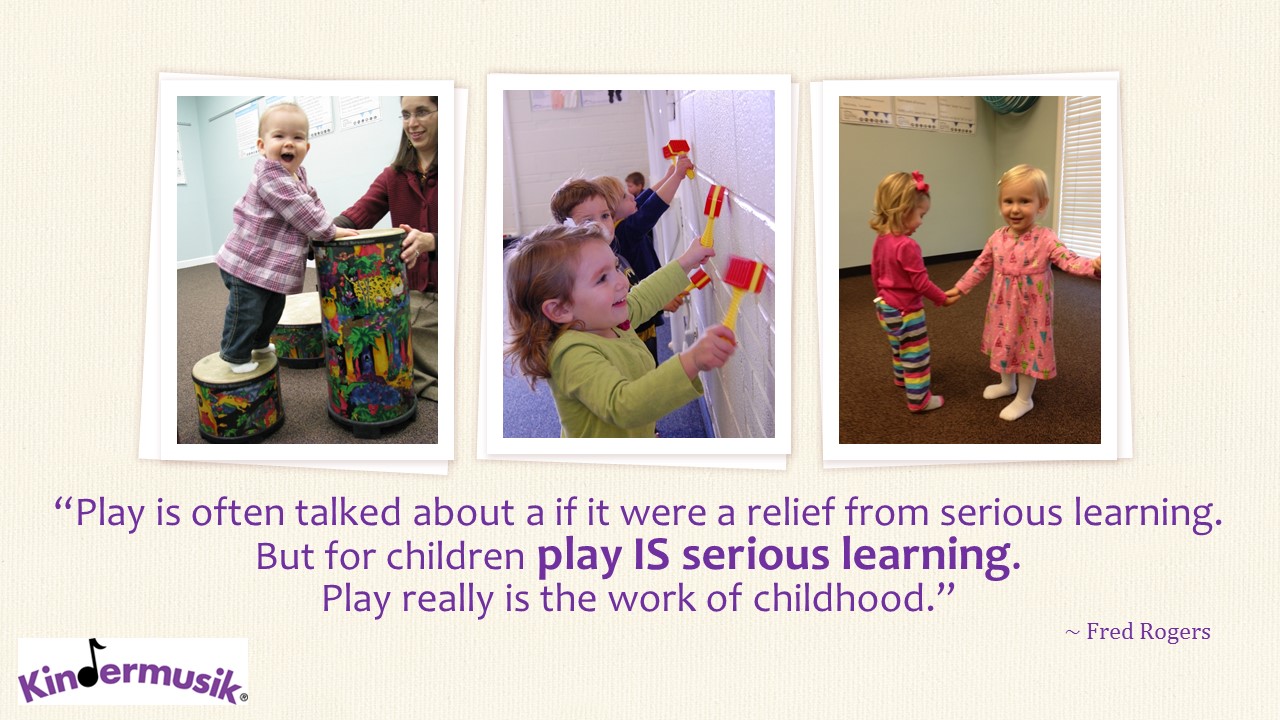
Play is the work of childhood.


So why DO kids blur the line between work and play?
  Because play IS their work!  Play is the most important activity of early childhood.  So even when it looks like a child is “just” playing, there’s really some serious learning and developing happening as a result of the play.
Music and movement activities are perfect for inspiring a child’s play, not just in Kindermusik class but also at home, because musical activites:

  • encourage children to think creatively and “out of the box”
  • give children many opportunities for open-ended exploration
  • use usual objects in unusual ways (i.e., a plastic hair curler that becomes a pull toy)
  • invite children to use their imaginations
  • stimulate expressive skills
  • incorporate pretend play

Children will engage in play in different ways at their different stages of development.  Here’s a quick overview so that you know what to expect as you observe your child at play.
Stages of Play


Shared by Theresa Case who has an award-winning Kindermusik program at Piano Central Studios in beautiful upstate South Carolina.

How Pizza, Pickle, & Pumpernickel Help Kids Learn How to Read

bigstock_Baby_Girl_Clapping_Hands_724132The steady diet beat of “Pizza, Pickle, Pumpernickel” helps children learn how to read. Of course, we are talking about the children’s nursery rhyme, not the food! Being able to move the entire body to a steady beat contributes to the ability to speak and read fluidly. In fact, children who can keep a steady beat independently score higher on reading assessments.
In this lap bounce version from Kindermusik@Home, even the youngest children can experience steady beat throughout their entire bodies. The more children experience steady beat with the help of a grown-up, the more likely they will be able to keep a steady beat independently. This steady beat activity works for older children, too. Try clapping hands to the beat or bouncing a favorite stuffed animal. As an added bonus to this music activity for kids, fingerplays improve and advance memory and language skills by linking motions to words.

So, go ahead and order in some “Pizza, Pickle, Pumpernickel”!

Kindermusik@Home

Find out more about Kindermusik at www.Kindermusik.com.

Contributed by Lisa Camino Rowell, a freelance writer living in the Atlanta area.

New Research: Music Can Offset Children’s Academic Gaps

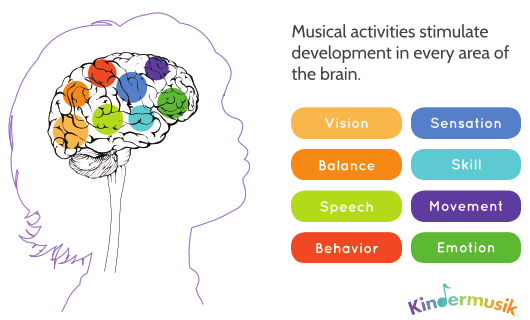
Musical activities stimulate development in every area of the brain

Musical activities stimulate development in every area of the brainMusic changes us. Of course, we know that music can move us to tears, conjure up (and make) memories, or even quiet a child’s cries. However, music also literally changes our brains!
A new presentation from neuroscientist Nina Kraus at the American Psychological Association’s 122nd Annual Convention displays some of the strongest research to-date proving how music changes the brains of children who are most at risk.

The Science Behind Music’s Impact on Learning

At the convention, Kraus shared her research findings that indicate learning to play a musical instrument or to sing can help disadvantaged children strengthen their reading and language skills by improving the way their nervous systems process sounds in a busy environment, such as a classroom. The boost to the neural function can lead to improved memory and longer attention spans, which help children focus better in school and improve communication skills.
“Research has shown that there are differences in the brains of children raised in impoverished environments that affect their ability to learn,” Kraus explained in a press release about her research study, Biological, Behavioral, and Academic Impact of Musical Training in At-Risk Children. “While more affluent students do better in school than children from lower income backgrounds, we are finding that musical training can alter the nervous system to create a better learner and help offset this academic gap.”
See, music changes our brains!
Kraus’ partner at The Harmony Project is Margaret Martin, DrPH, MPH. She started The Harmony Project in 2001 to serve children of poverty in areas with school dropout rates above 50 percent. To help prove that music improves language and literacy abilities of children, she enlisted the help of Kraus. And, what a great partnership for all music educators!
“Early sustained music learning is actually the frame upon which education itself can be built for low income kids,” Martin explained in this PBSNewsHour segment:
[youtube]https://www.youtube.com/watch?v=AZHg8dr6gf0#t=18[/youtube]

Musical training in early childhood

In Kindermusik early childhood classes for children from newborn through age 7, we intentionally use music as the vehicle for learning. So naturally, we get excited when research proves that musical activities really do have a positive impact on the way children learn.
Kindermusik supports all areas of development including—musical, language, emotional, physical, social, and cognitive development. When children actively participate in musical experiences, they engage their whole brain in the process. Here are just four areas and examples of how Kindermusik programs use music (and movement) to support a young child’s development:

  1. Communication Skills: When we recite a rhyme about shaking an apple tree then shake our bodies in the same way or sing “Head, Shoulders, Knees & Toes” and move our bodies to touch our heads, shoulders, etc., children develop a vocabulary and understanding of these concepts, even in infancy…by seeing, hearing, and doing.
  2. Listening Skills: By focusing intently on one sound, such as the beat of a drum,
    Laura Ainamo teaches English in Zimbabwe with Kindermusik
    Kindermusik class in Zimbabwe teaches children through music.

    children practice the skills of attention and engaged listening. Encouraging children to imitate the sound and discussing the sound increases comprehension and learning.
  3. Memory: Young children move to learn and learn to move. We specifically include lots of movement in our classes, which stimulates the release of chemicals in children’s brains that support memory and learning. So, when we dance a jig or hop like a frog children get the wiggles out….and keep the learning in!
  4. Comprehension: Engaging in language and literacy-rich musical activities that incorporate movement such as tapping the steady beat to a nursery rhyme correspond to greater comprehension.

Find out more about Kindermusik at www.Kindermusik.com.

Contributed by Lisa Camino Rowell, a freelance writer living in Atlanta, Georgia.