Meet a Kindermusik educator: Simone Melder

Each week we feature a randomly selected Kindermusik educator from around the world. This week, meet Simone!

Name:
Simone Melder

Location:
Blackburn South, Victoria, Australia

Number of years you’ve taught Kindermusik:
Eight

Studio name and link:
Kindermusik with Simone
http://www.kindermusikwithsimone.com.au

Describe yourself in five words or less:
positive, nurturing, fun-loving, compassionate

Favorite Kindermusik song:
Skinnamarink

Favorite Kindermusik activity, and why:
Snowflakes are falling – from Hello Weather.  I just LOVE the look of sheer delight on the children’s faces, when they open their eyes and find that snowflakes have fallen on them and all around the room!

A proud moment in a Kindermusik classroom:
My proudest moment was when a child who had spent four lessons burying her face in her mother’s bosom, too shy to participate , suddenly came “alive” and started taking part in everything.  She was my Kindermusik star!

Something your Kindermusik children or families have taught you (could be inspirational, humorous, practical, etc.):
The children have taught me to expect the unexpected.  Never rely on a “plan” because your plan can go haywire in a split second. I have learned to stay centered and calm in the midst of chaos!!

Something funny a child has said or done in your classroom:
When introducing Bach to my ABC Music and Me class, I said that Bach had died many years ago.  One little girl asked me “Did he go to heaven?”  to which I replied, I am sure he did as he wrote such beautiful music!

The reason you teach:
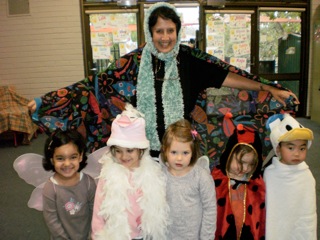
There is nothing that gives me greater joy than to bring the joy of  music into the lives of so many children.  I found Kindermusik late in life, after spending 40 boring, unproductive years in an Administrative position.  I am very grateful that I have been able to follow my dream and that I am still fit and healthy and, at my age, am able to crawl around the room like a caterpillar, or flutter like a butterfly!  The children make me come alive and I consider them part of my family.

Kids can get stressed too

Relaxation is something we all search for, yet we don’t always find time for it. Life can be stressful and fast-paced, and it’s often difficult to find time to let our bodies and minds relax. Sometimes even when we’re “relaxing” we’re thinking about what’s next on the to-do list!

Adults stress tend to stress about grown-up things like the responsibilities of maintaining a family, paying the bills, and so on. But children experience stress too. They may not be able to express it, but here are some behaviors that could be signs of stress:

  • > mood changes
  • > changes in sleep patterns or nightmares
  • > exhibiting behaviors of a younger age (thumb sucking, bedwetting, clinging, etc.)
  • > no appetite or wanting to eat all the time
  • > needing to go to the bathroom frequently
  • > nail biting
  • > engaging in disruptive behavior

If you notice some sudden changes in your child’s behavior,  stress could be a factor.

You may ask what on earth could they be stressed about? After all, they don’t have any bills to pay! Children tend to experience stress in new situations, when changes happen, or when they are confronted with challenges that require new skills. These might include learning to play with a new toy, learning to share with a sibling, making new friends, completing a project, and so on.

But don’t get stress yourself! Parents and caregivers can model and teach children ways to manage stress. Here are a few suggestions:

  • > keep a consistent routine
  • > make sure the child is getting enough sleep
  • > if the source of stress can be removed, simply remove it
  • > laugh, joke, sing, dance
  • > set aside some quiet time
  • > do something active to relieve stress, like jumping, running, or playing
  • > do a creative, calming activity like coloring

These activities will help your child learn to manage stress and deal with challenging situations. (Of course, if a behavior persists or becomes a serious issue, you may need to consult your physician.)

The goal is simple: make your kids feel good. When they feel good, you feel good!

What other activities can we do with our children to help them manage stress? Post an idea in the comments area below.

Special thanks to Kindermusik educator Vanessa Cabrera for sharing this post from her Language, Music & More blog. Information about Vanessa’s Maryland Kindermusik program can be found at her blog.

One group’s Kindermusik journey

Today was the final class for my first group of “graduating” kids, who are moving on from Kindermusik to other activities. When I first became licensed as a Kindermusik Educator, I had no idea what to expect.  My first year, I had less than a dozen students, and struggled to keep up with the demands of memorizing so many lesson plans in addition to my regular private lessons and my job as Korben and Sophie’s mom.

My first two classes were toddlers in Our Time (Sophie’s class) and kids in Young Child, which included Korben and my good friend Carrie’s twins.  The second year, I didn’t have enough interest to make a Young Child 3 group, so I called Lisa Arriaga at “Sing and Play Fine Arts” in Pearland to see if she was offering YC 3, and she said, “I’ll offer it if you’ll come teach it!”  I didn’t want Korben to miss out, so I jumped at the chance, and I really enjoyed teaching a fun group of girls… and Korben.  At the end of the fall, the girls all decided to switch to piano.  Korben’s been studying piano in addition to KM since he was 4, so I was disappointed that he wouldn’t get to learn the recorder in Kindermusik class.

Meanwhile, I began a new group of Young Child students on Semester 1 and 2, and that group stayed together through the first year, summer Adventures, and Semester 3.  When they re-enrolled in Semester 4, I was thrilled!  Korben is 7 now, so he was still young enough to join their class and finish the Young Child program.  Another of my private students who was struggling with private instruction also joined the class for this final semester, and we have all had SO much fun this spring.

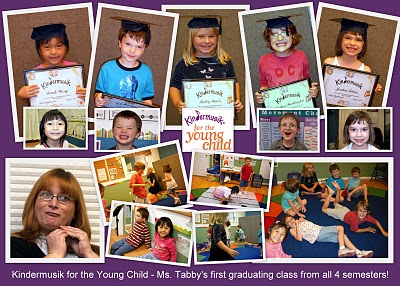
In order from left to right, I’d like to take a moment to share my favorite experiences with each of these kids.  Sarah is the quietest in the class.  She often will come and whisper to me what her choice for movement in our hello song is.  She is also very sweet and has drawn me pictures and cards that I treasure, and is quite the artist.  She is the most musical of all the kids in the class, and practices with dedication that will serve her well as she begins to study piano.  Andy is the class clown.  He likes to be the center of attention, and I see a career in performance in his future.  He is highly intelligent and curious, and has kept me on my toes.  Bailey just joined us this spring, but she is very quick to learn all the new songs we sing.  She has a great ear and a big voice for someone so small, and she really enjoyed being in a group setting.  Korben is the oldest in the group, and he struggled at times with the job of being a good example for the other kids, as not only the oldest, but the teacher’s son.  He had the easiest time playing the recorder, since he had a whole year of development on most of the kids.  Jordan is my silly sweetheart.  She likes to joke around, but she also is the most physically affectionate of the class.  She would be happy just to sit in my lap, no matter what we were doing.

As a voice teacher, I am amazed at how much the children’s voices developed over the course of their Kindermusik experience.  Without exception, all of the children who graduated today are able to sing accurately on pitch. Jordan’s mom said, “I don’t know where she got it from!  It certainly wasn’t me.”  Well, I know where Jordan got it from… Kindermusik!  The best part about it is that the kids don’t even realize that they’re learning to sing accurately – they think we’re just playing games. They think it’s super fun, and sing all kinds of songs to our simple melodies from class, and that practices that skill of  singing on pitch.

I am so grateful to have been given the opportunity to know and love these children.  I will miss having them as students, and I know that they will be more successful in all their future educational endeavors for having taken Kindermusik, regardless of whether they’re studying music or math.  I look forward to having many more graduating classes in the coming years, but this first class will always hold a special place in my heart.
-Tabby Worthington

Thanks to Tabby and her class for allowing us to share this great story and photo collage. We’re proud of her and these kids, and know they are all on to great things! More info on Tabby’s Houston Bay area Kindermusik program can be found at www.kmtabby.com.


Meet a Kindermusik educator: Peggy Durbin

Each week we feature a randomly selected Kindermusik educator from around the world. This week, meet Peggy!

Name:
Peggy Durbin

Location:
Columbia, MD 21042

Studio name and link:
Kindermusik with Peggy Durbin
www.makingmusik.com/peggydurbin

Number of years you’ve taught Kindermusik:
16

Describe yourself in five words or less:
Dedicated, Dependable, Organized, Positive & Easy-Going

Favorite Kindermusik song:
Walk & Stop – so simple, effective and adaptable

Favorite Kindermusik activity, and why:
I love Roll Over, Rover. Adults lose their inhibitions about being in a class with new people and just focus on having fun with their children.  Children love it when adults are playful and engaged.

A proud moment in a Kindermusik classroom:
My proudest moments are when families enroll their second, third or fourth child.  That shows me that they value the experience so much that they must provide it for all of their children.

Something your Kindermusik children or families have taught you (could be inspirational, humorous, practical, etc.):
A Kindermusik mother of a newborn child told me that her child stopped nursing when the music stopped in the Jasmine Flower song!  What a great example that even the youngest child learns from the experiences in a Kindermusik classroom.

Something funny a child has said or done in your classroom:
Often parents will initially express concern that their child may not participate when visiting a free class.  I love it when the child leaves mom or dad’s lap to sit with me during the class!

The reason you teach:
Young children energize me!  I love introducing the world to them through music and movement.  Not only is it enriching to the children, but it also opens the eyes of many parents on how to interact and play with their children.  Play is how young children learn!

Children are ready to learn long before schools are ready to teach

Music is a magic little key to your child’s heart and mind. It’s a dynamic sensory experience that evokes a powerful response in children. Early exposure to music is a vehicle for profound learning.

We’ve found that music and movement that involves interaction, demonstration, and exploration is the perfect way to introduce a child to the learning environment.  That’s why Kindermusik provides a unique opportunity to begin your child’s preparation for school – and, for that matter, for life.

Our program is carefully structured and developmentally appropriate. That means the music and activities reflect the age of your child. The Kindermusik classroom is set up in a manner that is most similar to what your child will experience in preschool and/or kindergarten.

This can give your child a great head start.

That said, don’t confuse Kindermusik with the potentially stressful environment you might find in a “toddler prep school”. Our program is not design to push children. In fact, quite the opposite. Instead you’ll find that our curricula nurtures and mirrors your child’s development with a fun, engaging, and stimulating environment. We encourage all children to learn and participate at their own pace. You’ll hear our Kindermusik educators say this all the time.

We know that these days parents have dozens of activities to choose for their children. Our goal is to stand out above the rest as the best option for you and your child. We feel that our research-based, research-proven program will not only prepare your child for school and the future, but you’ll get to have a lot of fun along the way!

Want to preview a Kindermusik class for free? Fill out this online form and an educator near you will contact you with more information. We hope to see you in Kindermusik soon!

Growing up Kindermusik

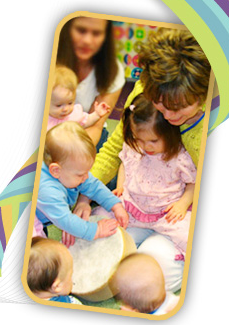
Recently, we refreshed our kindermusik.com homepage (have you seen it?) with some new colors and photos. Those who visit the site often immediately started asking about the cute new homepage photo.

The photo is of Kindermusik educator Kathy Morrison and several of the kids in her class. Kathy’s program, Kathy’s Music, has been in the top 1% of Kindermusik programs for five years running.

The photo is about two years old, and in a recent email exchange with Kathy, she commented about the children pictured. She writes:

This was a Kindermusik Village class that I taught about two and a half years ago.  Each time I see this on Kindermusik.com, it gives me a little jolt because that’s me and those are my students. How cool is that, and how sweet are those children?!

Now these children are 3 years old and have moved up through our Kindermusik program as the years have gone by.  Teaching children as babies and having the opportunity to watch them grow and learn along the way – that’s why I teach Kindermusik. It’s why I work hard every day to provide an excellent classroom experience that is fun for the families, educational for the children, and helps make great parenting easier.

Once upon a time, it was one of my own children, as a baby, on the floor  in a Kindermusik class. My children’s lives were so enriched by Kindermusik over the years and I want to pass that along to other children and families in our community.

We thank Kathy for sharing her passion, both in words and picture. It’s such a nice little snapshot of Kindermusik in action. Kathy’s Music has four locations in and around Pittsburgh. You can visit her studio’s website or blog.

Orchestrating some fun on the web

from the SFS Kids site

The earlier you can expose your child to classical music and the magic of the symphony orchestras, the better. Music appreciation is something you want to instill early in a child’s life. (Shameless self-promotion: music appreciation is one of the skills children develop in Kindermusik classes. Find a Kindermusik class near you to learn more.)

Summer  is one of the best times to take in a symphony. Many cities have outdoor venues and band shells where orchestras perform regularly. If there is a lawn area, is there any better way to take in a picnic? Kids of almost any age will love this. Let them dance and sway to the music. If you can talk quietly during the performance, introduce them to the various instruments on stage or other musical concepts. Some orchestras even have performances specifically designed for kids.

if you can’t get to a performance any time soon (or even if you can!), a number of symphony orchestras have wonderful kid-focused websites. Here are a few to check out.

The San Francisco Symphony Orchestra Kids has an energetic home-page at www.sfskids.org. You’ll find a quirky variety of musical games and activities.  Compose your own music, learn about the instruments of the orchestra, and more.

Or check out these other musical sites:

  • Dallas Symphony Orchestra Kids: www.dsokids.com
  • New York Philharmonic Kids Zone: www.nyphilkids.org
  • Austin Symphony Orchestra Kids: www.austinsymphonykids.org

Extravagant fondness and passion

photo from CNN.com

I was awestruck by Luis Soriano, of Magdalena, Columbia (click here to see Luis’s story on CNN.com) whose passion for early childhood literacy takes him, astride his “biblioburro” for five hours at a time, to share books with children in rural villages. Self funded, using his weekends, his 4,200 books are now the largest library in his community.

I think of his passion as an extravagant fondness for education. Why extravagant? Because it extends beyond reason, beyond what is convenient and easy.

Kindermusik is a community of passionate educators. I received an update from an educator in the Chicago area today who has maintained her Kindermusik teaching schedule despite months of chemotherapy and radiation – all so the children can learn from her strength. In turn, she is buoyed by the children and the music.

May we all sing through our challenges, ride burros for literacy and generally act with extravagant fondness for what we know makes a difference in our world.
-Michael Dougherty, CEO of Kindermusik International

Using movement to activate the brain

Mom and baby

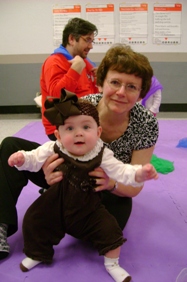
Mom and babyResearch has proven that the area of the brain that deals with cognitive thought is activated through movement. In other words, movement can literally turn on your child’s mind! For example, when you hold your baby and whirl around in one direction and then whirl in the opposite direction, this stimulates his neural pathways and actually helps them develop.

Moving with your child is a great way to spend time because it’s fun and it has a great benefit.

We’ve put together a few ideas of movements you can do at home with your child. Try these to get those brain muscles flexing.

Kindermusik’s movement ideas for…

…your baby: Put on a favorite piece of music and pick up your baby.  While holding him, place one foot in front of the other and rock from front to back, balancing most of your weight on one leg at a time.  Swoop, swirl, and swing your baby high and low in response to the music.

…your toddler: The world of a toddler is a very physical place, and your child will learn a new word more easily when you pair it with the action. So try doing different actions together while saying the word. For example, jump up and down and say the word “jump.”

…your preschooler: Encourage your preschooler’s creativity. Play some music and ask her to make up a different dance for the verse and the chorus. Help her distinguish between the two. She will not only be stimulating her brain through movement, but also learning musical concepts as well.

Have a movement idea of your own? Feel free to share it in the comments area below.