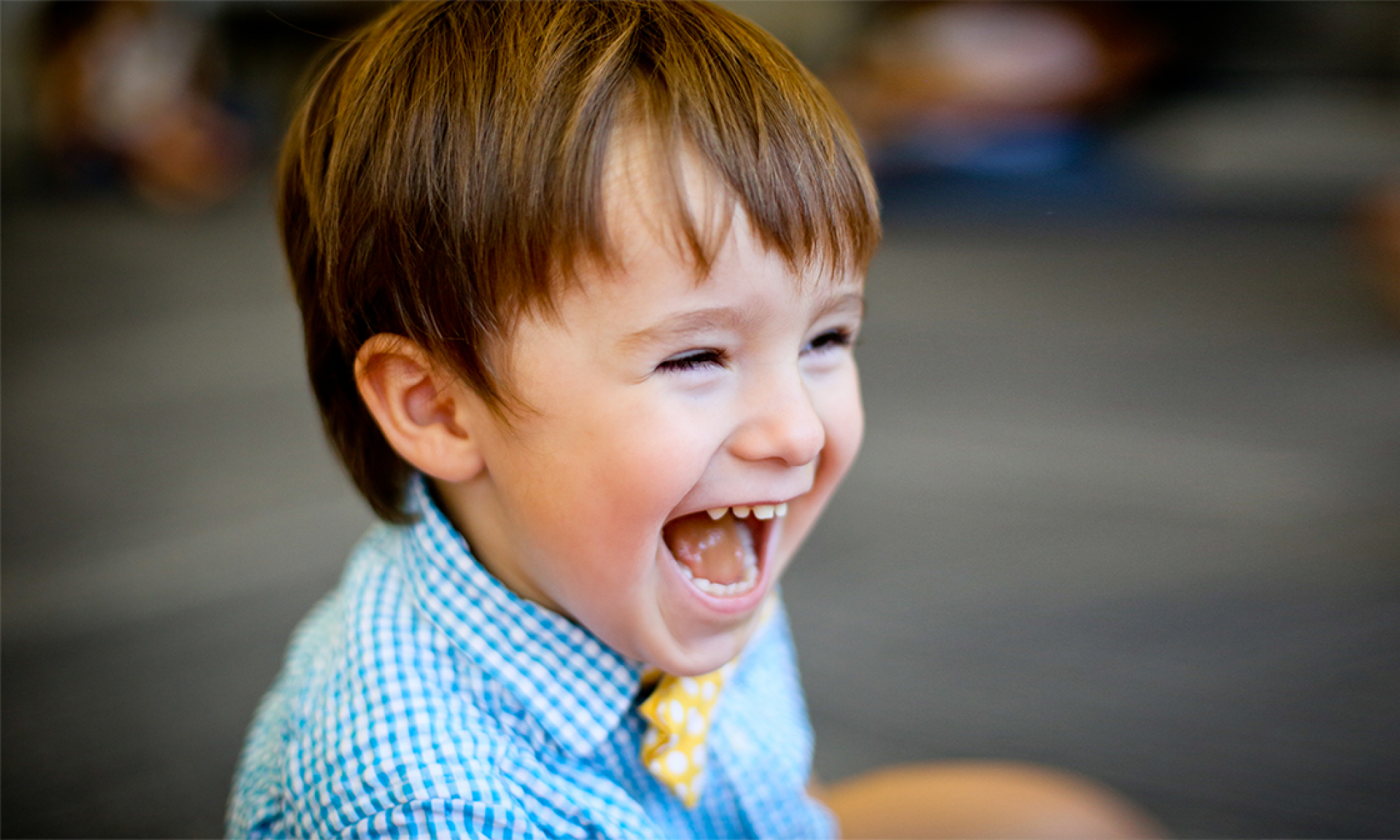
Meet Luke. You’ll be glad you did.

The following post was graciously shared with Minds on Music from Studio3Music. We all agree: it’s what Kindermusik is all about!

This arrived in my inbox the other day from one of our Kindermusik moms, Melissa. I read it, and by the middle of the email, I had tears streaming down my face. I have never had a story about one of our Kindermusik children touch me quite as much as Luke’s. Enjoy!

My child is special.  Yes, I know what you’re thinking, ‘your child is special too’, but my child is REALLY special.  Luke is a special needs child. In short, he was born with brain damage.  He has developmental, fine and gross motor, and significant speech delays.  One thing that Luke is not delayed in is his love for music!

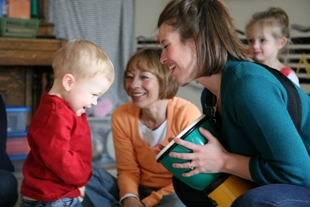
We started Kindermusik with Luke when he was 2. As we sang during Luke’s first class his teacher, Beth, explained how holding the different sized egg shakers encouraged different motor skills.  I felt a pang of emotion shoot like lightening through me.  “This is perfect for Luke”.

We played with items with different textures, something Luke’s physical therapist had suggested just weeks earlier.  We drove cars on different body parts, played games, and of course sang and danced!  I knew right away that Kindermusik going to be great for Luke.

After that first class I buckled Luke in his car seat, drove about a quarter of a mile down the road and began to sob. I was (and am) SO thankful that Luke has this opportunity to nourish and support him in such a fun way.  I immediately turned my car around and went back to the Kindermusik class.

Miss Beth saw my tear stained eyes and gave me a big hug before I could even share anything with her.  Once I found some composure I briefly shared Luke’s condition with Beth and told her what her class means to us.  Here she is, just doing her job, like so many other Kindermusik teachers but she is actually helping to HEAL my child…and expand yours!

For most of Luke’s first round of Kindermusik he was typically just along for the ride.  He didn’t have the fine motor skills to play many of the instruments, his sensory issues made it difficult for him to transition from playing to being held quietly during cuddle time, he doesn’t have the ability to talk so singing along was out, he didn’t make any sounds at all for that matter, also, he couldn’t sit still for story or rolling a ball back and forth, and he didn’t mimic so he wasn’t quite developing thru watching either.  I pretty much held his hands, literally, throughout every exercise and activity, manually supporting his hands and fingers in participation.

Despite all this, Luke LOVED Kindermusik.  He began to get excited when we’d pull into the parking lot for Kindermusik, squealing, smiling, and kicking his legs in excitement!  Then one day, as we left class I put Luke in his car seat.  I sat my keys in his lap while I buckled him in and he took my keys, put them between his legs, and put his arms up and out to his sides.  Luke was mimicking!  Luke was trying to play!  Luke was thinking in his sweet little brain:

Jingle, jingle, jingle, go the car keys.
Jingle, jingle, jingle, go the keys.
Lost them, lost them, where are the car keys?

I couldn’t wait to tell Miss Beth…and everyone else for that matter!

Luke is now three and in his second week of his second round of Kindermusik.  Now Luke zips around the room yipping and squealing.  He had class this morning and did 6, count them 6, new things in those precious 45 minutes.

First, Luke attempted hammering his rhythm sticks!  He switched his grip around until he was able to hit the top of one stick with the other like he was hammering in a nail.  No hand-over-hand, he just did it!  He knew he did it too!  He made sure I saw him and I could see the pride in his smile.  I felt that lightening bolt of emotion shoot through me again.

Next, he noticed that I had put the top of the tone bar back on upside down.  Noticing this is huge. Next, he tried to problem solve by turning the bar over.  Of course his logic was flawed, but for a little boy without a frontal lobe, attempting to problem solve is huge!

NEXT, Luke allowed me to hold, embrace, and rock him during the cuddle part of class!  I think he even enjoyed it!  After this we played with balls.  Luke still couldn’t sit still or roll the ball but he did something unexpected, he caught the ball, a few times!!!  I’ve never seen him do this before and, since he has an older brother, balls are big things in our house!

Also during ball time, he saw a classmate sitting on her ball and bouncing on it…what did Luke do?  He mimicked!  He put that ball under his little tush and tried to sit on it!  He couldn’t balance well enough to do it but he tried…I almost cried!

Lastly, when class was over, Luke “eagerly awaited” his hand stamp.  His version of eager waiting is standing up an inch from where I’m sitting and pointing with a limp wrist at Miss Beth stamping the other kids.  I escorted him up front and he got his stamp.  That’s not new, what is new is what happened next:  he pulled up his shirt up, along with the sensory leotard top he wears, stuck out his belly, and gently patted his stomach.  HE wanted to have his tummy stamped like some of the other kids and, in his own way, he TOLD me this!  Talk about leaps and bounds!

Another thing we’ve noticed since starting Kindermusik is that if Luke is “playing” a musical instrument with his hands he may, on rare occasion, vocalize. In a sweet, soft, broken, purposeful whisper we’ve heard him sing:  “ahhhhhhh”,  “oooooooooh”, and “ooouuuuuuu”.  He is always the first to notice that music is playing: in the car, at the mall, on a commercial, anywhere.  He is drawn to it.

If Kindermusik can have such an impact on my special needs child, just imagine what it is doing for your child!

If you ever get the chance to meet Luke you will know immediately that he’s special. You may not even notice that he is handicapped because you’ll be so mesmerized by his hugely gregarious smile and his eyes shooting darts of love at you more accurately than one of Cupid’s arrow.

-posted by Melissa, Momma to Luke, who says that there is indeed something special about Luke, and her family is SO thankful that he has the musical therapy of Kindermusik harmonizing with them to help heal him.

Special thanks to Studio 3 Music for allowing us to share this great post from the Studio 3 Music blog. Studio 3 Music in Seattle, Washington, the world’s largest Kindermusik program.

Meet a Kindermusik educator: Betsy Flanagan

Name:
Betsy Flanagan

Location:
Madison WI & Surrounding Communities

Studio name and link:
Musical Pathways Foundation
www.musicalpathways.net

Number of years you’ve taught Kindermusik:
7

Describe yourself in five words or less:
Passionate & Loving People Coach

Favorite Kindermusik song:
Skinnamarink

Favorite Kindermusik activity, and why:
Tants, Tants Yidelekh:   Accesses all 6 regions as we dance and laugh as a community, while children enjoy and learn the timbres and tonality while feeling the structure, beat and sequence of the dance for cognitive, emotional, physical and language fun!  It’s a BLAST!

A proud moment in a Kindermusik classroom:
A class had begun the semester disconnected, parents unengaged with their children, and at the end of the semester were completely engaged in scaffolded, joyful play with their children.  Tears of joy came right then and there as I stepped back and watched this beauty in action.

Something your Kindermusik children or families have taught you (could be inspirational, humorous, practical, etc.):
Love has many different faces and we need to engage in relationships verses assumptions.   I will never again assume that someone is not enjoying my class because of how they look, because when we originally participated in the Loyalty Surveys, I discovered that people could Love you and not appear or communicate as we might expect.    Now I form relationships with all my families.   My life is richer and there will be no surprises!

Something funny a child has said or done in your classroom:
Walked into the middle of the Hello circle in Our Time and proudly pulled down his pants to show us his new Batman Bigboy pants – got so excited he peed right there.  Precious!

The reason you teach:
To change the world, one child, one family at a time.

When you run out of words

This post was shared with Minds on Music from Kindermusik educator Analiisa Reichlin. 

I sat at the dining room table with my head in my arms and just sobbed. Our studio email accounts had disappeared, our website was being migrated from a very slow, old server to a new one, and the ½ hour project turned into a week-long nightmare, and the site was down during our busiest time of the year.

Our dog Buddy had been bitten or stung by something, and had gone into anaphylactic shock. In addition, after 3 years of deals falling through at the last moment, we were just about to put an offer in on a house. But that was before the unexpected expenses that wiped our savings out.

It was only 7:30am on Tuesday. And the week really didn’t get much better. I’m sure you’ve had weeks like that, too. But before this gets too depressing…

I found myself frequently bursting into song this week. And of all the odd things – hymns from my childhood. There was something comforting about them. I began wonder why.

I remember when I took my husband-to-be, Karl, to his first musical – Showboat. I grew up on musicals, and went to as many as I could when I lived in New York City. So I was totally dumbfounded when he turned to me shortly into the first act and said, “They just burst into song. Why did they do that?”

I’m thinking, “Well, it’s a musical.

Years later I asked [my Kindermusik partner] Miss Allison (with her degree in musical theater), why do they burst into song? And she said that the character has reached the point where the emotional intensity of the moment can no longer be conveyed with words.

So this week, when I ran out of words, I found myself singing. But why the hymns? Certainly because the words brought me comfort. But also because when I sang them, I was brought back to the time when I was young, surrounded by my family, in a moment when I felt very loved, and at peace. Where I needed to be emotionally this week.

I got to thinking…What songs did I sing to my babies, and now with my children? Because those are the songs that they are going to sing when they are grown up and need to remember the emotional security and comfort of those who loved them best.

-by Miss Analiisa, who knows that the math formulas she teaches her children may not be remembered when they are older, but the music and songs she instills in them will be in their memories forever.

Einstein and his violin

This article was written by Kindermusik educator Helen Peterson. Helen’s Kindermusik of the Valley program, located in and around the twin cities, MN, is one of the top programs in the world. Enjoy this little vignette!

A few years ago, Tucker and I took a quick trip to Washington D.C. and, like thousands of other tourists, I made him sit in Albert Einstein’s lap for a picture.

Albert Einstein’s schoolteachers told his parents that he was “stupid” and simply couldn’t learn. They urged his parents to take him out of school.

What did his parents do instead? They bought him a violin. It was a turning point.

In later years, Einstein would turn to his violin while trying to work out his scientific problems and formulae. Once, when asked about his theory of relativity, Einstein explained, “It occurred to me by intuition, and music was the driving force behind that intuition. My discovery was the result of musical perception.”

Your child rocks!

When your baby cries, you instinctively scoop him up and rock him.  His need to move and his ability to be soothed by movement are vital in the first 15 months of life when the vestibular system – the area that gives him a sense of balance and distance – is developing.
Aside from the physical benefits of movement, your child also recieves an emotional benefit from rocking and bonding with you.  This quiet, rocking ritual can provide him with a sense of security, allowing him to grow into an assured, confident learner with a healthy self-esteem.

Rocking is still important as your young child grows and will often become a favorite – and memorable – activity for both child and parent.  Even older children benefit from the stimulation of the vestibular system.  Urges to run and tear around the house can be mellowed by taking a few minutes for quiet or even more active rocking.

Kindermusik Tips for your Baby, Toddler, and Preschooler

  • > Rocking your baby: Place a blanket on the floor and lay your baby in the middle.  With an adult caregiver on either side, pick up a corner of the blanket and gently “hammock” your child.  If your baby doesn’t like rocking this way, simple lay him on his back and gently rock him side-to-side to the rhythm of the music.
  • > Rocking with your toddler:  Toddlers can rock a favorite stuffed animal, or while you sit on the floor, your toddler can hug you from behind as you rock back and forth to the music.
  • > Rocking with your preschooler: Preschoolers will love to curl their bodies into little balls, and rock and roll around the room. Want to let your inhibitions go? Do this with them! Fits of giggles are sure to follow.

Meet a Kindermusik educator: Jessica Solares

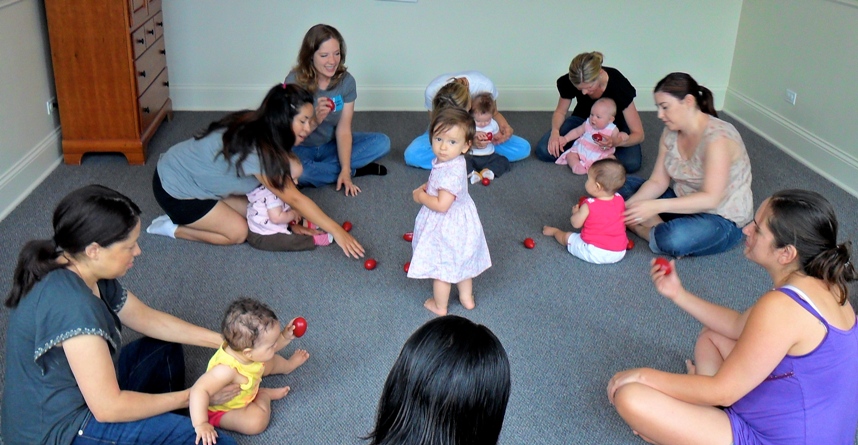
(Jessica is pictured in the gray shirt with blue emblem near the back of the room.)

Name:
Jessica Rice Solares

Location:
Chicago, IL, USA

Studio name and link:
Bucktown Music
www.bucktownmusic.com

Number of years you’ve taught Kindermusik:
1.5

Describe yourself in five words or less:
From me:  creative, passionate
From my customer loyalty surveys: talented, fun, clever

Favorite Kindermusik song:
So many great ones, but “Big Black Bear” really stands out.  I love seeing the kids pretend to go on a walk and then the sleeping bear wake up and ROAR!

Favorite Kindermusik activity, and why:
Once again, really difficult to choose, but recently, “Snail & Grasshopper” from Village Dewdrops.  I love that it teaches AB music form, fast/slow, major/minor, ASL, and incorporates so many senses:  auditory, kinesthetic, visual.  Plus the babies all crack up during the bouncing and anticipate the stopping.

A proud moment in a Kindermusik classroom:
When I looked around a Village class and saw most adults dancing with someone else’s child.  What a wonderful community where everyone trusts each other with their children!

Something your Kindermusik children or families have taught you (could be inspirational, humorous, practical, etc.):
My families have taught me to be respectful and not to judge, and that there are unlimited ways to do something, or think about something.  Everybody has their own way, and that’s good.

Something funny a child has said or done in your classroom:
One 3 year old boy wasn’t seeming to pay attention during a Family Time class, and then at the end, he grabbed his little sister’s hands, swung her around, and sang “Skinnamarinky Dinky Dink, Skinnamarinky Do, I LOVE YOU!!!” at the top of his lungs!

The reason you teach:
I love seeing the children and parents grow and learn, and am honored to be part of that experience.  It is important to me to show the parents that THEY are their child’s most important teacher.  I’ve also found that students who have completed the Kindermusik program have shown an increased ability for abstract musical concepts, have better rhythm and intonation, and better listening and attention skills.

What can your child learn from a puddle?

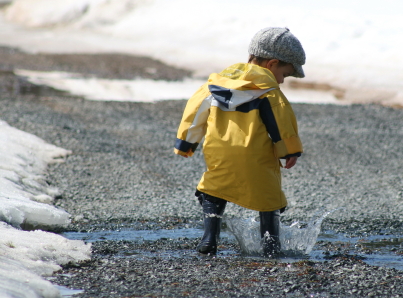
What would it be like to walk through a puddle for the first time? To not notice it coming up and then just hear the rhythm of your walk change from a tap tap tap to splish splish splash? . . . You look down and notice you are standing in water. You see it, consider it, feel it. What an adventure of the senses!

Parents know how lucky they are to see this happen right before their eyes: their child discovering something new – something that has a sound, or a feeling, or shines, or moves. Discovery can be an incredible gift.

By letting your child walk through that puddle, millions (maybe billions) of sensory connections are made. Thought patterns, optical pathways, auditory stimulation, and your child’s perception of the world are altered and strengthened.

Embrace what a difference you make for your child by taking those walks that last a long long time but cover very little ground. Remember, every stone, pine cone, ant, bird, leaf, and puddle holds a world of discovery. Don’t miss it! Don’t worry about the puddle – the shoes will dry and the pants can be cleaned. The work of the child is to experience something new every day, and that’s one of the best ways you can help your kids learn and grow.

-This post was contributed by Kindermusik educator Helen Peterson. Helen’s Southern Twin Cities program, Kindermusik of the Valley, is in the top 1% of Kindermusik programs around the world.

Music and movement: magical ingredients to learning

Music and movement are magical ingredients to learning for both the child and parent. A baby’s first communication is through movement. A toddler immediately responds to lively music with silly gyrations and flailing limbs – and while these movements usually make us giggle, to him they are serious attempts to coordinate movement with rhythmic patterns. The preschooler seems to be constantly moving – leaping off couches, rolling down hills, and spinning around and around until she falls down in a giggling flop on the floor.

Movement is fundamental for the development of the central nervous system, and science proves it. But what’s more, movement and rhythm are also essential for the development of the soul. These are things that can’t be measured with research and studies.

When a parent moves with her infant, a special bonding takes place that is key to social and emotional growth. When a parent sings to her child, not only are language skills being developed, but also a sense of love, comfort and harmony. The special touching, laughing, and rhythmic moving that takes place in a music and movement class lays a very strong and much needed foundation for a happy, healthy and joyful life!

Here are just a few of the ways that Kindermusik children learn through the interactive music and movement activities of the Kindermusik classroom:

  • Intentional touch is designed to provide stimulation of the nervous system, relaxation and bonding.
  • Activities involve unilateral, bi-lateral and cross-lateral movements that help develop the brain and muscles.
  • Movement and dance steps allow the caregiver and child to experience different rhythms and locomotor movements.
  • Synchronized dances develop sequencing, provide reassuring repetition and social interaction.
  • Expressive movement provides variety, creativity, and opposing feelings such as fast and slow, high and low.
  • Rocking and swinging stimulate the vestibular system, which is so important to balance and even eye movement.
  • Props, such as the “humongous” scarves and parachutes, provide tactile and visual stimulation.

So put on your Kindermusik CD at home and don’t worry about performing the dances “just right.” Don’t even worry about right and left! Simply move to the music and have fun! It all makes a difference.

-This post was adapted from a past issue of Kindermusik Notes and was originally written by Anne Green Gilbert, Director of the Creative Dance Center and Kaleidoscope Dance Company in Seattle, Washington, and a consultant for Kindermusik International.

The family that laughs together…

Overtone Singing Crazy Sounds

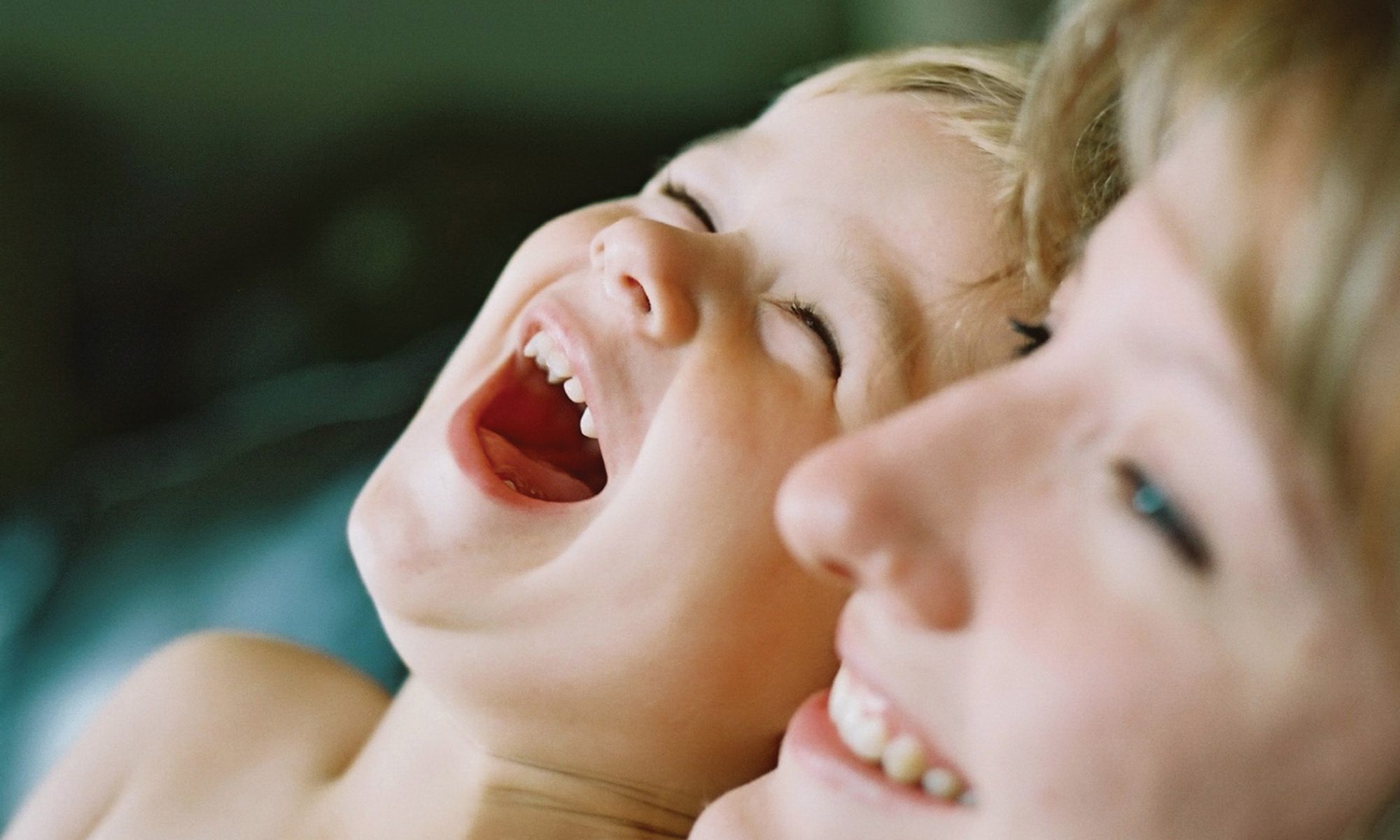
Giving your child a simple smile can improve his or her self image and brain development. When your child sees you smile, it not only makes her feel good, it strengthens connections in the brain as well.

Studies have shown that smiling and laughter can strengthen the immune system, lower blood pressure, and reduce stress levels. And a healthy sense of humor can help a child handle problems as they grow into adults, as well as enhance the social skills they need to make friends.

Along with smiling, laughter is a sound that’s naturally interesting to your toddler. As he’s getting ready to learn to talk, he needs help learning how to listen so he can distinguish one sound from another to form his first words. Play active listening games like “One ha-ha-happy family”, described below. As you listen, exaggerate your body posture, lean into the sound, brighten your eyes, and model the body expressions of a good, active listener for a happy, talking toddler.

One ha-ha-happy family
Laugh out loud. Ask your toddler to make the sound back. Laugh lots of different ways to your toddler. Wait for her to copy you, and vice versa. Record the sound of your toddler laughing. (Family idea: Make a “Laughter Scrapbook”! Record your family laughing together and all the different ways you can laugh. Keep adding to the recording as the years go and by and hear how the sound of your laughter changes.)

As well as listening games, why not combine physical games with music? This will give your toddler something to laugh about, learn more words about, and develop better coordination.

When you’re a toddler, running is usually accompanied by fits of laughter. This new found physical control makes games like “Ring around the Rosy” a huge hit. Rosy can fall down or do the silly walk – have fun by exploring lots of ways Rosy can “all fall down” by doing other movements that your toddler finds funny, like playing chase or running. Explore sound with your baby before bedtime. Put on your favorite lullaby (or sing it yourself) and play along gently with a musical instrument.

Say “Cheese!”
Smiling and laughing play a large part in the bonding and attachment process that help your child feel secure and safe. Children primarily use their parents’ facial expressions as a guide for behavior. The emotional experiences a child has (especially during the first years) help shape emotional responses throughout life. It’s worth remembering that a simple smile is one building block for your relationship with your child. Your face is where your child looks for reassurement, comfort, and  attention. So don’t be afraid to show your child those pearly whites!


Meet a Kindermusik educator: Holly Lesnick

Name:
Holly Lesnick

Location:
Orlando, FL

Studio name and link:
Grow and Sing Studios
http://www.growandsing.com

Number of years you’ve taught Kindermusik:
8 years

Describe yourself in five words or less:
Wife, mother, friend and teacher

Favorite Kindermusik song:
Butterfly Wings

Favorite Kindermusik activity, and why:
There are so many favorites, but nothing brings me more joy than a roomful of babies and their caregivers dancing to Hop Up my Baby! The smiles and laughter are infectious!!

A proud moment in a Kindermusik classroom:
One day, I greeted my Our Time class as they entered the classroom. One by one everyone entered the classroom, and I realized I had an overfilled day with my full class of enrolled families, plus preview families and families making up classes. I welcomed the challenge and during quiet time, I looked around, and every single child was cuddled up with their parent or caregiver, and all were singing together. It was magical.

Something your Kindermusik children or families have taught you (could be inspirational, humorous, practical, etc.):
That each week is like a box of chocolates, you never know what you are going to get. I love it, and it keeps me on my toes at ALL times!

Something funny a child has said or done in your classroom:
“Miss Holly, can you come live with us?”

The reason you teach:
The question should be why I teach KINDERMUSIK. It is the most fulfilling work I’ve ever done. I love connecting with the children, but also with the parents, and sharing my passion for music. My motto is “Connecting Families through the Magic of Music”, and that’s what I get to do. It’s such a wonderful combination that makes it right for me.