Researchers say bilingual children are often on their mental toes, switching back and forth between two languages. That mental acuity has an influence on a number of abilities, new research shows. Studies show bilingual children have larger vocabularies, a deeper understanding of words, as well as “selective attention,” or, the ability to focus on what’s important.
Who says Klingon is a dead language? The Calgary Herald, November 2, 2012
The language was created more than 30 years ago for the American Sci-Fi television show, Star Trek. With only 2,000 to 3,000 words, and new book coming out, it’s the most spoken fictional language ever created.
Several parents with children with autism celebrated the release of this article over the Halloween holiday. Could be because the study simply shows that early intervention with focused interaction between parents and their children could lead to changes in the child’s brain activity. “This may be the first demonstration that a behavioral intervention for autism is associated with changes in brain function as well as positive changes in behavior,” said Thomas R. Insel, director of the National Institute of Mental Health
If test scores keep going up, they will. Educators can’t ignore a student’s preference for an interactive tablet over a used textbook, and it seems grades are improving, too. “Houghton Mifflin recently performed a pilot study using an iPad text for Algebra 1 courses, and found that 20 increase in the number of students who scored ‘Proficient’ or ‘Advanced’ in subject comprehension when using tablets rather than paper textbook counterparts.”
Meet Hannah Pingree, former Main Speaker of the House and #6 finalist for the Healthy Child Healthy World’s “Mom on a Mission” Competition (and honorary KI Star Steward!). Hannah has successfully convinced state legislators to regulate and ban toxic chemicals in consumer products. Of the nearly 80,000 known toxins ubiquitous in consumer goods, only 200 have been tested and regulated. This is absolutely horrific (Halloween-caliber) if you consider the deadly effects of toxins in children, and how frequently children put toys and plastic into their mouths. Hannah believes that moms are paramount in the crusade to regulate the production of these toxins. See for yourself!
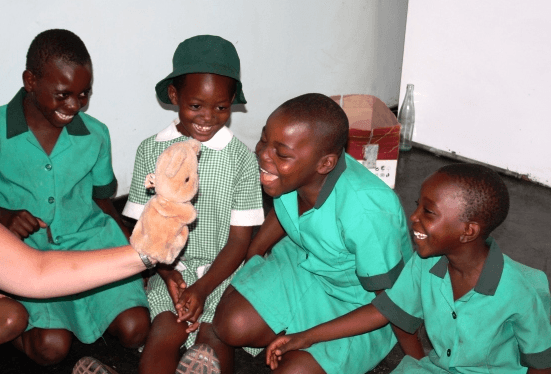
Puppets can help to provide a cultural connection to the classroom while helping young children learn English.
Puppets are often used in the ESL classroom for young children. These playful characters are used to provide a cultural connection to the classroom, to enhance storytime, and to model conversational phrases. In addition, the puppet can speak exclusively in English, and the teacher can speak in the child’s first language to help facilitate class activities.
Even in the most playful classroom, behavior issues with puppets can arise. For one educator, a few students started a “hitting game” with the puppet during class time. Should this problem arise, an educator can use the opportunity to set appropriate boundaries with the puppet and all the classroom props – such as instruments – and redirect the behavior back to appropriate, playful classroom behavior.
We asked curriculum authors and Master Kindermusik Educator Carol Penney and Cindy Bousman to provide a few classroom behavior tips.
Here’s what they had to say:
When the puppet is first introduced to the class, it is important to set and state acceptable behaviors. Be clear and simple when these are stated. The same goes with instruments, books, visuals, and all other materials used in the class. When a teacher does this, it’s helping the children build and develop respect for other people’s “things.”
1. Start all over with a brand new puppet. Even if it is a homemade sock puppet. Talk to the children as a class about how to treat and handle this new puppet. If a child starts to hit the new puppet, immediately withdraw the puppet and explain why, then go on to the next child. The child needs to understand hitting the puppet is an unacceptable behavior.
2. Let puppet stay at home for a while. The teacher can use his or her own hand as a puppet – opening and closing four fingers together and thumb. To make it interesting, put circle stickers on hand for eyes.
3. Speak up. Say, “I don’t want you to hit my doll. You can touch him gently and sing or say hello or you can choose not to.” Make clear what you expect and/or remove the temptation.
Want to know more? Read more about using puppets in the ABC English & Me classroom in “One Puppet, One Language.”
If you have clothes that are not suitable for donation…think about upcycling.
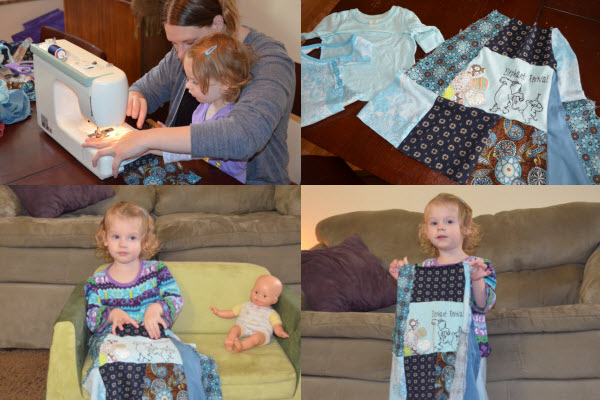
This Kindermusik kid and her mom upcycle clothing! They re-use baby clothes by sewing them into creative outfits like this patchwork skirt.
Enhance Family Bonds
When the going gets tough, the tough gets going– for any of our U.S. East Coast families stuck inside (hopefully with power!) during the blows of Hurricane Sandy, we’re thinking of you! While power outages and being stuck at home is disruptive, Psychology Today points us to the silver lining: how to use hurricane preparation to enhance family bonds. Among these pointers, we’re told to 1) assign everyone a role, 2) practice emergency drills, 3) take advantage of power outage as a chance to communicate, 4) emphasize togetherness and unity and 5) take pictures to document the experience.
Why not use this time to get crafty, like Kindermusik kid, Stella, and her mom pictured above? These Star Stewards upcycled Stella’s old baby clothes by sewing them together to make a patchwork skirt. The skirt features a t-shirt from one of the child’s favorite bands, Elephant Revival, which was her first live concert when she was just eight weeks old! — She was born to love music!
Don’t forget to submit YOUR Star Steward projects, stories, and ideas!
WIN 50 free Kindermusik songs & $100 donation to your favorite charity by sharing your family’s Green/Sustainability/Eco efforts by 12/07/12.
Laura Ainamo teaches English in Zimbabwe with ABC English & Me
Many stories coming out of Zimbabwe these days are tough to hear. A suffering economy. Rising inflation. The AIDS crisis, spiraling crime, and the country is struggling to preserve its disappearing Mother Tongue languages as well as learn English.
Learn how Kindermusik is helping to preserve Mother Tongue Languages and visit the Mother Tongue Lullaby Project Tumblr page
Yet in a small school in Zimbabwe, 20-year-old Finnish Educator Laura Ainamo is making music. Laura uses music, rhythm, songs, and animals to help children there learn English. One of her classroom challenges is to find one program that helps children at different ESL levels. ABC English & Me is helping to bring these groups together, Laura says.
Below, she shares her own classroom experience.
Hi, my name is Laura and I am from Finland. I’m 20 years old and I just finished my high school. I am in Zimbabwe for three months. Staying here till 29th of November. I am teaching ABC English & Me to eight groups of ten children.
Most of the children are in 1st and 2nd grade, but about ten of the children are in 3rd and 4th grade because they do poorly in English.
I have printed the visuals in color and have them laminated, I am using a laptop for the music and I have all the instruments sent by Kindermusik. I have a puppet called Maria, she is a bear and named after my big sister in Finland.
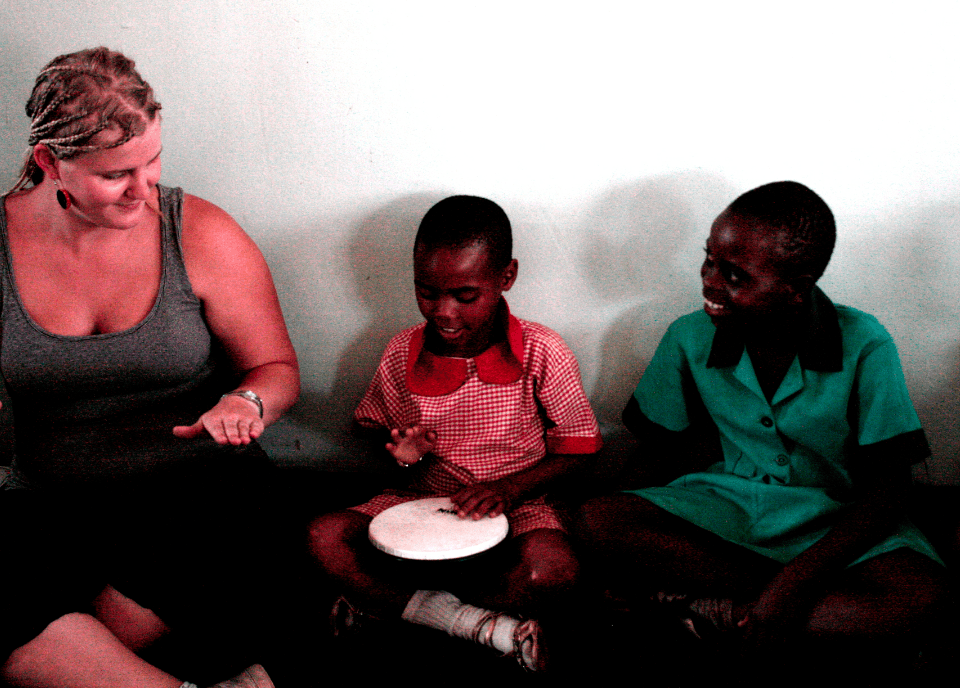
Lessons that I have had have been good. The children like the instruments and tapping the drum but most of them have been able to count to four already or they know many of the animals. Sometimes I do extra activities, such as a little game with the egg shakers. I say “down, up, or middle” and they have to put the shakers where I tell them to go.
They are also very musical and they like the songs. Unfortunately my time here won’t be enough for more than maybe the 1st and 2nd theme but we already have a likely successor to take over and she will be helping me with my lessons. She is Nyasha and lives in Zimbabwe.
– Laura Ainamo
ABC English & Me incorporates a multi-media approach to learning English, using integrated pictures, songs, activities and stories with each new unit theme. Each unit is about 4 weeks and incorporates some repetition with the introduction of new activities. "Rub Your Ears!" In the classroom, children spend time listening to sounds of instruments, or sound effects in a story, to develop focused listening skills.Puppets are one of the tools of the program: They can be used to reinforce the "One Parent, One Language" approach in ELL classrooms. The puppet can speak English while the Educator can clarify instructions in the child's mother tongue. The children smile and play music together, while learning English.Children develop an awareness of the rhythm and patterns of language using musical instruments, such as the egg shaker.
Visit the English Language Learning category or Subscribe to our blog for current news on ABC English & Me, ELL research, and Kindermusik programs around the world.
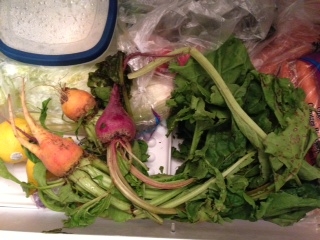
What’s in our CEO’s fridge, you ask? The short answer? Michael Dougherty (one of 35 employee owners) bought magnificent beets and carrots from his local CSA (Community Supported Agriculture) in Greensboro, North Carolina. Take a look at the picture he submitted for the Star Steward Contest!
And the long answer? Michael bought food that strengthens individual, community, and environmental health by being, well, just food. If you haven’t heard of a CSA, lettuce inform you! CSAs allow urban and suburban residents to purchase an entire season of fresh local produce. For $400-$600 a season (4-6 months), farmers deliver between 7-10 seasonal vegetables to your local pickup point each week. Each week, you’ll get what the farm has available; you could get carrots and beets one week, or potatoes and cauliflower the next. For a few extra dollars a week, you can tack on dairy, nuts, flowers, or swap the week’s vegetable for another.
How does this help farmers? Paying up front allows
farmers to plan and invest in new equipment. It also eliminates the corporate supply chain so farmers get what they deserve. Finally, eating seasonal produce reduces the need for pesticides, storage treatments, and overseas shipping, which has human health and environmental benefits. Food, when it’s really just food, tastes better. As Michael Dougherty says, "This was our first experience with a CSA, and our experience was so positive. We feel closer to our food. We know where it comes from. We understand the earth gives us certain foods at certain times – and, often, lots of it! We appreciate what it takes to grow, care for and pick food. We are gratified that farmers have pre-sold their food and, in turn, know their customers." Sounds like a Star Steward to me!
Don’t forget to submit your Star Steward Contest entries!
WIN 50 free Kindermusik songs & $100 donation to your favorite charity by sharing your family’s Green/Sustainability/Eco efforts by 12/07/12.
Kindermusik Educator Jane Denizot in FranceJane Denizot is an ABC English & Me Educator in Calvados, France. This week, she shares a few tips on how she incorporates repetition with a few activity twists in the ELL classroom for young children.
I find it is essential to have repetition and the proof is that they are learning fast. I just try to spice up things that are repeated to change it a little. I am on week two “1, 2, 3, GO!” and have followed the units as prescribed, just adding in an extra song when I thought we needed more movement.
Jane’s tips on giving repetition a twist in the ABC English & Me classroom
Add simple play props. At first we had no steering wheels for the Grandad’s farm activity, then later, we added coloured paper plates.
Repeat familiar movement and language concepts with a new song. I used the “Blue Danube” to follow on from “Clever Cows” repeating the “Up, Up” and “Down, Down” in time to the music with our scarves and they loved it.
Add in some silly moves for the “Hello” and “Goodbye” songs.
Play a new song. I also added in another activity, “The Morning Sun has Risen,” with instruments and lots of cock a doodles!
Visit the English Language Learning category or Subscribe to our blog for current news on ABC English & Me, ELL research, and Kindermusik programs around the world.
Watch a classroom of preschoolers writing letters from that day’s preschool lesson plan and you will see children wiggling in their seats, looking longingly over at the art table, poking classmates with fingers, or talking to each other. Preschoolers are still learning how to self-regulate or how to control and direct their own actions, thoughts, and feelings. More and more research shows the importance of teaching self-regulation as part of a preschool or toddler curriculum. Studies indicate that self-regulation may even be a predictor of both early academic success and later adult health and wealth.
Latino English Language Learners and Self-Control
While the body of research on the importance of self-regulation continues to grow, little research exists that targets specific cultural factors that may affect self-control skills in ELL preschoolers. A professor from Loyola University Chicago recently published an article in the Child Development Perspectives journal that took initial steps towards identifying two aspects found specifically in the immigrant Latino culture—familism and acculturation—that may affect the self-regulation of preschooler English Language Learners. Familisim refers to a cultural aspect that puts the needs of the family as a whole above the needs of the individuals in the family. Acculturation is the process of change a person or family encounters when one culture begins to merge with another culture, such as changes in food, clothing, and language. The author stresses the need for additional research that will take into consideration these unique aspects of immigrant Latino English Language Learners.
Preschool curriculum develops self-control using music
Studies show that music can help develop self-control in young children, including English Language Learners. In fact, researchers recommend using music to engage the entire familyin learning, including in cultures that place a high regard on the family.
Based on over 30 years of research detailing the ways music instruction boosts self-regulation, listening, early literacy and language, and more, Kindermusik created ABC Music & Me, a preschool and toddler curriculum. ABC Music & Me uses music to teach early literacy and language development to young children and engage families in their children’s education. The research-based curriculum aligns with state standards, including the Common Core, and can be especially beneficial for English Language Learners.In addition to our “English Language Learners Strategies Guide” that provides unit-by-unit, lesson-by-lesson tips, ABC Music & Me includes materials in English and Spanish to increase parent involvement and support the common language spoken in the home.
For more information about using ABC Music & Me as a preschool or toddler curriculum with English Language Learners, email us at info@abcmusicandme.com.
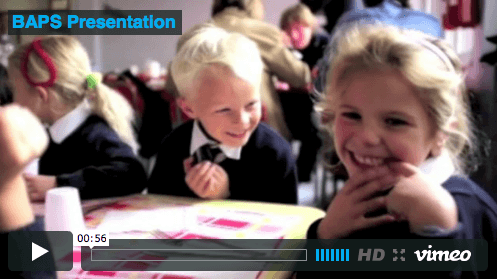
The British American Preschool is located in Milan, Italy and offers ABC English & Me. Take a look inside the Milan, Italy preschool devoted to the unique learning needs of bilingual children. Click the image above and scroll down to watch the video. The British American Preschool in Milan, Italy is devoted to the unique learning needs of young bilingual children. In addition to meeting the child’s changing language needs, the school is focused on helping children develop a balance of interests and skills — from studies in science to the arts.
“Early childhood is a period of rapid mental growth and development,” according to the school’s Web site. “Young children need a rich foundation of stimulating experiences that will be essential for later learning, a strong sense of self-esteem, and excitement and curiosity for learning.”
The school incorporates the Jean Piaget theory that “play is a child’s work.” Based on the school’s mission to learn through play and to develop a variety of skills, ABC English & Me is one of the programs that the school offers its students.
Here, the school’s director, Debbie Chilver, talks about how the music based activities in ABC English & Me help to develop English language skills, as well as the child’s attention span (in Italian of course! Scroll down for the English translation).
Debbie Chilver, Director at the British American Preschool of Milan – Italy
English and Me è un programma che coinvolge molto i bambini. E’ sorprendente vedere come bambini così piccoli partecipano alle attività. Si può notare facilmente che la loro capacità di attenzione viene sviluppata durante le lezioni e che esse sono finalizzate al raggiungimento di obbiettivi tipici degli “early years”.
Possiamo prendere un semplice gesto come su e giù, per esempio. Lo si fa nel rituale dei saluti e poi si ripete in altre attività, come in una delle storie o con gli strumenti. La lezione è strutturata in maniera tale da promuorere la consapevolezza di tutto il corpo.
Si può anche vedere che le lezioni sono ben pensate. Non appena i bambini sono in procinto di distrarsi l’attività cambia e ci si muove. Si può notare che gli obbiettivi e la sequenzialità delle attività volte al loro raggiungimento sono state testate.
Sento che la musica è uno dei più grandi veicoli per l’insegnamento. La musica è un eccellente forma di comunicazione per l’insegnamento di una seconda lingua. Cominciare presto, sviluppa nei bambini un apprezzamento per la musica che li accompagnerà per il resto della loro vita. E’ come piantare questo seme in tenera età e poi vederlo crescere.
In English
ABC English and Me is a program that gets the children extremely involved. It’s amazing how such small children participate in the activities. You can see that their attention span is really being developed by this class.
After having looked at the scope you can see that it is very structured towards early years objectives. We can take a simple movement like up and down for example. You do it in the ritual greating and then it is repeated in other activities like in one of the stories or with the instruments. The lesson is structured with full body awareness in mind. You can also tell that the lessons are well thought out.
As soon as the children are about to get distracted the activity changes and they do a movement. You can see that the scope and sequence of the lessons have been tested out also.
I feel that music is one the greatest vehicles for teaching. Music is a form of communication that is great for teaching language as a second language. Starting children young will develop music appreciation for the rest of their lives. You can lay this seed at an early age and then watch it grow.
Parents and children participate in ABC English & Me at the bilingual school in Milan, ItalyThe British American Preschool focuses on the unique learning needs of bilingual children.
Visit the English Language Learning category or Subscribe to our blog for current news on ABC English & Me, ELL research, and Kindermusik programs around the world.
In a nutshell, spatial awareness is the understanding of objects (including your own body) in relationship to the surrounding space. For children, that starts with discovering hands and feet, grows to moving safely on a playground, and leads to judging distances while driving or solving math problems. It’s a huge skillset that affects so many critical aspects of positive whole-child development.
So how do you know if little ones are on or off-track with these skills?