
Original Draft: Jan 25, 2012
My eldest son, started Kindermusik when he was 5. He is in the Young Child music classes, which builds the foundations of musical theory & performance. He’s learning high and low, rests and beats (steady beats, of course), and is embarking on learning how to read music and play the glockenspiel (what many of us would call a xylophone). It’s a curriculum that’s easy to understand, especially being a musician myself, because it simply teaches the foundations of music through fun, interesting exercises, and at-home learning extensions.
When I had my second son, I thought it would be amazing to attend Kindermusik classes with him for the entire 7 year curriculum, knowing what I know about the benefits music & movement classes have on early childhood development. As a violist and vocalist married to a professional bass player who majored in music education, we believe in and understand the benefits of early exposure to music. This makes music very important to our family. Unlike many early childhood activities, Kindermusik has true lasting extensions that contribute to your child’s brain, body, heart & soul. The curricula is research-based and developed with key foundations of learning that improve cognitive, emotional, social, & physical development, which basically gets your child ready for school and life. So, of course, I decided to enroll my baby in January 2012.
We went to our first “Cock-A-Doodle-Moo” class this Monday and I was not 100% sure what to expect. I had a lot of unanswered questions… How will my 7 month old react to a room full of strange people? Would he cry the whole time because he’s teething really badly right now? Will he be screaming when all the other kids are quiet and quiet when the rest are engaged? Would all the other Moms already know each other from last semester? Would I or my son be judged by the other Moms? I had already watched this Kindermusik video, which did help alleviate some of my concerns (but I was still a little apprehensive)
Here’s what I learned in my first Kindermusik baby music class:
- You will need “sole!” Shoes have to come off and there’s a lot of floor-based sitting & activities. A lot of the parents had really cute socks on, knowing this. Comfortable clothes that cover your derriere, when sitting, are also a must!
- A good voice is nice to have, but not necessary! Our class is focused on the farm and includes familiar children’s music, folk songs, & nursery rhymes. Everyone who wanted to sang could, but there was no pressure; the educator carried the singing. There were about 8 kids in the class, mostly Moms, but and 2 Dads (both musicians, with the best voices in the class, by far)!
- All ages were welcome! All the babies were aged around 6 months to 18 months, although the class is open to newborn+. The activities seemed to be enjoyed by all ages.
- What a work out! One unadvertised bonus of Kindermusik is that it is a good way to lose some baby weight! I moved, grooved, marched (forward and backward), rocked, swooped, laughed, sang, and danced with my near 20 lb. baby in my arms. Phew!
- Baby bonding at its best! The class is a great opportunity to bond with your baby. We spent some quiet lullaby time with lights off, looking at the twinkly lights on the ceiling. We also spent some time doing baby massage, which I know is really beneficial to the parent-child bond.
- Parents can be parents. Like everywhere else where you have parents gathering, people do compare their babies to yours and their development too. Many love talking about their experiences as a parent and this is a perfect “Mommy and Me” class environment for it. (Again, Dads were welcome and there too!) In my case, I was proud to hear others say, “Wow! He’s 7 months old and THAT mobile?” *Blush* But, considering my two children developed VERY differently, I could see myself questioning my child and his abilities – comparing him versus the others. A good Kindermusik educator should ensure to set expectations to all parents in the room, celebrating the individuality of every child in the class. And, being in a social environment with other children is such a good motivator for little ones. Kindermusik has had a lot of success with special needs children in the classroom because they have a chance to interact with other children through enjoyable learning activities.
- Kids do the darnedest things. For the first class, your baby or child will be a little out of his element. My little one kind of sat there and looked around. Although he is very mobile and is usually off like a rocket shot, he DID cling to me and seem a little surprised about everything around him. He clung to me a lot of the time and we had to do some modified movements; for example, he was NOT all about laying still for the massage. But, we cuddled and had a moment anyway! He LOVED when we would walk around/march and sing. The grin on his face during those activities was enough to make the class worth it times a thousand.
- Kids are seriously cute! If you like kids, Kindermusik music classes seriously equal cuteness overload. Babies are free to break free in these classes, explore, meet other little ones, and just have fun. Educators guide the classroom through activities, but in a flexible way that makes the little ‘extras’ that the kids do just a part of the fun! I haven’t laughed so hard as I did when a little 10 month old girl walked up to another baby boy and spent an entire activity hugging and making faces at him. It was just too much.
- There is a definite sense of community! There is a good chance a lot of the other families will know each other. People who go to Kindermusik classes tend to put all of their kids in classes, building a community amongst themselves over time. And, semesters build on each other. So, if you’re in the Monday at 11:30 class in the fall semester, you’re likely to continue with the same group for the spring semester. I (and one other latecomer) were the sole ‘new families’ in our class. This meant that introductions meant “everyone introduce themselves to Jamie!” I had a friend in the class, which made it extra fun and everyone was very open and friendly.
- I GOT OUT OF THE HOUSE AND TALKED TO ADULTS FOR A SECOND (even if it was between songs!) It was really nice for me to meet other Moms of children the same age, since I am one of the first in my group of girlfriends to have had children.
- I learned all kinds of fun things! Our Kindermusik classes are chock full of what are called “Foundations of Learning” (or FOLs) that explain why you do each activity and how it helps your little one develop his brain or body. Kindermusik prides itself on providing applicable parenting resources and at-home learning tools with each of its classes and sends you home with all kinds of fun educational tools for you and your little one!
So, that’s what I learned in my first Kindermusik baby music class. If you’re interested in trying out a Kindermusik class, you can find one near you and sign up for a free preview class. I, personally, can’t wait until next Monday!
Update: 1 Year Later
Well, it was an interesting first year of Kindermusik class. As my little one passed his 1 year birthday, he became interested in simply running and colliding with every child in Kindermusik. Since there were newborn babies in that class who looked as if they could be fragile, I made the decision to move him into another class more suitable to his developmental needs – and was thrilled that his Kindermusik teacher and studio owner was able to work with us to find a better class match. We moved up to a Family-based class, where he fit in much better (and couldn’t accidentally kill any babies) – and was also sometimes on the receiving end of a collision. Huge progress!
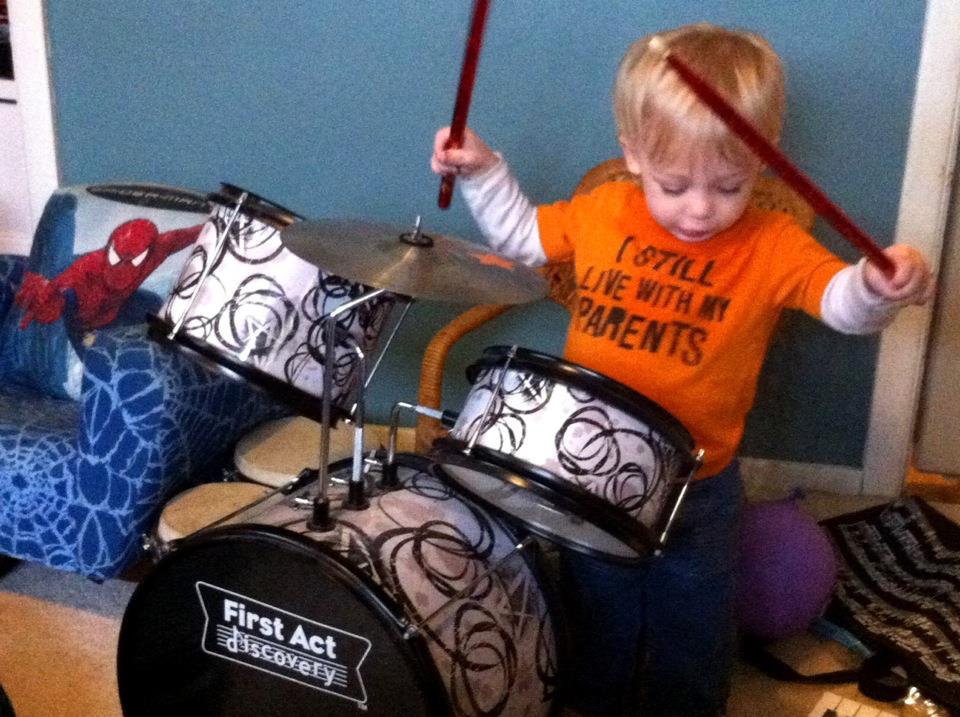
The year in music was the best ever! Both of my little ones are so musical, it’s incredible. My 18 month old bangs on drums and literally sings day and night. His favorite toys and activities play music. Anytime music comes on anywhere, he dances! He has been using sign language, much learned in Kindermusik class, to communicate. And, is highly interested in books and other learning games related to music class. As a family, we really enjoyed the digital Kindermusik @Home learning materials provided through those classes too and have still been dancing to the songs and reading the eBooks almost every day. And, now, every time it’s time for music class, my 18 month old races off, grabs his sneakers, and sits at the door, waiting for us. I’m so excited he will get a full 7 years of benefit from this program!
Here he is, in his musical element:

The author attends Kathy’s Music with her two sons in Pittsburgh, PA. Her 6 year old has been known to say some very cute things about music class, including: “I love Miss Kathy. She’s the best teacher ever. Can you tell her that?” and “Music class is the best part of being a kid.”







 “Experiences and sensations are learning. Sensations form the base understanding from which concepts and thinking develop. Therefore, sensory enriched environments are imperative to learning.”