

Can farm animals and a bear aid oral language skills development, fluency, and vocabulary development in English Language Learners? Yes—especially when featured in Kindermusik@Home!
ESL activities for kids that support:
Oral language skills and fluency
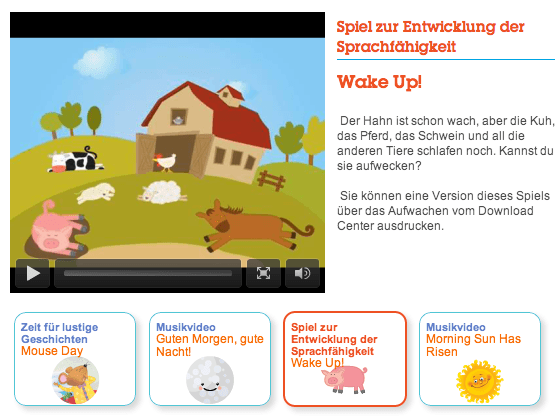
The “Wake Up!” Game featured in the Good Morning, Good Night! unit of ABC English & Me is a fun ESL activity for kids and parents to do together. In the game, children help wake up all of the farm animals by saying, “Wake Up!”
to each animal. Teaching and practicing a short, simple, and useful phrase supports oral language fluency. Children can try this at home by helping to “wake up” favorite stuffed animals, dolls, or even pets.
Vocabulary development and fluency
The “Bear Gets Dressed” Word Game featured in the Sunny Day, Rainy Day unit of ABC English & Me focuses on the "clothes" vocabulary theme. Theme-based games provide structure and repetition to help English Language Learners deepen their understanding of new words. Parents can encourage children to use the English word for each piece of clothing they put on in the morning.
Looking for more ESL activities for kids or an English Language Learners curriculum? ABC English & Me uses music, movement, activities, and puppets to teach early learners English. Plus, Kindermusik@Home connects the classroom learning to the everyday routines and rituals of the whole family.
We call it play, the work children do all the day long. From rolling a ball to tasting it, from building with blocks to knocking them down, a child’s job is to play.
Activities for Kids at Home
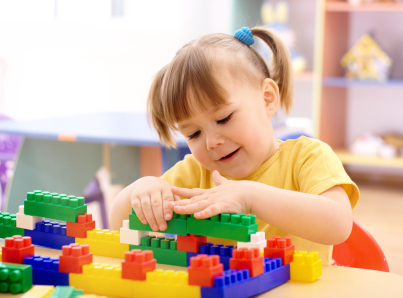
Children learn and grow through play. Toys that mimic everyday objects, like kitchen appliances and gardening tools help a child to act out what he sees the grown-ups doing. Toys that specifically encourage creativity, like blocks, scarves, and Legos equip children as they use their ever-amazing minds to construct and pretend. Other simple things that inspire open-ended play include cardboard boxes, dress-up clothes, and Lincoln logs. Read here for more open-ended play ideas.
The most important play-thing
As parents, we want our children to have the best toys to help with their development. After
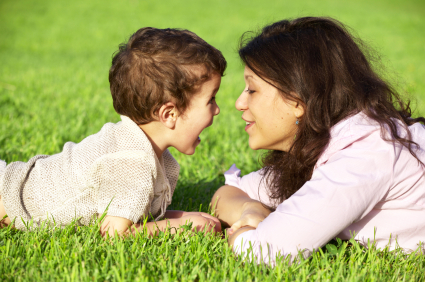
all, creating a stimulating home environment is the least we can do. But the most important play-thing that your child can have does not come in a box or from a store. Children need loving parents and caregivers to not only provide them with quality tools for their work, but they need adults to stop, sit, and become co-workers at play. This is one of the best educational activities for 2 year olds, 3 year olds, and beyond. It’s easy to delight a child with a new toy and walk away. But a child needs personal interaction with the adults in her life as she learns and grows.
It’s hard to take a break from what we view as important: work-related issues, financial problems, the upkeep of a home. But investing daily in the lives of our children by sitting down with them, allowing them the freedom to choose what to play, following them and labeling their actions, resisting the urge to organize and perfect their play, is the most important work that you can do as a parent.
Inspiring play through music and movement
In our Kindermusik classes you’ll find lots of inspiration for play, both musical and non-musical. Though our classes are music-based, we’ll give you lots of tips and ideas for playing with your child in class and at home – tips and ideas that come from an understanding of the concept of scaffolding, from learning more about your child’s developmental stage, and from the child-centered way that we approach our classes. There’s nothing like a Kindermusik class to give you a reason for playing with your child – once a week in class and throughout the week at home.
The simple act of investing time in play with your child is one of the very best investments you can make. Take a few minutes to play today!
Edited and revised by Theresa Case, whose Kindermusik program at Piano Central Studios in Greenville, SC, is proudly among the top 1% of Kindermusik programs worldwide.
What do a cardboard castle and a paper plate sun have in common? They’re both two of the many kids craft ideas conveniently found in Kindermusik@Home.
Crafts for Preschoolers
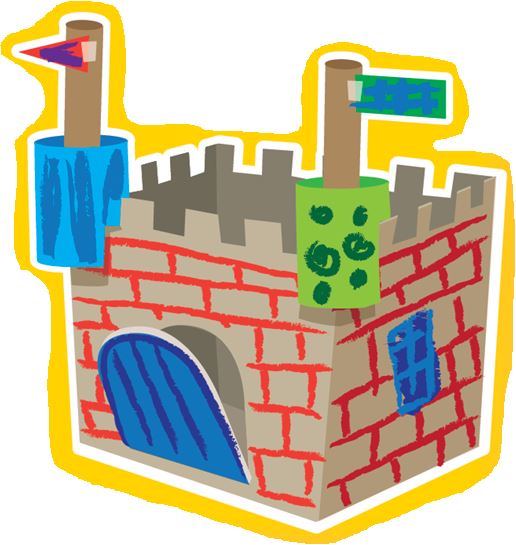
What’s great about the cardboard castle featured in Make Believe are the kid-friendly instructions. With just a little help from an adult, they are just perfect for preschoolers who thrive on a little independence and the joy of creative self-expression. The best parts are all the imaginative pretend play once the castle is complete, and the learning that happens best through active play and hands-on interaction.
Crafts for Toddlers
A simple but fun craft idea for toddlers is found in Kindermusik@Home, Up in the Sky. Hint: You might want to make two so that you can both sing and dance with your Paper Plate Sun. (Or turn on the recording of “Mr. Sun.”) The paper plate sun is one of several “sky crafts” that promote interactive learning while also inspiring together-time ideas.
As a unique benefit of your Kindermusik enrollment, your Home Materials, conveniently available when you log in to Kindermusik@Home, offer you and your child music and then some – engaging, delightful craft ideas being among the highlights.
Together time fueled by creativity and imagination…
…all inspired by the power of Kindermusik – in class and at home all week long. Shared by Theresa Case, whose Kindermusik program at Piano Central Studios is among the top 1% of Kindermusik programs worldwide.
Long before Kermit the Frog sang, “It’s not easy being green,” Chief Seattle spoke about the importance of sustainability for kids. He said, “We do not inherit the earth from our ancestors. We borrow it from our children.” At Kindermusik, we take those words and our role as educators and protectors of the environment for kids seriously. It’s one of the reasons we introduced Kindermusik@Home in 2012. With these educational activities for kids, families participate in age-appropriate digital learning, such as reading eBooks, virtual fieldtrips, and music downloads, that connects the classroom with a family’s daily routines and rituals while also supporting Kindermusik International’s commitment to sustainability.
4 ways Kindermusik@Home helps protect the environment for kids
Kindermusik@Home eliminates the printing and shipping costs of traditional books, CDs, instruments, and packaging.
Virtual fieldtrips introduce children to new ideas, places, animals, and people without using carbon fuels to travel long distances or possibly disturbing fragile ecosystems. On a virtual fieldtrip, families may visit the studio of a drum maker in Chicago, go on a bird walk to see and hear birds from around the world, or even experience a carnival (without the long lines!).
Digital eBooks provide children and families with the same educational benefits of print books while saving nearly 5 million (and growing!) sheets of paper each year.
Parents discover creative ways to re-use items normally reserved for the recycle or trash bin to create instruments, parade crafts, a train, and more. These fun and practical ideas spark imaginations and turn “trash” into a beloved treasure.
To learn more about enrolling in a Kindermusik class and receiving access to Kindermusik@Home, contact a local educator and Find a Kindermusik Class Near You.
Schools, preschools, and childcare centers can also benefit from Kindermusik@Home. To learn more about bringing our digital early learning curriculum into your classroom while also increasing parental involvement, email us at info@abcmusicandme.com
You might have heard the exciting news – there’s something new at Kindermusik. But not only is there a brand-new curricula with fresh and delightful themes, there is also a whole new kind of home materials to complement those themes and extend the classroom experience in a whole new way. Introducing… Kindermusik@Home!
Advantage #1: More educational activities for kids to enjoy
The new curricula introduce a new theme every four lessons, and with every new theme comes another set of learning activities and parenting resources, automatically delivered to you.
Advantage #2: With you wherever you (or your device!) are
As long as you have your phone, your tablet, or your computer, you have your Kindermusik@Home with all of the activities, resources, play ideas, and music at your fingertips.
Whether you’re at home, or on-the-go, you and your kids can enjoy fun and educational activities, any time or day of the week!
Advantage #3: Yours for always and forever
The longer you’re enrolled in Kindermusik, the larger your library of Kindermusik@Homelearning games and educational activities for kids becomes. And that library will always be available to you, even if you are no longer enrolled in Kindermusik classes.
There’s no better gift you can give your child than Kindermusik, especially when it includes all of the advantages of Kindermusik@Home! Shared by Theresa Case, whose Kindermusik program at Piano Central Studios in Greenville, SC, is proudly among the top 1% of Kindermusik programs worldwide.
Researchers have known for years that babies have a preference for the sound of their mother’s voice. A preference they show by turning their head towards the sound of their mother, and increase suckling.
Recently researchers asked if a baby born to a bilingual mother would have a preference for one language over the other. If a child’s mother is bilingual, which language would the baby prefer? The mother’s first language, or the second?
The answer is both — and then some.
In the study, (published June 6, 2012 by Francois Grosjean, Ph.D. in Life as a Bilingual), researchers studied children born to bilingual mothers — who spoke English and Tagalog — and children born to monolingual mothers.
When the babies were exposed the sounds of language, researchers watched the baby’s suckling behavior: an increase in suckling showed a baby’s increased interest in a language.
In the study, babies born to bilingual mothers showed interest in both of the mother’s languages — English and Tagalog. Babies born to monolingual mothers showed an interest only in their mother’s first language.
Tuned in to a new language
In the same study, researchers introduced a third language, Chinese, which is similar to Tagalog, and the babies born to bilingual mothers also responded with suckling to the sound of the new language. Babies born to a monolingual mother seemed to show no additional interest.
“The authors concluded that the acquired interest in the two languages these infants had been exposed to could help them pay attention to the languages and hence acquire them in their first years of life ….. IF they were raised in a bilingual environment, of course.”
Kindermusik@Home
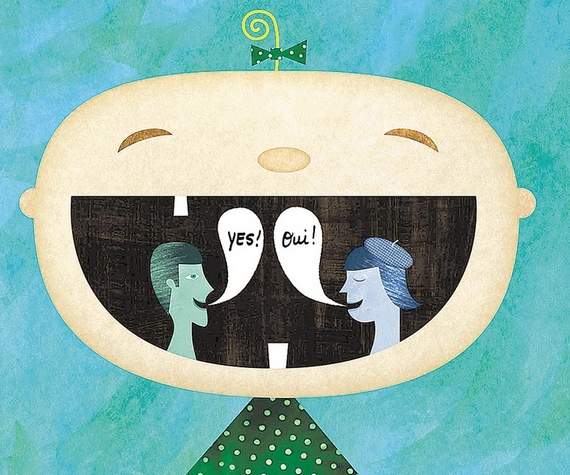
Clever Cows Create a bilingual environment and nurture early language learning with ABC English & Me. Try this activity: No matter how you say it — love, giliw, or 爱 — your child loves the sound of your voice. The ability to hear and distinguish between sounds in English or any other language is called phonemic awareness, and is a skill critical to school success and learning to read. And because nursery rhymes are often silly and fun to say, they are particularly developmentally appropriate for very young English learners!
By watching and listening to (over and over again) this Clever Cows video, and learning this simple nursery rhyme, your child is developing his or her rhyming, word segmentation, and sound discrimination skills; enriching her growing English vocabulary; and being introduced to basic story structures such as beginning and end, problem and solution, and cause and effect. Don’t forget to count the cows when you are done: 1, 2, 3, 4!
See more music and movement activities featuring the Clever Cows, music, and second language learning at my.kindermusik.com
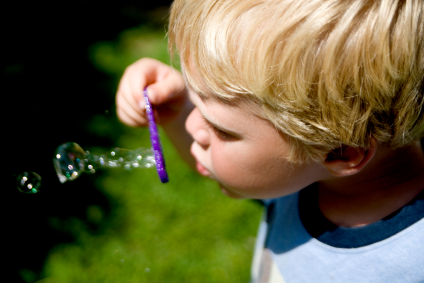
Did you know that the second week of March is National Bubble Week? Someone, somewhere, has determined that the second week in March is the week when we as a nation should all enjoy some bubbles. (Hmm… wonder if a bubble bath counts?!)
When I think of bubbles, a lot of happy childhood memories come flooding back. Bubbles are such simple things, but they make for a few minutes or even many hours of delighted squeals and happy smiles. Bubbles are usually a “together” activity between the adult who can’t blow fast enough and the child who makes herself nearly dizzy trying to chase and catch all of the bubbles before they pop on the ground.
You know, bubbles are a lot like music. Music makes memories too, because it brings families together. That togetherness is what warms my heart most as a Kindermusik educator. I freely admit that I often find tears pricking my eyes as I observe parents and children in class bonding together and enjoying precious time with each other. And then what’s really great is hearing how the music doesn’t stop once class is over; it goes home — soothing, delighting, engaging, entertaining, giving, and making a difference in all the important ways.
So… whether you celebrate National Bubble Week or not, I hope you’ll be reminded of the simple joys in life — music, together time with your child, and oh yes, bubbles. Go ahead, celebrate! Click here for a simple, easy recipe for homemade bubbles.
Colored Bubbles
1 cup granulated soap or soap powder (Ivory Soap powder)
1 quart warm water
Liquid food coloring
Dissolve the soap in warm water then stir in a few drops of food coloring More ideas: http://www.tooter4kids.com/Bubbles/Activities_Recipes.htm Originally written by Molly McGinn for Kindermusik International
Whether you’re looking at it or wishing for it, there’s something magical about snow. Here are a few of our favorite musical ideas and fun snow-themed crafts that you can enjoy with your child.
Try indoor skating!
Skating indoors is easy and fun. All you need is a pair of paper plates – one set per skater – and some skating music. You may remember this activity from Kindermusik class. You can even decorate the top side of your skates if you like. Music that’s not too fast or too slow is ideal. (Think something like the Blue Danube Waltz…) Push the furniture out of the way and have skate away!
Create your own charming Chalky Snow Art
For this art project, all you need is ½ cup of water, ½ cup of liquid laundry starch, and chalk. First, mix the water and starch together. Brush it over a piece of dark colored heavy paper (or even something like cardboard). Next, draw on the wet paper with the chalk. If the end of the chalk gets sticky before you are finished, simply scrape it off and keep drawing.
Sing, sing, sing and move, move, move!
You know that familiar childhood song, “If You’re Happy and You Know It”? You’re sure to get lots of giggles by trying all kinds of snow-related movements:
If you’re happy and you know it…
Stomp in the snow
Slide on the ice
Catch the snowflakes
Clap your mittens
Roll in the snow
And when you’re all done enjoying the magic of snow, why not cuddle up for some hot chocolate?
Shared by Theresa Case, whose Kindermusik program at Piano Central Studios in Greenville, SC, is proudly among the top 1% of Kindermusik programs worldwide.
Mollie Greene is a former Kindermusik Educator, musician, mother, writer, and published craft book author living in Greenville, SC.
One of my favorite bloggers is former Kindermusik Educator Mollie Greene. She posts pictures, adores coffee, and in the summer, complains about the heat like a paper daisy wilting in the sun. My favorite posts are the lists, like this one: “2013 things to do in 2013.”
say no to guilt
say yes to long walks
buy large houseplants and keep them alive
play goldberg variations
play gin rummy
make the dog behave
One of Mollie’s paper creations, available on her Etsy shop.
Her carefully crafted sentences and lists drop and gently spin like her carefully crafted paper mobile artworks. In addition to writing, Greene also creates and makes paper art, available on her Etsy shop, Royal Buffet.
Hey Mollie. Add this one to the list: Publish that new paper craft book.
The former Kindermusik educator, musician, writer, blogger, crafter, and mother of four is about to add “published author” to her list of accomplishments. In July, Greene and California publisher Chronicle Books will release Sweet Paper Crafts, 25 Simple Projects to Brighten Your Life. You can pre-order it now on amazon.com
Greene created the book with photographer (and her husband) Aaron Greene. Her paper work has also been featured on numerous Web sites and blogs including Martha Stewart Weddings, Free People, Design Sponge, and Decor 8. In print, her work has appeared in Southern Living Magazine and the craft book Playing with Books.
Her first paper-craft book was a self-published project with Aaron, Make & Do Paper Fascinations for Every Lovely Occasion.
We recently caught up with a properly caffeinated Mollie Greene to say congratulations, and to ask, “how’d you do it?”
Mollie’s new book is available for pre-order now on amazon.com
Name: Mollie Greene Location: Greenville, SC Kindermusik Educator: 2001-07 at Piano Central Studios. The studio’s founder and owner, Theresa Case, is also author for this blog’s Foundations of Learning posts.
Why did you start teaching Kindermusik?
In college (for Piano Performance at Bob Jones University) I had to observe a Kindermusik class, and I was impressed with the storytelling aspect of the class, and the themes, and dancing, and using music to work with kids is always fun. I just thought it was a whole lot of fun, and I thought it would be a fun way to make a living for a little while.
Why did you stop teaching Kindermusik?
After I had my third baby it was just too crazy. I have four children now. Henry is 10, Jude is 8, Lola is 5, and Dot is 5 months.
The new book is different from your first self-published book. How so?
In the self-published book we did about 10 tutorials. They were mostly things that people had asked me about. We thought about putting the tutorials in a blog format but, because there were so many, we just did it as a book.
The new book with Chronicle has 25 projects and the crafts are all different, there’s much more variety.
Some activities are things that I’ve sold in my Etsy shop. Most are new projects that I’ve been working on with my editor so there would be more variety – in the kind of paper you would use and the variety of projects – so there wouldn’t be 25 butterfly projects. They all needed to be different so there will be more appeal to more people across the entire book.
Some were things I haven’t made in years, made when I was a kid, for a more modern, grown up way to make it.
Mollie sells her paper creations online.
Are the crafts for kids or adults?
The book targets adults. Most of the projects take a little more time or skill with scissors, but most of the projects could be adapted for kids. Otherwise, most of the crafts are good for kids around middle school and up.
How did you get the book published?
Chronicle Books is a great source for art books, books about the arts – especially crafting books. I sent them a copy of the self-published book because we didn’t know if they’d be interested in picking that one up; and because it was a good sample of the work.
The editor I sent it to liked it and she helped us get it started.
How long did it take for Chronicle to respond to you and and pick up the book?
We sent the first book in October and heard back in November, 2011. We started working on it in February and it was only a few months before we had to get the ball rolling and start writing.
On your blog, you said this project started last spring, “when I was morning sick and in the midst of a big household move.” Why in the world would you do that?
It all kind of came at once. I’d just found out I was pregnant with Dot and we were moving across town, and they just wanted to get started so we could publish it by this summer. So we had to get it all done by last summer.
And I just thought, you know, you have more time than you think you have. If you can get organized, you can do more than you think you can. Which is not my typical way of living.
Mother Goose could well be called the Mother of Early Literacy. “Hey Diddle, Diddle,” “Little Miss Muffet,” and other nursery rhymes support early literacy by building phonemic awareness through experiences that recognize, repeat, and predict rhymes. Rhyming word play contributes to phonemic awareness as children begin to hear the differences and similarities between words like “moon” and “spoon” and “muffet” and “tuffet.”
Along with favorites from Mother Goose, this holiday season add a penguin to your early literacy activities with Penguin’s Christmas Gift. This story download, created by Kindermusik International, combines rhymes with active listening as children hear the story of a tiny penguin who turns an ordinary tree into an extraordinary one for an extra special Christmas at the zoo.
Download Penguin’s Christmas Gift here and use it in your class next month to support early literacy growth.
4 additional early literacy activities to use with Penguin’s Christmas Gift
If you are like many early literacy educators, your Pinterest boards contain dozens (if not hundreds!) of early literacy activities to use in the classroom. We culled through some of our favorites to use along with Penguin’s Christmas Gift.
Body Rhyme Early Literacy Activity This early literacy activity isn’t really about penguins or Christmas. We just love the movement and use of rhyming words to support phonemic awareness.
Early literacy curriculum that uses music as the vehicle for learning
ABC Music & Me, our early literacy curriculum, uses music and movement to teach young children early literacy and language. In addition to the research-based curriculum, ABC Music & Me increases parent involvement in early childhood education by providing families with materials to use together at home.
For more information about using ABC Music & Me as an early literacy curriculum, email us at info@abcmusicandme.com.