
Musical heritage tells a story of events, traditions, rituals, and all the little things that bind communities together from one generation to the next. It’s also intentionally and biologically rooted.
Specific sounds and movements intertwined in these traditions, at a basic level, build survival, through what we now call social-emotional and relational health.
As we celebrate Hispanic Heritage Month, let’s take a look at some those specific musical traditions, what science says about group movements and dance, and how you can recreate these socially charged activities in your environment.
The science behind musical heritage
Research shows that when humans make music together in any setting or group, a lot happens in the brain. A collaborative study between Bar-Ilan University and the University of Chicago developed a model of five engaged functions and mechanisms directly tied to social connection: empathy circuits, oxytocin secretion, reward and motivation (think: dopamine), language structures, and lowered cortisol (the stress hormone).
Recent findings in Hispanic music and dance traditions
A 2026 study from the University of Colorado Boulder found that when tango dance partners were in synch, their brainwaves aligned, which is the behavior we need when teams are working toward a goal—from cleaning up toys to completing a group project.
“When we dance, our brains are actually coupling…we are synchronizing our brains through our behavior.”
– Thiago Roque | ATLAS Institute
Why did those researchers choose the tango? It’s not always choreographed and it’s not always the same. Dancers have to look at each other’s cues and work together to move from point A to point B. When we think about little brains who often improvise their own dance moves together, that’s powerful stuff.
So how can you recreate this kind of social connection at home or in a teaching environment?
Let’s take a look at two easy musical activities of Hispanic origin that you can lead wherever you are.
Improvise movements to “De Colores”
To tap into the benefits of coordinated movements and improvisation, try dancing in a group to “De Colores.” We love this slow-paced Mexican folk song that is perfect for slowing down active bodies, focusing attention, and connecting as a group.
Play it below or stream it on the free Kindermusik app, and follow the instructions.
- Grab colorful scarves or ribbons and distribute one per child.
- Name, then call out, the colors to take turns dancing.
- Encourage the children to freeze when they are waiting and watch others move.
For infants and younger toddlers, wave and gently drag the scarf over their arms, legs, and face. Then, allow them to explore it freely.
Synchronize circle dance movements with “La Raspa”
Circles, in general, are one of the oldest used forms of gathering in all cultures. Dr. Renata Valree, Director of Peace in Education at California State University Dominguez Hills says “circles can help students gain valuable social and emotional skills transferable to other areas of their lives beyond the classroom. By promoting active listening, empathy, open communication, and respect for diversity, circles help students become better communicators, problem-solvers, and thought leaders.”
That’s exactly what happens during “La Raspa”. Participants are watching, encouraging, and respecting one another’s creativity, while unlocking confidence through a few minutes of fun.
Play “La Raspa” below or stream it on the free Kindermusik app, and follow the instructions.
- Stand in a circle formation and dance to the music.
- Encourage the children to dance freely, then call out and copy the children’s chosen movements.
For older children, you can even teach the traditional partner-game motions. Watch these instructor demonstrate the steps in the video below.
Continue the learning in our free webinar
Want to learn more ways to support Hispanic Heritage all year long and strengthen bilingual learners?
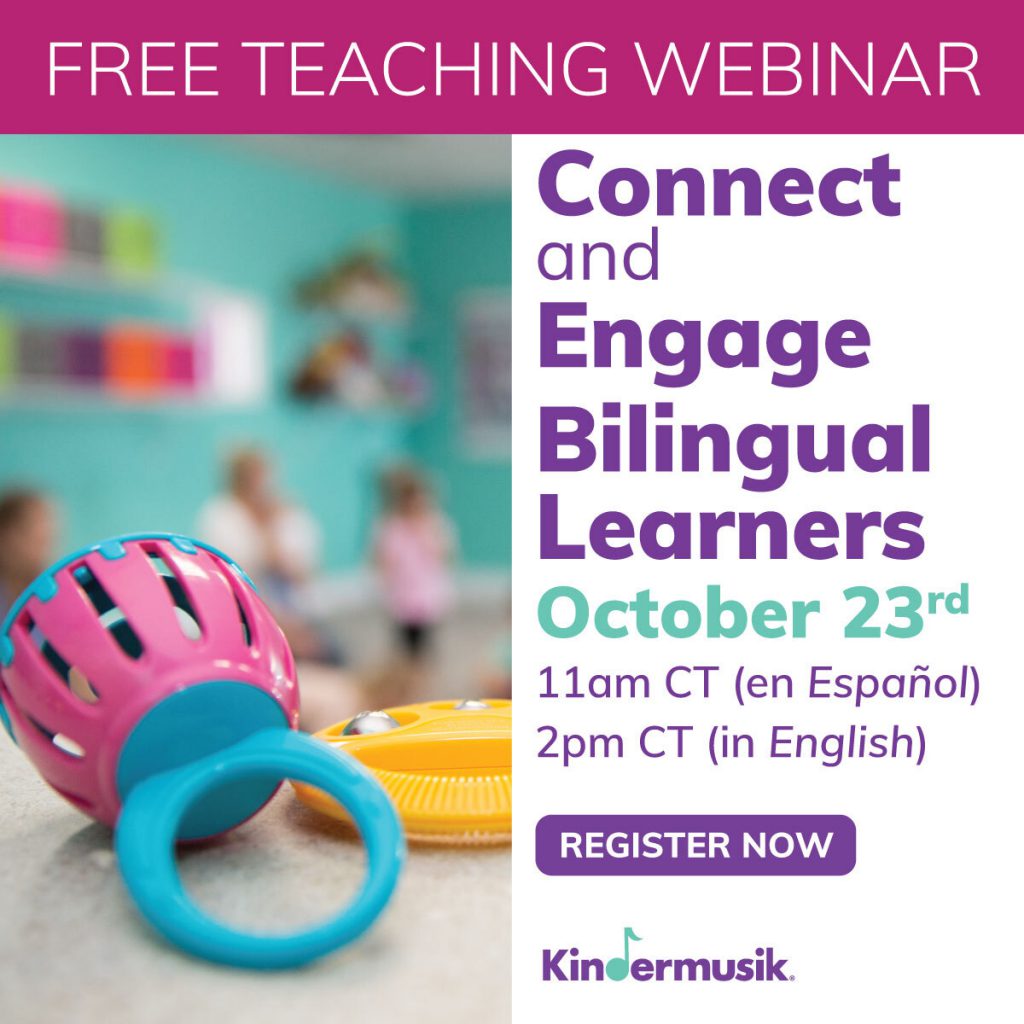
Join us October 23rd for our free teaching webinar (led in Spanish and English)!
Keep musical heritage alive
The biological benefits of all musical traditions are vast, and an easy and engaging way to celebrate cultures and support young learners they grow.
Play different culturally-rooted songs in your space, recreate or learn the corresponding dances, and watch how consistent shared music-making strengthens us individually and in groups—it’s exactly what little ones need to reach early developmental milestones and succeed in every stage of life!
Check out our musical bilingual teaching resources or find a family class near you.