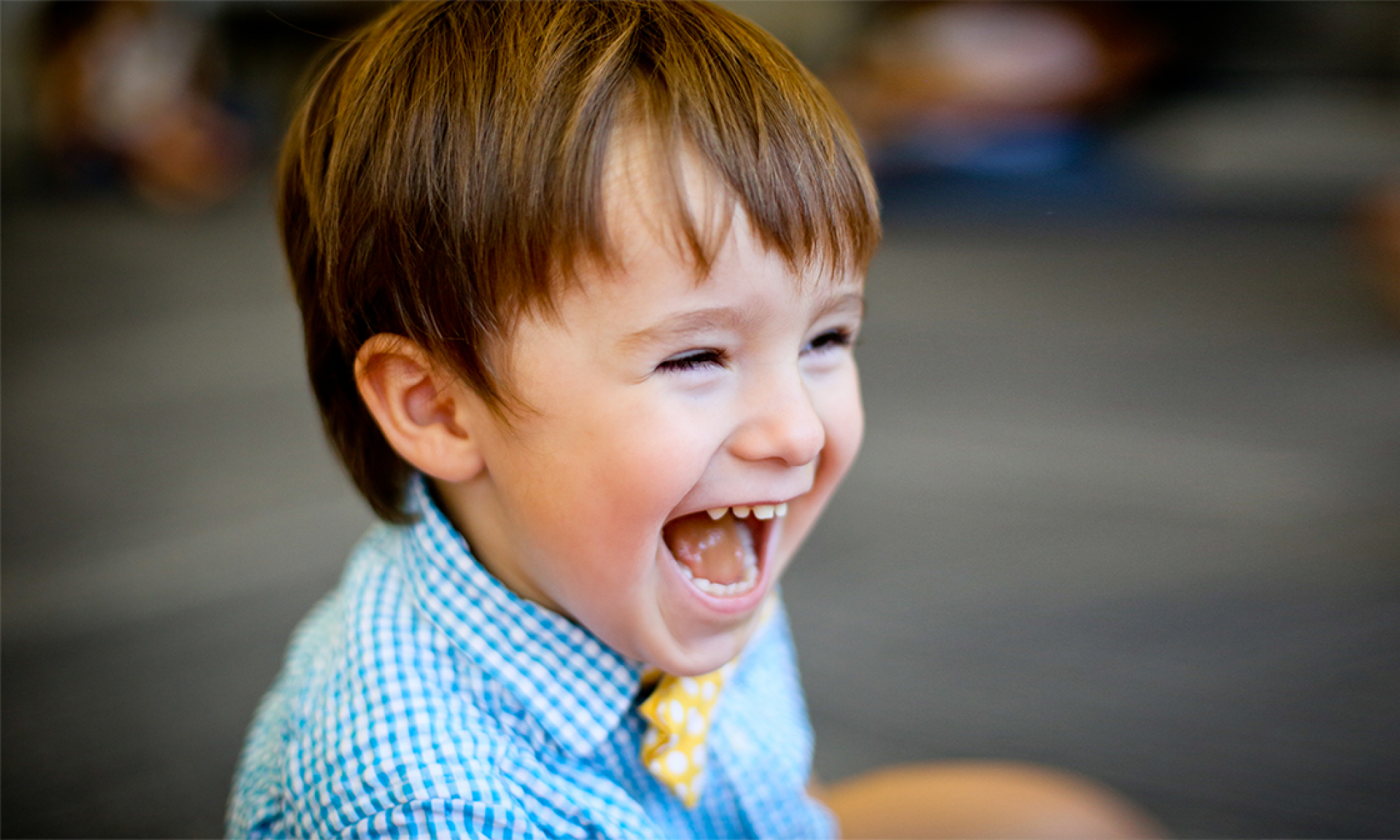

Your child rocks!

When your baby cries, you instinctively scoop him up and rock him.  His need to move and his ability to be soothed by movement are vital in the first 15 months of life when the vestibular system – the area that gives him a sense of balance and distance – is developing.

Aside from the physical benefits of movement, your child also recieves an emotional benefit from rocking and bonding with you.  This quiet, rocking ritual can provide him with a sense of security, allowing him to grow into an assured, confident learner with a healthy self-esteem.

Rocking is still important as your young child grows and will often become a favorite – and memorable – activity for both child and parent.  Even older children benefit from the stimulation of the vestibular system.  Urges to run and tear around the house can be mellowed by taking a few minutes for quiet or even more active rocking.

Kindermusik Tips for your Baby, Toddler, and Preschooler

  • > Rocking your baby: Place a blanket on the floor and lay your baby in the middle.  With an adult caregiver on either side, pick up a corner of the blanket and gently “hammock” your child.  If your baby doesn’t like rocking this way, simple lay him on his back and gently rock him side-to-side to the rhythm of the music.
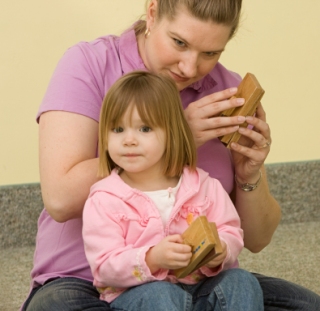
  • > Rocking with your toddler:  Toddlers can rock a favorite stuffed animal, or while you sit on the floor, your toddler can hug you from behind as you rock back and forth to the music.
  • > Rocking with your preschooler: Preschoolers will love to curl their bodies into little balls, and rock and roll around the room. Want to let your inhibitions go? Do this with them! Fits of giggles are sure to follow.

What can your child learn from a puddle?

What would it be like to walk through a puddle for the first time? To not notice it coming up and then just hear the rhythm of your walk change from a tap tap tap to splish splish splash? . . . You look down and notice you are standing in water. You see it, consider it, feel it. What an adventure of the senses!

Parents know how lucky they are to see this happen right before their eyes: their child discovering something new – something that has a sound, or a feeling, or shines, or moves. Discovery can be an incredible gift.

By letting your child walk through that puddle, millions (maybe billions) of sensory connections are made. Thought patterns, optical pathways, auditory stimulation, and your child’s perception of the world are altered and strengthened.

Embrace what a difference you make for your child by taking those walks that last a long long time but cover very little ground. Remember, every stone, pine cone, ant, bird, leaf, and puddle holds a world of discovery. Don’t miss it! Don’t worry about the puddle – the shoes will dry and the pants can be cleaned. The work of the child is to experience something new every day, and that’s one of the best ways you can help your kids learn and grow.

-This post was contributed by Kindermusik educator Helen Peterson. Helen’s Southern Twin Cities program, Kindermusik of the Valley, is in the top 1% of Kindermusik programs around the world.

Music and movement: magical ingredients to learning

Music and movement are magical ingredients to learning for both the child and parent. A baby’s first communication is through movement. A toddler immediately responds to lively music with silly gyrations and flailing limbs – and while these movements usually make us giggle, to him they are serious attempts to coordinate movement with rhythmic patterns. The preschooler seems to be constantly moving – leaping off couches, rolling down hills, and spinning around and around until she falls down in a giggling flop on the floor.

Movement is fundamental for the development of the central nervous system, and science proves it. But what’s more, movement and rhythm are also essential for the development of the soul. These are things that can’t be measured with research and studies.

When a parent moves with her infant, a special bonding takes place that is key to social and emotional growth. When a parent sings to her child, not only are language skills being developed, but also a sense of love, comfort and harmony. The special touching, laughing, and rhythmic moving that takes place in a music and movement class lays a very strong and much needed foundation for a happy, healthy and joyful life!

Here are just a few of the ways that Kindermusik children learn through the interactive music and movement activities of the Kindermusik classroom:

  • Intentional touch is designed to provide stimulation of the nervous system, relaxation and bonding.
  • Activities involve unilateral, bi-lateral and cross-lateral movements that help develop the brain and muscles.
  • Movement and dance steps allow the caregiver and child to experience different rhythms and locomotor movements.
  • Synchronized dances develop sequencing, provide reassuring repetition and social interaction.
  • Expressive movement provides variety, creativity, and opposing feelings such as fast and slow, high and low.
  • Rocking and swinging stimulate the vestibular system, which is so important to balance and even eye movement.
  • Props, such as the “humongous” scarves and parachutes, provide tactile and visual stimulation.

So put on your Kindermusik CD at home and don’t worry about performing the dances “just right.” Don’t even worry about right and left! Simply move to the music and have fun! It all makes a difference.

-This post was adapted from a past issue of Kindermusik Notes and was originally written by Anne Green Gilbert, Director of the Creative Dance Center and Kaleidoscope Dance Company in Seattle, Washington, and a consultant for Kindermusik International.
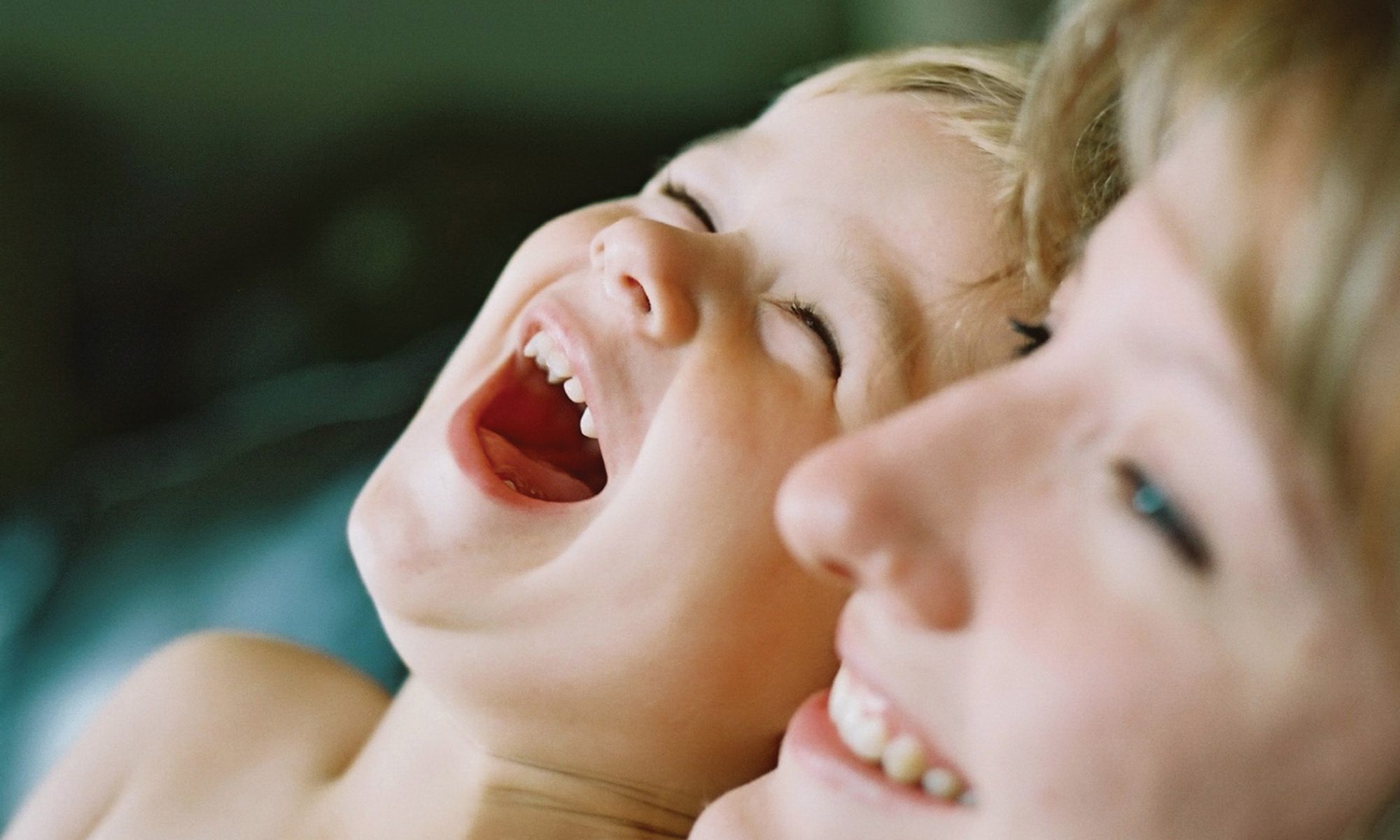
The family that laughs together…

Overtone Singing Crazy Sounds

Giving your child a simple smile can improve his or her self image and brain development. When your child sees you smile, it not only makes her feel good, it strengthens connections in the brain as well.

Studies have shown that smiling and laughter can strengthen the immune system, lower blood pressure, and reduce stress levels. And a healthy sense of humor can help a child handle problems as they grow into adults, as well as enhance the social skills they need to make friends.

Along with smiling, laughter is a sound that’s naturally interesting to your toddler. As he’s getting ready to learn to talk, he needs help learning how to listen so he can distinguish one sound from another to form his first words. Play active listening games like “One ha-ha-happy family”, described below. As you listen, exaggerate your body posture, lean into the sound, brighten your eyes, and model the body expressions of a good, active listener for a happy, talking toddler.

One ha-ha-happy family
Laugh out loud. Ask your toddler to make the sound back. Laugh lots of different ways to your toddler. Wait for her to copy you, and vice versa. Record the sound of your toddler laughing. (Family idea: Make a “Laughter Scrapbook”! Record your family laughing together and all the different ways you can laugh. Keep adding to the recording as the years go and by and hear how the sound of your laughter changes.)

As well as listening games, why not combine physical games with music? This will give your toddler something to laugh about, learn more words about, and develop better coordination.

When you’re a toddler, running is usually accompanied by fits of laughter. This new found physical control makes games like “Ring around the Rosy” a huge hit. Rosy can fall down or do the silly walk – have fun by exploring lots of ways Rosy can “all fall down” by doing other movements that your toddler finds funny, like playing chase or running. Explore sound with your baby before bedtime. Put on your favorite lullaby (or sing it yourself) and play along gently with a musical instrument.

Say “Cheese!”
Smiling and laughing play a large part in the bonding and attachment process that help your child feel secure and safe. Children primarily use their parents’ facial expressions as a guide for behavior. The emotional experiences a child has (especially during the first years) help shape emotional responses throughout life. It’s worth remembering that a simple smile is one building block for your relationship with your child. Your face is where your child looks for reassurement, comfort, and  attention. So don’t be afraid to show your child those pearly whites!


The child cannot wait


Gabriela Mistral, a Chilean poet, educator, and diplomat, was the first Latin American to win a Nobel Prize in Literature. It was awarded to her in 1945.

Among the many topics she covered, Gabriela often wrote about children. It was obvious how important they were in her work and life. In fact, she even donated the proceeds from one of her books to children who were orphaned by the Spanish Civil War.

We recently came across one of Gabriela’s passages that sums up our own convictions on children as well. It goes:

“Many things we need can wait. The child cannot. Now is the time his bones are being formed, her blood is being constituted, his brain is being developed. To her we cannot say tomorrow. His name is today.”

We couldn’t agree more.

Have a great quote that you want to share? Post it in the comments area, below.

Want 10 free music download credits at play.kindermusik.com?

(NOTE: the survey has been closed at this time. Thanks to those who participated!)

If you have been to Kindermusik.com in the last 90 days, just complete this short survey to claim 10 free download credits! Survey responses are completely anonymous. Parent and caregiver feedback is so important to us. We really appreciate you taking the time to help us make improvements.

Click this link to take the survey.

You will be given a promotional code for the free music downloads at survey completion. Thanks!

Music and art are peas in a pod

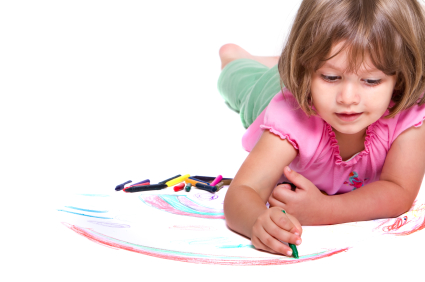
A little child gripping a paintbrush in her hand can quickly discover her “inner conductor.” Smocked in your old shirt and hovering over the kitchen table, arms raised, she conducts the swirl of colors on—and sometimes off—the page.

That’s just one small example of how music and art can go hand in hand. Plus, the same activities that develop musical skills in a young child also develop skills that a young artist needs: hand-eye coordination, creative expression, and visual literacy.

Want some ideas for bringing music and art together with your child? We’ve got some!

For Babies…

Your face is the artwork. You instinctively tend to hold your baby about eight to nine inches from your face—just close enough to provide her with needed visual stimulation. In the first two months of her life, that’s also her best field of vision. According to Carla Hannaford, author of Smart Moves, Why Learning is Not All in Your Head, sight is the least developed sense in a young baby. Most learning—almost 90 percent—occurs through touch and taste. Visual literacy (the ability to see texture and perspective in two-dimensional pictures) is learned later. You can help your baby develop visual literacy by showing her things that encourage her eyes to move. And in the first year of life, her favorite thing to look at is your face.

Your baby loves the contrast between your bright eyes and dark mouth, the many lines of your face, your facial expressions, and so on. The distance between your facial features begins to give your baby the information she needs to build her visual literacy.

Visual and auditory experiences actually shape the wiring of the brain. While seeing moving objects is not necessarily easy for infants, your newborn’s attention will also be attracted to bold, sharp patterns and objects. Showing your infant high contrast items such as black-and-white designs, brightly colored toys, and smiling faces is a great way to support his or her development.

Here are a few more activities to develop eye strength:

  • > When you read together, trace your finger across the words as you read. This encourages your baby to follow your finger.
  • > Hold and shake a rattle or instrument. Move it slowly allowing your baby to track the instrument with her eyes.
  • > Sing. Research has shown that babies will turn their heads to look in the direction of the sound of their parent’s voice.

For Toddlers…

The development of your toddler’s drawing ability begins when the scribbling stage is over. Sometime between the ages of 12 and 18 months, your toddler will probably attempt to “write” by making marks on paper, and at about 18 to 24 months she may surprise you by drawing vertical and horizontal lines or a circle, according to Art and Creative Development for Young Children by Robert Schirrmacher.

The toddler years also mark a phase of drawing sometimes referred to as “Potato People.” These are drawings that feature wide bodies with stick figure legs and arms. Since your toddler spent so much time looking at your face as a baby, much of what he draws in the first year will be faces like these with appendages as an afterthought. Give him plenty of time with paper and crayons to help him develop his drawing skills and move beyond the “Potato People” phase (despite how cute those drawings end up being).

For a colorful activity, “paint” with tissue paper:

  • > Cut the tissue paper into strips, or squares and put a very small amount of water into shallow bowls.
  • > Show your toddler how to scrunch up the tissue and dip into the water to create a watercolor effect.
  • > Encourage your toddler to tell you all about his creations. Talk about the colors, ask him about the shapes. To incorporate music, can you two make up a little song about the creation? Point and label—as you do with everything else in your toddler’s world.

For Preschoolers…

With preschoolers, you can dive in and draw to the music! With her increasingly abstract reasoning skills, her imagination is soaring. She’s also more physically coordinated and able to hold a pencil, crayons, and scissors with greater control. And while she enjoys being to able to draw more geometric shapes, much of the preschooler’s choice of color, is emotional, according to Art and Creative Development for Young Children.

What does the music look like? The emotional aspect of music, combined with tempo and rhythm, make drawing to music a perfect activity for this age.

  • > To really get the imagination going, pick out some music and ask your preschooler to “draw out the music.” Ask him if this is blue music or red music. What would purple sound like?
  • > Use the paper for wall art or wrapping paper. Glue it to bookmarks and give them to Grandma and Grandpa.

Music is from everywhere!

Let’s take a spin around the world to find some of the wonderful music you’ll hear in Kindermusik this semester. Have a look!

Your babies 0-18 months will enjoy the sounds of:  May There Always Be Sunshine (Russia),  Zum Gali Gali (Israel), The Keel Row (Northumberland)  Suliram (Indonesia, Polovtsian Dance (Poland).

Join your toddlers 18-36 months in singing:  The Barn Sull (Scandanavia),  Duermete, mi Nino (Latin America)  Fais D0-Do (France).

Preschoolers will love hearing and learningJapanese Rain Song (Japan, Wggis Song (Switzerland) Funiculi Fuicula (Italy) Lirum Larum (Germany), Siyahamba (Zulu).

And that’s just a sampling of what you’ll find at Kindermusik right now.

Exposing your child to different music and cultures at a young age is a fantastic way to promote understanding, diversity, and spark developing minds and imaginations. After class, talk to your child about faraway places and cultures. Let your child know there is a great big world out there to embrace, explore, and enjoy.

To find a class near you, visit the Kindermusik Class Finder today. You can also hear some of our music from around the world at play.kindermusik.com (register today to get three free download credits)!

Thanks to Kindermusik educator Helen Peterson for contributions to this entry. Helen’s Twin Cities program, Kindermusik of the Valley, is one of the top Kindermusik programs in the world.

Parenting a special needs child

Are you the parent of a special needs child, or know someone who is? It can be as challenging as it is rewarding, and sometimes a little extra help is welcome.

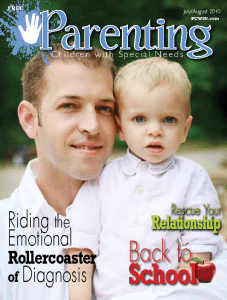
We recently came across a magazine called Parenting Children with Special Needs. It’s relatively new and currently only being distributed in print in the Kansas City area, but it’s available online to anyone. The content is not specific to any region or situation. You’ll find some really great stuff there that is sure to be valuable.

Magazines like this, and others like it, give parents and caregivers ideas, suggestion, and–sometimes most importantly–support, when it comes to raising a child with special needs.

At Kindermusik International, we often here stories from parents and educators who have seen success with Kindermusik when it comes to their special needs child. In many cases, music is one of the rare things that the child responds to. We’re proud to have our name associated with helping special needs children and their parents in any way we can.

So if you’re a parent looking for a little help, a supportive word, or something new to try, there are resources out there. We’ll routinely post them here at Minds at Music. Have a special needs resource you want to share? Post it in the comments area below!

Want to try Kindermusik with your special needs child to see if it’s a good fit? You can find classes and sign up for a free class preview at our Kindermusik Class Finder.

Kids can get stressed too

Relaxation is something we all search for, yet we don’t always find time for it. Life can be stressful and fast-paced, and it’s often difficult to find time to let our bodies and minds relax. Sometimes even when we’re “relaxing” we’re thinking about what’s next on the to-do list!

Adults stress tend to stress about grown-up things like the responsibilities of maintaining a family, paying the bills, and so on. But children experience stress too. They may not be able to express it, but here are some behaviors that could be signs of stress:

  • > mood changes
  • > changes in sleep patterns or nightmares
  • > exhibiting behaviors of a younger age (thumb sucking, bedwetting, clinging, etc.)
  • > no appetite or wanting to eat all the time
  • > needing to go to the bathroom frequently
  • > nail biting
  • > engaging in disruptive behavior

If you notice some sudden changes in your child’s behavior,  stress could be a factor.

You may ask what on earth could they be stressed about? After all, they don’t have any bills to pay! Children tend to experience stress in new situations, when changes happen, or when they are confronted with challenges that require new skills. These might include learning to play with a new toy, learning to share with a sibling, making new friends, completing a project, and so on.

But don’t get stress yourself! Parents and caregivers can model and teach children ways to manage stress. Here are a few suggestions:

  • > keep a consistent routine
  • > make sure the child is getting enough sleep
  • > if the source of stress can be removed, simply remove it
  • > laugh, joke, sing, dance
  • > set aside some quiet time
  • > do something active to relieve stress, like jumping, running, or playing
  • > do a creative, calming activity like coloring

These activities will help your child learn to manage stress and deal with challenging situations. (Of course, if a behavior persists or becomes a serious issue, you may need to consult your physician.)

The goal is simple: make your kids feel good. When they feel good, you feel good!

What other activities can we do with our children to help them manage stress? Post an idea in the comments area below.

Special thanks to Kindermusik educator Vanessa Cabrera for sharing this post from her Language, Music & More blog. Information about Vanessa’s Maryland Kindermusik program can be found at her blog.