Want a $1000 grant to help children? Here’s your chance!

Ever had a great idea for a project that would make children’s lives better but you didn’t have the financial support to make it happen? An idea like:

– Collect new children’s books for children in foster care
– Add universally accessible playground equipment at your local elementary school
– Create a database of service providers who work with children with special needs in your area
– Offer a “Craft Camp” for preschoolers with a military parent who is currently deployed

Well, the Kindermusik Good Beginnings Grant Program is just for you! Anyone can apply for a Good Beginnings Grant. (Note: you must be 18 or older and live in the U.S. or Canada.)

At Kindermusik, we always say “a good beginning never ends.” Our worldwide network of Kindermusik educators will tell you that nothing compares to getting a child off to a good start. We’ve been doing it for 30 years, but now it’s YOUR turn! We are looking for parents, teachers, individuals, organizations, schools, or small businesses with a passion for making a child’s life better.

Our Good Beginnings Grants are your chance to put $1,000 toward a project that will make a difference in the lives of children. The project can be education, playful, musical, or whatever!

From now until December 16 we will be accepting applications. Then, starting in early January the public will vote on their favorite ideas! Get your friends and family to vote (and keep voting each day) to better your chances of winning. The top five vote getters will have their projects funded.

Ready to complete your application? Or want to learn more? Head to:

www.kindermusik.com/grants

Have questions? Post them below in the comments area. Good luck!

5 Aesthetic Awareness Activities for Kids

A young girl picks up leaves on a nature walk to build aesthetic awareness.

Aesthetic awareness, or the ability to observe, process, react to, and value nature and artistic expression, plays an important role in early development.

Our reactions to unusual sounds and sights can occur naturally, but grownups nurturing the listening skills, self-control (think: standing still to watch a hummingbird), and conversation it takes to really appreciate the beauty around us is critical for children.

Here are a few easy tips you can try…

Continue reading “5 Aesthetic Awareness Activities for Kids”

Musical variety is the spice of life

You’ve probably heard the old proverb: “Variety is the spice of life.” When it comes to music, musical variety is definitely the spice of life! When you expose your children to music from around the world, you expose them to different cultures, countries, ideas, and experiences, along with these developmental benefits:

Greater language proficiency
Just as you read a variety of books to expand your child’s vocabulary, exposure to a wide variety of music and sounds expands your child’s “ear vocabulary.” High quality musical recordings and real instruments help your child “fine tune” her ear to recognize and imitate the sounds that make up words and language.

Spatial awareness
When a child listens to music, her mind perceives the sound in multi-dimensional ways. The sound is loud or soft, fast or slow, it moves up and down, or left to right. Eventually, she’ll use that “awareness of space” to work with her body when she walks through the living room and tries not to hit the coffee table. Much later, this same awareness is necessary skill for learning how to get around things, jump, run, and move in zig-zag ways.

Temporal reasoning
You see this skill in action when a preschooler tells a story. He starts with his own experience and then moves to some imagined place with a princess or a superhero then goes back to something real again. Music does the same thing. It goes back and forth between established places (the chorus) and to new places that take you somewhere else (the verse). The ability to go back and forth from something established to something imagined comes from temporal reasoning, a skill used in music writing, storytelling, and problem solving.

Emotional intelligence
With exposure to a greater variety of musical styles-like jazz, folk, or classical, this increased exposure to music increases a child’s awareness, and understanding of different moods and emotions.

Cognitive skills
Research shows that music contributes to the development of a child’s ability to reason, his sense of patterning, and his memory skills.

Musical appetite
In the early years between newborn and age 7, your child is developing his musical taste buds as he learns to appreciate the finer things and to enjoy new musical tastes and textures. The wider the array of musical styles, the richer his “appetite” will be.

Try this at home… Your child is naturally musical. Hearing you sing and listening to recordings are like food for her musical appetite. Sing with child at least three times a day. Consider these song sessions musical breakfast, lunch, and dinner. (By the way, “lunch” can be interpreted loosely. Just plan the routine of singing together at a time that works for your schedule – when your child wakes up, in the car, doing dishes, at naptime, fixing supper, etc.!) Once you start, you will find that there is a song for everything. If you can’t remember what that song is, make one up!

Posted by Theresa Case whose Kindermusik program at Piano Central Studios is proudly among the top 1% of Kindermusik programs worldwide.

Science in the shower

This post was generously shared from the Studio3Music blog.

I am a teacher by profession, and a home schooling mom by trade. (Or is it the other way around?) In any case, I spend most of my waking hours teaching somebody something. If you are a parent, your “other job” is being a teacher, too.

Your child’s job? (I’m talking about children newborn to 7 specifically, here.) Your child’s job is to play. Play IS work for a child’s brain. The brain is designed for the first seven years of life to simply organize things. And organizing play is how the brain does just that. I don’t mean organized play. Organized play is something that adults do to children. Telling them how and what to play.

So why are their rooms so messy? Well, it’s not THAT kind of organization either. The brain’s job is to organize all the sensory input it is receiving. Done well, and your child will be a happy and eager learner when they enter elementary school.

Way back in 1949, N.A. Alessandrini defined play as, “A child’s way of learning and an outlet for his innate need of activity. It is his business or career. In it he engages himself with the same attitude and energy that we engage ourselves in our regular work. For each child it is a serious undertaking not to be confused with diversion or idle use of time. Play is not folly. It is purposeful activity.”

This is still true today. The “occupation” of play for a child serves as a foundation for the development of future occupations (the kind they earn money for!) when your child grows up.

Now for your job… As teachers of our children, what can we do that allows them to organize their play? By providing them with open ended toys like blocks, cars, dress-up clothes, art supplies, dolls (for boys, too!) legos, a sand box or water table, kid-friendly pans, utensils and pretend food.

Do sit down and play alongside your child. As well, give them room to play as they wish. Remember, there really is no wrong way to play with a toy. (I don’t consider breaking toys or eating sand playing.) Your child will play with the toys the way the brain needs to in order to organize itself.

Case in point. Science in the shower. We have an accumulation of foamie shapes left over from various craft projects. Big and little animals, cars, etc. A couple of months ago, I took a big handful of them and gave them to my 4 year old Natalie in the shower. The only thing I had to do was demonstrate that they “stuck” to the wall when wet. And then I stepped back and observed her.

It’s been months now, and they are still in the shower. She doesn’t want to take a bath because she wants to still play with those foamie pieces. What have I observed? Natalie organized her own play. Literally – Everytime I go to take a shower, all those animals will be arranged in a different pattern. Sometimes by color, by habitat, by size.  That’s science in the shower.

And then I get to see the outward manifestation of the internal organization that is going on. Because sometimes, Natalie takes two of the animals, and one is “bad”, and one is “good”, or one won’t let the other play with it, so she practices making friends, and works through social situations that are typical at this age.

You see, her brain knows what it needs. Your child’s does, too. We just have to provide the “tools” and the space to allow that to happen.

Special thanks to Studio 3 Music for allowing us to share this great post from the Studio 3 Music blog. Studio 3 Music in Seattle, Washington, the world’s largest Kindermusik program.

Sometimes ACTIONS are louder than WORDS

Have you ever sat in a movie theater, and several people in the row behind you are all talking? I bet you found it difficult to concentrate on the movie.

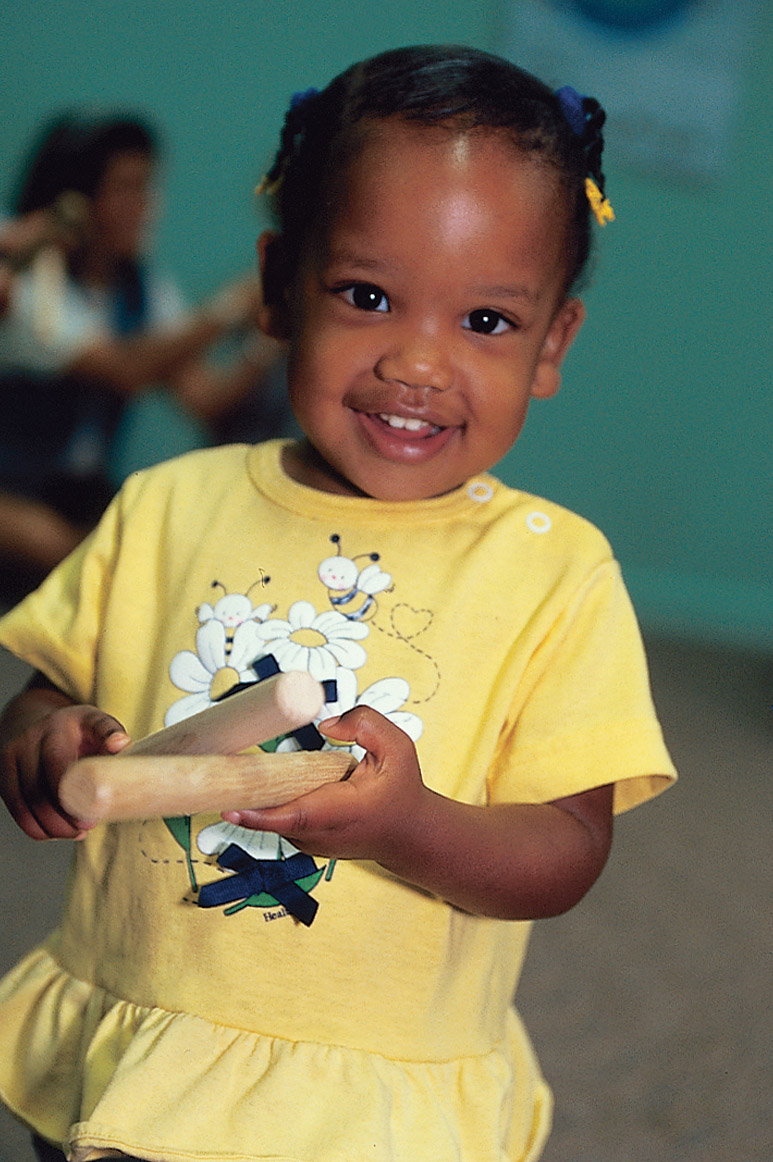
What does this have to do with your child in a Kindermusik class? Just imagine this scenario: your Kindermusik teacher brings out a basket of rhythm sticks and sings “two for you and two for your grownup”. Most of the grownups in the room start encouraging their child to go get the sticks. They encourage them with their voices and now we hear 10 adults telling their child to go get sticks. At this point, some of the children will start to “tune you out”. I like to call this “selective hearing loss”. (I have teens at home and I am very familiar with this temporary, albeit sometimes annoying ailment.)

Although we highly encourage you to talk to your child throughout the day and label movements, sounds, and objects to help with language acquisition, there are times when we have to allow them to figure out what to do without being told. Allow them to problem solve.

I want to share with you an experiment we did in a few of my classes. I asked the adults not to give directions to their child during this class – just sing when it was appropriate in the lesson. The toughest part was the “no talking”. But they all agreed and were curious to witness their child in this somewhat altered environment. I encouraged them to guide their little one by being a model and using non-verbal cues.

Here is what some of the adults said at the end of class:
* They showed more patience
* They were more “in the moment” with their children
* Their children were more attentive and focused
* Their children felt freer to create, explore, and express themselves

Try a version of this experiment at home. Take time to explore with your child without giving them opinions or directions. Be a model for them through your actions and not your words. It’s not easy, but it may allow you to be “in the moment” with your child in a way you have not been before.

Special thanks to Kindermusik educator Cathy Huser for sharing this insightful post from her blog.  Cathy’s program, Kindermusik of Cleveland, has been a top ten Kindermusik Maestro program for 10 years running.

What do you hear?

Pitter, patter, pitter, patter… I can HEAR the rain.

Musically speaking, rain sounds are short sounds.  The musical term “staccato” refers to sounds that are separated and often short.  It’s the perfect word to use when playing with – and describing – rain sounds.  But did you know that being able to identify a sound as “short” (staccato) or “long” (legato) actually involves some pretty high-level thinking and listening skills?

Active listening differs from simple hearing in that we must choose it as an intentional act. Analytical listening, like the kind we will do in Kindermusik class when we explore different shaker sounds and mimic and identify a variety of rain sounds, takes the development of our music listening skills to a whole new level.

Analytical listening is an absolutely vital skill, for music class and for life because it requires children to:
– Evaluate what is heard and comprehended
– Contemplate and reflect
– Weigh new information against what is already known
– Discuss by sharing thoughts, opinions, and viewpoints

As Kindermusik teachers, it is an awesome privilege for us to be able to help shape a child’s disposition and aptitude for learning music – practicing the skills that lead to competency and enjoyment and encouraging the attitude that music is fun.  Music truly is a powerful tool for representing ideas and expressing individuality, especially when a child develops the ability to listen analytically.

In the Kindermusik classroom where so many of the senses are often engaged simultaneously and where imagination can soar, musical learning truly has the potential to be the strongest and most powerful.

Posted by Theresa Case, whose Kindermusik program at Piano Central Studios is proudly among the top 1% of programs worldwide.

Let’s jump for joy!

This article was originally written by Kindermusik educator Helen Peterson. Helen’s Kindermusik of the Valley program, located in and around the twin cities, MN, is one of the top programs in the world.

In a relatively recent study, 4 to 6 year old children in music and movement programs were tested to see how they compared to children enrolled in a traditional physical education program. The results were interesting, to say the least. The children getting music and movement instruction showed more growth in motor skills than those in a standard physical education program. Here’s a quote from Early Childhood Research Quarterly (Vol. 19, Issue #4, 2004):

“In a study 50 children were enrolled in a music and movement program, and 42 children were enrolled  in a traditional physical education program. After 8 weeks, the children in the music AND movement group had improved significantly in both jumping and dynamic balance skills when compared to their peers in the traditional program.”

As a Kindermusik educator, I have had many parents ask me how Kindermusik compares to Gymboree or Little Gym, now I can honestly say (as I suspected): movement + music (Kindermusik) really is the best choice.

Meet Luke. You’ll be glad you did.

The following post was graciously shared with Minds on Music from Studio3Music. We all agree: it’s what Kindermusik is all about!

This arrived in my inbox the other day from one of our Kindermusik moms, Melissa. I read it, and by the middle of the email, I had tears streaming down my face. I have never had a story about one of our Kindermusik children touch me quite as much as Luke’s. Enjoy!

My child is special.  Yes, I know what you’re thinking, ‘your child is special too’, but my child is REALLY special.  Luke is a special needs child. In short, he was born with brain damage.  He has developmental, fine and gross motor, and significant speech delays.  One thing that Luke is not delayed in is his love for music!

We started Kindermusik with Luke when he was 2. As we sang during Luke’s first class his teacher, Beth, explained how holding the different sized egg shakers encouraged different motor skills.  I felt a pang of emotion shoot like lightening through me.  “This is perfect for Luke”.

We played with items with different textures, something Luke’s physical therapist had suggested just weeks earlier.  We drove cars on different body parts, played games, and of course sang and danced!  I knew right away that Kindermusik going to be great for Luke.

After that first class I buckled Luke in his car seat, drove about a quarter of a mile down the road and began to sob. I was (and am) SO thankful that Luke has this opportunity to nourish and support him in such a fun way.  I immediately turned my car around and went back to the Kindermusik class.

Miss Beth saw my tear stained eyes and gave me a big hug before I could even share anything with her.  Once I found some composure I briefly shared Luke’s condition with Beth and told her what her class means to us.  Here she is, just doing her job, like so many other Kindermusik teachers but she is actually helping to HEAL my child…and expand yours!

For most of Luke’s first round of Kindermusik he was typically just along for the ride.  He didn’t have the fine motor skills to play many of the instruments, his sensory issues made it difficult for him to transition from playing to being held quietly during cuddle time, he doesn’t have the ability to talk so singing along was out, he didn’t make any sounds at all for that matter, also, he couldn’t sit still for story or rolling a ball back and forth, and he didn’t mimic so he wasn’t quite developing thru watching either.  I pretty much held his hands, literally, throughout every exercise and activity, manually supporting his hands and fingers in participation.

Despite all this, Luke LOVED Kindermusik.  He began to get excited when we’d pull into the parking lot for Kindermusik, squealing, smiling, and kicking his legs in excitement!  Then one day, as we left class I put Luke in his car seat.  I sat my keys in his lap while I buckled him in and he took my keys, put them between his legs, and put his arms up and out to his sides.  Luke was mimicking!  Luke was trying to play!  Luke was thinking in his sweet little brain:

Jingle, jingle, jingle, go the car keys.
Jingle, jingle, jingle, go the keys.
Lost them, lost them, where are the car keys?

I couldn’t wait to tell Miss Beth…and everyone else for that matter!

Luke is now three and in his second week of his second round of Kindermusik.  Now Luke zips around the room yipping and squealing.  He had class this morning and did 6, count them 6, new things in those precious 45 minutes.

First, Luke attempted hammering his rhythm sticks!  He switched his grip around until he was able to hit the top of one stick with the other like he was hammering in a nail.  No hand-over-hand, he just did it!  He knew he did it too!  He made sure I saw him and I could see the pride in his smile.  I felt that lightening bolt of emotion shoot through me again.

Next, he noticed that I had put the top of the tone bar back on upside down.  Noticing this is huge. Next, he tried to problem solve by turning the bar over.  Of course his logic was flawed, but for a little boy without a frontal lobe, attempting to problem solve is huge!

NEXT, Luke allowed me to hold, embrace, and rock him during the cuddle part of class!  I think he even enjoyed it!  After this we played with balls.  Luke still couldn’t sit still or roll the ball but he did something unexpected, he caught the ball, a few times!!!  I’ve never seen him do this before and, since he has an older brother, balls are big things in our house!

Also during ball time, he saw a classmate sitting on her ball and bouncing on it…what did Luke do?  He mimicked!  He put that ball under his little tush and tried to sit on it!  He couldn’t balance well enough to do it but he tried…I almost cried!

Lastly, when class was over, Luke “eagerly awaited” his hand stamp.  His version of eager waiting is standing up an inch from where I’m sitting and pointing with a limp wrist at Miss Beth stamping the other kids.  I escorted him up front and he got his stamp.  That’s not new, what is new is what happened next:  he pulled up his shirt up, along with the sensory leotard top he wears, stuck out his belly, and gently patted his stomach.  HE wanted to have his tummy stamped like some of the other kids and, in his own way, he TOLD me this!  Talk about leaps and bounds!

Another thing we’ve noticed since starting Kindermusik is that if Luke is “playing” a musical instrument with his hands he may, on rare occasion, vocalize. In a sweet, soft, broken, purposeful whisper we’ve heard him sing:  “ahhhhhhh”,  “oooooooooh”, and “ooouuuuuuu”.  He is always the first to notice that music is playing: in the car, at the mall, on a commercial, anywhere.  He is drawn to it.

If Kindermusik can have such an impact on my special needs child, just imagine what it is doing for your child!

If you ever get the chance to meet Luke you will know immediately that he’s special. You may not even notice that he is handicapped because you’ll be so mesmerized by his hugely gregarious smile and his eyes shooting darts of love at you more accurately than one of Cupid’s arrow.

-posted by Melissa, Momma to Luke, who says that there is indeed something special about Luke, and her family is SO thankful that he has the musical therapy of Kindermusik harmonizing with them to help heal him.

Special thanks to Studio 3 Music for allowing us to share this great post from the Studio 3 Music blog. Studio 3 Music in Seattle, Washington, the world’s largest Kindermusik program.

When you run out of words

This post was shared with Minds on Music from Kindermusik educator Analiisa Reichlin. 

I sat at the dining room table with my head in my arms and just sobbed. Our studio email accounts had disappeared, our website was being migrated from a very slow, old server to a new one, and the ½ hour project turned into a week-long nightmare, and the site was down during our busiest time of the year.

Our dog Buddy had been bitten or stung by something, and had gone into anaphylactic shock. In addition, after 3 years of deals falling through at the last moment, we were just about to put an offer in on a house. But that was before the unexpected expenses that wiped our savings out.

It was only 7:30am on Tuesday. And the week really didn’t get much better. I’m sure you’ve had weeks like that, too. But before this gets too depressing…

I found myself frequently bursting into song this week. And of all the odd things – hymns from my childhood. There was something comforting about them. I began wonder why.

I remember when I took my husband-to-be, Karl, to his first musical – Showboat. I grew up on musicals, and went to as many as I could when I lived in New York City. So I was totally dumbfounded when he turned to me shortly into the first act and said, “They just burst into song. Why did they do that?”

I’m thinking, “Well, it’s a musical.

Years later I asked [my Kindermusik partner] Miss Allison (with her degree in musical theater), why do they burst into song? And she said that the character has reached the point where the emotional intensity of the moment can no longer be conveyed with words.

So this week, when I ran out of words, I found myself singing. But why the hymns? Certainly because the words brought me comfort. But also because when I sang them, I was brought back to the time when I was young, surrounded by my family, in a moment when I felt very loved, and at peace. Where I needed to be emotionally this week.

I got to thinking…What songs did I sing to my babies, and now with my children? Because those are the songs that they are going to sing when they are grown up and need to remember the emotional security and comfort of those who loved them best.

-by Miss Analiisa, who knows that the math formulas she teaches her children may not be remembered when they are older, but the music and songs she instills in them will be in their memories forever.

Einstein and his violin

This article was written by Kindermusik educator Helen Peterson. Helen’s Kindermusik of the Valley program, located in and around the twin cities, MN, is one of the top programs in the world. Enjoy this little vignette!

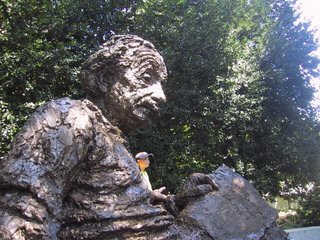
A few years ago, Tucker and I took a quick trip to Washington D.C. and, like thousands of other tourists, I made him sit in Albert Einstein’s lap for a picture.

Albert Einstein’s schoolteachers told his parents that he was “stupid” and simply couldn’t learn. They urged his parents to take him out of school.

What did his parents do instead? They bought him a violin. It was a turning point.

In later years, Einstein would turn to his violin while trying to work out his scientific problems and formulae. Once, when asked about his theory of relativity, Einstein explained, “It occurred to me by intuition, and music was the driving force behind that intuition. My discovery was the result of musical perception.”