All about the beat

In all Kindermusik classes, there is always emphasis on hearing, feeling, moving, and even “seeing” a steady beat. It may seem very elementary, but it is essentially the cornerstone of music.

More importantly, steady beat plays a huge importance in our speech, movement, thoughts and verbal organisation. From a baby’s first hesitant steps, he slowly finds his pace and soon starts to walk steadily and confidently. Our preschoolers who have a strong sense of beat would be able to use the scissors more skillfully. Ever watch a basketball game? The steady dribble of the ball before it is tossed smack into the basket require an acute sense of beat and timing. A master chef needs to have a command of steady beat in his knife skills. Even writers rely on a sense of steady beat and rhythm in their prose to produce a good read.

Because it is such a fundamental element, parents and teachers often do not give sufficient attention to the development of this very important underlying skill – a strong sense of beat. The consequence of insufficient steady beat experiences in early years can result in poor physical coordination, halting speech (in some cases, stuttering), and even weakness in thought flow. Would you have imagined that something so apparently a strictly musical characteristic can have such bearing on so many areas of our functioning?!

Here are some simple and fun activities that you can do with your child at home to reinforce the concept sense of steady beat:

Movement – Turn on the music and pretend to be a marching band. March, stomp or jump to the music.  For younger babies, put them on your lap and bounce to a steady beat or dance with them around the room to the steady beat of the music.

Instrument play – Use the instruments from your home materials or make your own. An old pot and spoon will make a very fun ( and loud!) drum. Practice keeping a steady beat along with the music.

Reading – Nursery rhymes are a great way to introduce steady beat. Clap or tap along as you recite your child’s favourite rhymes.

Originally written by Chiat Goh. 

Mozart Therapy

A recent article from Science Daily summarized some very interesting findings by the Tel Aviv Medical Center, namely that creating a musical environment for premature babies positively affected their ability to grow and thrive.  Preemies who were exposed to 30 minutes of music by Mozart expended less energy during that 30 minutes, thereby using fewer calories and allowing for greater weight gain.  Having a healthy body weight means that these babies have a stronger immune system and go home sooner.

“The TAU study is the first to quantify the effect of music, specifically Mozart, on newly born children. ‘Medical practitioners are aware that by changing the environment, we can create a whole new treatment paradigm for babies in neonatal care,’ says Dr. Mandel. ‘That’s our main goal — to improve their quality of life’.”

While the study is based on the controversial “Mozart effect” and researchers still aren’t clear on the long-term effects of Mozart’s music, one result is certain – music makes a difference.  Thousands of Kindermusik educators around the world can attest to that; we are privileged to see the wonderful effects of music on young children and their families week in and week out.  We especially love it when science confirms what we’ve known all along: one of the best gifts you can give your child is the gift of music.

Written by Theresa Case, Maestro Educator since 2000 and owner of Kindermusik at Piano Central Studios in Greenville, SC.

All cooped up?

Winter time is always a challenge, no matter where you live.  If it’s not snowy, it’s rainy.  And often it’s cold – too cold to be outside.  Or you’re all trying to get well from the latest virus that the whole family passed around one by one.  So what’s a parent – and a kid! – to do when you’ve been cooped up inside the house for too long?  We suggest that you get moving… to some music, that is!

The easiest way to get started is just to turn on some lively music – you know, that kind that has your feet going and your hands clapping before you even know it.  Even just a minutes of carefree, not-thinking-about-the-laundry dancing with your child can turn around the day around for both of you!  Of course, movement is not just important for helping children let off a little steam or pent-up energy, but it is also a key factor in their overall development.  And it’s a great way for a child to be able to get close to and connect with someone she loves.

You might also enjoy moving in a slightly more “structured” way by making a small circle and doing a circle dance.  Remember “Ring Around the Rosie”?  Circle dances like “Ring Around the Rosie” actually help your child focus on directing and moving her busy little body.  She also becomes aware of her body in relation to the larger physical space.  She learns about coordinating her movements with the words of the song.  Plus, she increases her memory and attention span as she follows the simple sequence of steps.  Who knew a little dancing could accomplish so much?!

By the way, if you’re looking for some new music, or you just want some high-quality children’s music recordings that the whole family will love, now is the perfect time to peruse the hundreds of selections at play.kindermusik.com.

Contributed by Theresa Case, director of Piano Central Studios in Greenville, SC, whose Kindermusik program at Piano Central is in the top 1% of Kindermusik programs worldwide.

Why Music Supercharges Early Brain Development

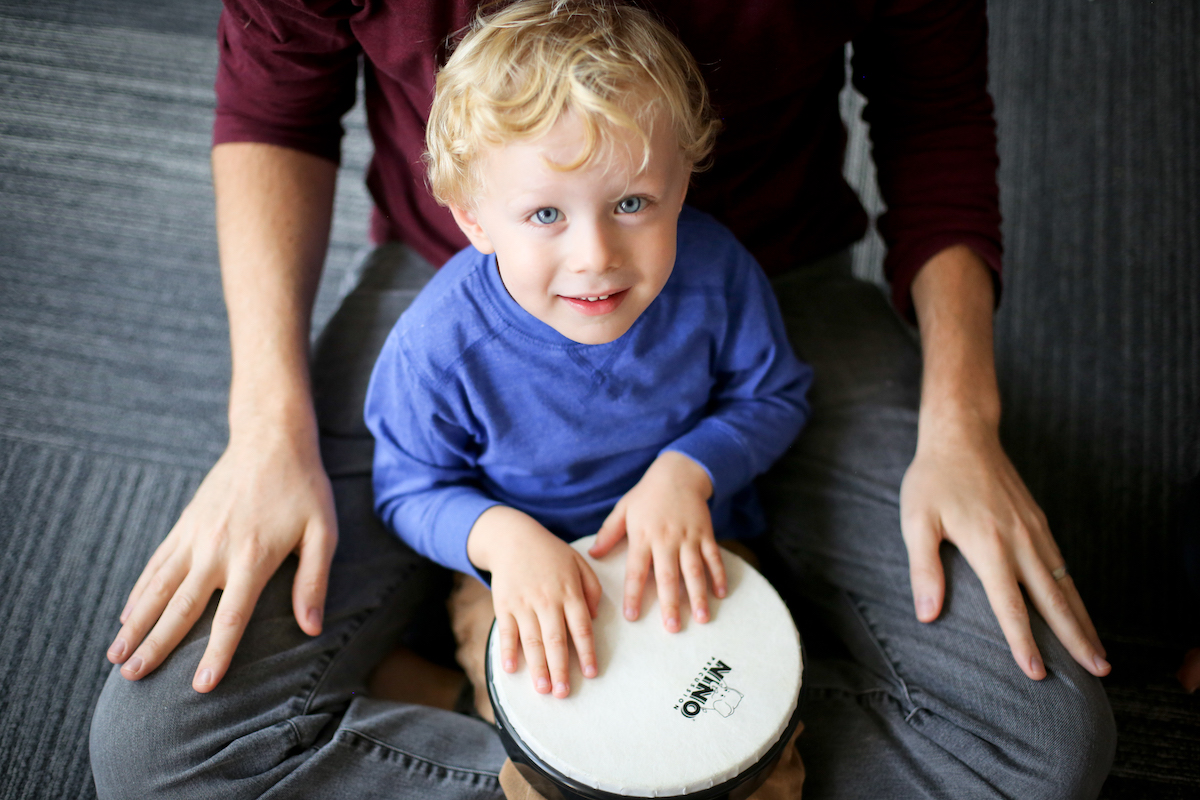
Steady beat (by tapping a drum or your lap) is one of the many ways music supercharges early brain development.

Steady beat (by tapping a drum or your lap) is one of the many ways music supercharges early brain development.

Research shows that listening and playing along with music is one of the few activities that fully supports early brain development.

How?

It engages both hemispheres of your child’s brain.  Add the fine motor coordination it takes to hold an instrument and tap in time with the music, and your child is working on the hand-eye coordination and finger strength that’s necessary to hold a pencil, tie a shoe, use scissors, and dribble a basketball later on.

Early Brain Development Tips

For your baby – Gently tap the steady beat on your baby’s hand, foot, or knee with an instrument.

For your toddler – Invite your child to use the instrument to tap on his own toes, knees, or even a tummy!

For your preschooler or big kid – Preschoolers and older kids can march around the house in a musical parade.

Musical Brain Boosting Tools

Did you know Kindermusik has a free kid-friendly app? Download it today on Google Play or from the App Store, and choose from themed playlists (like colors, nap time, and food), tappable instrument play, and more!


Originally compiled by Kindermusik educator Theresa Case. Theresa’s program, Kindermusik at Piano Central Studios in Greenville, SC, USA, is proudly among the top 1% of Kindermusik programs worldwide. Search for a class with Theresa or find a virtual or in-person class wherever you are.

I love it when a plan comes together

So for months now we have had Kindermusik classes.  And many of my families have been together all that time, so they have become family to each other.  Just the other day, a magical moment happened in class.

We have been working on building this “family” community by having a gathering time at the beginning of class, so that parents and care givers can connect. We then continue on with singing a hello song that incorporates all the children’s names, and we like to do circle dances to help bring people together in a relaxed, fun, safe environment.

One of my favorite circle dances right now is Love Somebody.  We have been having a great time walking in and out of the circle, and then the big finish is tell all the children in class that we all love them….and now even the adults will point to each other!  Our families in class are so comfortable singing and doing activities that when a new person comes into class, they all openly embrace that parent and child.

As  Kindermusik teachers, we want there to be that connection between parents.  We hope and plan to have that happen. We love hearing the play dates being organized, but most of all we love having that special time with each of our classes!

– shared by Miss Beth from Studio 3 Music, the world’s largest Kindermusik program.

The music in your head: How did it get there?

Music education is a vital part of a child’s life. Research shows that our abilities to sing in tune, move to a steady beat and yes, hear music in our heads, are all formed by the time we are 8- or 9-years old. That doesn’t mean you can’t learn to sing or dance or play the piano after the third grade, but the learning windows for musical aptitudes do begin to close.

Do you ever hear a song in your head over and over again? Can you imagine not being able to hear music this way? Audiation, the ability to hear music when no musical sound is present, is an acquired skill. Similar to thinking thoughts without talking aloud, when you audiate, you internalize and “think” music. To practice audiation with your child, leave off the last word of a favorite song. Stop completely. Observe and listen to your child. What is the reaction? When you play this game with familiar songs, you are engaging your child’s ability to think and “speak” with you musically.

Were you lucky enough to have wonderful parents who sang to you all the time? Did you sing endless rounds of “She’ll Be Comin’ Round The Mountain” when you went on vacation? Repetition is a critical part of your child’s growth and development between the ages of birth and seven. Repetition aids in strengthening the neural pathways in the brain. So when your child wants you to “Read it again, Mommy!” or “Play that song again, Daddy!”, do it!!!

Babies are innately musical. They respond to music and sound in utero. Carla Hannaford, author of Awakening the Child Heart, tells us that hearing and language begin in utero and become the first window to the material world as the embryo physically reacts to sound 23 days after conception. Sound becomes the organizer of our physical structure and later, via the mother’s coherent heart rhythm, gives us the patterns on which to form a coherent understanding of patterns within our world.

People often ask, “What do you do with an infant in a music class?” Babies can be soothed with music. Brain development is stimulated by music. A Kindermusik Village class, for example, provides a rich environment of music, movement, language and touch for babies newborn to 18 months. This combination of music and movement stimulates the Vestibular System, the fluid in the brain. According to Dr. Alfred Tomatis, without a fully developed Vestibular System that allows us verticality and balance, language and learning become difficult. Language development begins with movement and is supported with interactive communication and music. Hannaford points out that early music education, including the interplay of music, movement and sound, is key to developing language, math, relational and learning skills, as well as creativity.

Toddlers love to clap and pat to the steady beat of favorite tunes. Steady beat is the unchanging, underlying beat that pulses through every top-10 tune on the radio. Different from rhythm – a combination of various short and long sounds – steady beat is what we tap our toes, pencils and imaginary drums to. For many toddlers, steady beat is an innate ability nurtured with lots of opportunity to practice. For others, it is a skill that can be learned through practice. The ability to keep a steady beat is a gift that we all want our children to have. A study showed 100% of first string professional football players can move their bodies to a steady beat. Moving to a steady beat develops a sense of timing and the ability to organize and coordinate movements like walking, dribbling a basketball, driving and using scissors. Not true for 2nd string. Kindermusik classes provide many opportunities for toddlers to play instruments and move to a steady beat and parents are educated about ways to keep music alive at home.

Preschoolers are exploding with ideas and questions. Creative music and movement provide an outlet for the imaginary characters that live inside a child. 3- and 4-year olds flourish in an environment where there is music, movement and an opportunity for them to contribute ideas. In a Kindermusik Imagine That! class, a child can explore voice and ideas, add instruments to songs and rhymes, act out enticing characters and grow socially while interacting with peers.

For a kindergarten or first grade child, reading readiness is an important issue. I often imagine how it would have been to have the language of music and the English language concurrently integrated into my life: learning to read and write music while learning to read and write language.

Kindermusik provides a whole child approach to music education. Children move and sing, play musical games, learn about music in other cultures, talk about and listen to the instruments of the orchestra, develop their discriminative listening skills, build self-esteem through group interaction and music making, begin to read and write basic musical notation and much more.

I often get calls from eager parents, ready to spend gobs of money on private music lessons for their 3-, 4- and 5-year olds. I first ask them, how are the children’s fine motor skills? Are they reading? How big are their hands? Are they ready to practice at least 20-30 minutes each day? By the time children complete a 2-year Kindermusik class, they have played a pre-keyboard instrument, a simple string instrument and a wind instrument. They are eager to pursue private lessons and have more staying power!

When you choose a music program, make sure it is compatible with you and your child. Be prepared to be an active participant and supporter of your child’s music experience. It could be the best investment you ever make.

Music turns kids on. So turn it up!

Thanks to Stephanie Bartis, M.M., for sharing this great article, orginally written for the Art of Well Being. Stephanie is a member of Kindermusik’s Maestro Conductor Circle, which distinguishes her and her studio, Bartis Creative Studio, as among the top 1% Kindermusik programs worldwide.


Change a child’s life by casting your vote

Have you heard about our Good Beginnings grant program? We’re giving five $1,000 grants to projects submitted by individuals and organizations around the U.S. and voted on by individuals like you.

We received over 40 fantastic applications, each one touching, thoughtful, and extremely important. They are all deserving! But we need you to help choose the five that get funded.

Visit www.kindermusik.com/grants to see all of the ideas and vote for your favorite(s). You can vote every day, up to 10 times a day between now and February 9, 2011. The top five vote getters will receive Good Beginnings grants.

Here’s just one idea submitted by KidzNotes. KidZNotes transforms futures through classical, orchestral music training beginning in the pre-school years to combat poverty, strengthen inner-city education, and foster positive decision-making to unlock the world. KidZNotes is based on Venezuela’s El Sistema.

Embed YouTube video: http://www.youtube.com/watch?v=uQPB9JS4woE

Other ideas include:

  • > Supply MP3 players with headphones for families to enhance musical learning opportunities in learning centers, designed for parent and child interactive experiences in Canton, Ohio
  • > Support breastfeeding families by through the creation of the Nursing Nook in Vida, Oregon
  • > Offer Kindermusik classes to at-risk families in Owensboro, Kentucky
  • > Bring musical instruments to children in community centers
  • > Provide music classes at the local library for children at Round Top-Carmine Elementary School in Texas where the school district is unable to fund such classes
  • > Set up a themed-based building to have a place to play and learn for disadvantaged children in Irmo, South Carolina
  • > Create a resource guide for special needs families

And so many more wonderful ideas. Take a few minutes to visit www.kindermusik.com/grants, check out some ideas, and cast a few votes. Thanks!

Note #1: We are currently experience trouble with voting and the Internet Explorer 7 browser. We are trying to correct the issue. Other browsers appear to be working fine.

Note #2: VOTING. You may be wondering how the 24-hour voting period is determined. Voters can vote up to 10 times within a 24-hour period. Unlike the application period which ended at the same time for everyone, the 24-hour Voting period is different for each Voter. The 24-hour period starts when a person casts her first vote for the day. So for example, if a person casts her first vote on Wednesday at 1:00pm EST, she has until 12:59:59pm EST on Thursday to cast her 10th vote. Her number of potential votes (10 per day) starts over again at 1:00pm EST on Thursday. Any unused votes from the previous 24-hour period do not carry over into the next.

Try a free Kindermusik class preview in 2011

Happy new year! The new year means a lot of things: a fresh start, a resolution or two, a new calendar hanging on the wall, the struggle to remember to write the correct year on your personal checks! (Or is that just us?)

Have you thought about what special activities you’ll plan with your child to make this year one of growth, bonding, learning, and great memories? If you’ve begun mulling over this question, hopefully Kindermusik is on your list.

We know there are a lot of choices for parents today, but we think Kindermusik is simply the best choice a parent can make. Our classes are engaging, age-appropriate, and research-based, not to mention an absolute blast! But don’t take our word for it. Check out the community page on our new website to read some quotes from mommy bloggers across the web. These are unsolicited blog entries from parents who absolutely love taking their kids to Kindermusik.

So try Kindermusik to see if it’s right for you. Sign up for a free Kindermusik class preview:

CLICK HERE FOR A FREE CLASS PREVIEW

Kindermusik has it all. It’s music, it’s movement and dance, it’s learning, it’s connecting with other parents, and perhaps best of all, it’s bonding with your child. We know you’re going to love it, and we hope to see you in class soon!

Have questions? Visit our newly redesigned website at www.kindermusik.com or email us at info@kindermusik.com.

Make it a musical, TOGETHER Christmas!

Although this is the time of year when many Kindermusik programs take a brief holiday break, no one has to take a break from musical, family-oriented activities over the holidays!  In fact, the holidays are the perfect time to take a few minutes here and there to de-stress, make a memory, and enjoy all that the holidays were meant to be.  Here are a few ideas and resources to get you started:

Favorite holiday-themed books (teacher-tested and kid-approved!)
Dream Snow by Eric Carle
The Snowy Day
by Ezra Jack Keats
Snowballs
by Lois Ehlert
Flannel Kisses
by Linda Brennan
Llama Llama Holiday Drama by Anna Dewdney
The Mitten by Jan Brett

Favorite music downloads  from play.kindermusik.com
Jingle Bells Play-Along
Rudolph, the Red-Nosed Reindeer
Over the River
The Jolly Snowman
The Little Drummer Boy
Ding Dong Merrily on High
The Night Before Christmas


Family activities to bring a smile and create a memory!
Pretend Sleigh Ride: Turn on “Over the River.” Pull a laundry basket with a sturdy rope or slide it around.  Add bells to the side of the basket to get the full effect.
Make a Snowman out of Dad: Play “The Jolly Snowman” as you use toilet paper to wrap up a family member like a snowman.  Add a hat, scarf, mittens, etc for fun.  Don’t forget to take LOTS of pictures.

Pots and Pans Play-Along: Get out some wooden spoons and some pots and pans.  Play along to “Jingle Bells” or “Rudolph.”

Easy food crafts
Marshmellow snowmen
Gingerbread house from graham crackers
Homemade Hot Chocolate Mix
Reindeer Hand Print


Posted by Theresa Case, whose Maestro Kindermusik program at
Piano Central Studios in Greenville, SC, is proudly among the top 1% of Kindermusik programs world-wide.

One way to show how thankful you are

Yesterday was the Thanksgiving holiday in the U.S. As an international company, we know that many of our parents and educators are outside the U.S. and don’t celebrate this day. But the holiday’s theme is universal—setting aside a time to stop and give thanks for everything that we have. It doesn’t matter what date the calendar shows, any day is a good day to do this.

One of the most common ways we show thankfulness is by helping others. This could be a friend in need, a special group of individuals, a stranger—anyone. And if there’s one thing we at Kindermusik International have learned after 30 years, it’s that our Kindermusik community of educators and parents is one of the most giving, caring, and generous communities you’ll ever find. Bar none.

This led us to develop the Kindermusik Good Beginnings Grant Program. If you haven’t heard us talking about it yet, the program allows anyone (individuals, small organizations, schools, foundations, Kindermusik educators, etc.) to apply for a $1000 grant for any project that will help children. We will be awarding five Good Beginnings grants, as chosen by the general public. Voting on project ideas will open in early January and run through February. We are currently accepting project applications through December 16, 2010.

So, in this time of thanks, consider demonstrating how thankful you are by applying for a Good Beginnings grant. If you live in the U.S. or Canada, all you need to do is come up with a project idea that will help children. It can be anything! Need help thinking of an idea? Visit the application site for some examples to get the juices flowing. When you’re ready, simply fill out the online application at www.kindermusik.com/grants. (Consider including photos and/or a short video to give your application some pop!) When voting opens in January, spread the word to family and friends to vote for your idea. Simple, right?

To our friends beyond the U.S. and Canadian borders, we wish we could have extended this program worldwide. Though we tried, strict international rules and regulations prevented it. However, you can still be part of the process! When voting opens on January 5, 2011, we invite you to visit the grants site and vote for the projects you like best. Anyone can vote (up to ten times a day, each and every day through February 9, 2011).

Now it’s our turn to give thanks: thank you for being part of our Kindermusik community, and thanks for everything you do to get children off to a great start!