“A powerful idea communicates some of its strength to him who challenges it.” – Marcel Proust
It’s the “Season of Giving” for many Kindermusik families. For the hard-nosed environmentalists among us, the holidays create a certain challenge to sustain the sustainability mindset when buying, wasting, and indulging are part of the holiday milieu.
THUS, we’ve decided to extend the Kindermusik Green Competition
deadline through Friday, December 7th.
We know you’re busy, but we firmly believe in the positive contagiousness of challenging one another to be environmental leaders by sharing our stories among the community. Environmental leadership is both about standing OUT to set an example for what’s right, and about letting examples of others’ good works to instigate our moral mojo.
KI Green has celebrated company sustainability efforts for over a year. Now it’s time to celebrate YOU.
WIN 50 free Kindermusik songs & $100 donation to your favorite charity by sharing your family’s Green/Sustainability/Eco efforts by 12/07/12.
Kindermusik International is pleased to announce two December workshops in Brescia and Reggio Emilia, Italy celebrating the child-centered, parent-inclusive approach to education known as the Reggio Children Approach.
These special workshops were made possible between a special liaison between Kindermusik International’s Angelica Manca and Reggio Children. The organization focuses on research, study, and development to bring high quality, affordable early childhood programs to families around the world.
The Little England Arts Academy is a bilingual arts academy.
Saturday December 1, 2012 in Brescia, Italy
Come visit Niki Scavolo’s gorgeous Bilingual school “Little England” located in the North of Italy (Brescia, Italy). Niki has been a Kindermusik educator since 2009, training more than 10 of her educators and has successfully used Kindermusik to increase student enrollments at her school, both as an afterschool program as well as part of her core curricula. Niki will be walking us through the pedagogy she follows, the alignment with other approaches, such as Reggio Children, and her beautiful facilities! Plus get some Kindermusik training on our new digital material!
Featured speaker Claudia Giudici is President of Preschools and Infant toddler centres of Reggio Emilia and Member Board of Directors Reggio Children.
Monday December 3, 2012 in Reggio Emilia
Become a part of the future by learning more and collaborating on one of the world’s most innovative approaches to Early Childhood Education with Reggio Children! We will be having a tailor-made professional development training day at the Loris Malaguzzi Reggio Children Center in Reggio Emilia (Italy), guided by the lead Reggio Children Pedagogist Claudia Giudici.
Good morning KI Green, and happy Friday! Submit your sustainability efforts to the KI Star Steward Contest. If you’re holding back because you don’t think your efforts are worthy, you’re probably a better steward than you know. We found an awesome site, “The Everyday Environmentalist” that categorizes sustainable practices by work, play, health, and travel. There are dozens of fresh ideas— we’re sure you do some of them :-). Tell us which of these practices you champion by commenting here!
Here are a few of our favorite ideas. They’re our favorites because they target our biggest-impact habits and offer reasonable “why not” solutions.
Buy “shade grown” or “Fair Trade Certified” coffee. Anyone who depends on a morning cup(s) of coffee deserves to drink the best stuff for them, and for the environment. Keeping the globe caffeinated is a huge agricultural undertaking: more than 5 billion pounds of pesticides are used annually for agricultural purposes across the globe. Further, coffee trees that are grown within tropical forests (not in place of them) provide habitats for over 150 species of migratory birds. These “shade grown” coffee trees benefit both the environment and the actual beans; shade grown beans ripen more slowly giving them fuller, richer flavor. If you can buy locally grown coffee beans, too, you’ll be especially sustainable. Find where you can by “Bird Friendly®" coffee here!
Going paperless. Switching from mail bill pay to online is a serious sustainable feat. If only one in five households switched to electronic bills, statements and payments, the collective impact would save 151 million pounds of paper, avoid filling 8.6 million garbage bags and eliminate 2 million tons of greenhouse gas emissions, according to The Nature Conservancy. Plus, consolidating your bills online is easier to manage!
Unplug your electronics. Keeping your electronics plugged in keeps a constant flow of electricity going to your circuits. Plus, it increases the risk of electrical fires and blown fuses. Try plugging in proximate electronics to a power strip, and make it an older child’s nightly chore to safely unplug strips every night before bed.
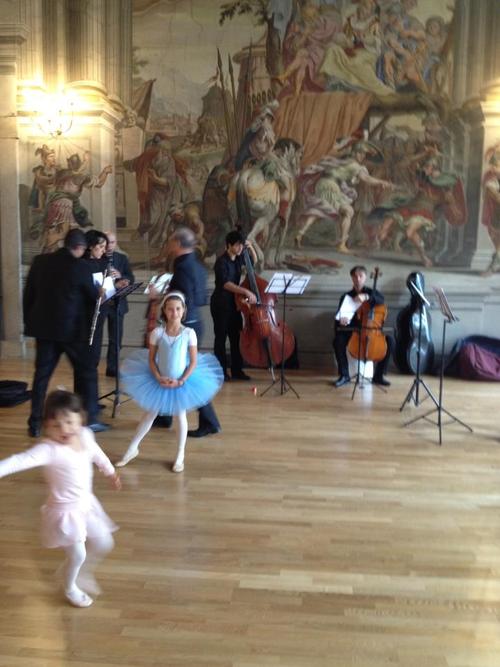
In response to a popular holiday song, “Do you hear what I hear?” the answer just might be: maybe. Hearing distinct differences in sounds takes practice. For example, back in August and September, early childhood teachers welcomed new students into the classroom. On that first day of school, the classroom full of children sounded like, well, a classroom full of children. By November, however, teachers learned to identify the distinct voices of each student. In music, we call distinct sounds timbre and it helps us distinguish the sound of a violin from a guitar; Jack’s voice from Aidan’s voice; and even aids in phonemic awareness by helping us hear the difference between the sound of a letter “v” and the sound of the letter “b.”
How people perceive timbre
Researchers from Johns Hopkins University recently created a computer model that mirrored how people make judgment calls regarding timbre. In the study, participants listened to two sounds played by different musical instruments and rated how similar the sounds appeared. The computer model recognized similar subtle differences in sounds that human participants did. For example, both acknowledged that the violin and cello appeared to be closer in sound to each other than a violin and flute and wind and percussive instruments were the most different.
“There is much to be learned from how the human brain processes complex information such as musical timbre and translating this knowledge into improved computer systems and hearing technologies,” researcher Moanya Elhilali said in the article, “Music in our ears: The Science of Timbre.”
We look forward to the next phase of this research!
Connection between timbre, phonemes, and early literacy
In ABC Music & Me,our early literacy and language curriculum, children explore the concepts of timbre whenever they compare the differences between and among sounds. Each week in class, children may participate in active listening, singing, vocal play, and instrument exploration activities to teach them auditory discrimination. That same sound discrimination helps children hear the minute differences between letter sounds or phonemes, which supports early literacy and language development. Plus, researchers agree that music improves phonemic awareness in young children.
For more information about using ABC Music & Me to teach young children early literacy and language development, email us at info@abcmusicandme.com.
We partner with a lot of experts to create and support our standards-based early literacy curriculum, ABC Music & Me, including experienced early literacy educators, trainers, researchers and professional musicians and music producers who understand how music can unlock a child’s potential. However, we also recognize the pivotal role of parent involvement in early childhood education, which is why all of our programs, including our early literacy curriculum, include a child’s first and best teacher: the parent.
Parents as Teachers and early literacy
The organization, Parents as Teachers (PAT), shares our commitment to equip parents with the tools and resources to help provide young children with school readiness skills, including early literacy. PAT organizations around the United States use our early literacy curriculum, ABC Music & Me, to increase parent involvement in early childhood education. For example, the Choctaw Nation Support for Pregnant and Parenting Teens is a PAT program that uses ABC Music & Me in its group connection meetings with parents and children. The Tulsa Public Schools Parents as Teacherseven received the coveted PAT Losos Prize for Excellence in 2010 in part for being the first in Oklahoma to use our early literacy curriculum, ABC Music & Me, to increase parent involvement in early childhood education.
National Parents as Teachers Conference
To learn more about how Parents as Teachers programs use our early literacy curriculum, stop by the ABC Music & Me booth at the National PAT Conference in St. Louis, Missouri, November 7-9. The first 100 people to visit Booth #2 will even receive a special surprise!
Not able to attend? Email us at info@abcmusicandme.com for more information about using ABC Music & Me.
Submit your sustainability efforts into the Star Steward Competition!
Star Stewards – submit your Green/Sustainability/Eco efforts to win 50 free Kindermusik song credits, $100 donation to your charity of choice, and have your sustainability project celebrated and promoted on Minds on Music!
No project is too big or too small… just check out these upcycled pinwheels from old sheet music, found on Dishfunctional Designs blog. Small, delicate designs from upcycled material make a big statement. Check out the other great, inspiring ways this blogger has repurposed the music!
Researchers say bilingual children are often on their mental toes, switching back and forth between two languages. That mental acuity has an influence on a number of abilities, new research shows. Studies show bilingual children have larger vocabularies, a deeper understanding of words, as well as “selective attention,” or, the ability to focus on what’s important.
Who says Klingon is a dead language? The Calgary Herald, November 2, 2012
The language was created more than 30 years ago for the American Sci-Fi television show, Star Trek. With only 2,000 to 3,000 words, and new book coming out, it’s the most spoken fictional language ever created.
Several parents with children with autism celebrated the release of this article over the Halloween holiday. Could be because the study simply shows that early intervention with focused interaction between parents and their children could lead to changes in the child’s brain activity. “This may be the first demonstration that a behavioral intervention for autism is associated with changes in brain function as well as positive changes in behavior,” said Thomas R. Insel, director of the National Institute of Mental Health
If test scores keep going up, they will. Educators can’t ignore a student’s preference for an interactive tablet over a used textbook, and it seems grades are improving, too. “Houghton Mifflin recently performed a pilot study using an iPad text for Algebra 1 courses, and found that 20 increase in the number of students who scored ‘Proficient’ or ‘Advanced’ in subject comprehension when using tablets rather than paper textbook counterparts.”
Meet Hannah Pingree, former Main Speaker of the House and #6 finalist for the Healthy Child Healthy World’s “Mom on a Mission” Competition (and honorary KI Star Steward!). Hannah has successfully convinced state legislators to regulate and ban toxic chemicals in consumer products. Of the nearly 80,000 known toxins ubiquitous in consumer goods, only 200 have been tested and regulated. This is absolutely horrific (Halloween-caliber) if you consider the deadly effects of toxins in children, and how frequently children put toys and plastic into their mouths. Hannah believes that moms are paramount in the crusade to regulate the production of these toxins. See for yourself!
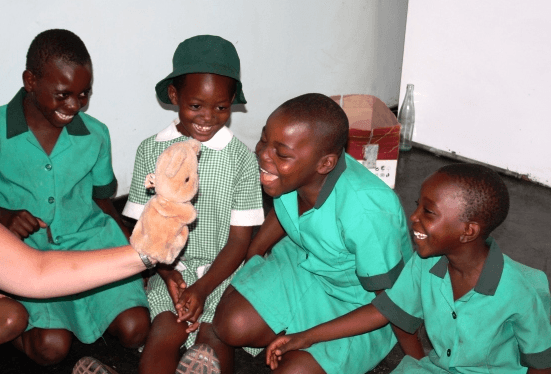
Puppets can help to provide a cultural connection to the classroom while helping young children learn English.
Puppets are often used in the ESL classroom for young children. These playful characters are used to provide a cultural connection to the classroom, to enhance storytime, and to model conversational phrases. In addition, the puppet can speak exclusively in English, and the teacher can speak in the child’s first language to help facilitate class activities.
Even in the most playful classroom, behavior issues with puppets can arise. For one educator, a few students started a “hitting game” with the puppet during class time. Should this problem arise, an educator can use the opportunity to set appropriate boundaries with the puppet and all the classroom props – such as instruments – and redirect the behavior back to appropriate, playful classroom behavior.
We asked curriculum authors and Master Kindermusik Educator Carol Penney and Cindy Bousman to provide a few classroom behavior tips.
Here’s what they had to say:
When the puppet is first introduced to the class, it is important to set and state acceptable behaviors. Be clear and simple when these are stated. The same goes with instruments, books, visuals, and all other materials used in the class. When a teacher does this, it’s helping the children build and develop respect for other people’s “things.”
1. Start all over with a brand new puppet. Even if it is a homemade sock puppet. Talk to the children as a class about how to treat and handle this new puppet. If a child starts to hit the new puppet, immediately withdraw the puppet and explain why, then go on to the next child. The child needs to understand hitting the puppet is an unacceptable behavior.
2. Let puppet stay at home for a while. The teacher can use his or her own hand as a puppet – opening and closing four fingers together and thumb. To make it interesting, put circle stickers on hand for eyes.
3. Speak up. Say, “I don’t want you to hit my doll. You can touch him gently and sing or say hello or you can choose not to.” Make clear what you expect and/or remove the temptation.
Want to know more? Read more about using puppets in the ABC English & Me classroom in “One Puppet, One Language.”
If you have clothes that are not suitable for donation…think about upcycling.
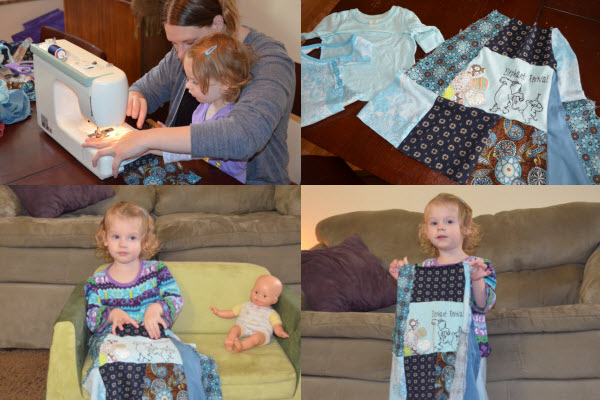
This Kindermusik kid and her mom upcycle clothing! They re-use baby clothes by sewing them into creative outfits like this patchwork skirt.
Enhance Family Bonds
When the going gets tough, the tough gets going– for any of our U.S. East Coast families stuck inside (hopefully with power!) during the blows of Hurricane Sandy, we’re thinking of you! While power outages and being stuck at home is disruptive, Psychology Today points us to the silver lining: how to use hurricane preparation to enhance family bonds. Among these pointers, we’re told to 1) assign everyone a role, 2) practice emergency drills, 3) take advantage of power outage as a chance to communicate, 4) emphasize togetherness and unity and 5) take pictures to document the experience.
Why not use this time to get crafty, like Kindermusik kid, Stella, and her mom pictured above? These Star Stewards upcycled Stella’s old baby clothes by sewing them together to make a patchwork skirt. The skirt features a t-shirt from one of the child’s favorite bands, Elephant Revival, which was her first live concert when she was just eight weeks old! — She was born to love music!
Don’t forget to submit YOUR Star Steward projects, stories, and ideas!
WIN 50 free Kindermusik songs & $100 donation to your favorite charity by sharing your family’s Green/Sustainability/Eco efforts by 12/07/12.