Sometimes I apologize in advance to my Kindermusik families for how many times we repeat a song in class. But then I cheerily remind them that experts tell us that repetition strengthens the brain – especially musical repetition!
Kindermusik songs that stay in your head may be a little annoying to parents, even though the kids love it! But it turns out that having songs in our heads – and hearts – may actually help us later on if we eventually suffer from a stroke or develop a degenerative disease such as Alzheimer’s or dementia. Just do a search – the videos out there will bring tears as you watch how an almost unresponsive elderly person suddenly lights up when hearing music or being sung to.
Scientists still cannot tell us how the same brain that loses its ability to retain memory will still retain and respond to lyrics and music, but as the author of this article describes it, it’s as if the music “tickles the brain circuits,” the same neural circuits that “…may help restore speech and cognition circuits” lost by Alzheimer and dementia patients or stroke victims. But best of all, listening and singing old songs makes these patients happy and for some, responsive on some level once again. It’s as if music brings them to life again, and it’s only music that has had that effect in study after study.
This is the power of music – the same power that makes such a difference in the mind and heart of the very young. And one of the reasons that I believe so strongly in the power of Kindermusik to change lives – for now and for life.
Contributed by Theresa Case whose award-winning Kindermusik program at Piano Central Studios in upstate South Carolina has been building musical memories with children and families for over 20 years now.
Infant social-emotional health…is that a new thing? Though some medical providers, first-year educators, and early childhood researchers have always valued things like eye contact, skin-to-skin, etc., that holistic terminology that includes ALL of the things supporting a baby’s social-emotional needs is relatively new for families.
It may sound like it’s a no-brainer—snuggle your baby, sing to your baby, and so on. But what’s not common knowledge are the many key behavioral competencies social-emotional development feeds.
The ability for babies to (eventually) self-soothe, for toddlers to not bite their friends, for older children to play well with others, or listen when the teacher’s talking, or not run into traffic…it’s all connected to positive social-emotional growth.
And the first stop is baby’s connection with parents or primary caregivers.
That’s a lot of pressure for grownups, but infusing music into daily interactions can lighten the load. There’s a deep-seated and innate response to music, even in very young children, and when you share that joy with another human, it’s incredibly powerful.
[vc_row][vc_column][vc_column_text]Okay folks…this is going to be a weird post, but stay with me. I’m a collegiate choral director, so singing is big part of my life. The human voice constantly amazes me. As of late, I have been doing a lot of guest conducting with middle school age kids. This age group is a hoot. They are hungry to express who they are becoming and are excited to make music together. Voices are changing at this age and, particularly young men, are figuring out how their new voices work and what they can do. Speaking of what voices can do…[/vc_column_text][/vc_column][/vc_row][vc_row][vc_column][vc_column_text]
Overtone Singing
We are capable of singing two pitches at once.
Let me say that again: the human voice is capable of producing two distinct pitches at once. This is called overtone singing. Now – before I blow your mind with some pretty mazing video, let me give you a basic explanation of what overtones are. Within any pitch produced, there is a series of overtones. When I sing a note, there are actually a host of notes that make up the composite sound you are hearing. By manipulating the space inside your mouth, you can cause specific overtones to be heightened and easily perceived.
I know…it sounds crazy. Check out this guy singing Amazing Grace with overtones:[/vc_column_text][vc_video link=”https://www.youtube.com/watch?v=kFWYSW4vfcA”][vc_column_text]I promise, that is actually him. He is clearly producing two pitches at once – a drone pitch that stays the same and the changing whistle pitches above.
Maybe only crazy choral conductors do this, but have you ever hit a note in a room or a stairwell and it “rings” more than any other note? You have hit the resonant pitch for that space. This singer, by changing the shape of the space inside his mouth, changes the resonant frequency causing different overtones to be highlighted. And that’s how he gets different pitches above his drone.[/vc_column_text][/vc_column][/vc_row][vc_row][vc_column][vc_column_text]
One Voice: Two Pitches
So this guy produces a static bottom pitch and is able to heighten any of the pitches in that static pitches’s overtone series. I won’t bore you with what those pitches are, but it is always a specific set relating to that bottom pitch produced.
What would happen if you changed the bottom pitch? Well, you’d have access to another set of overtones. Well guess what? There is a guy in Texas named Stuart Hinds who has training himself to change the bottom pitch while also being able to hit any note in the overtone set at will. This takes INCREDIBLE control. The result of this training? Mr. Hinds is able to sing in a round WITH HIMSELF! I promise, what you are about to see and hear is only one person singing. You will see a spectrogram, a visual representation of sound over time. The very bottom stream is the main, bottom pitch that Mr. Hinds sings. You’ll then see the overtones he wants to highlight as the very top stream of notes. Take a listen:[/vc_column_text][vc_video link=”https://www.youtube.com/watch?v=aU5rtkO6CX8″][vc_column_text]Once again, I know it seems impossible, but those whistle tones are actually being produced by Mr. Hinds’s voice and only Mr. Hinds’s voice. There is no manipulation here. Once voice, two pitches. Pretty amazing.
For me, the most amazing thing about this is the capacity of the human voice. The variety is staggering. We can listen to a rock singer, a folk singer, or an opera singer. We can enjoy R&B and Country. Rap, Pop, Ska, and Jazz – the list never ends – all from the human voice. And think about this as you listen to all of this singing: a child that experiences music on a regular basis will have a deeper appreciation for music throughout her or his life.
Listen to Mr. Hinds with your child. Ask questions. Can they hear the overtones – the whistle tones? Ask if they can believe that it’s only one person singing! See if you can produce overtones. Check out Anna-Maria Hefele’s (another great overtone singer) How-to video. Explore the possibilities![/vc_column_text][/vc_column][/vc_row][vc_row][vc_column][class_finder_form css=”.vc_custom_1458189350961{padding-top: 20px !important;padding-right: 20px !important;padding-bottom: 20px !important;padding-left: 20px !important;}”][/vc_column][/vc_row]
[vc_row][vc_column][vc_column_text]Last month, The New York Times reported on new research conducted at the Massachusetts Institute of Technology involving the most musical of organs: the brain. Professors Nancy Kanwisher and Josh H. McDermott, and postdoc fellow Sam Norman-Haignere have proven that there are neural pathways dedicated to experiencing music – think a special HOV lane specifically reserved for musical transportation. And it doesn’t seem to matter what type of music it is. Regardless of the style – hip hop, show tunes, rock and roll – these pathways only light up in scans for music. Other sounds seem to have no effect.[/vc_column_text][vc_column_text]
The Auditory Cortex
The part of the brain in question is rather small, but important. The Auditory Cortex, as you might have guessed, is responsible for processing aural info – any sounds that come at you get dealt with here.
image source: Wikipedia
The area in question is that tiny pink part of the temporal lobe. Now, why does that matter? Well, I thought it might be worth mentioning that the temporal lobe, among other things, is responsible for long term memory, and we know that music and memory are closely related. I’ll admit it: sometimes I have to sing the alphabet song in my head when putting things in alphabetical order. And those of you of a certain age might remember this gem from Cheers:[/vc_column_text][vc_video link=”https://www.youtube.com/watch?v=-F_tT-q8EF0″][vc_column_text]Come on now, friends…the brain is a complex subject. I’m never above bringing in a 1980s sitcom to underscore a point. The fact that the Auditory Cortex is located in the lobe of the brain that deals with long term memory AND there are pathways nearby that only light up when we experience music is telling and perhaps more than coincidental.
So…beyond the fact that music is an incredibly enjoyable pastime, why does this matter to us? Well, there is a theory out there that music is actually older than speech. If music is “more fundamental” to the human brain than everyday verbal communication, than it can have tremendous impact on the human experience. Dr. Josef Rauschecker, the director of the Laboratory of Integrative Neuroscience and Cognition at Georgetown University puts it this way:[/vc_column_text][blockquote cite=”- NYT, 2/8/2016″]…music works as a group cohesive. Music-making with other people in your tribe is a very ancient, human thing to do.[/blockquote][vc_column_text]More proof that music is integral to our lives. So get out there! Light up those pathways that seem to have been put in place just to respond to music. Make some musical memories. And as we have learned over the past few posts, make those memories meaningful by creating them with someone special – your spouse, your kids. Hey, if you build a bookshelf, you put books on it. Your brain is built to respond to music: give it what it wants.[/vc_column_text][/vc_column][/vc_row][vc_row][vc_column][class_finder_form css=”.vc_custom_1457675287583{padding-top: 20px !important;padding-right: 20px !important;padding-bottom: 20px !important;padding-left: 20px !important;}”][/vc_column][/vc_row]
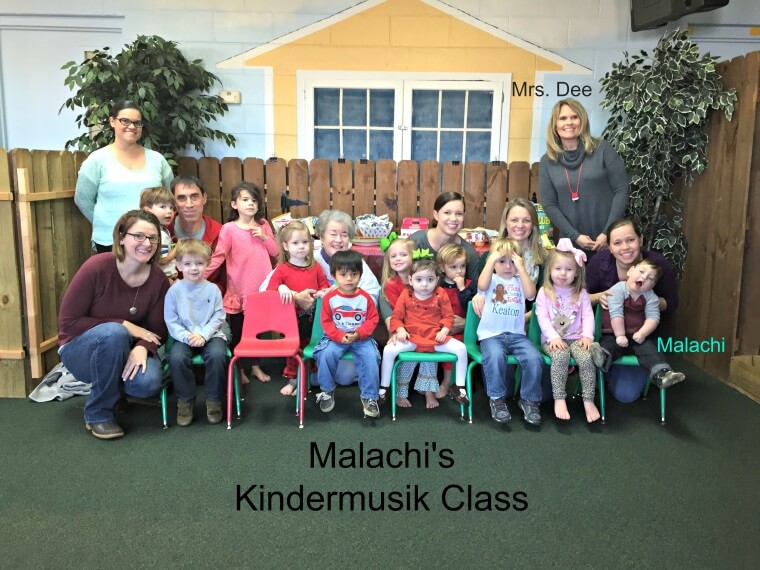
[vc_row][vc_column][vc_column_text]My name is Dee Lancaster and I am a Maestro Educator ending my 13th year of teaching Kindermusik in Cleveland, TN. I love my job and thank God every day for the beautiful families that have come into my life through Kindermusik.
One of the most rewarding things about my job is getting to know these families and hearing about the difference Kindermusik is making not only in their child’s development but also in their family interactions and relationships. I feel especially blessed to play a part in the lives of families with unique challenges and special needs. I wanted to share a letter with you from one of these families who also happens to be a current recipient of the Carol D. Penney scholarship. The letter is long but so worth the read. It is my great pleasure to introduce you to Malachi.
[/vc_column_text][vc_column_text][/vc_column_text][vc_column_text]In February 2013 our lives were dramatically changed by the birth of our son Malachi. While most birth stories are riddled with joy, ours was overshadowed by fear and uncertainty. Our son Malachi was born at just 24 weeks gestation with a birth weight of only 1 pound 12 ounces. Malachi was born without a heartbeat, and after 15 long minutes of CPR he came to life. During that time his brain hemorrhaged internally causing major, irreversible damage. We were given the option to stop lifesaving care and we were told that Malachi would never walk, talk, or breathe on his own. We chose to allow him to fight as long as God saw fit, and I am pleased to tell you that today we have a joyful and happy almost three year old.
As a result of his traumatic birth, Malachi has several medical conditions. In addition to his cerebral palsy, Malachi is legally blind, suffers from severe epilepsy, and has a VP shunt to control his hydrocephalus. He also has multiple orthopedic issues and we are still told that he is not expected to walk, but we continue to hold out hope. To date, Malachi has had 11 surgeries on his eyes, brain, feet, stomach, and heart. These diagnoses require several specialist appointments every week resulting in lots of road trips and unpleasant medical testing.
When we first heard about Kindermusik I was immediately intrigued. Before Malachi’s birth, I always envisioned myself as the type of mother who would have her kids involved in as many activities as possible. I found myself not only mourning the loss of having a “typical” child, but also mourning the loss of being able to experience “typical motherhood”. Due to Malachi’s weakened immune system, he had not been able to be around any children and we were starting to feel very isolated. I decided to take Malachi to a trial Kindermusik class, and what I saw in my son amazed me.
Malachi immediately responded to the stimulus around him with such joy. I was afraid that the excitement would trigger his seizures, but those fears disappeared as I watched him anticipate what we would be doing next. He has always been motivated by music, but even more exciting was to see him react to hearing the other children in the room. The curiosity and excitement in his eyes reassured me that this was something we needed to pursue.
Malachi struggles to maintain an upright sitting position and control his head, but during Kindermusik class he is so excited that he engages those muscles with ease. He gets more of a workout at his weekly Kindermusik class than during his weekly physical therapy sessions! Aside from seeing many physical improvements during our sessions, cognitively Malachi is tracking conversations, learning how to follow directions, and responding when asked questions. It is so refreshing as his mother to find an activity that helps us get closer to so many of our goals for Malachi.
Kindermusik days are something that Malachi looks forward to, and responds with excitement when I tell him that we are going to music class. It is the one weekly appointment in our very busy week that he can’t wait to get to. And I am so thankful that I can brighten up his schedule with something that brings him so much joy. It has certainly been a blessing to our family. There is nothing more heart-warming than hearing your child giggle uncontrollably at the children around him.
We also have been able to incorporate our home materials into our every day. We sing the songs during therapy to keep him engaged and we play the CD in the car on our long car trips. He has the books memorized and smiles with anticipation when we come to his favorite part. Malachi takes a little longer to process things and repetitive things allow him time to catch up with the song. He will even attempt to sing along during many of the songs.
Thanks to Kindermusik and the Carol D. Penney scholarship, I no longer have to mourn over the loss of my “typical motherhood”. In fact, just a few weeks ago we saw one of our classmates out in public. The little boy said hi to Malachi and treated him like a friend. We didn’t have to answer questions about his leg braces, or explain why Malachi didn’t look at him and respond. Kindermusik has brought some much needed normalcy to our world.
Thank you for providing ways for families like mine to participate in your amazing program. There is a sweet little boy in Tennessee who appreciates you more than you know. If you would like to follow Malachi’s story you can find us on Facebook by searching “Malachi’s Miracles”.[/vc_column_text][/vc_column][/vc_row]
[vc_row][vc_column][vc_column_text]We are musical beings. From the beginning, we are designed to make music. It’s in the rhythm of our movement, of our breathing. If we listen carefully, we can hear music in a baby’s cooing, in her babbling. This music reassures us that our child is content. He’s happy with the world around him. The reality is that this aural connection, the music in the sounds we hear while in the womb preprogram us to make specific music in our first cries. Some of the initial external programing for our growing brains comes from the rhythms, highs, and lows of the speech sounds outside of our little natal apartment. Researchers have discovered that babies in different countries cry in different “accents”. Those accents closely match the cadences (think rhythm, rise, and fall of an area’s speech patterns). Check out a portion of Annie Murphy Paul’s TED Talk – What we learn before we’re born:[/vc_column_text][vc_video link=”https://youtu.be/stngBN4hp14?t=4m48s”][vc_column_text]Annie Murphy Paul and the “accents” of infants’ cries.[/vc_column_text][vc_column_text]
Crying as Language: Language as Music
Murphy is most likely referring to studies conducted by Kathleen Wermke of the Center for Prespeech Development and Developmental Disorders at the University of Wurzburg in Germany. Wermke found that this accented crying occurred as early as the first days of ex-utero life. The music of the mother’s voice helps to provide a foundation for the maternal bond long before birth. While this crying is not technically a language, it certainly has linguistic qualities – flow, intonation, varied volume. And it’s precisely those aspects that, in turn, have musical qualities – melodic shape, repeating patterns, and tempo.[/vc_column_text][vc_column_text]
So What of Actual Music?
The womb is actually an incredibly noisy locale. Lots of musical sounds besides speech make their way to the developing ear. It’s like a street level apartment in New York City. You have the ever present heartbeat of the mother, the whooshing of blood pumping, the gurgling of food digesting, and the sounds of the lungs constantly inflating and deflating. Can actual music get through this biological big band and have an effect on a baby in-utero? Annie Murphy Paul thinks so.[/vc_column_text][/vc_column][/vc_row][vc_row][vc_column][vc_single_image image=”8449″ img_size=”medium” css=”.vc_custom_1454220063752{padding-top: 2px !important;padding-right: 2px !important;padding-bottom: 2px !important;padding-left: 2px !important;}”][vc_column_text]
Simple is Best
I need to disclose that I am a classically trained musician – and I love classical music. But as it turns out, it’s likely that the complexity of this music is lost while competing with the “street noise” of the womb. In her interview with New York Magazine, Dr. Deborah Campbell, the Director of Neonatology at The Children’s Hospital at Montefiore, reminds us that infants have the capacity to recognize simple melodies experienced while displacing mom’s bladder. Think folk music. And guess what? As it turns out (here’s where we tie a bow on all this), folk music is often based on the pace, rhythm, and melody of a region’s speech patterns!
So…if you put the headphones on your tummy, or sing to your partner’s navel, stick to the classics, time-tested folk music. Kindermusik uses a great deal of this music in our classes, and while there are many reasons this category of music is so effective with new humans, its ability to be internalized quickly and repeated easily is certainly connected to its special relationship with the language of origin.
Next time you hear your baby cry, hear the music. She’s singing to you in your language.[/vc_column_text][/vc_column][/vc_row]
By Dr. Doreen Fryling, Ed.D.[/vc_column_text][vc_column_text]If you’re reading this, you are probably the parent of a young child. So, I know you’ve only got a minute. I’ll keep this short.
You want your child to reap the benefits of a lifetime of music making. You’ve heard the buzz, read the articles about why music education is beneficial to children, and maybe even experienced the rewards of music yourself. But this age’s seemingly unlimited access to music-making can be daunting rather than empowering. It can be hard to know if you’re doing the right thing with your child.
Start by making music a normalized activity. This means that music is a part of your child’s everyday life, happens spontaneously, and without judgment. For young children, music making most often occurs as some form of singing. The very youngest will coo and babble and imitate. Vocalization becomes more consistent and structured as children age, with school-aged children able to sing complete songs. [/vc_column_text][vc_column_text]
The author and her son (19 months).[/vc_column_text][/vc_column][/vc_row][vc_row][vc_column][vc_column_text]
Someone told me not to sing…
But let’s talk about judgment. The number one thing that I hear from people when I tell them that I am a music teacher is that someone told them not to sing. Most often, they recount stories of family members making fun of them. Let’s put an end to this useless and harmful practice. Make your home a place where your child feels safe to sing. Don’t tease–or worse, coach–your child. Young children are, by nature, not great singers. It’s all part of the developmental process. Don’t let adult ears put undue pressure on a child to “be better.” Let your child just sing. Make it a normal thing that happens in your home.
Music making for young children is not about performing. Try to balance the need to show-off your child’s abilities by understanding that they make music not for the sake of performing, but because it’s a natural human ability that offers psychological and physical rewards. Music making for young children might happen anywhere – in a stroller, in the car, or while playing on the floor. It doesn’t necessarily need to be directed, though it’s a wonderful bonding activity to sing with your child. Allow for creative vocal improvising (singing narratives while playing with toys) by providing quiet times for play. Turn off TVs, stereos, computers, tablets, and smartphones, and give your child time to make music without the competition of our noisy world. You, too, might find yourself singing, if you allow for quiet time during the day.[/vc_column_text][vc_video link=”https://youtu.be/wNZF7J717DU”][vc_column_text]The author’s son (4 years old) spontaneously singing at a museum.[/vc_column_text][/vc_column][/vc_row][vc_row][vc_column][vc_column_text]
Music: Not for the few…
Music making for the young child, and anyone really, is not reserved only for people with a profound natural ability. Music making can be enjoyable for anyone at any ability level. That being said, if you are a parent who does not love their own singing voice for whatever reason, I beg of you to ignore that inner dialogue holding you back from singing in front of anyone and let your child hear you sing. Sing while you change their diaper, sing while you prepare meals, sing while you clean-up (together). The model you provide of a confident, expressive singer will be the foundation for your child’s own musical beliefs.[/vc_column_text][/vc_column][/vc_row][vc_row][vc_column width=”1/2″][vc_column_text]
The author’s daughter imitating what she’s seen her parents do when they look at music. She was just happily singing whatever she wanted as she turned the pages.
Children absorb the music around them. Don’t feel like you have to feed them a steady stream of Mozart, or so-called “children’s music.” First of all, you’ll drive yourself crazy. Second of all, good music is good music. Let them hear the music you enjoy. (Just make sure it’s not too loud. Protect those little ears).
Find music around you. Point out music in stores, on the street, and at events. Try a young person’s concert at a local venue. Just be realistic about how long your child will stay engaged. You may want to take them to a show, but know that you may need to step out (several times) or leave before it’s done. Seek out free music concerts, because they’re way easier to cut your losses and leave early if need be. Outdoor concerts are perfect for little kids.[/vc_column_text][/vc_column][/vc_row][vc_row][vc_column][vc_column_text]Foster creativity in your child by letting your child free play with small instruments (hand drums, bells, shakers, pots and pans!). And no, your child will not be scarred for life if you don’t start violin lessons at age three. If there’s an interest and a willingness on your part to find the right teacher and help with practicing, go for it. If not, wait until your child is ready and/or your school offers instrumental lessons.
Vocal lessons, however, are unnecessary until after your child goes through puberty. If your child wants to sing more, take them to group music lessons as young children and then enroll them in a children’s choir when they are school-aged. Don’t forget to support your local school music programs, because that’s the place where they’ll have their most consistent music education as they journey from childhood to young adulthood![/vc_column_text][/vc_column][/vc_row][vc_row][vc_column width=”1/2″][vc_column_text]
Just to review:
Make music everyday with your child
Don’t judge your child’s music making
Sing for/with your child
Let your child play in a quiet environment
Seek out appropriate concert experiences
Listen to any kind of music with your child
Limit exposure to devices that displace creative free play
Don’t project your own feelings of musical inadequacy on your child
Express joy/thankfulness/praise when your child makes music for/with you
Benefits from music making as a child include improved well-being, intellectual growth, health benefits, joy from music making, and social benefits such as self-confidence and connectivity to other children. So whatever you do, provide time and support for music making to occur in your child’s life. It just may be the greatest gift you give them.
The author’s children magically getting along while improvising at the piano.
[/vc_column_text][/vc_column][/vc_row][vc_row][vc_column][vc_column_text]A note from Dr. Boyle: Wonderful information from Dr. Fryling! So what are you waiting for? Sign up for a free Kindermusik class near you![/vc_column_text][vc_column_text]
Doreen Fryling, Ed.D. is in her twentieth year as a public school music educator. She currently teaches IB Music and chorus classes at South Side High School in Rockville Centre, NY, and has previously taught K-5 general music and middle school chorus. Doreen is a founding member of the eVoco Voice Collective and a professional chorister in the Brick Choir in NYC. In addition to her school choirs, Doreen has conducted the Hofstra University Chorale, the Hofstra University Chorus, and the MYO Nassau Concert Choir. She also maintains an active schedule as a collaborative pianist.
Doreen recently completed a Doctorate of Education in Learning and Teaching at Hofstra University. She holds degrees, as well, from Susquehanna University and the University of Michigan. In 2016, Doreen was recognized as a semifinalist for the Grammy Music Educator Award. Doreen shares her love of music making with her husband, David, and their two children. You can read more from the author at www.doreenfryling.org.
Fryling, D. S. (2015). Persistence in choral music: An investigation into psychological and sociological factors involved in choral membership (Order No. 3734137). Available from Dissertations & Theses @ Hofstra University; ProQuest Dissertations & Theses A&I. (1732359916). Retrieved from http://ezproxy.hofstra.edu/login?url=http://search.proquest.com.ezproxy.hofstra.edu/docview/1732359916?accountid=11449
Hallam, S. (2010). The power of music: Its impact on the intellectual, social and personal development of children and young people. International Journal of Music Education, 28(3), 269-289. doi:10.1177/0255761410370658
Media Use by Children Younger Than 2 Years. (2001, November 1). Retrieved January 18, 2016, from http://pediatrics.aappublications.org/content/128/5/1040..info
Williams, K. E., Barrett, M. S., Welch, G. F., Abad, V., & Broughton, M. (2015). Associations between early shared music activities in the home and later child outcomes: Findings from the Longitudinal Study of Australian Children. Early Childhood Research Quarterly, 31113-124. doi:10.1016/j.ecresq.2015.01.004[/vc_column_text][/vc_column][/vc_row]
[vc_row][vc_column][vc_single_image image=”8342″ img_size=”620×288″ alignment=”center”][/vc_column][/vc_row][vc_row][vc_column][vc_column_text]Ok…I’m about to tell you all something you already know…our babies, our toddlers, our kids…they feel stress! We “old” folks don’t have a monopoly on this lovely feature of the human condition. Now think about this: we are supposed to have things together by adulthood, but let’s face it, how many times do you get into a situation and look around for a more “adultier” adult than you!? We are supposed to have a developed sense of self-awareness that allows us to – hopefully – use developed coping strategies to process stress in a heathy way. Now…imagine an infant or toddler experiencing a stressful situation. Not only might the situation be new, they are still figuring out how to respond! This can compound stress in a child. No fun, right?
Harumph! Don’t look at me!
Recently, the Center for the Developing Child at Harvard University (I’ve heard of this Harvard – supposedly they’re pretty smart, guys) posted about ways to mitigate (Ivy League lingo for the win!) toxic stress in kids. The main idea? If we can’t help kids deal with stress, the health development of the next generation might be thrown of the tracks and “can have damaging effects on learning, behavior, and health across the lifespan.” So…what can we do?[/vc_column_text][/vc_column][/vc_row][vc_row][vc_column][vc_column_text]
Responses to Stress
The Center defines three types of responses to stress and how these responses impact the body:
Positive – this is common and often short-lived. New babysitter? Perhaps a new food to try? A child might experience this type of response. Think a short rise in heart rate.
Tolerable – Often the result of a loss of a loved one or perhaps experiencing something scary like breaking a bone. This can last longer than the Positove response. With an environment of supportive adult relationships, the effects of this type of stress can have a buffering impact and help a child recover.
Toxic – this is longer lasting and can be a result of such awful things as neglect, abuse, or the results of economic hardship – and occurs when supportive relationships are not present.
One aspect of these supportive relationships is “Serve and Return.” As it turns out, a tennis match of interactions between our children and caring adults has a positive impact on developing brain structures, stress levels, and processing stress in a healthy way. From the Center:
“When an infant or young child babbles, gestures, or cries, and an adult responds appropriately with eye contact, words, or a hug, neural connections are built and strengthened in the child’s brain that support the development of communication and social skills. Much like a lively game of tennis, volleyball, or Ping-Pong, this back-and-forth is both fun and capacity-building. When caregivers are sensitive and responsive to a young child’s signals and needs, they provide an environment rich in serve and return experiences.”
As you build the circle of positive interactions for your child, you increase the child’s ability to respond to the world, learning that these “tall people” really care, and it would seem that the earlier this occurs, the better.
Now…think about the types of interactions that occur during Kindermusik classes. See a connection? I do! When taking part in regular group musical activities lead by a caring adult, a child’s circle of positive relationships grows. Singing together, call and response activities (a musical version of “serve and return”), and group movement, all can have a positive impact on stress levels. Did you know that groups that sing together can sync their heart beats? Crazy, right?
So consider this the next time your child is overwhelmed by the world around them…and not just when they are anxious to go to bed at night…sing a song together, dance together, or get out some pots and use them as drums. You bang and then have them mimic you. Music can reduce those hormone levels, singing can control breathing, and that stress response can be brought back to a healthy place.
Friends…the power of music![/vc_column_text][/vc_column][/vc_row]
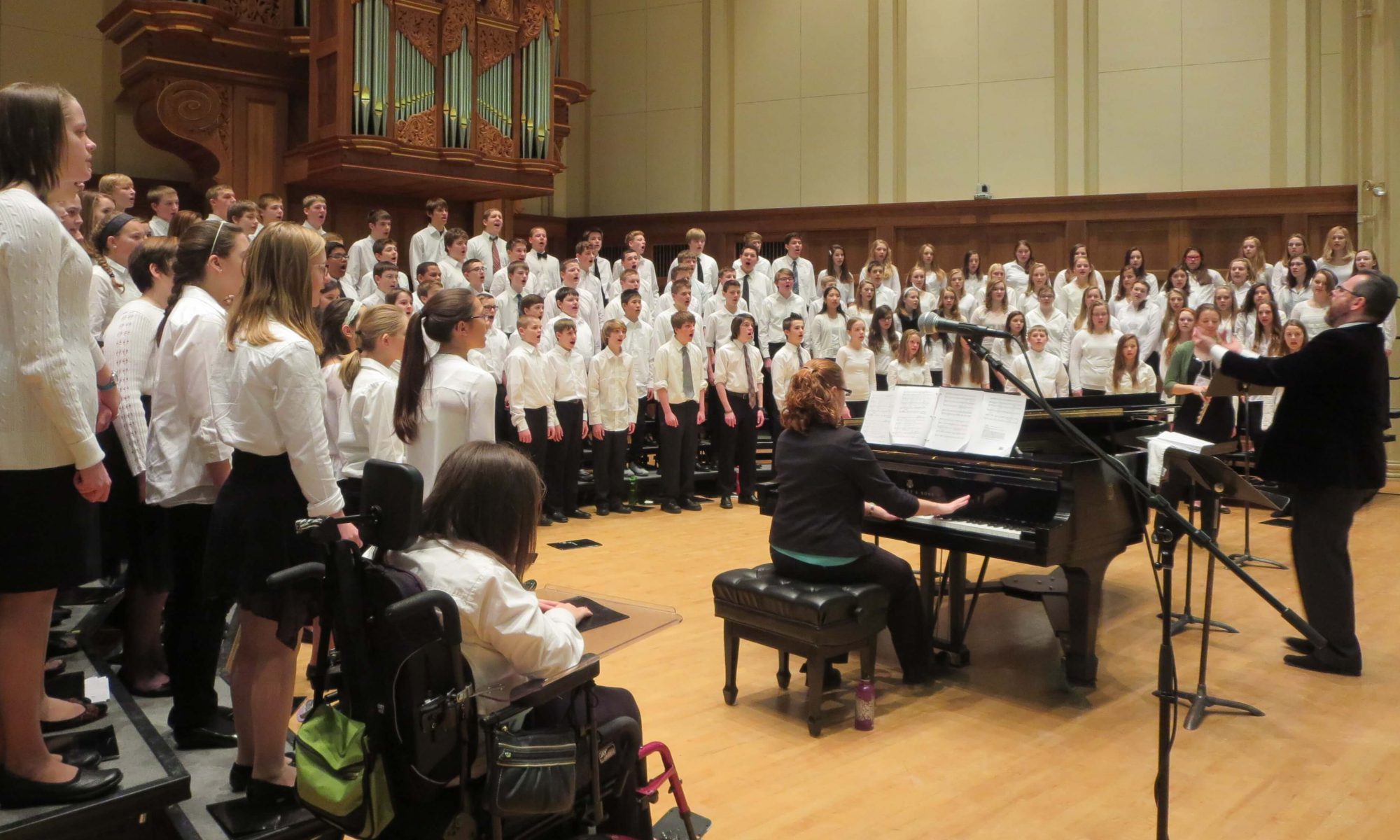
Dr. Boyle conducts the Middle Level All State Choir in Wisconsin. Scedra is right in the front row.
[/vc_column_text][/vc_column][/vc_row][vc_row][vc_column][vc_column_text]I teach my students that it’s the conductors job to make others musically powerful. This concept was crystalized for me by Ben Zander in his TED Talk. If you haven’t watched it, you should! As conductors, we develop a vision and inspire others to realize that vision.
When I work with choirs, I tell it like it is. I tell them what I expect – and to paraphrase my friend and fraternity brother, Karl Paulnack, from his Welcome Address to the parents of incoming Boston Conservatory students – I expect them to save lives with their music.
The Wisconsin Middle Level All State Choir was no different. They sang! They gave away their collective voice, honoring the composers, each other, and the audience. I told them – you never know whose life you might change with your music. I believe that. I believe that there could be someone in that audience whose life is at the crossroads – and honest and selfless art given freely by a group of emotionally connected middle schoolers has the power to pull them down the road that leads to life.
We sang! But we also talked about the music. We talked about the historical context of McCartney’s “Blackbird” – so relevant today. Not about a blackbird, friends. Sir Paul wrote this in response to the riots occurring in ’68 after Dr. King was assassinated. And the middle school musicians ate up this information. You could have heard a pin drop when I talked to them about this.
I have started taking a moment at festivals to ask students why they sing – particularly in choir. One young woman, Scedra (pronounced Say-dra – her name was a combination of the initials of grandmothers and great grandmothers) particularly touched me. Scedra was born 2 months premature. She fit in the palm of your hand. Her father’s wedding ring could slide up her arm to her shoulder with room to spare. Scedra is in a wheel chair. She put her hand up to share why she sang….[/vc_column_text][/vc_column][/vc_row][vc_row][vc_column][blockquote cite=””]“I sing because it makes me feel like flying. I don’t feel like I’m in my chair. It’s like I’m not disabled anymore.”[/blockquote][/vc_column][/vc_row][vc_row][vc_column][vc_column_text]I wept. I’m weeping now typing this. 149 of her new friends instantly applauded her. The smile on her face eclipsed her chair. Scedra is often (at first sight) defined by her wheelchair, but in that moment, she was simply and beautifully a young woman overjoyed to be making music with her new friends.
Scedra and a host of her colleagues shared from their hearts in a room full of people they had just met. Music did this. Music created this place that allowed these people to be who they were (are!) without fear of judgment.
And that is music’s power.
These young men and women changed my life and for that I will be forever grateful.
Thank God, the universe, and all good things for music.[/vc_column_text][/vc_column][/vc_row]
Happy New Year! It is my great honor to join the Kindermusik team as the editor of Minds on Music Blog. Music has and continues to be my life’s passion, and I am excited to curate a useful resource on behalf of this wonderful organization. Learn more about me here.
We often read that music has tremendous collateral benefit in other subject areas, such as math and English. This is quite true, with plenty of research to back this up. But music possesses intrinsic worth, providing a host of benefits to our human condition. In fact, last year the US Senate voted to list music as a core subject in the Every Child Achieves Act. This recognition was a huge win for music educators and students alike. We’ll explore some of these intrinsic benefits in depth this year, but before we do, here’s a brief list exploring involvement in music for music’s sake.





 [/vc_column_text][vc_column_text]In February 2013 our lives were dramatically changed by the birth of our son Malachi. While most birth stories are riddled with joy, ours was overshadowed by fear and uncertainty. Our son Malachi was born at just 24 weeks gestation with a birth weight of only 1 pound 12 ounces. Malachi was born without a heartbeat, and after 15 long minutes of CPR he came to life. During that time his brain hemorrhaged internally causing major, irreversible damage. We were given the option to stop lifesaving care and we were told that Malachi would never walk, talk, or breathe on his own. We chose to allow him to fight as long as God saw fit, and I am pleased to tell you that today we have a joyful and happy almost three year old.