
 We get fired up about the importance of early childhood education. The reason is simple. In the first seven years of a child’s life, their brains are firing up with learning—literally! Every new experience lights up the synapses in the brain and repetition makes those pathways stronger.
At the age of two, a child’s brain includes over a 100 trillion synapses. That’s 50 percent more than we have as adults. While these new connections form rapidly and are strengthened through repetition, the brain also prunes connections not used frequently. This strengthening and deleting that happens in young children’s brains ultimately helps them process thoughts and actions more quickly.
Babies’ brains ripe for learning more than one language
All that action in the brain makes children under the age of 7 the ideal age for engaging in new experiences, including learning more than one language. In fact, new research conducted with six-month-old infants in Singapore indicates a generalized cognitive advantage that emerges early in infants raised in a bilingual home and is not specific to a particular language.
“As adults, learning a second language can be painstaking and laborious,” explained co-author and Associate Professor Leher Singh in a press release. “We sometimes project that difficulty onto our young babies, imagining a state of enormous confusion as two languages jostle for space in their little heads. However, a large number of studies have shown us that babies are uniquely well positioned to take on the challenges of bilingual acquisition and in fact, may benefit from this journey.”
The study found that:
- The infants raised in a bilingual home become bored with familiar images faster than children brought up in a monolingual home.
- Those same infants paid more attention to new images when compared to babies living in a monolingual home.
So what does that all mean? According to the press release, previous studies show that a quicker response to familiar objects and interest in new objects can predict preschool developmental outcomes, including non-verbal cognition and expressive and receptive language. Think about it. Children learning two languages at the same time are exposed to the sounds of more than one language and must learn to distinguish between the two. This makes for more—and stronger—neural connections! See why we get fired up for early childhood education?
Rocking the bilingual brain
At Kindermusik, our ELL curriculum, ABC English & Me, uses songs, story time, puppets, and Total Physical Response for English Language Learning. Research shows that music  has a positive impact on learning a second language. For example, in class ELL students may hear and repeat the rhythmic language of a nursery rhyme or song multiple times. The repetition creates stronger connections in the brain and helps children learn to speak and later read in English as their English language phonological awareness increases.
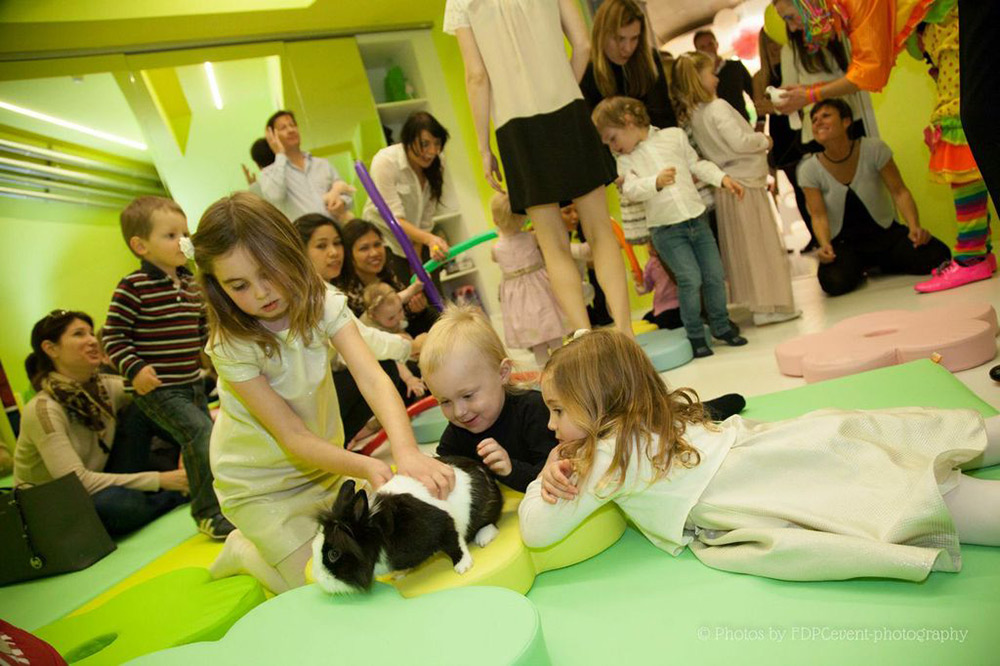
 Once upon a time, an educator who loved music moved from Milan, Italy, to bring the joy of learning English through music to children in a land faraway. Around the same time, an enchanting place called
  “I’ve only been living in Monte Carlo and teaching Kindermusik at the Munchkins Club for a few months but I can already see the children’s progress in so many ways, including:
 Of course, what fairytale is complete without a princess? Alina’s story includes Princess Charlene of Monaco, who visited the Munchkins Club to show her support for early childhood education.


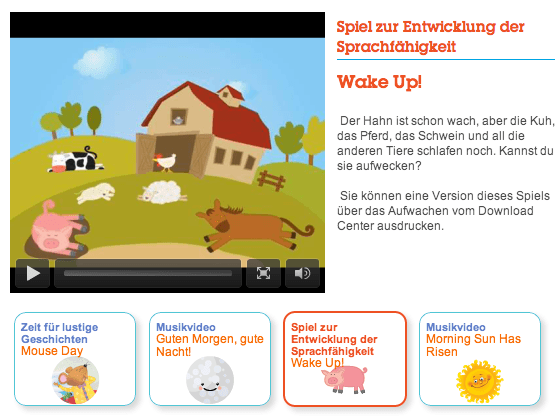
 Young children love to search for hidden or missing items. Following the English language directions in the video, and then finding (and saying hello to!) the frogs, fish, and ducks, provides young ELL students much-needed feelings of mastery and success in English.