Any normal Mom can be driven quickly insane by the annual Christmas toy craze. If I hear my 5 year old exclaim, "I want that!" during another toy commercial, well, it just might throw me over the edge. I came across an article on Facebook titled: "The 5 Best Toys of All Time" and noticed it had been shared by a number of my friends, including some of our top Kindermusik educators. I figured this article must include some great toys that are educational, musical, imaginative and would help me finish my Christmas shopping. What I found was even better… Continue reading “The Top 5 Best Toys of All Time”
6 Tips for Less-Stressed Holidays for Parents
With the holidays just around the corner, it’s a good time to have a plan for reducing the feelings of stress and overwhelm that are often a part of the holiday season, despite our best efforts otherwise. Here are six tips that can help you formulate a plan to ensure that the whole family can enjoy the holidays to their fullest.
Determine to take time for the little moments. A holiday-themed or other favorite book before nap or bedtime. A dance around the kitchen while the pasta cooks. A drive through the neighborhood to see all the lights. A cup of homemade hot chocolate.
Choose to establish one new tradition or special holiday ritual for your family. Perhaps it’s attending a local kid-friendly holiday concert. Or maybe you might choose to make or buy an Advent Calendar to help you count down the days. With older children, you might opt for taking cookies to an elderly shut-in.
Enjoy the music of the season. Take all of your favorite Kindermusik-style activities right into the holidays! Move-along, play-along, dance-along, and sing-along to all of your holiday favorites. You might even find some new musical inspiration for the holidays at Kindermusik’s music download site, play.kindermusik.com. Enjoy a free holiday music download of Winter Wonderland on us this month only!
Keep your daily routines as consistent as possible. While everyone in the house benefits from a predictable routine, young children especially need the familiar predictability of their regular schedule to keep them from falling apart or feeling out of sorts. Continue reading “6 Tips for Less-Stressed Holidays for Parents”
FOL Fridays: Movement & Learning
It is through dancing with others that children can quickly learn to work within the group dynamic. Movement becomes more than just fun – it becomes the road to communication, fostering both social interaction and cooperation. Structured dance, such as what we often enjoy together in Kindermusik, or free dance, which is easy to enjoy together at home, allows for creative self-expression while also giving the children the opportunity to learn how they understand themselves in relation others.
Tips for parents: Make it a family dance night – even just a couple of numbers will do! Start by making a list of some of your favorite “move-to-it” music selections. Choose from your own library or try something new from play.kindermusik.com. Then forget everything else and just have fun! The joy of dancing together will benefit not just your child, but all who are involved.
– Contributed by Theresa Case, whose Greenville, SC program, Kindermusik at Piano Central Studios, is proudly among the top 1% of Kindermusik programs worldwide.
The Power of YOU
Recently, a new tablet came on the market, designed specifically for children ages 4 and younger. (Yes, that’s 4 years old and younger!) The Vinci is a “real touch-screen Android-based product” with a tagline of “Inspire the Genius.”
Technology is a great thing, but I’m still a firm believer in some old-fashioned approaches to childhood. No one – and no thing – is better for your child than YOU. As your child’s first and best teacher, here is some simple, every day encouragement that I hope will help you inspire the genius that is uniquely your child.
Start by embracing your role as your child’s first and best teacher. You know your child better than anyone – what makes him giggle or what calms him down. It’s the little things like the happy little rituals and time together that you incorporate throughout the day that matter the most to your child developmentally, academically, and emotionally in the long run. Continue reading “The Power of YOU”
The “Signs” of Language Learning
I was doing some research today on baby sign language and ran across an interesting article. Even though sign language is a great way to encourage early communication in young children, some parents, like the one in the article, are concerned that this form of early communication might delay their child’s verbal development.
The opposite is typically true. The combined experience of movement and spoken language encourages your baby’s understanding of the word, as well as increases retention of the new word. This is because he is engaged actively in the learning experience, and the movement has stimulated the brain to receive the incoming information. “Talking and signing together flood the baby with language,” says Acredolo whose research, published in the Journal of Nonverbal Behavior, indicates signing may even give children a slight future verbal edge. “At 36 months, the [signing] babies in our study were speaking, on average, the equivalent of non-signing 47 month olds,” she says. *
Parents can begin to work on baby sign language as early as 3-6 months, and children will typically begin to sign back around 6-12 months old. However, it’s not too late if your child is past that age. Sign language can be a fun way to communicate for children of all ages. I recommend taking a sign language class, such as Sign and Sing, with your child to learn how to present the signs in an interactive, age appropriate, and fun way. A sign language class will also help you to understand your child’s hand development. If a sign is too difficult for them to form, your child will likely make adjustments to the sign. Once you learn what to look for, you may be surprised to find your child has several signs they are already using.
*MSNBC.com article written by Victoria Clayton
~ Written by Kindermusik educator Aimee Carter, owner of Kindermusik at Delightful Sounds, as originally posted on her “More Than a Children’s Music Class” blog.
FOL Fridays: Relaxation
Children learn many skills from adults, such as tying their shoes or reading a book. They must also learn how to relax, self-calm, channel feelings, and focus. With continued practice, persistence, and a little creativity, children learn not only how to relax, but also how to use this skill effectively every day, even in chaotic environments (Cox and Orlick 1996). Relaxing together with a little soothing, gentle music in the background will go a long way towards helping your child find his own calm amid the busy chaos that can be our lives.
TIP: Establish a Relaxation Ritual in your home, perhaps first-thing in the morning or just before bedtime. Turn on some quiet music and just relax with your child – holding them if they’re small enough or just cuddling up beside each other if they’re too big for your lap. Model being still and not talking, just breathing deeply and quietly enjoying one another’s company. You might also want to sing a simple lullaby to your child at the end. This will likely become a very treasured and much-anticipated time for you and your child(ren).
– Compiled by Theresa Case, M.Ed. Theresa’s Kindermusik program at Piano Central Studios in Greenville, SC, is proudly among the top 1% of Kindermusik programs worldwide.
FOL Fridays: Repetition
Again, again!! Children learn through repetition. Each time a child is exposed to a new object or experience, new neural connections are made in his brain. Through repetition, these connections are strengthened and learning occurs. Every Kindermusik curriculum is designed to repeat certain activities – in part because of this important connection between repetition and learning, but also because repetition of activities helps to create the Kindermusik class community. Ritual and repetition at home are important components of a predictable and nurturing home life as well.
TIP: So go ahead, sing that song or read that book again. For the hundredth time. Take satisfaction in knowing that you’re doing your child’s brain a world of good!
– Compiled by Theresa Case, M.Ed., whose Kindermusik program at Piano Central Studios in Greenville, South Carolina, is proudly among the top 1% of Kindermusik programs worldwide.
Discover your learning styles!
Authored by Donna Detweiler and shared with permission from the Studio 3 Music blog. Based in the Seattle, WA area, Studio 3 Music is the world’s largest Kindermusik program.
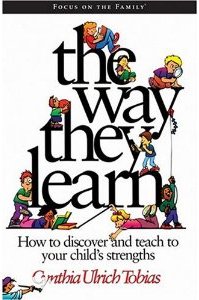
Insight from: The Way They Learn, by Cynthia Tobias
Cynthia Tobias has been writing about kids, learning styles and education for a long time. Her books are incredibly practical.
Decoding My Husband’s Bent
In her book titled, The Way They Learn, “They” can refer to us, or our spouses, or our children, anyone really! So, I found this book to provide helpful and interesting insight into myself, my spouse, my children and other significant relationships in my life. The last time I read it, I retained the most information about my “bent,” my preference for taking in information and processing it. This time, I found myself immersed in the chapters that decoded my husband’s bent. Even after 14 years of marriage, I don’t always understand his motivations or behaviors. Cynthia writes:
What seldom occurs to us is that other people, perhaps even those in our own family, may view the world in an entirely different way than we do…and have dramatically dissimilar approaches to life. You begin to realize that people are fundamentally different.
After discovering all sorts of insights into his life, not only did I feel I understood him better, but I trust him more! Let’s be honest, it’s the areas of our greatest differences—those pesky “opposites attract” areas that create the most strife. Often, we simply don’t understand our spouses, or our children’s attitudes or actions.
When Our Children Are Different Than Us
The more children you have, the more potential you have to see this in action. Cynthia draws lots of insights from her life experience—she and her husband are raising identical twins, which are identical only to the casual observer! As a parent, being a little less clueless about why our kids do what they do—primarily when it’s different that our “doing”– can be tremendously helpful for us and them.
In my next couple of blogs, here’s what I hope to help you learn from Cynthia’s book.
*What are the two main ways that you, your spouse and your children take in information? Are you a concrete or abstract perceiver?
*What are the two main methods people use to order the perceived information? Do you order information sequentially or in random chunks?
*How does this information help you to have the most beneficial relationship with others, as a parent or spouse or friend?
Discovering your learning style and your loved ones’ learning styles is exciting because it’s empowering. I don’t know about you, but I’m always ready to add some tools to my relational and parenting tool box. Talk to you again soon!
Introducing… FOL Fridays!
At the heart of the Kindermusik curriculum are Foundation of Learning statements, or “FOLs” as we Kindermusik educators fondly call them. These FOLs are the “how comes” and “so whats” behind every music and movement learning activity we do in class. You see, we want you to not only have FUN in our Kindermusik classes; we also want you to understand WHY the activities are so musically and developmentally beneficial for your child and HOW you can use these same activities ideas to make your every day parenting routines just a little bit easier.
With that in mind, we thought it would be interesting to introduce a short series we’re calling FOL FRIDAYS that will highlight some of our favorite, tried-and-true Foundation of Learning statements and parents tips. Check back with us each Friday to see our latest featured FOL. You’ll love the musical and developmental insights into that precious little person in your life!
– Compiled by Theresa Case, M.Ed. Theresa’s Kindermusik program at Piano Central Studios in Greenville, South Carolina, is proudly among the top 1% of programs worldwide.
Through a Nana’s eyes
Special thanks to Studio 3 Music, the world’s largest Kindermusik program, for sharing this special post by from their blog with us. The author, Colleen, is not just a grandmother; she’s also a licensed Kindermusik teacher at Studio 3!
It’s no wonder Grandmothers are afforded such a high level of respect in so many cultures: we are survivors! We have borne children, raised them to adulthood and now stand ready to assist a whole new batch of babies. Our hair a little grayer (not that anyone else will actually KNOW that fact), our gait a little slower, and perhaps our speech a bit more selective, having learned a thing or two along the way….hopefully!Each week I gather with a group of grandmothers much as I gathered with other moms when my children were young. Oh, the special companionship we share! We compare stories and pictures, laugh until we cry, cry until we laugh. We celebrate remembered successes and occasionally can’t resist commiserating over the things we wished we’d done differently. But in general, we relish the richness a new generation of babies brings to our lives.
Being one of the newer members of the Studio3 teaching team, I also have the special privilege of being the oldest and the one with the most (make that “only”!) grandchildren. I could never have imagined even two years ago that my days would be spent so delightfully singing and skipping, hopping and bouncing, dancing and snuggling with little ones while learning a plethora of nursery rhymes, not to mention dozens of dances, silly songs and stories. I feel I’ve been granted a rare and wonderful privilege.
But, of course, the best part is the children….and we Nanas and Papas see them very differently than Mommies and Daddies. Grandparent’s eyes are somehow different than parent’s eyes, probably because they are old and practiced. We have seen how very quickly a little one pulls his way up to wobbly knees, quickly followed by toddling feet that all too soon make way for bicycle pedals. Babies are not babies for long. Toddlers are not toddlers for long. Children are not children for long.
In the midst of the morphing the moments seem to stretch on forever! Will they never sleep through the night? Will he ever use a spoon? Are diapers forever? (Well, that Depends, I guess!) It’s hard to take the long view when the short view involves such intensity.
I guess that’s one of the rewards of grandparenting. We have seen the long view and discovered that it arrives all too soon! I share with you a little poem someone took the time to embroider and frame as a gift for me when I was a young mom, in hopes you will pay it more heed than regrettably I, especially the last stanza. Credited to Ruth Hamilton, it first appeared in the Ladies Home Journal in 1938 (before even MY time!).
Babies Don’t Keep
Mother, oh Mother, come shake out your cloth,
Empty the dustpan, poison the moth,
Hang out the washing and butter the bread,
Sew on a button and make up a bed.
Where is the mother whose house is so shocking?
She’s up in the nursery, blissfully rocking.
Oh, I’ve grown shiftless as Little Boy Blue
(Lullaby, rockaby, lullaby loo).
Dishes are waiting and bills are past due
(Pat-a-cake, darling, and peek, peekaboo).
The shopping’s not done and there’s nothing for stew
And out in the yard there’s a hullabaloo
But I’m playing Kanga and this is my Roo.
Look! Aren’t her eyes the most wonderful hue?
(Lullaby, rockaby, lullaby loo).
The cleaning and scrubbing will wait till tomorrow,
For children grow up, as I’ve learned to my sorrow.
So quiet down, cobwebs. Dust go to sleep.
I’m rocking my baby and babies don’t keep.