
Splish, splish, SPLASH!

The following post was shared from Kindermusik educator Joy Granade.

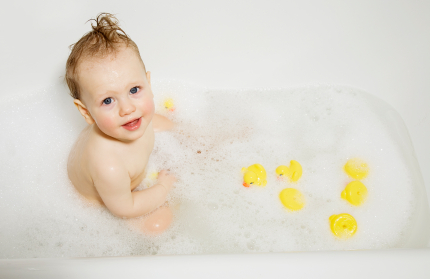
Some days bathtime feels like a chore, just one more part of the day you have to slog through to get the kids into bed, so you can crash.  However, over the years it’s been amazing to watch the way my hubby has turned bathtime into a special ritual with the boys.

When my oldest was first born, my hubby proudly declared that he wanted the responsibility for bathtime.  At first I wasn’t quite so sure as his early attempts were filled with some crazy misadventures.  But before long I saw what a treasure bathtime was quickly becoming for my two (and now three) guys.

Proud Kindermusik mama that I am, I have seen in action how important rituals and routines are for helping babies, toddlers, preschoolers (and even grownups) find order and peace in their days.  Not only have I seen them ease tantrums and tears, but I’ve also watched how they help us as a family calm and connect to one another.  So, here are a few lessons I’ve learned from watching my sweet hubby at bathtime with the boys:

Give yourself time. When you don’t feel rushed, you both can be really present in the moment, which helps you make bathtime a bonding experience but also helps your little one feel relaxed and ready for bed.

Bathtime can be playtime. And of course for little people, playtime is always learning time.  Whether you just grab a small colander, funnel, and measuring cups from the kitchen or you buy bathtoys, water play is a blast and a great way to learn.  Watch how things sink or float.  Talk about colors.  Count.  Play with textures – washcloths or even sponges cut into shapes or animals.  Identify letters (foam ones are fun to stick on the wall).

We even used bathtime to teach a lot of sign language (DUCK, WATER, BATH, IN, OUT, MORE).  Our favorite toys:  ducks, stacking cups with holes that water can drip through, and now dinosaurs we can bathe.  I’ve also heard of families bringing baby dolls or cars to share in the bath as well.

Consider using your hands.  Touch is one of the most important ways we connect.  A long time ago my hubby declared that he didn’t want to use baby washcloths much, though they are sometimes necessary.  He knew that the special act of washing our boys with his bare hands communicated love and affection in a way that a washcloth couldn’t.

Add a little massage. With our littlest babies in the Village classes, we often share a time of baby massage.  Bathtime is the perfect time to extend this activity.  Whether you just give a little extra squeeze as you scrub your little one down, or you pull out some lotion for a sweet massage after you’ve toweled off, this kind of loving, intentional touch aids in digestion, relieves colic, promotes health, and might even help your child sleep.

Even after we quit giving massages at bathtime, I continued to give backrubs and leg and arm massage as we snuggled before bed when I knew our kids were having a hard time settling down for bedtime.

And of course…make music! Because transitions have always needed a little extra creativity in our household, we made up a bathtime song years ago.  (It sounds like the old Batman TV show theme but uses the word Bathtime instead of Batman.  Only my hubby.)  But it grew from there.  Before long we had songs we sang to calm crying babies as we toweled them off, chants for counting “piggies” in the bath (“This little piggy…”), and even songs about scrubbing in the tub.  Sometimes we just sang our latest favorite Kindermusik songs or even made up new silly songs.  It never matters what we sing, it always makes bathtime easier – especially when it’s been a long day.

Time to get out of the tub! And last but not least, all good things must come to an end, and with bathtime, sometimes the fun is so great that getting out is hard.  That’s why it’s a good idea to come up with a few rituals for getting out.

Over the years ours have evolved.  For our babies, we sang lullabies to help ease the transition.  Then as the boys grew, they counted down 5 minutes, 3 minutes, 1 minute till time to get out of the bath.  Soon they were making choices about how to get out of the tub – stomp like a dinosaur out of the bath or jump like a monkey.

But the best was what happened on the other side of the tub wall.  Whether they hid under the towel, played peekaboo, or pretended to be butterflies wrapped in a towel cocoon, there was always a big snuggle at the end of bath – my favorite part!

Special thanks to Kindermusik educator Joy Granade for sharing this post from her blog, Kindermusik with Joy. Information about Joy’s Kindermusik program in Kansas City, MO, can be found at her blog.
I love it when a plan comes together

So for months now we have had Kindermusik classes.  And many of my families have been together all that time, so they have become family to each other.  Just the other day, a magical moment happened in class.

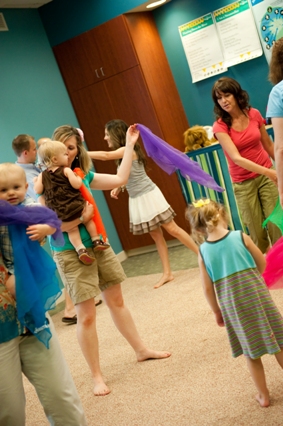
We have been working on building this “family” community by having a gathering time at the beginning of class, so that parents and care givers can connect. We then continue on with singing a hello song that incorporates all the children’s names, and we like to do circle dances to help bring people together in a relaxed, fun, safe environment.

One of my favorite circle dances right now is Love Somebody.  We have been having a great time walking in and out of the circle, and then the big finish is tell all the children in class that we all love them….and now even the adults will point to each other!  Our families in class are so comfortable singing and doing activities that when a new person comes into class, they all openly embrace that parent and child.

As  Kindermusik teachers, we want there to be that connection between parents.  We hope and plan to have that happen. We love hearing the play dates being organized, but most of all we love having that special time with each of our classes!

– shared by Miss Beth from Studio 3 Music, the world’s largest Kindermusik program.

Meet a Kindermusik educator: Erika Ellis

Name:
Erika Ellis

Location:
Burbank, CA

Studio name and link:
Music and Friends Studio
www.musicandfriendsstudio.com

Number of years you’ve taught Kindermusik:
Less than one

Describe yourself in five words or less:
Caring, Fun-loving, Enthusiastic, Creative, Silly

Favorite Kindermusik song:
Wishy Washy Wee

Favorite Kindermusik activity, and why:
I love “Clever Cows” from Village Cock-a-doodle-MOO!, where we physically show a child what going up and down the musical scale FEELS like – early musical learning at its best! Babies love going way up in the air and hearing the sound of their caretaker singing high and low.

A proud moment in a Kindermusik classroom:
When I was playing some of our instrumental pieces for Gathering Time, the song I had once used for rocking came on. A little boy immediately lay down and pretended to sleep! A few of the other toddlers joined him and I knew they had been practicing relaxation at home!

Something your Kindermusik children or families have taught you (could be inspirational, humorous, practical, etc.):
Seeing parents and children in class has really reinforced the importance of special bonding time. There is something so magical about mothers and fathers singing lovingly to their babies or playing music enthusiastically with their toddlers. Kindermusik reminds me to treasure these moments with my own family.

Something funny a child has said or done in your classroom:
One walker in Village has a routine of coming to stand next to me when I am sharing information about the next activity. He puts his hand on my shoulder, like he’s supporting me while I sing and talk to the moms. It cracks me up every time!

The reason you teach:
I fell in love with the Kindermusik experience as a parent with my infant son. I was able to enrich our home life with what we learned in class. Since it was such a positive influence on our lives, I wanted to share it with others.

The music in your head: How did it get there?

Music education is a vital part of a child’s life. Research shows that our abilities to sing in tune, move to a steady beat and yes, hear music in our heads, are all formed by the time we are 8- or 9-years old. That doesn’t mean you can’t learn to sing or dance or play the piano after the third grade, but the learning windows for musical aptitudes do begin to close.

Do you ever hear a song in your head over and over again? Can you imagine not being able to hear music this way? Audiation, the ability to hear music when no musical sound is present, is an acquired skill. Similar to thinking thoughts without talking aloud, when you audiate, you internalize and “think” music. To practice audiation with your child, leave off the last word of a favorite song. Stop completely. Observe and listen to your child. What is the reaction? When you play this game with familiar songs, you are engaging your child’s ability to think and “speak” with you musically.

Were you lucky enough to have wonderful parents who sang to you all the time? Did you sing endless rounds of “She’ll Be Comin’ Round The Mountain” when you went on vacation? Repetition is a critical part of your child’s growth and development between the ages of birth and seven. Repetition aids in strengthening the neural pathways in the brain. So when your child wants you to “Read it again, Mommy!” or “Play that song again, Daddy!”, do it!!!

Babies are innately musical. They respond to music and sound in utero. Carla Hannaford, author of Awakening the Child Heart, tells us that hearing and language begin in utero and become the first window to the material world as the embryo physically reacts to sound 23 days after conception. Sound becomes the organizer of our physical structure and later, via the mother’s coherent heart rhythm, gives us the patterns on which to form a coherent understanding of patterns within our world.

People often ask, “What do you do with an infant in a music class?” Babies can be soothed with music. Brain development is stimulated by music. A Kindermusik Village class, for example, provides a rich environment of music, movement, language and touch for babies newborn to 18 months. This combination of music and movement stimulates the Vestibular System, the fluid in the brain. According to Dr. Alfred Tomatis, without a fully developed Vestibular System that allows us verticality and balance, language and learning become difficult. Language development begins with movement and is supported with interactive communication and music. Hannaford points out that early music education, including the interplay of music, movement and sound, is key to developing language, math, relational and learning skills, as well as creativity.

Toddlers love to clap and pat to the steady beat of favorite tunes. Steady beat is the unchanging, underlying beat that pulses through every top-10 tune on the radio. Different from rhythm – a combination of various short and long sounds – steady beat is what we tap our toes, pencils and imaginary drums to. For many toddlers, steady beat is an innate ability nurtured with lots of opportunity to practice. For others, it is a skill that can be learned through practice. The ability to keep a steady beat is a gift that we all want our children to have. A study showed 100% of first string professional football players can move their bodies to a steady beat. Moving to a steady beat develops a sense of timing and the ability to organize and coordinate movements like walking, dribbling a basketball, driving and using scissors. Not true for 2nd string. Kindermusik classes provide many opportunities for toddlers to play instruments and move to a steady beat and parents are educated about ways to keep music alive at home.

Preschoolers are exploding with ideas and questions. Creative music and movement provide an outlet for the imaginary characters that live inside a child. 3- and 4-year olds flourish in an environment where there is music, movement and an opportunity for them to contribute ideas. In a Kindermusik Imagine That! class, a child can explore voice and ideas, add instruments to songs and rhymes, act out enticing characters and grow socially while interacting with peers.

For a kindergarten or first grade child, reading readiness is an important issue. I often imagine how it would have been to have the language of music and the English language concurrently integrated into my life: learning to read and write music while learning to read and write language.

Kindermusik provides a whole child approach to music education. Children move and sing, play musical games, learn about music in other cultures, talk about and listen to the instruments of the orchestra, develop their discriminative listening skills, build self-esteem through group interaction and music making, begin to read and write basic musical notation and much more.

I often get calls from eager parents, ready to spend gobs of money on private music lessons for their 3-, 4- and 5-year olds. I first ask them, how are the children’s fine motor skills? Are they reading? How big are their hands? Are they ready to practice at least 20-30 minutes each day? By the time children complete a 2-year Kindermusik class, they have played a pre-keyboard instrument, a simple string instrument and a wind instrument. They are eager to pursue private lessons and have more staying power!

When you choose a music program, make sure it is compatible with you and your child. Be prepared to be an active participant and supporter of your child’s music experience. It could be the best investment you ever make.

Music turns kids on. So turn it up!

Thanks to Stephanie Bartis, M.M., for sharing this great article, orginally written for the Art of Well Being. Stephanie is a member of Kindermusik’s Maestro Conductor Circle, which distinguishes her and her studio, Bartis Creative Studio, as among the top 1% Kindermusik programs worldwide.

Why Steady Beat Matters + How to Assess It

A teacher engages her preschool class in mimicking drum taps to test steady beat competency.

You know that thing that makes you want to rock, sway, clap, or tap to the music? That’s steady beat—the ongoing, repetitive pulse that occurs in songs, chants, and rhymes. 

But it’s more than just an ideal skill for dance or instrument lessons—steady beat is a critical aspect of early childhood development that affects everything from walking, to reading, to dribbling a basketball.

Continue reading “Why Steady Beat Matters + How to Assess It”

Change a child’s life by casting your vote

Have you heard about our Good Beginnings grant program? We’re giving five $1,000 grants to projects submitted by individuals and organizations around the U.S. and voted on by individuals like you.

We received over 40 fantastic applications, each one touching, thoughtful, and extremely important. They are all deserving! But we need you to help choose the five that get funded.

Visit www.kindermusik.com/grants to see all of the ideas and vote for your favorite(s). You can vote every day, up to 10 times a day between now and February 9, 2011. The top five vote getters will receive Good Beginnings grants.

Here’s just one idea submitted by KidzNotes. KidZNotes transforms futures through classical, orchestral music training beginning in the pre-school years to combat poverty, strengthen inner-city education, and foster positive decision-making to unlock the world. KidZNotes is based on Venezuela’s El Sistema.

Embed YouTube video: http://www.youtube.com/watch?v=uQPB9JS4woE

Other ideas include:

  • > Supply MP3 players with headphones for families to enhance musical learning opportunities in learning centers, designed for parent and child interactive experiences in Canton, Ohio
  • > Support breastfeeding families by through the creation of the Nursing Nook in Vida, Oregon
  • > Offer Kindermusik classes to at-risk families in Owensboro, Kentucky
  • > Bring musical instruments to children in community centers
  • > Provide music classes at the local library for children at Round Top-Carmine Elementary School in Texas where the school district is unable to fund such classes
  • > Set up a themed-based building to have a place to play and learn for disadvantaged children in Irmo, South Carolina
  • > Create a resource guide for special needs families

And so many more wonderful ideas. Take a few minutes to visit www.kindermusik.com/grants, check out some ideas, and cast a few votes. Thanks!

Note #1: We are currently experience trouble with voting and the Internet Explorer 7 browser. We are trying to correct the issue. Other browsers appear to be working fine.

Note #2: VOTING. You may be wondering how the 24-hour voting period is determined. Voters can vote up to 10 times within a 24-hour period. Unlike the application period which ended at the same time for everyone, the 24-hour Voting period is different for each Voter. The 24-hour period starts when a person casts her first vote for the day. So for example, if a person casts her first vote on Wednesday at 1:00pm EST, she has until 12:59:59pm EST on Thursday to cast her 10th vote. Her number of potential votes (10 per day) starts over again at 1:00pm EST on Thursday. Any unused votes from the previous 24-hour period do not carry over into the next.

Try a free Kindermusik class preview in 2011

Happy new year! The new year means a lot of things: a fresh start, a resolution or two, a new calendar hanging on the wall, the struggle to remember to write the correct year on your personal checks! (Or is that just us?)

Have you thought about what special activities you’ll plan with your child to make this year one of growth, bonding, learning, and great memories? If you’ve begun mulling over this question, hopefully Kindermusik is on your list.

We know there are a lot of choices for parents today, but we think Kindermusik is simply the best choice a parent can make. Our classes are engaging, age-appropriate, and research-based, not to mention an absolute blast! But don’t take our word for it. Check out the community page on our new website to read some quotes from mommy bloggers across the web. These are unsolicited blog entries from parents who absolutely love taking their kids to Kindermusik.

So try Kindermusik to see if it’s right for you. Sign up for a free Kindermusik class preview:

CLICK HERE FOR A FREE CLASS PREVIEW

Kindermusik has it all. It’s music, it’s movement and dance, it’s learning, it’s connecting with other parents, and perhaps best of all, it’s bonding with your child. We know you’re going to love it, and we hope to see you in class soon!

Have questions? Visit our newly redesigned website at www.kindermusik.com or email us at info@kindermusik.com.

Make it a musical, TOGETHER Christmas!

Although this is the time of year when many Kindermusik programs take a brief holiday break, no one has to take a break from musical, family-oriented activities over the holidays!  In fact, the holidays are the perfect time to take a few minutes here and there to de-stress, make a memory, and enjoy all that the holidays were meant to be.  Here are a few ideas and resources to get you started:

Favorite holiday-themed books (teacher-tested and kid-approved!)
Dream Snow by Eric Carle
The Snowy Day
by Ezra Jack Keats
Snowballs
by Lois Ehlert
Flannel Kisses
by Linda Brennan
Llama Llama Holiday Drama by Anna Dewdney
The Mitten by Jan Brett

Favorite music downloads  from play.kindermusik.com
Jingle Bells Play-Along
Rudolph, the Red-Nosed Reindeer
Over the River
The Jolly Snowman
The Little Drummer Boy
Ding Dong Merrily on High
The Night Before Christmas


Family activities to bring a smile and create a memory!
Pretend Sleigh Ride: Turn on “Over the River.” Pull a laundry basket with a sturdy rope or slide it around.  Add bells to the side of the basket to get the full effect.
Make a Snowman out of Dad: Play “The Jolly Snowman” as you use toilet paper to wrap up a family member like a snowman.  Add a hat, scarf, mittens, etc for fun.  Don’t forget to take LOTS of pictures.

Pots and Pans Play-Along: Get out some wooden spoons and some pots and pans.  Play along to “Jingle Bells” or “Rudolph.”

Easy food crafts
Marshmellow snowmen
Gingerbread house from graham crackers
Homemade Hot Chocolate Mix
Reindeer Hand Print


Posted by Theresa Case, whose Maestro Kindermusik program at
Piano Central Studios in Greenville, SC, is proudly among the top 1% of Kindermusik programs world-wide.

The “Process”

This post was shared from a mom enrolled in Kindermusik classes at Studio3Music, the world’s largest Kindermusik program.

As a mom of 2 very different boys, one with sensory processing issues and one with a severe bleeding disorder, I know things in my house can be far from considered normal.  I remember going to Kindermusik when the older one (with SPD) was little.  He was always so BUSY!

It seemed like all the other 6-9 month old babies were happy and content to sit in their mommies’ laps and smile and clap with the music.  They would wave as the shakers were put away and smile again when the next song would start.  Not my baby.  He would crawl around the room, looking under curtains, pulling himself up where ever he could.  He’d look for anything out of place to discover and get into.  I was practically chasing him around the room!

When shaker time was over, he’d fight to keep that thing in his hand and when the shakers disappeared, he’d scream and cry through the entire next song.  I’d quietly soothe him, whispering in his ear.  I could feel all the other moms looking at me.  Sometimes we’d leave the room until things got calm.

This is when I’d come back and Miss Allison would talk about “The Process.” My younger boy never had this issue, although his deal is to just lie like a log on the floor during the dancing music.  Everyone just dances over him like he’s a prop on the carpet.  Of course I’m used to being the family that stands out in a crowd.  Neither child really follows anything.

After years with Miss Allison and learning from Montessori school, I have become adjusted to knowing what “The Process” really means.  At 6-9 months old, the older child was processing everything in his environment.  Including the music and songs of Kindermusik.  A week or two after learning a new song or dance he’d try mimicking it at home.  Not often in class.  He was too busy there.  Too busy PROCESSING everything.

The little one does the same thing.  He may just lay and roll on the floor in class, but on the way home he sings every single word to every song.  I learned something else about The Process over these 5 years as well.  Letting go of the Perfectionist in myself.

After setting out all the supplies for our family gingerbread house, I had ideas of creating a masterpiece, but after several summers of Kindermusik crafts and home art projects I knew the house was going to be anything but that.  The boys jumped right in icing and decorating until every bit of candy was either on that house or had been eaten.

Throughout, I kept reminding myself that it’s all about THE PROCESS.  I’ve seen other moms do all the gluing and sticking and messy work for their art projects or have a separate “kid’s Christmas tree” so that the “real” tree can look like Martha Stewart’s, and that’s fine.  Those trees are beautiful and the projects look just like the originals.

What I’ve learned about The Process is that as much as I want that perfect looking tree and gingerbread house for my very own, I remember the original ones even more. I remember the hand turkey with 3 eyes and feathers on his head but none on the fingers part.  The gingerbread house with candy only on one side or only decorated with the blue candies.  I remember the Santa picture that I had to be in with my sweats on, hair a mess and no makeup because the little one would not go near the man in the red suit.  This is all part of The Process.

The Process, where not only the children are learning and growing and absorbing, but I am too! The perfectionist still wants to fight it but I remember all these things to keep her at bay, and until the children can hang outside Christmas lights on their own, I can still light up the neighborhood in my own Martha Stewart-ness.  So the next time you see us dancing to the beat of our own drum, you can stare, it’s okay. We are just processing and making memories while doing it.

Shared with permission from Studio 3 Music, the world’s largest Kindermusik program, from a Studio 3 Music blog post written by Kindermusik mommy Heidi Forrester… who still hopes her gingerbread house will one day look like the picture on the package.

Introducing: America the Musical, the Vook!

Drum roll, please!!  Kindermusik International is very excited to present our new Vook, America the Musical.

In partnership with Vook, makers of video-enhanced books for the web, iPhone, and iPad, Kindermusik International has created a music-and-video-enhanced, interactive version of our popular America the Musical book.  If you have an iPad, you just have to check this out – America the Musical. It’s tons of interactive fun and learning.  Read on for your sneak peek…

Who was Yankee Doodle anyway? Many of you have been singing these ballads by heart for years. Now you can get the real story behind songs like “Oh! Susannah and “This Land Is Your Land.” Take a musical journey through history and learn about the cultures, politics, and lifestyles of the people who settled America and inspired the famous lyrics.

You will delight in exploring the pages of this book through interactive touch. You”ll hear stories, listen to music, watch short, funny video clips about “Amazing Presidents,” and interact with historical figures like Paul Revere and Lewis and Clark who are brought to life through imaginative dialogue and entertaining character voices.

Penned in kid-friendly language and filled with odd, interesting facts sure to delight young listeners (one president had hippo bones and cow’s teeth in his mouth!), this interactive app is an unforgettable musical history lesson that brings ten decades of the American story to life with vivid characters, engaging and humorous dialogue, Monty-Python-style videos, and ten favorite American folk songs.

Click here to check it out now in the iTunes store! Available now for just $6.99. We hope you enjoy!