
6 Ways for you and your child to live it up — for free!

The best things in life are free. Check out these wonderful ways for your child to live it up without spending a penny.

Free Music
Of course, we think the best thing you can do with your child is Kindermusik! Go to play.kindermusik.com to register and receive three, free music downloads.  There are just so many incredible developmental benefits to exposing your children to music early in life. You can also preview our children’s music classes at no cost, while connecting with other parents and spending quality time with your tyke.

Check the Local Library
Libraries are one of the best no-cost places to take your kids. They’re stocked full of books, music, and DVDs for your learning little one.

Kids Eat Free
Many restaurants nationwide have specific days of the week where kids eat free. Websites like kidseat4free.com will find the restaurants in your area that offer free dining for kids.

Your Local Museum for Free Kids Day
Most museums offer free days for kids. Mark the free local museum deal days in your calendar early on so you remember when the days roll around. You’ll be learning together in no time.

Fishing Classes
Teach your little ones about the fun and excitement of the great outdoors while doing some kid-friendly angling. Many fishing retailers offer free fishing classes for kids. For example, Orvis offers free fly-fishing classes May through July.

Free Bowling for Kids
Strike up some learning fun at a participating alley near you—for FREE. Keep score the old-fashioned way—by hand—to practice counting and simple math. Go to kidsbowlfree.com to get rollin’.
FOL Fridays: Imagination and Pretend Play

“Learning to imagine [is the] first step in stretching the human potential.” (Karen Miller, Ages and Stages, p. 65)  The ability to pretend and imagine usually starts at around 18 months.  From there, the developmental progression of pretend play generally moves from using one object to represent something else, to dressing up and/or pretending to be something else, to role-playing and interacting while in that role.  Kindermusik classes help provide the kinds of experiences that provide the opportunity for imagination to blossom, but you will probably notice that your child engages most readily – and sometimes most humorously! – at home where your child is the most comfortable.

IDEA: Simple toys like blocks and stuffed animals, dress-up clothes from the thrift store, and even empty containers or cardboard tubes can inspire hours of pretend play.  Organize these items into containers that are easily accessible to your child.

– Compiled by Theresa Case, M.Ed., whose Kindermusik program at Piano Central Studios in Greenville, South Carolina, is proudly among the top 1% of Kindermusik programs worldwide.

The teacher makes the difference

When you have a Google alert set for “Kindermusik,” you end up with a whole variety of posts on the subject.  One recent alert contained some comments from a mom who made the insightful observation that the TEACHER makes all the difference in the quality of your Kindermusik experience.  She couldn’t be more right.  Here’s a little of what she had to say:

“I recently enrolled my 18mth old in an Our Time class.  She LOVED it.  I loved that the teacher wasn’t busy corralling kids, everyone was left to enjoy and experience the class however they wanted/needed to.  The teacher was energetic and informative on WHY activities were chosen and made transitions from one activity to the next very smooth.  I would recommend the class to anyone IF the teacher has good reviews.”

As a whole, Kindermusik educators are a group of loving, nurturing, musically inclined individuals who have two things in common – a love for children and a passion for making a difference in the lives of children and their families through music.  Personally, I am very blessed to have a wonderful staff of eight Kindermusik teachers teaching with me here at Piano Central Studios.  You know what?  We’re all different.  We have different personalities and different teaching styles even though we follow the same lesson plans.  The beauty of it all is that parents and children have different personalities and learning styles too!

Just like the Kindermusik teachers on my staff, not all Kindermusik programs are the same.  Often it is “love at first sight.” Sometimes it’s just a matter of allowing time to adjust to a new environment and a new experience.  But sometimes it’s necessary to try out another teacher or another program offering Kindermusik.  As independent educators and programs, we all bring different goals, gifts, abilities, and experience to the table.  Don’t be afraid to seek out the Kindermusik program – and the Kindermusik educator – that’s just right for you!  That’s one of the reasons why KI’s Class Finder is set up like it is – to help parents find a class that’s conveniently located with scheduling and educators that meet their needs.  I think this mom said it best, “I’d try again with another instructor before writing it off completely.  [Our teacher] Ms Amy really loves her job and it shows in how she teaches the class.”

To read this mommy’s comments in their entirety, click HERE.  To try a FREE Preview Class, click HERE.

Shared by Theresa Case, M.Ed., whose Kindermusik program at Piano Central Studios in Upstate South Carolina is proudly among the top 1% of Kindermusik programs worldwide.

FOL Fridays: Movement and Body Control

During movement activities, children learn to organize the available space in relation to themselves and in relationship to objects and other individuals… this is how they develop body control, spatial awareness, and confidence in the power and ability of their own bodies.  (Linda Carol Edwards, The Creative Arts)

TIP:  Turn on some dancing music and dance around the room together.  Add a prop like a scarf, a ball, or a hoop for more movement and body control fun and learning.

– compiled by Theresa Case, M.Ed., whose Kindermusik program at Piano Central Studios in Greenville, South Carolina, is proudly among the top 1% of Kindermusik programs worldwide

FOL Fridays: Repetition

Again, again!!  Children learn through repetition.  Each time a child is exposed to a new object or experience, new neural connections are made in his brain.  Through repetition, these connections are strengthened and learning occurs.  Every Kindermusik curriculum is designed to repeat certain activities – in part because of this important connection between repetition and learning, but also because repetition of activities helps to create the Kindermusik class community.  Ritual and repetition at home are important components of a predictable and nurturing home life as well. 

TIP:  So go ahead, sing that song or read that book again.  For the hundredth time.  Take satisfaction in knowing that you’re doing your child’s brain a world of good!

– Compiled by Theresa Case, M.Ed., whose Kindermusik program at Piano Central Studios in Greenville, South Carolina, is proudly among the top 1% of Kindermusik programs worldwide.

Discover your learning styles!

Authored by Donna Detweiler and shared with permission from the Studio 3 Music blog.  Based in the Seattle, WA area, Studio 3 Music is the world’s largest Kindermusik program.

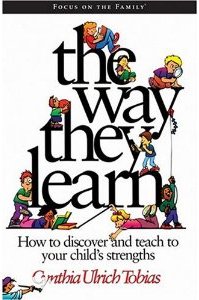
Insight from: The Way They Learn, by Cynthia Tobias

Cynthia Tobias has been writing about kids, learning styles and education for a long time. Her books are incredibly practical.

Decoding My Husband’s Bent

In her book titled, The Way They Learn, “They” can refer to us, or our spouses, or our children, anyone really! So, I found this book to provide helpful and interesting insight into myself, my spouse, my children and other significant relationships in my life. The last time I read it, I retained the most information about my “bent,” my preference for taking in information and processing it. This time, I found myself immersed in the chapters that decoded my husband’s bent.  Even after 14 years of marriage, I don’t always understand his motivations or behaviors.  Cynthia writes:

What seldom occurs to us is that other people, perhaps even those in our own family, may view the world in an entirely different way than we do…and have dramatically dissimilar approaches to life. You begin to realize that people are fundamentally different.

After discovering all sorts of insights into his life, not only did I feel I understood him better, but I trust him more!  Let’s be honest, it’s the areas of our greatest differences—those pesky “opposites attract” areas that create the most strife. Often, we simply don’t understand our spouses, or our children’s attitudes or actions.

When Our Children Are Different Than Us

The more children you have, the more potential you have to see this in action.  Cynthia draws lots of insights from her life experience—she and her husband are raising identical twins, which are identical only to the casual observer! As a parent, being a little less clueless about why our kids do what they do—primarily when it’s different that our “doing”– can be tremendously helpful for us and them.

In my next couple of blogs, here’s what I hope to help you learn from Cynthia’s book.

*What are the two main ways that you, your spouse and your children take in information? Are you a concrete or abstract perceiver?

*What are the two main methods people use to order the perceived information? Do you order information sequentially or in random chunks?

*How does this information help you to have the most beneficial relationship with others, as a parent or spouse or friend?

Discovering your learning style and your loved ones’ learning styles is exciting because it’s empowering. I don’t know about you, but I’m always ready to add some tools to my relational and parenting tool box. Talk to you again soon!

FOL Fridays: Emotions and Learning

Emotions have a tremendous impact on learning.  Simple family activities like rocking together help develop a child’s sense of security and worth, allowing him to grow into an assured, confident learner with healthy self-esteem.

IDEA: Need some music to set the mood?  KI’s music site, play.kindermusik.com, has some great lullabies that make for perfect rocking music.

 – Compiled by Theresa Case, M.Ed.  Theresa’s Kindermusik program at Piano Central Studios in Greenville, South Carolina, is proudly among the top 1% of Kindermusik programs worldwide.

Introducing… FOL Fridays!

At the heart of the Kindermusik curriculum are Foundation of Learning statements, or “FOLs” as we Kindermusik educators fondly call them.  These FOLs are the “how comes” and “so whats” behind every music and movement learning activity we do in class.  You see, we want you to not only have FUN in our Kindermusik classes; we also want you to understand WHY the activities are so musically and developmentally beneficial for your child and HOW you can use these same activities ideas to make your every day parenting routines just a little bit easier.

With that in mind, we thought it would be interesting to introduce a short series we’re calling FOL FRIDAYS that will highlight some of our favorite, tried-and-true Foundation of Learning statements and parents tips.  Check back with us each Friday to see our latest featured FOL.  You’ll love the musical and developmental insights into that precious little person in your life!

– Compiled by Theresa Case, M.Ed.  Theresa’s Kindermusik program at Piano Central Studios in Greenville, South Carolina, is proudly among the top 1% of programs worldwide.

Highlighting one of our Good Beginnings grant recipients

Kindermusik International

One of the best things a child can have is a good beginning. That’s because the early years are the most impressionable and formative for a child.  At Kindermusik International, we believe this so strongly that we chose as our tagline “a good beginning never ends”.

Though we primarily focus on supporting Kindermusik programs around the globe, we’re always looking for ways to make children’s lives better and do what we can to get children off to a great start. This led to our Good Beginnings Grant Program, which was open to anyone–both Kindermusik educators and non-educators as well–in the U.S. and Canada who had a good idea for a project that would benefit the lives of children. We allowed the public to vote on the projects they liked the most.

The response was overwhelming.  In the end, over half a million votes were cast in the space of just over one month. Kindermusik educator Katie Henderson of Bloomington, Illinois, is leading one of the winning projects. Her project was to provide a bilingual Kindermusik class for low income Hispanic families in her area.  We recently received a wonderful note from Katie, and wanted to share an excerpt here.

“Music Connections is in its 17th year of offering Kindermusik in central Illinois. We consist of a passionate team of 10 educators who have witnessed the profound ‘Kindermusik difference’ in ‘normal,’ middle-class families. We are committed to finding a way to provide these benefits on a larger scale to children and families who have special needs and cannot afford our program. We have witnessed, firsthand, how language is greatly enhanced in normal children who are experiencing the song-rich, literature-rich environment of Kindermusik. We are SO excited by the gains the Spanish-speaking children in this project will make as they have a joyful, loving experience with their parents, our teaching team, and other volunteer English-speaking moms who can model and connect with them.”

Kindermusik International is very excited that we could play a small role in making this happen. But the real credit lies with Katie and her team. Keep up the great work! Check out the Music Connections website to learn more about Katie’s program.

Check back here at Minds on Music for regular features on the progress of our Good Beginnings grant winners.

A lifetime of benefits

The musical experiences your child enjoys in the early years can provide a lifetime of benefits.  At Kindermusik, we see this every day. And our numerous research studies have proven the results as well. We’ve found that a child who stays enrolled in Kindermusik classes is highly likely to exhibit growth in some or even all of the following areas:

perseverance
confidence
responsibility
identity and self-esteem
discipline
love of music and art
culture
identification of talents
using time wisely
teamwork
following directions
intellectual and social development
precision and motor control
overcoming fears in public speaking and shyness
commitment to excellence
creativity and self-expression

Want to find a Kindermusik program near you? Visit our  Class Finder, or come try a free preview class.  You’ll be glad you did!