
FOL Fridays: Emotions and Learning

Emotions have a tremendous impact on learning.  Simple family activities like rocking together help develop a child’s sense of security and worth, allowing him to grow into an assured, confident learner with healthy self-esteem.

IDEA: Need some music to set the mood?  KI’s music site, play.kindermusik.com, has some great lullabies that make for perfect rocking music.

 – Compiled by Theresa Case, M.Ed.  Theresa’s Kindermusik program at Piano Central Studios in Greenville, South Carolina, is proudly among the top 1% of Kindermusik programs worldwide.

Introducing… FOL Fridays!

At the heart of the Kindermusik curriculum are Foundation of Learning statements, or “FOLs” as we Kindermusik educators fondly call them.  These FOLs are the “how comes” and “so whats” behind every music and movement learning activity we do in class.  You see, we want you to not only have FUN in our Kindermusik classes; we also want you to understand WHY the activities are so musically and developmentally beneficial for your child and HOW you can use these same activities ideas to make your every day parenting routines just a little bit easier.

With that in mind, we thought it would be interesting to introduce a short series we’re calling FOL FRIDAYS that will highlight some of our favorite, tried-and-true Foundation of Learning statements and parents tips.  Check back with us each Friday to see our latest featured FOL.  You’ll love the musical and developmental insights into that precious little person in your life!

– Compiled by Theresa Case, M.Ed.  Theresa’s Kindermusik program at Piano Central Studios in Greenville, South Carolina, is proudly among the top 1% of programs worldwide.

Highlighting one of our Good Beginnings grant recipients

Kindermusik International

One of the best things a child can have is a good beginning. That’s because the early years are the most impressionable and formative for a child.  At Kindermusik International, we believe this so strongly that we chose as our tagline “a good beginning never ends”.

Though we primarily focus on supporting Kindermusik programs around the globe, we’re always looking for ways to make children’s lives better and do what we can to get children off to a great start. This led to our Good Beginnings Grant Program, which was open to anyone–both Kindermusik educators and non-educators as well–in the U.S. and Canada who had a good idea for a project that would benefit the lives of children. We allowed the public to vote on the projects they liked the most.

The response was overwhelming.  In the end, over half a million votes were cast in the space of just over one month. Kindermusik educator Katie Henderson of Bloomington, Illinois, is leading one of the winning projects. Her project was to provide a bilingual Kindermusik class for low income Hispanic families in her area.  We recently received a wonderful note from Katie, and wanted to share an excerpt here.

“Music Connections is in its 17th year of offering Kindermusik in central Illinois. We consist of a passionate team of 10 educators who have witnessed the profound ‘Kindermusik difference’ in ‘normal,’ middle-class families. We are committed to finding a way to provide these benefits on a larger scale to children and families who have special needs and cannot afford our program. We have witnessed, firsthand, how language is greatly enhanced in normal children who are experiencing the song-rich, literature-rich environment of Kindermusik. We are SO excited by the gains the Spanish-speaking children in this project will make as they have a joyful, loving experience with their parents, our teaching team, and other volunteer English-speaking moms who can model and connect with them.”

Kindermusik International is very excited that we could play a small role in making this happen. But the real credit lies with Katie and her team. Keep up the great work! Check out the Music Connections website to learn more about Katie’s program.

Check back here at Minds on Music for regular features on the progress of our Good Beginnings grant winners.

A lifetime of benefits

The musical experiences your child enjoys in the early years can provide a lifetime of benefits.  At Kindermusik, we see this every day. And our numerous research studies have proven the results as well. We’ve found that a child who stays enrolled in Kindermusik classes is highly likely to exhibit growth in some or even all of the following areas:

perseverance
confidence
responsibility
identity and self-esteem
discipline
love of music and art
culture
identification of talents
using time wisely
teamwork
following directions
intellectual and social development
precision and motor control
overcoming fears in public speaking and shyness
commitment to excellence
creativity and self-expression

Want to find a Kindermusik program near you? Visit our  Class Finder, or come try a free preview class.  You’ll be glad you did!

Through a Nana’s eyes

Special thanks to Studio 3 Music, the world’s largest Kindermusik program, for sharing this special post by from their blog with us.  The author, Colleen, is not just a grandmother; she’s also a licensed Kindermusik teacher at Studio 3!

It’s no wonder Grandmothers are afforded such a high level of respect in so many cultures: we are survivors!   We have borne children, raised them to adulthood and now stand ready to assist a whole new batch of babies.  Our hair a little grayer (not that anyone else will actually KNOW that fact), our gait a little slower, and perhaps our speech a bit more selective, having learned a thing or two along the way….hopefully!Each week I gather with a group of grandmothers much as I gathered with other moms when my children were young.   Oh, the special companionship we share!  We compare stories and pictures, laugh until we cry, cry until we laugh.  We celebrate remembered successes and occasionally can’t resist commiserating over the things we wished we’d done differently.  But in general, we relish the richness a new generation of babies brings to our lives.

Being one of the newer members of the Studio3 teaching team, I also have the special privilege of being the oldest and the one with the most (make that “only”!) grandchildren.   I could never have imagined even two years ago that my days would be spent so delightfully singing and skipping, hopping and bouncing, dancing and snuggling with little ones while learning a plethora of nursery rhymes, not to mention dozens of dances, silly songs and stories.   I feel I’ve been granted a rare and wonderful privilege.

But, of course, the best part is the children….and we Nanas and Papas see them very differently than Mommies and Daddies. Grandparent’s eyes are somehow different than parent’s eyes, probably because they are old and practiced.  We have seen how very quickly a little one pulls his way up to wobbly knees, quickly followed by toddling feet that all too soon make way for bicycle pedals.   Babies are not babies for long.   Toddlers are not toddlers for long.   Children are not children for long.

In the midst of the morphing the moments seem to stretch on forever!    Will they never sleep through the night?    Will he ever use a spoon?   Are diapers forever?   (Well, that Depends, I guess!)   It’s hard to take the long view when the short view involves such intensity.

I guess that’s one of the rewards of grandparenting.   We have seen the long view and discovered that it arrives all too soon!   I share with you a little poem someone took the time to embroider and frame as a gift for me when I was a young mom, in hopes you will pay it more heed than regrettably I, especially the last stanza.   Credited to Ruth Hamilton, it first appeared in the Ladies Home Journal in 1938 (before even MY time!).


Babies Don’t Keep

Mother, oh Mother, come shake out your cloth,
Empty the dustpan, poison the moth,
Hang out the washing and butter the bread,
Sew on a button and make up a bed.
Where is the mother whose house is so shocking?
She’s up in the nursery, blissfully rocking.

Oh, I’ve grown shiftless as Little Boy Blue
(Lullaby, rockaby, lullaby loo).
Dishes are waiting and bills are past due
(Pat-a-cake, darling, and peek, peekaboo).
The shopping’s not done and there’s nothing for stew

And out in the yard there’s a hullabaloo
But I’m playing Kanga and this is my Roo.
Look! Aren’t her eyes the most wonderful hue?
(Lullaby, rockaby, lullaby loo).

The cleaning and scrubbing will wait till tomorrow,
For children grow up, as I’ve learned to my sorrow.
So quiet down, cobwebs. Dust go to sleep.
I’m rocking my baby and babies don’t keep.

All about the beat

In all Kindermusik classes, there is always emphasis on hearing, feeling, moving, and even “seeing” a steady beat. It may seem very elementary, but it is essentially the cornerstone of music.

More importantly, steady beat plays a huge importance in our speech, movement, thoughts and verbal organisation. From a baby’s first hesitant steps, he slowly finds his pace and soon starts to walk steadily and confidently. Our preschoolers who have a strong sense of beat would be able to use the scissors more skillfully. Ever watch a basketball game? The steady dribble of the ball before it is tossed smack into the basket require an acute sense of beat and timing. A master chef needs to have a command of steady beat in his knife skills. Even writers rely on a sense of steady beat and rhythm in their prose to produce a good read.

Because it is such a fundamental element, parents and teachers often do not give sufficient attention to the development of this very important underlying skill – a strong sense of beat. The consequence of insufficient steady beat experiences in early years can result in poor physical coordination, halting speech (in some cases, stuttering), and even weakness in thought flow. Would you have imagined that something so apparently a strictly musical characteristic can have such bearing on so many areas of our functioning?!

Here are some simple and fun activities that you can do with your child at home to reinforce the concept sense of steady beat:

Movement – Turn on the music and pretend to be a marching band. March, stomp or jump to the music.  For younger babies, put them on your lap and bounce to a steady beat or dance with them around the room to the steady beat of the music.

Instrument play – Use the instruments from your home materials or make your own. An old pot and spoon will make a very fun ( and loud!) drum. Practice keeping a steady beat along with the music.

Reading – Nursery rhymes are a great way to introduce steady beat. Clap or tap along as you recite your child’s favourite rhymes.

Originally written by Chiat Goh. 

Mozart Therapy

A recent article from Science Daily summarized some very interesting findings by the Tel Aviv Medical Center, namely that creating a musical environment for premature babies positively affected their ability to grow and thrive.  Preemies who were exposed to 30 minutes of music by Mozart expended less energy during that 30 minutes, thereby using fewer calories and allowing for greater weight gain.  Having a healthy body weight means that these babies have a stronger immune system and go home sooner.

“The TAU study is the first to quantify the effect of music, specifically Mozart, on newly born children. ‘Medical practitioners are aware that by changing the environment, we can create a whole new treatment paradigm for babies in neonatal care,’ says Dr. Mandel. ‘That’s our main goal — to improve their quality of life’.”

While the study is based on the controversial “Mozart effect” and researchers still aren’t clear on the long-term effects of Mozart’s music, one result is certain – music makes a difference.  Thousands of Kindermusik educators around the world can attest to that; we are privileged to see the wonderful effects of music on young children and their families week in and week out.  We especially love it when science confirms what we’ve known all along: one of the best gifts you can give your child is the gift of music.

Written by Theresa Case, Maestro Educator since 2000 and owner of Kindermusik at Piano Central Studios in Greenville, SC.

All cooped up?

Winter time is always a challenge, no matter where you live.  If it’s not snowy, it’s rainy.  And often it’s cold – too cold to be outside.  Or you’re all trying to get well from the latest virus that the whole family passed around one by one.  So what’s a parent – and a kid! – to do when you’ve been cooped up inside the house for too long?  We suggest that you get moving… to some music, that is!

The easiest way to get started is just to turn on some lively music – you know, that kind that has your feet going and your hands clapping before you even know it.  Even just a minutes of carefree, not-thinking-about-the-laundry dancing with your child can turn around the day around for both of you!  Of course, movement is not just important for helping children let off a little steam or pent-up energy, but it is also a key factor in their overall development.  And it’s a great way for a child to be able to get close to and connect with someone she loves.

You might also enjoy moving in a slightly more “structured” way by making a small circle and doing a circle dance.  Remember “Ring Around the Rosie”?  Circle dances like “Ring Around the Rosie” actually help your child focus on directing and moving her busy little body.  She also becomes aware of her body in relation to the larger physical space.  She learns about coordinating her movements with the words of the song.  Plus, she increases her memory and attention span as she follows the simple sequence of steps.  Who knew a little dancing could accomplish so much?!

By the way, if you’re looking for some new music, or you just want some high-quality children’s music recordings that the whole family will love, now is the perfect time to peruse the hundreds of selections at play.kindermusik.com.

Contributed by Theresa Case, director of Piano Central Studios in Greenville, SC, whose Kindermusik program at Piano Central is in the top 1% of Kindermusik programs worldwide.

Why Music Supercharges Early Brain Development

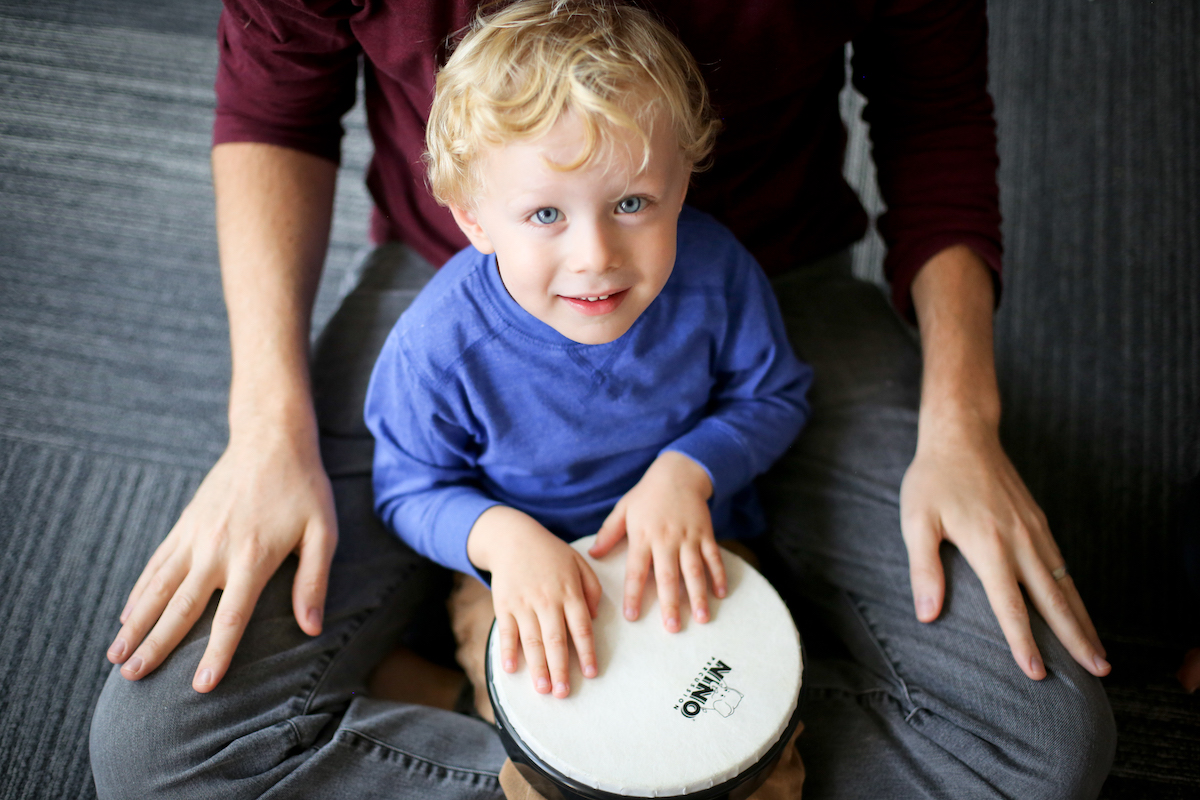
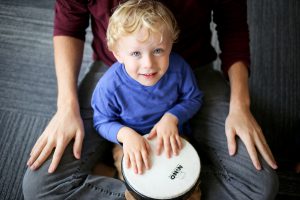
Steady beat (by tapping a drum or your lap) is one of the many ways music supercharges early brain development.

Steady beat (by tapping a drum or your lap) is one of the many ways music supercharges early brain development.

Research shows that listening and playing along with music is one of the few activities that fully supports early brain development.

How?

It engages both hemispheres of your child’s brain.  Add the fine motor coordination it takes to hold an instrument and tap in time with the music, and your child is working on the hand-eye coordination and finger strength that’s necessary to hold a pencil, tie a shoe, use scissors, and dribble a basketball later on.

Early Brain Development Tips

For your baby – Gently tap the steady beat on your baby’s hand, foot, or knee with an instrument.

For your toddler – Invite your child to use the instrument to tap on his own toes, knees, or even a tummy!

For your preschooler or big kid – Preschoolers and older kids can march around the house in a musical parade.

Musical Brain Boosting Tools

Did you know Kindermusik has a free kid-friendly app? Download it today on Google Play or from the App Store, and choose from themed playlists (like colors, nap time, and food), tappable instrument play, and more!


Originally compiled by Kindermusik educator Theresa Case. Theresa’s program, Kindermusik at Piano Central Studios in Greenville, SC, USA, is proudly among the top 1% of Kindermusik programs worldwide. Search for a class with Theresa or find a virtual or in-person class wherever you are.

Splish, splish, SPLASH!

The following post was shared from Kindermusik educator Joy Granade.

Some days bathtime feels like a chore, just one more part of the day you have to slog through to get the kids into bed, so you can crash.  However, over the years it’s been amazing to watch the way my hubby has turned bathtime into a special ritual with the boys.

When my oldest was first born, my hubby proudly declared that he wanted the responsibility for bathtime.  At first I wasn’t quite so sure as his early attempts were filled with some crazy misadventures.  But before long I saw what a treasure bathtime was quickly becoming for my two (and now three) guys.

Proud Kindermusik mama that I am, I have seen in action how important rituals and routines are for helping babies, toddlers, preschoolers (and even grownups) find order and peace in their days.  Not only have I seen them ease tantrums and tears, but I’ve also watched how they help us as a family calm and connect to one another.  So, here are a few lessons I’ve learned from watching my sweet hubby at bathtime with the boys:

Give yourself time. When you don’t feel rushed, you both can be really present in the moment, which helps you make bathtime a bonding experience but also helps your little one feel relaxed and ready for bed.

Bathtime can be playtime. And of course for little people, playtime is always learning time.  Whether you just grab a small colander, funnel, and measuring cups from the kitchen or you buy bathtoys, water play is a blast and a great way to learn.  Watch how things sink or float.  Talk about colors.  Count.  Play with textures – washcloths or even sponges cut into shapes or animals.  Identify letters (foam ones are fun to stick on the wall).

We even used bathtime to teach a lot of sign language (DUCK, WATER, BATH, IN, OUT, MORE).  Our favorite toys:  ducks, stacking cups with holes that water can drip through, and now dinosaurs we can bathe.  I’ve also heard of families bringing baby dolls or cars to share in the bath as well.

Consider using your hands.  Touch is one of the most important ways we connect.  A long time ago my hubby declared that he didn’t want to use baby washcloths much, though they are sometimes necessary.  He knew that the special act of washing our boys with his bare hands communicated love and affection in a way that a washcloth couldn’t.

Add a little massage. With our littlest babies in the Village classes, we often share a time of baby massage.  Bathtime is the perfect time to extend this activity.  Whether you just give a little extra squeeze as you scrub your little one down, or you pull out some lotion for a sweet massage after you’ve toweled off, this kind of loving, intentional touch aids in digestion, relieves colic, promotes health, and might even help your child sleep.

Even after we quit giving massages at bathtime, I continued to give backrubs and leg and arm massage as we snuggled before bed when I knew our kids were having a hard time settling down for bedtime.

And of course…make music! Because transitions have always needed a little extra creativity in our household, we made up a bathtime song years ago.  (It sounds like the old Batman TV show theme but uses the word Bathtime instead of Batman.  Only my hubby.)  But it grew from there.  Before long we had songs we sang to calm crying babies as we toweled them off, chants for counting “piggies” in the bath (“This little piggy…”), and even songs about scrubbing in the tub.  Sometimes we just sang our latest favorite Kindermusik songs or even made up new silly songs.  It never matters what we sing, it always makes bathtime easier – especially when it’s been a long day.

Time to get out of the tub! And last but not least, all good things must come to an end, and with bathtime, sometimes the fun is so great that getting out is hard.  That’s why it’s a good idea to come up with a few rituals for getting out.

Over the years ours have evolved.  For our babies, we sang lullabies to help ease the transition.  Then as the boys grew, they counted down 5 minutes, 3 minutes, 1 minute till time to get out of the bath.  Soon they were making choices about how to get out of the tub – stomp like a dinosaur out of the bath or jump like a monkey.

But the best was what happened on the other side of the tub wall.  Whether they hid under the towel, played peekaboo, or pretended to be butterflies wrapped in a towel cocoon, there was always a big snuggle at the end of bath – my favorite part!

Special thanks to Kindermusik educator Joy Granade for sharing this post from her blog, Kindermusik with Joy. Information about Joy’s Kindermusik program in Kansas City, MO, can be found at her blog.