Music isn’t just learning notes and playing them. Youlearn notes to play to the music of your soul.
~ Katie Greenwood
FOL Fridays: Vocal Play
Playing with vocal inflection – the intonations of melody of language – is a critical part of early childhood vocal development, which may begin as early as 5-7 months of age, and provides older children the opportunity to explore the complexity of communication. Vocal play allows children to practice the precise coordination of lips, tongue, and breathing necessary to speak words.*
Ideas for parents: Vocal Play can happen any time, but can be especially fun in the car or during bath
time. An easy way to facilitate vocal play is to sing a snippet of a song or chant a short rhythm pattern or poem and invite your child to echo you back. Or you can sing part of a song or say part of a poem and have them respond with the next line. It’s a simple little game that’s both engaging and beneficial for your child’s vocal development.
– Contributed by Theresa Case, whose Greenville, SC program, Kindermusik at Piano Central Studios, is proudly among the top 1% of Kindermusik programs worldwide.
*adapted from Furuno et al, 1997
Luke’s Kindermusik Story: Part 2

Special thanks to Miss Beth of Studio 3 Music for allowing us to share this great post from the Studio 3 Music blog. This is a follow up to the first part of Luke’s story, which can be read here.
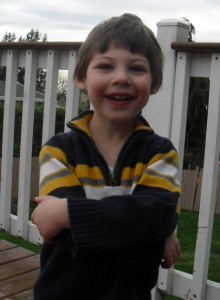
Two years ago I had the wonderful opportunity to meet Luke and his mommy, Melissa. They joined my class and Melissa shared Luke’s story with me. He is an amazing little boy. I know, I know, I know….you all think that I say that about all the terrific children I have in my class, which IS true, because I cherish each and every one of them!
But Luke’s story is just a little different. He is a special needs child, but I have to tell you that when you spend time with Luke, you are the one who feels special. Luke has been in class with his mommy for two years and this fall, I suggested to Melissa that we move him up to the next level. This is now a class that he stays by himself with me and his classmates for about 40 minutes and then Mom comes back and does a sharing time.
The first day he started his new Kindermusik class, he ran in and was so excited to see me and his classmates after our summer break. Most of the children in this class have been with Luke on his 2 year Kindermusik journey. The parents of all the children have built a community and treasure the relationship that Luke has formed with their children as much I do!
Luke is not able to communicate verbally, but he understands everything! Being in an
Imagine That class now gives him the opportunity to express himself in different ways. Imagine That is a child directed class, meaning that I have songs and a lesson plan, but we arrive at those musical destinations by getting the children to interact with the “story”.
Last week, we were pretending to go the park, and I asked the children how they would like to get there. We had some great ideas about running, jumping, flying like dragons….then I asked Luke how he would like to move. He started spinning, and so we all spun our way to the park!
Singing “Hello” to Build Language Skills
Our friends at Kindermusik by Sound Steps in Dallas, TX tweeted this adorable video of a super cute Kindermusik toddler singing “Hello!” This video is a great example of how babies and toddlers build language skills through music. Plus, listening and practicing the cues in the song (waving, bouncing, etc) also begins the early building blocks for self-control. So, sing Hello with us and don’t forget to reinforce the learning with the take home activities provided for each Kindermusik music class!
[youtube=http://www.youtube.com/watch?v=eWQtTkVlLSU&feature=youtu.be&w=480&h=360]
A Happy New Year’s Minds on Music Quote
“May your coming year be filled with magic and dreams and good madness. I hope you read some fine books and kiss someone who thinks you’re wonderful, and don’t forget to make some art — write or draw or build or sing or live as only you can. And I hope, somewhere in the next year, you
surprise yourself.” -Neil Gaiman
Happy 2012 from your friends at Kindermusik!
FOL Fridays: Experiential Learning
Moving with a prop provides an excellent opportunity for multi-sensory learning. Gliding a hoop through the room to music, for example, engages the senses of touch, hearing, and sight. Moreover, children can visualize the
rhythm and melody and physically apply what they are hearing when they move their props. Props are a fun way to experience music and movement concepts!
Resources for parents: Make your own props by recycling simple things around the house. An oatmeal container can become a drum. A paper towel tube can become a conductor’s baton or a fairy princesses’ scepter. Empty boxes can become a jack-in-the-box toy to hide in and jump out of. A shoe box can become a stringed instrument by cutting a whole in the top and stretching some rubber bands across it. Sturdy paper plates can be filled with dried pasta and securely fastened together to make a tambourine shaker. What excites your child’s imagination and gets them moving around?
– Contributed by Theresa Case, whose Greenville, SC program, Kindermusik at Piano Central Studios, is proudly among the top 1% of Kindermusik programs worldwide.
So-long 2011, Hello 2012
The below blog post comes from our friends at Kindermusik by Sound Steps in Dallas, TX. The Kindermusik community wishes you and yours a Happy & Musical New Year!
It seems so cliche, and I hate to be a cliche, but there’s no getting around the facts that the
end of something demands reflection and the beginning of something offers hope. For this post’s purposes, I’m talking about “so-long 2011″ and “hello 2012.”
I don’t doubt that you have a list of happy things and sad things that you have experienced this past year. There have been years in the past that I couldn’t wait to kick down the road and other years that had so many beautiful experiences, that I thought would never compare to any year to come. But usually, it has been a combination. Being the prevailing optimist that I am, I can usually see the reason or the resulting growth for the painful times and can eagerly embrace the blessings for what they are.
Now, let me wave my “Being a Mom is Complicated, etc!” banner and encourage anyone out there who has moments of confusion, identity crisis, questions of worth, longing for an old life or a more exciting life. I really don’t think there’s enough talk about these years with little ones and how intense it can be with no end in sight. How vulnerable or insecure you can feel, comparing yourself to other moms and so on. I can hardly put it into words what it feels like to love the job of being a mom and loving those precious babies so much and yet having moments of feeling like wondering who you are separate from those babies and that role and trying to remember what you like to do without feelings of guilt or selfishness.
I’m sure you have your own version and I’m sure, like my version, it’s more complex than 3-4 sentences and it is tied to experiences about your own mom, your hopes for being the best mom you can be and p.s., all of the other roles you have in you life as a human. And guess what? There’s not really a pause button on life where you can take your time and analyze it, strategize it and then press play and put it into action. But, I will say that it’s a worthy quest with no wrong answers and no dumb questions. Continue reading “So-long 2011, Hello 2012”
Minds on Music Quote
FOL Fridays: Rituals and Routines
From infancy on, children count on rituals and routines for comfort and security. Routines comfort children and serve as cues for what is expected of them, giving them a sense of control over their environment. When a child knows what will happen next and what is expected of him, he will be better able to participate and to act independently, which is an important developmental step.
Tips for parents: Around the holidays, it’s easy for the schedule to be disrupted. When you are able to keep as much of a consistent routine as possible for your child, you’ll find the holidays to be much happier and enjoyable for all! Another help is to keep some favorite and/or familiar music playing in the car and at home. The holidays are also a good time to establish special rituals which, over time as they are repeated year after year, will add greatly to the joy and anticipation of the season.
– Contributed by Theresa Case, whose Greenville, SC program, Kindermusik at Piano Central Studios, is proudly among the top 1% of Kindermusik programs worldwide.
A Parent’s Introduction to the Glockenspiel
At about the age of five, many children are ready for first experiences with a melodic instrument. Eye-hand coordination is improving, melodic memory is stronger, and the child has a keen interest in re-creating the melodies he or she sings and hears. Because of its size and delightful sound quality, the glockenspiel is an ideal first melodic instrument for young children and will be used throughout all four semesters of the program. However, the child’s success with this instrument is very much dependent upon careful preparation, a highly sequential approach to its use, and encouraging reinforcement at home.

In Semester 1 of the Young Child curriculum, long before the glockenspiels go home with the children, there are many experiences that nurture a level of beat competency and basic melodic memory that help to ensure success for each child at the glockenspiel. Of utmost importance in this process is the notion that children play from musical memory rather than by simultaneous reading and playing. This is not to say that children do not learn to read musical notation. On the contrary, children learn to read notation vocally and to commit to memory what they have read and heard many times. From this musical memory, the child approaches the glockenspiel with patterns so familiar that full concentration can be placed on the actual manipulation of the instrument.
Of course, learning to read and play simultaneously is a skill all musicians need to develop.

However, very few children at this stage of development are ready for this highly integrated skill. This skill will develop naturally in most children as the processes of sensory integration are refined, but this rarely happens before the age of seven or eight.
The preparation for glockenspiel playing takes place over the first thirteen weeks of Semester 1. Steady beat activities, simple ensembles, and a repertoire of songs provide the foundation for successful first experiences in Lesson 13. From Lesson 13 until the end of the second semester, glockenspiels will be used in each lesson.
Things to consider when working with the glockenspiel: Continue reading “A Parent’s Introduction to the Glockenspiel”