

4 best practices for teaching young English Language Learners

Teaching Young English Language LearnersEarly language development begins long before children say recognizable words. Linguist Patricia Kuhl notes that a six-to-eight month old baby can discriminate any sound in any language. In early language development, children naturally learn phonetically by interacting with other people. In contrast, learning another language in later years, such as in high school or at university, often includes many hours of learning through grammar, syntax, and conjugating verbs. Je suis. Tu es. Il est.
As our world becomes increasingly global, more and more parents and education professionals see the benefits of beginning foreign language education at younger ages. In fact, the French Education Minister suggested in 2011 that children begin learning English in nursery school when they are three years old.
When we developed ABC English & Me, we merged our decades of early childhood music education experience with the latest research on teaching young children another language.

Research-based best practices for young English Language Learners

  1. The “Natural Approach.” In this teaching practice, the important underlying principle is an emphasis on language “acquisition” as opposed to language “processing.” The Natural Approach encourages children to speak and think in the second or foreign language. This takes precedence over analytical processing of formal language structure and syntax.
  2. Total Physical Response. A young learner responds to language learning through body movements, which helps comprehension and fluency.
  3. English language stories. When stories are read expressively to young English Language Learners, the association of foreign words nourishes both language development and listening skills in the new language. The foreign sounds of spoken and sung English, through repetition, become recognizable at first and subsequently comprehended.
  4. Early childhood music. Finger plays, traditional nursery rhymes and songs reinforce phonemic awareness and the systematic relationship of letters of the alphabet and the sounds connected to each letter. Plus, musical instruction and experience help the brain improve its ability to distinguish between rapidly changing sounds, referred to as auditory processing. This auditory processing is critical to developing phonemic awareness, a necessary aspect of foreign language acquisition. Children who hear English words, even without grasping their meaning, will develop an ear for the language, especially if it is heard musically.

ABC English & Me - Teaching English to Children through MusicRead more about the positive impact of music and movement on young children’s acquisition of English, the research behind it, and how our ESL curriculum puts it into practice.

Test

Test

FOL Fridays: The Benefit of a Routine

happy child at music classRegular schedules provide a framework that orders a young child’s world. While predictability can be tedious for adults, children thrive on sameness and repetition. “Knowing what to expect from relationships and activities helps children become more confident,” says Dr. Peter Gorski, assistant professor of pediatrics at Harvard Medical School (Asher).

Tips for parents: The days never seem

to go exactly as planned with young children, but it’s helpful for both of you to have a general schedule for the day. Naps and moods will improve tremendously, and you’re likely to have fewer outbursts to deal with. Of course, one predictable weekly activity that we highly recommend is… Kindermusik!

– Contributed by Theresa Case, whose Greenville, SC program, Kindermusik at Piano Central Studios, is proudly among the top 1% of Kindermusik programs worldwide.

How Music Classes Prepare Your Child for School

Early childhood education is important, and Kindermusik International believes that you – the parent – are your child’s first and best teacher.  But what to do with your child until he is 7 years old?  We’d like to recommend Kindermusik classes!

9 ways Music Classes prepare your child for school

teaching children in Kindermusik - mom and sonMusic classes in the early years that include parental involvement and focus on learning in a fun, developmentally appropriate way inspire a lifelong love for learning.
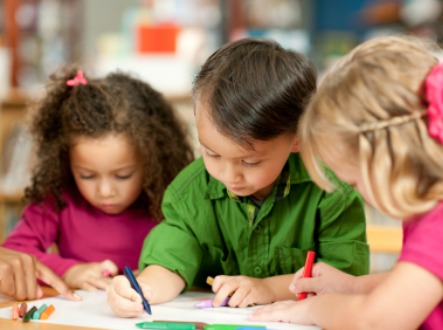
Practice with steady beat, enjoying movement activities, and playing instruments help develop coordination and motor skills necessary for cutting with scissors, holding a pencil, or kicking a ball, for example.
Music classes that are teaching children rhymes and then later, the basics of beginning to read music pave the way to literacy.
Music classes give your child a place to practice those all-important social skills, like cooperatively play, sharing, and following directions.
The best music classes will encourage your child to think creatively, developing critical thinking skills and the ability to problem-solve.
In an environment where process, not performance, is stressed, music classes build self-confidence and a willingness to try new things.
Music classes that gradually increase a child’s independence at the class help the child more successfully transition to the school classroom.
In these classes, children have the opportunity to bond and interact with their teacher, learning to listen and respond to someone other than the special adults who surround them at home.
Science and research have proven time and time again that music positively impacts a child in all areas of development – social/emotional, language, cognitive, physical, and language/literacy.

Kindermusik Classes - Enroll Now - For a Child's Brain, Body, Heart & SoulFrom music skills to life skills, it’s all there in Kindermusik, where music and learning play!  Find a class near you and try a free Kindermusik class on us today.

 
Written by Theresa Case, whose Kindermusik program at Piano Central Studios in Greenville, SC, is proudly among the top 1% of Kindermusik programs worldwide.

5 essential skills taught in early childhood education

Source: She Knows Activity Center

In early childhood education, we understand that teaching children involves celebrating the uniqueness of each child and preparing them for academic success beyond the preschool classroom. As creators of a standards-aligned daycare and preschool curriculum, we also know just how important these early years can be to a child’s lifelong learning abilities. Early childhood education may look like fun and games (and it is!) but the skills learned through these “fun and games” as part of a daycare or preschool curriculum can help a child make a smoother transition to Kindergarten.

5 skills taught in early childhood education that prepare a child for Kindergarten

  1. Early literacy skills, including knowing all the letters in the alphabet by sight and sound, vocabulary acquisition, phonological awareness, and print awareness, help prepare a toddler and preschooler for the more rigorous reading instruction in elementary school.

  2. An elementary school classroom usually includes more students and involves more time sitting at a desk when compared to a preschool classroom. Children with strong inhibitory control abilities can sit quietly, stay focused on the task at hand, think before they act, and behave in other appropriate ways.

  3. In Kindergarten, a child’s fine motor skills get a workout with writing letters and words, drawing shapes, using scissors, and even typing on a computer.

  4. Social and emotional skills help a child make friends, share, participate in classroom discussions, and like inhibitory control, can help a child experience fewer classroom behavior challenges.

  5. Children may spend up to 75 percent of classroom time learning through listening. While hearing is one of the five senses, learning how to actively listen takes practice and can also be a foundational skill for literacy and language development.

Preschool curriculum uses music to teach key skills

When used as part of a daycare curriculum, research shows music can engage young ABC Music & Me - Early Literacy and Language Curriculumlearners and teach them these key skills needed for continuing academic success. For example, a new study shows that children participating in ABC Music & Me, our daycare curriculum, 30 minutes each week experience a 32 percent literacy gain when compared to other children.

Schools, preschools, and childcare centers can learn more about using our daycare curriculum, ABC Music & Me, by emailing us at info@abcmusicandme.com

Research Proves Just 30 Minutes/Week of ABC Music & Me Delivers 32% Literacy Gain!

Improving Student Language & Literacy Skills:

A Study of the Effectiveness of ABC Music & Me

Overview

To evaluate the effectiveness of Kindermusik’s ABC Music & Me curriculum, an independent research firm, SEG Measurement, conducted a national, multi-site study* following 299 preschool children during the 2012-13 school year. ABC Music & Me is a supplemental early childhood curriculum that uses music and movement to engage young children while teaching a variety of skills critical to later school success. Extensive at-home materials, provided to parents monthly with each new curriculum unit, inform families of their children’s classroom experiences and provide the means for continuing classroom learning at home.

Research Proves 32% Literacy GainThe findings indicate that students in classes using the ABC Music & Me program made significantly greater gains in language and literacy skills as compared to students in classes that did not use any of the ABC Music & Me program components.

Study Design

The study examined the effectiveness of the ABC Music & Me program by comparing the growth in language and literacy skills among preschool students receiving the ABC Music & Me curriculum to a comparable group of preschoolers who did not receive the ABC Music & Me program.
The study incorporated a pre- and post-test treatment- and control-group design. All participating students took the Phonological Awareness Literacy Screening (PALS) Pre-K Assessment** at both the beginning and end of the school year. Students in the treatment group received ABC Music & Me instruction and activities as part of their preschool curriculum during the school year. Students in the control group did not receive any ABC Music & Me instruction or activities.
Students in the control and treatment groups attended the same or comparable schools, and statistical analyses were conducted to ensure that the groups were comparable. Analysis of Covariance was used to compare treatment and control-group performance on the post-test while controlling for any initial differences in ability.
Teacher and parent feedback regarding ABC Music & Me was also collected through biweekly teacher surveys on curriculum usage, an end-of-year teacher survey, a classroom environment survey, and two parent surveys investigating families’ use of the ABC Music & Me Home Materials.

Results

The results of the study show that students who received ABC Music & Me instruction showed significantly larger gains on the PALS test than did students who did not receive ABC Music & Me instruction. In fact, ABC Music & Me students showed 32% more improvement on the PALS test than did control group students. These results indicate that the ABC Music & Me program successfully boosts preschoolers’ language and literacy skills.
Graph: Research Proves PreK Student Literacy GainsResults from teacher surveys indicate that preschool teachers found the ABC Music & Me curriculum to be effective in teaching a variety of skills, and would strongly recommend it to other preschool teachers, and that parents would recommend the program to other parents.

Conclusions

Students who participated in ABC Music & Me showed significantly greater gains in language and literacy skills than students who did not receive ABC Music & Me instruction.
Teachers who used ABC Music & Me found the program to be effective in many areas. Both teachers and parents would strongly recommend the program to others.
*This study was conducted by SEG Measurement, supported by a grant from Kindermusik International. SEG is an independent research firm, providing research services to educational publishers, technology providers, and government agencies, since 1979.
**About PALS: The PALS-(Phonological Awareness Literacy Screening (PALS) Pre-K Assessment is a scientifically-based phonological awareness and literacy screening that measures preschoolers’ developing knowledge of important literacy fundamentals and offers guidance to teachers for tailoring instruction to children’s specific needs. The assessment reflects skills that are predictive of future reading success and measures name writing ability, upper-case and lower-case alphabet recognition, letter sound and beginning sound production, print and word awareness, rhyme awareness and nursery rhyme awareness.
View a Summary of the Report
View the Full Report

10 Benefits of Becoming a Licensed Kindermusik Educator

Theresa Case licensed Kindermusik educatorWhy teach Kindermusik? There are many benefits of becoming a licensed Kindermusik educator, but here are the top ten favorites.
1.  Convenient online training and the connections you make with other educators-in-training
2.  The community of passionate, caring Kindermusik educators from all around the world who regularly connect and share virtually via the Kindermusik Cafe
3. The Kindermusik curricula which has been carefully researched and created by Kindermusik International, the world’s most trusted name in musical learning
4.  Access to one-of-a-kind digital Teacher Guides where you’ll find an incredible amount of resources, helps, support, and ideas with every lesson plan
5.  Opportunities for ongoing professional development that keep you motivated, inspired, and growing as a teacher
6.  Having a company like Kindermusik International partnering with you
7.  The tools, support, and empowerment to do something you LOVE
8.  The precious children and their families whose lives you will touch
9.  The satisfaction of making a difference in a child’s life, possibly from newborn to 7 years
10.  The smiles, the joy, and the hugs that you’ll get each and every week in class

Learn more about teaching Kindermusik TODAY!

Written by Theresa Case, who has had the privilege of being a licensed Kindermusik educator since 1994 and whose Kindermusik program at Piano Central Studios in Greenville, SC, is proudly among the top 1% of Kindermusik programs worldwide.

Using Kindermusik@Home to Make Parenting a Little Bit Easier

One of the fabulous benefits of your enrollment in Kindermusik is Kindermusik@Home – a whole new way to access and enjoy your Home Materials throughout the week.  But how can Kindermusik@Home make parenting a little bit easier?  Well, you might turn to Kindermusik@Home when you…

  • need a lullaby to calm your baby to sleep
  • are looking for a special way to connect with your child and sneak in a few giggles or cuddles
  • are desperate for a diversion in the long line at the grocery store or the waiting room at the doctor’s office
  • can’t remember the words to your child’s favorite song from class
  • can’t get out on a rainy day and an educational activity for kids like a video field trip or kid-friendly recipe might be just the thing
  • want to help your child get even more out of his or her weekly Kindermusik class
  • have a few minutes to really engage with your child and need some inspiration to make that time meaningful and fun
  • have a child begging you to read his favorite story from Kindermusik class and you’re not anywhere near the bookshelf at home (Gotta love these mobile apps for kids!)
  • want to play a developmentally appropriate, kid-friendly game together
  • are ready to download all of the great music from your Kindermusik class
  • need expert advice and a window of insight into the precious miracle that is your child
  • are looking for an easy way to begin expanding your child’s awareness and understanding of the world around her
  • need some great music and activity ideas to soothe or clam, play together, chase away the blues, or share some giggles
  • need all of this with you wherever you are – at home or on the go

Kindermusik@Home… It’s all in there!

Kindermusik@HomeAnd here’s your sneak peek:
Take a TOUR on your PC, your Mac, or your Tablet or Mobile Device
Try a FREE Kindermusik@Home Activity, “Stroll around Town

Written by Theresa Case, whose Kindermusik program at Piano Central Studios in Greenville, SC, is proudly among the top 1% of Kindermusik programs worldwide.

3 ways to turn Garbage Day into recycling activities for kids

Garbage day causes lots of excitement in homes with small children. Preschoolers and toddlers can often be found with faces pressed to windows or jumping up and down in delight as they watch those big trucks noisily shift from house to house. And, oh happy day, if the driver actually blows the horn!
When parents think about activities for kids at home, most probably don’t think of “Trash Day” as one filled with educational activities for kids. However, it can be, especially if parents think about the environment! Try these three ways to learn about sustainability for kids.

3 ways to turn Garbage Day into learning about the environment for kids

1. Go on a virtual field trip—courtesy of NPR— to see what happens to glass bottles after they leave your at-home recycle bin.


2. Read “How a New Bottle Becomes a Used Bottle” and ask your child questions about what you read together. Make connections between what you read to the video you watched. Identify glass recyclables in your own home.

3. Play with magnets. In recycling centers, metal objects are separated from glass objects using powerful magnets. Gather various child-friendly objects from around your house and use magnets together to sort the objects into two piles.

Recycling activities for kids can be fun for the whole family. Plus, it helps your child to understand how we all impact the world around us.