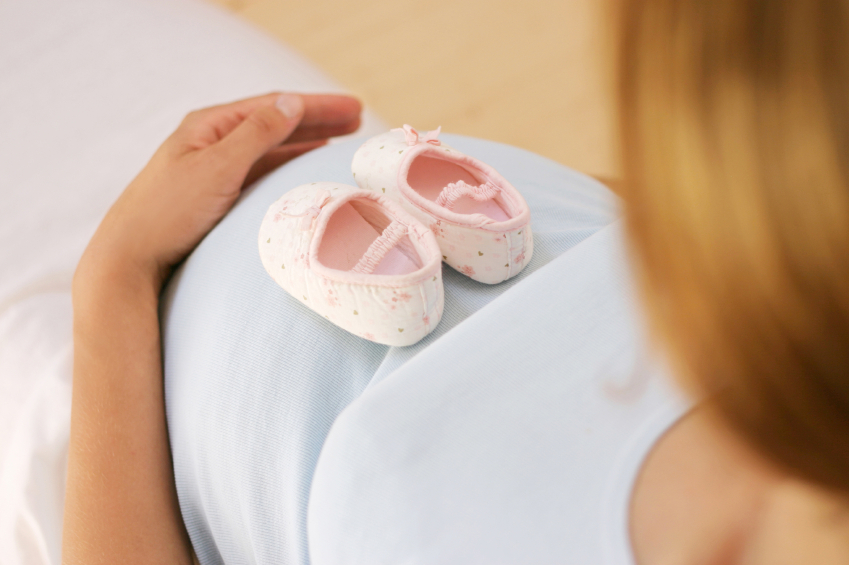


Expectant parents plan for – and worry about! – a lot of things. Your unborn baby’s musical development may not be on the check list just yet, but don’t worry – you and your baby are more prepared than you might think.
Your baby is already musical! After all, he/she has been listening to the steady beat of your heartbeat and listening to your voice – which happens to be the most beautiful sound in the world to your little one’s ears!
Your baby is able to see, hear, feel, and learn even before birth. Music is a powerful stimuli, and as such, can help enhance physical, emotional, sensory, and mental development. According to Dr. Sarah Brewer, “…[m]usically stimulated babies seem to develop more quickly, talking up to six months earlier, and have improved intellectual development.”
Your baby is already developing musical preferences. Studies have shown that the music a baby hears frequently while in the womb will be some of his favorite music to listen to when he’s born… until he’s around two years of age, that is. After that, he’ll let you know what his new opinions are about music!
Your baby benefits from a variety of music. You don’t have to limit your pregnancy play list to only Mozart or quiet lullabies. “Diversity of different kinds of music are essential and can be useful for the baby’s future writing, reading, and language skills,” says Dr. Philip A. De Fina, chief neuropsychologist and director of neurotherapies at the NYU Brain Research Laboratories.
As with all good things, the key with music stimulation is moderation. If you’re getting tired of listening to certain music, chances are your baby is too! To find some great music recordings and musical inspiration, look no further than your nearest Kindermusik educator. One of the hallmarks of Kindermusik is our musical variety in class and at home through your @Home Materials. Your local Kindermusik educator would be delighted to have you come visit a class, even before your baby is born. And then your Kindermusik enrollment is one more thing you can check off the list before your new arrival turns your life happy-crazy upside-down.
And so, when things settle down a bit, we’ll look forward to having you and your newborn in Kindermusik. The brain grows and develops at an astounding rate in the early years, and there’s no better window of opportunity for exposing your baby to the rich developmental benefits of music. Plus you’ll love the opportunity to gain precious insights into this new little miracle as you spend special time together in class, make new friends, find a support network, and savor these precious, fleeting moments of babyhood. Parents agree… there’s no better bonding experience than Kindermusik. We’ll look forward to seeing you in class soon!
4 Benefits of Music for Big Kids
Growing up, but not all grown up yet – thankfully! The early years of childhood pass so quickly, and before you know it, your child has officially earned “big kid” status. The turbulence of the toddler years and the exuberance of the preschool years are past, and your big kid can mostly be described as composed, calm, cheerful, and capable. Big kids are eager, curious learners, and they love to share their ideas.
For a big kid, self-esteem, feeling capable, and doing things the “right way” all go hand-in-hand. They thrive on structure and affirmation, but they still need time to play and have fun. Big kids love being part of a group, and they crave friendship and acceptance from their peers, preferring to play and interact with others than to be by themselves. And while their thinking can be black-and-white, cognitively, they have made huge leaps in their ability to problem-solve and think more abstractly. Big kids tend to ask alot of “why” and “how” questions because they love to know a lot of facts. They love simple games, and having lots of time for creative play is very important. Movements are much more poised and controlled, and big kids loving showing off their new-found physical skills.
It is truly the age of opportunity for these learners-in-waiting. But it also a time not to be rushed through or passed over. The big kids years are a special time to settle in and enjoy the last phase of early childhood and to provide your child with experiences and opportunities that will set him up for success in school, in music, and in life.
That’s where Kindermusik comes in, providing a weekly class that satisfies the need to be part of a group, to learn new things, to play games, and to express oneself through music and movement. And in the middle of all of the fun and music-making, a very strong foundation is being laid for a successful transition to music lessons a little later on.
Here are four invaluable benefits of music for big kids:
1. Music exposes big kids to big, new ideas.
At this age, these eager learners are ready to be introduced to rhythms and rhythm patterns, music symbols, keyboards and dulcimers, and writing and composing their own music through hands-on and developmentally appropriate experiences. They can follow the story line of a work like “Peter and the Wolf” and identify the various motifs and instruments that are the hallmark of this beloved musical tale.
2. Music teaches big kids to be good listeners.
Focused listening and discriminatory listening are a big part of music. Listening for certain things in music or to certain music sounds as well as being able to distinguish between musical sounds and instruments develop listening skills. And while being a good listener is a musical skill, it’s also an extremely valuable life skill.
3. Music helps make the cognitive connections needed for nearly every kind of intelligence.
We all want our kids to be smart and to be successful, and music is the one common contributing factor in almost all of the nine types of intelligence. According to articles like this one and this one, it’s early experiences with music that best spark the brain connections and neural networks that actually shape the brain and impact how it will function later in life.
4. Music is one thing that stays in a child’s heart for forever.
There are lots of choices for early childhood – dance, sports, gymnastics, and more! But music is the one love, the one ability, that a child has the potential to carry with them all the way through their entire lives. Developing in your child a love and appreciation for music at an early age is a life-long gift you can give, and it’s something that will also carry with it special memories of the loved ones who made that gift possible.
For parents…
You want to give your child every advantage, and there’s truly no greater advantage you can give than music, especially in a program like Kindermusik. It’s the right activity at the right time, when your child is poised and ready to soak it all in and be enable to apply that knowledge to music lessons and musical experiences in the future. Kindermusik truly is the perfect foundation for lifelong learning.
And yet as profoundly as Kindermusik affects your child’s musical development, the musical learning is fun, pressure-free, and exactly what your child needs at a time when they can benefit from it the most.
“Music develops the appetite for learning and creates habits of self-discipline and personal tenacity which carry over into every facet of school. Young musicians are skilled at concentration, alertness, memory, and self-control. These attributes are basic for success in higher education, but more importantly, in succeeding at life.”
—The Joy of Inspired Teaching, by Tim Lautzenheiser, p. 55

Expose your child to the benefits of Kindermusik, the world’s leader in early childhood music and movement curricula. Try a Kindermusik class today!
7 reasons for children under 7 to learn a second language
Je suis. Tu es. Il est. Nous sommes. If you studied a second language in high school or college, you probably know all about conjugating verbs. As teenagers or adults, learning the grammar rules of another language often form the foundation for second-language learning. However, teaching a second language to children looks completely different. After all, children under the age of 7 can’t read or write. However, young children are uniquely suited to learn another language. Here’s why:
7 reasons for children under 7 to learn another language
- Learning a second language under the age of 7 is cognitively as easy as learning a first language. Young children learn languages by listening to the sounds, structures, and intonation patterns around them. So young ELL students learn English the same way they learn their first language.
- Young English language learners learn to speak like a native speaker, without an accent.

- Teaching English as a second language positively impacts the cognitive development in children. According to research, children who learn a second language experience better critical-thinking skills, enhanced spatial relations, and increased creativity when compared to their monolingual peers.
- Acquiring second-language fluency prepares children to live and work in a global society.
- Young English language learners experience a boost in the language and literacy abilities of their first language, including vocabulary development. Added bonus: this advantage continues to broaden as children grow older.
- Children who learn a second language exhibit enhanced attention skills when compared to monolingual peers.
- Learning a second language at an early age increases children’s confidence and teaches them to love learning.
ESL curriculum uses English songs for kids (and more!)
Our ESL curriculum builds on our more than 35 years of teaching young children. Through English songs for kids, story time, movement activities, and puppets, young ELL students learn English in a fun and engaging environment using research-proven methods. Plus, enrollment includes access to Kindermusik@Home where parents can support the English language learning at home where a child can continue to naturally acquire language skills.
Try this sample Kindermusik@Home activity. The Just Me! music video incorporates a multi-sensory teaching approach to support visual, auditory, and tactile learning.
Learn more about Kindermusik’s English Language Learning curriculum, ABC English & Me.
Contributed by Lisa Camino Rowell, a freelance writer in the Atlanta area.
4 Benefits of Music for Preschoolers
Imaginative. Adventurous. Exuberant. Brash. Social. Silly. Musical. Preschoolers are the living definition of all of these words… and more! It’s what we love most about this delightful age. Their energy, curiosity, and delight in living life out loud are fostered by an increasing sense of independence and self-confidence. They are developing their individuality and want to be noticed and acknowledged. Preschoolers are social butterflies, and their social skills are blossoming, as are their growing abilities to cooperate, problem-solve, share, and make friends.
Play is the preschooler’s work. In fact, there is no better way for these eager and curious thinkers to learn, grow, and develop than through play – play alone and play with others – including mom and dad! The expansiveness of the preschooler’s personality overflows into his vocabulary and self-expression. Preschoolers love playing with words, and they like to talk. A lot. And if you’ve heard it once, you’ve answered it a thousand times – this is the age of “why.” It’s how they learn and interact. Their movements become more expansive too, and the need to move is because of their boundless amounts of energy. (And you thought you were tired chasing them as toddlers!)
But perhaps the best way to sum up the preschooler season of childhood is with the word “readiness.” Preschoolers are on the verge of so much potential. They are ready – ready to try new things, take turns, be challenged, and work cooperatively with others. Simply put, they’re ready to get ready!
With music as the vehicle, Kindermusik helps your child be ready. Ready to face life head on, ready for school, ready for new adventures, and ready for that next step in music. Movement, imagination, play, creativity, exploration, interacting, and ensemble all set the stage for making sure your child has every advantage in a very critical season of childhood – that wonderful transition from baby to big kid that we call “preschooler”!
Here are four of the most powerful benefits of music for preschoolers:
1. Music encourages children to move.
Movement and music are as closely connected as movement and learning. At a time when there are increasing concerns about how long these young children are being required to sit still, being able to move to music is a gift. Here’s how a Washington Post reporter summed it up in her recent article, “In order for children to learn, they need to be able to pay attention. In order to pay attention, we need to let them move.”
2. Music fosters a sense of community and belonging.
At the core of every human being is a desire to belong. When that need to belong is fulfilled, it contributes to healthy emotional development and well-being. Self-confidence grows as a child learns to function within a group. And there’s no happier group experience than making music together!
3. Music provides an outlet for self-expression.
With gifts, experiences, thoughts, and ideas that simply overflow, a music class offers a secure environment for each individual child to explore, learn, and contribute. The value is in the experience itself with play, discovery, singing, story telling, and new challenges as the tools that open the door for self-expression, meaningful learning, and a lifelong love for music.
4. Music readiness and academic readiness go hand-in-hand.
The same skills and experiences necessary for a child to be ready for music lessons when they are older are the same skills and experiences that enhance and even accelerate academic readiness and success. Listening, identifying patterns, problem-solving, creative thinking, and self-confidence are skills that music develops – skills that are also a measurable contributors to academic achievement.
For parents…
You want to give your child every advantage. And yet, you don’t want to let him or her grow up too fast. Childhood is meant to be savored and enjoyed, a time that you share experiences and create memories that stay in the heart for years to come.
Kindermusik helps you linger in those precious moments of childhood and make the most of the preschool season with your child. With a class structure that includes time apart and time together, Kindermusik is perfect for the preschool season of childhood. You’ll love watching your child blossom, and you’ll love the way your time together in class and your music-making at home brings you together in new and special ways.
And the icing on the cake is knowing that you’re giving your child a gift that truly lasts a lifetime – the gift of a musical foundation and love for music that uniquely prepares your child like no other single activity can.
Experience the benefits of Kindermusik for yourself. Contact a local Kindermusik educator and visit a free class today!
6 Reasons Music Belongs in Head Start Programs
Something amazing happens in Head Start programs when music comes out to play. Children (and teachers!) smile and laugh, work together, and safely express thoughts and feelings through movement and music. And that’s just the beginning…
Continue reading “6 Reasons Music Belongs in Head Start Programs”
4 Benefits of Music for Toddlers
Toddlers are well, busy. They love to go, move, do, and say “No!” They also desperately crave predictability and routine. Parents are challenged by near polar opposite behavior – one minute all is well; the next, there’s a meltdown. A toddler will cling to mom as if he’ll never let go, and the next moment adamantly assert the independence of a teenager. At the same time, toddlers are becoming very social, interested in other people and moving from parallel play where they play alongside other children to cooperative play where they start to play with the other children.
If all of these changes weren’t enough, brain development is literally exploding. In fact, the only two times in a child’s life when there is such significant brain activity is when he/she is a toddler and a teenager. Vocabulary and communication skills are blossoming, as the toddler goes from about 10 words in his vocabulary to upwards of 300 or so words by age 3. Motor skills are also developing at a rapid rate – suddenly the child who was barely toddling along is now running, jumping, and galloping everywhere. Whew! No wonder moms and dads of toddlers are extra busy – and exhausted! – during this particular season of childhood.
With so much happening inside your toddler’s busy little mind and body, Kindermusik is one activity that beautifully supports and enhances this crucial season in your child’s life.
Though we could probably name a hundred, here are four benefits of music for toddlers:
1. A music class like Kindermusik provides an environment that is both stimulating and nurturing for toddlers.
With so much growth and development happening, toddlers need both the challenge of new things to learn and do as well as the comfort of loving adults and activities that nurture the soul.
2. Early experiences with music and movement give your toddler an early learning advantage.
The connection between music and academic achievement is undeniable, as highlighted in this recent article. There’s no better time to be enrolled in music classes than the toddler years when brain growth and development is at its peak, especially with the powerful combination that music and movement gives.
3. Music, specifically singing songs and speaking rhymes and chants, improves language development.
At a time when language development is most crucial, there’s nothing more beneficial to speech, syntax, and pre-literacy than singing simple songs and reciting chants. It will start with a few words here and there and then eventually grow into a small repertoire of favorite songs and rhymes that your toddler can sing or say all the way through.
4. Early childhood music classes put a song in a child’s heart to stay.
Toddlers love music, and giving them an early start with music plants the seeds that bloom into a lifelong love for and appreciation of music. Music is one gift you can give your toddler that will have a lifetime of meaning, memories, impact, and joy. No other activity has the potential to influence your child like music does.
For parents…
The entire Kindermusik experience, from class to home (and back again!), provides a vital support network for parents of busy toddlers. Not only does Kindermusik foster and strengthen the parent-child relationship, but Kindermusik classes are also a social outlet for parents as well, a place to share both the joys and challenges of parenting a toddler.
And since Kindermusik is all about helping make great parenting a little easier and even more musical, parents benefit tremendously from all of the helpful tips, ideas, and resources (including your Kindermusik Home Materials) that will help you navigate and enjoy the toddler years to their fullest.
Best of all, parents enjoy a unique kind of bonding and together time with your toddler that only music can give. With Kindermusik, you’ll be able to savor and linger in those precious, fleeting moments of toddlerhood with more cuddles, hugs, dances, lullabies, giggles, and sweet memories.
Experience the benefits of Kindermusik for yourself. Contact a local Kindermusik educator and visit a free class today!
5 ways Kindermusik helps preschoolers reach early learning benchmarks
Preschool teachers notice the signs long before the children do. Boxes of sharpened and unused crayons. Full canisters of tempura paints. New bags of sand for the sensory table. The smell of the freshly laminated name tags. Yes, all signs point to a new school year starting soon!
At the beginning of each school year, preschool teachers gather more than new supplies for the classroom. They also gather key information about the children by identifying and describing each child’s development in various domains. This benchmarking helps educators support the growth of each child to his or her fullest potential throughout the year.
Our early childhood curriculum uses music and movement to support the development and learning across and within domains. We use music to reach children of all abilities and in a classroom of children exhibiting a range of skills and competences.
Whether used in a preschool, Head Start or Early Head Start program, public school, or other early learning setting, Kindermusik’s early childhood curriculum delivers proven results. In fact, children participating for just 30 minutes a week experience a 32 percent more literacy gain than other children. Here are just some of the ways we use music, movement, and stories to help children reach standard benchmarks.
5 ways our early childhood curriculum helps children reach benchmarks
- Our Storytime gives preschool teachers ways to ask and answer questions about key details such as the plot or the characters. We know that children benefit from hearing the story multiple times, so it’s repeated weekly in each unit for preschoolers to become familiar with plot, characters, settings, and main events.
- Our Hosted Teaching CDs provide brief introductions with key information about a story’s topic and setting. In the second half of each unit, lessons pose a range of recall, inferential, compare/contrast, and beyond-the-text questions. At the end of storytime, the lessons give preschoolers opportunities to ask or answer questions about the story that can help deepen their understanding of the story or subject.
Our songs and poems use rhyme to improve phonological awareness. Research shows that lyrics can help young children improve their comprehension and build their vocabulary and listening skills. Plus, the engaging nature of music helps motivate young children to learn. And, of course, building vocabulary, comprehension, and listening skills are all part of the preschool standards.- Our songs, poems, rhymes, and rituals inspire children to acquire vocabulary incidentally by reading and listening to stories. The texts’ illustrations and activities give children tools to learn new vocabulary through both seeing and doing. To ensure comprehension, teachers often pause the Hosted Teaching CD and ask questions to assess learning as well as answer student questions.
- Each unit also includes explicit vocabulary instruction. Words essential to songs and poems appear on picture cards and are introduced through direct instruction or by modeling during group discussions. Research supports the use of direct vocabulary instruction, including the effectiveness of having young children learn robust, academic words.
To learn more about using our early childhood curriculum, ABC Music & Me, email us at abcinfo@kindermusik.com.
Babies: Dancing their way to friendship
Before social media, making friends and maintaining relationships involved more than clicking yes to a “Friend Request” or commenting on a status update. (Well, technically it still does.) To be a good friend, regardless of age, we need to share, use our “kind and polite words,” take turns, show empathy, listen, practice conflict resolution—essentially put into practice all those skills that make a good friend.
Dancing with babies form social bonds
Learning how to be a good friend takes practice and guidance. The first seven years of a child’s life present unique and lasting moments for laying the groundwork for healthy social development. Each week in our music classes, we provide many opportunities for children as young as newborns to practice cooperation, turn taking, active listening, paying attention, and other key social development skills that help children grow to be a socially confident and adept people.
Of course, we also dance, bounce to a steady beat, and move around in response to music a lot. Now new research indicates that all of that moving around together with young children positively affects their social behavior.
“Moving in sync with others is an important part of musical activities,” explains Laura Cirelli, lead author of an upcoming article in the journal Developmental Science. “These effects show that movement is a fundamental part of music that affects social behavior from a very young age.”
In the study, the team worked with 68 babies to determine if bouncing to music with another person makes a baby more likely to help the other person following the musical activity. Dancing in pairs, one adult held a baby facing outward toward another adult. Both adults and the baby gently bounced to the music. Some of the babies bounced at the same tempo as the adult across from them while others bounced at a different tempo. Afterwards, the babies who bounced to music at the same tempo as both adults were more likely to pick up an object “accidently” dropped by the other adult when compared to the babies moving at a different tempo.
The research implies that when we sing, clap, bounce or dance to a steady beat to music with babies, these shared experiences of synchronous movement help form social bonds between us and our babies. Or, to put it simple: Babies can literally dance their way to friendship!
Find a local Kindermusik educator and experience for yourself how our music classes for babies, toddlers, preschools, big kids, and families teaches vital life skills, including learning how to be a friend.
In the meantime, enjoy this free music and movement activity from Kindermusik@Home. It will get you and your little one dancing in various ways together—supporting social skills and parent-child bonding.
Contributed by Lisa Camino Rowell, a freelance writer living in the Atlanta, Georgia area.
Music & Movement Benefits: Language Development
Lifting. Squatting. Twirling. Bending. Whew! Sometimes Kindermusik class feels more like a workout than, well, a workout. Okay, maybe not P90x, but still! While a parent works out muscles each week, young children build early language skills through music and movement activities.
2 benefits of music and movement on language development
- Pairing the word with the movement helps babies and young children understand the concept. Pre-readers rely
almost exclusively on what they hear in order to acquire language. Children’s brains make a connection based on what they experience (being lifted high or twirling around) and hear (“up” or “twirl”). So, when a parent of caregiver lifts a child high “up, up in the sky” or “twirls around like a leaf” while singing the songs in Kindermusik class, young children learn the word and understand the concept. Later, children will discover those words correspond to marks on a page which eventually leads to letter recognition and reading. - Signing with hearing children boosts their communication skills. We use sign language throughout our music classes for babies. Using signs for words such as HELLO, GOODBYE, MORE, and STOP throughout class—and then later at home—supports communication and language development and even improves confidence and self-esteem. Plus, new research shows encouraging babies and toddlers to use gestures, such as sign language, helps in speech and cognitive development.
Parenting Tip: Play that fun-key music! Listen and move to music that combines key vocabulary with a movement or activity. Try favorite Kindermusik songs from class. Also use sign language for key words throughout the day. For example, sign MORE to ask if your child wants MORE fruit or HELLO when your little one wakes up from a nap.
Come experience for yourself the benefits of music! Contact a local Kindermusik educator and visit a class.
Contributed by Lisa Camino Rowell, a freelance writer living in the Atlanta area.
3,600+ ways to build a healthy parent-child bond in a baby's first year
3,600. That’s the approximate number of times a baby needs a diaper change in the first year alone. (Yowser! That’s a lot of diapers.) Of course, every diaper change satisfies the physical needs of a baby, but it also meets a baby’s developing social and emotional needs. Every time a baby cries and a parent responds to the need, it strengthens the vital parent-child connection. Building an attachment and a sense of trust not only lays a solid foundation of social and emotional development but also primes a baby’s brain for learning.
Strong healthy parent-child bonds as infants help children make friends
Researchers from the University of Illinois recently published a study in the journal of Developmental Psychology that showed young children with strong parent-child bonds tend to be more responsive and adaptable when meeting—and playing with—other children. They also tend to be more sympathetic to the needs and moods of other children.
In the study, the team measured the security of child-mother bonds for 114 children who were 33 months old. As part of the study, the parents reported on their child’s temperament, such as propensity towards anger or social fearfulness. Then when the children reached 39 months old, the researchers paired same-gender children and observed them playing together over three laboratory visits in the course of a month.
“Securely attached kids were more responsive to a new peer partner the first time they met,” explained Dr. Nancy McElwain in a press release. “A more securely attached child was also likely to use suggestions and requests rather than commands and intrusive behavior (such as grabbing toys away) during play with an anger-prone peer during the first two visits.”
The researchers believe that toddlers and preschoolers who develop strong bonds with their parents learn early on that their needs matter and confidently express themselves.
Kindermusik supports strong parent-child bonds from birth
Building healthy parent-child bonds starts in infancy. In our music classes
for babies (for all ages actually!), we create many moments to strengthen and celebrate this vital parent-child connection. Every time a parent sings lovingly to a wee one, the bond grows stronger. With each intentional and gentle touch, rock, or lap bounce, the bond grows stronger. And every time a caregiver gazes into a child’s eyes and smiles during tummy time, the bond grows stronger. As babies grow, this sense of security—and trust—gives little ones the confidence to explore new environments, try new things, and make new friends.
Enjoy this free activity from Kindermusik@Home that supports parent-child bonds.
Contact your local Kindermusik educator to experience for yourself how music creates healthy parent-child bonds.
Contributed by Lisa Camino Rowell, a freelance writer living in the Atlanta area.