


Toddlers can be gloriously happy one minute and extremely upset the next. Their little brains are undergoing so much growth in those early years, and they don’t yet have the vocabulary, context, or life experience to identify and process all of those emotions.
Helping toddlers understand and articulate their feelings can ease the chaos, but how?
Researchers at Michigan State University found that a simple strategy, called “emotion bridging,” can do just that, with the end result of fewer behavioral problems.
Emotion bridging is a straightforward, three-step process:
- Labeling the emotion: sad, happy, upset, mad, etc.
- Putting it into context: feeling this because of that
- Making a relevant connection: “Remember when you felt [emotion] because of [situation/experience]?”
One way to help the learning stick? The connective, transformative power of shared musical experiences.
Shared music-making is the ultimate emotion bridging support.
We know that even babies pay attention to music twice as long as speech. Why? Because our nervous systems begin to balance and our focus increases.
The joy of music also plays a big role in a toddler’s willingness to “discuss” emotions and come back to the topic again and again.
Three easy musical emotion bridging tools:
1. Pair lyrics with expression.
- Sing a simple song like “If You’re Happy and You Know It” and pair “happy” with a smile.
- Change the lyrics to “If you’re surprised and you know it…” and pair “surprised” with your best surprised face.
2. Identify feelings of a song’s character.
- Sing “Where Has My Little Dog Gone.” As you’re singing, “Oh where, oh where could he be,” make sure you’re using your expressive sad face.
- Then, talk together about the narrator. “They are sad because they lost their dog.”
3. Make a personal connection.
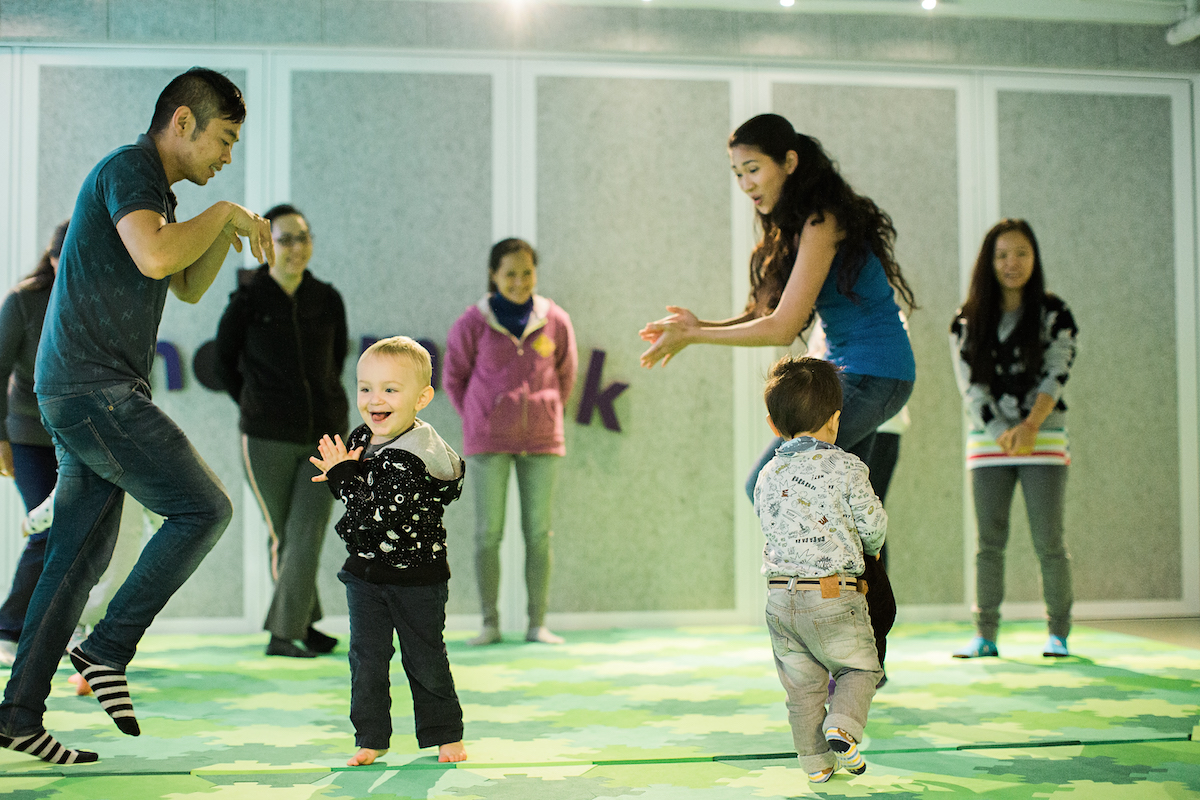
- Dance together to any song you like, and every time you repeat this activity change the pace—fast song, slow song.
- After you dance, ask your toddler(s) how it made them feel. If they’re non-verbal, describe how you felt dancing with words and expressions.
- Connect the feeling to a time they felt that same emotion. “That song made you feel jumpy? Remember when you felt jumpy because you were so excited about [fill in the blank]?”
Musical emotion bridging is not a one-and-done.
While the process is simple, these activities—like any other learning tool—should be practiced over time as all brains are prewired for repetition. With each short musical interaction, toddlers develop increased depth of experience for understanding, a wider vocabulary for expression, and the connection they need to wade through big feelings now and as they grow.
For more musical emotion bridging tools, find a Kindermusik class or check out our teaching solutions for all types of learning spaces.
This article was originally authored by Theresa Case who leads an award-winning Kindermusik program at Piano Central Studios in Greenville, South Carolina.
Great information here. I’ve also found that exploring commonly experienced emotions (sad, mad, happy, tired) at times when they aren’t being experienced is a helpful way to teach children, specifically toddlers, how to express themselves. When you have a toddler express how he or she feels when experiencing sadness through movement and sound, it teaches them to isolate that feeling. This later helps them make the distinction that experiences of anger or sadness are temporary.