
FOL Fridays: Routines and Rituals

While routines provide continuity, comfort and security for children, rituals provide children with the opportunity to build connections with others.  In a sense, rituals are routines with “extra sparkle.” Families often have rituals associated with holidays and birthdays.  According to Becky Bailey, author of I Love You Rituals, “loving, healthy rituals foster the development of loving, emotionally healthy children.”  From infancy on, children count on rituals and routines for comfort and security.  Routines comfort children and serve as cues for what is expected of them, giving children a sense of control over their environment.  When a child knows what will happen next and what is expected of him, he will be better able to participate and to act independently, which is an important developmental step (Poole 1998). 

IDEA: Plan for simple, fun ways to add the sparkle to your everyday routines that will turn them into special rituals.  A “wake up” poem in the morning, a posted schedule for the day, a special placemat at lunch, letting everyone tell about one favorite part of their day around the supper table, a family dance, and a lullaby sung before bedtime at night – any of these are the kinds of little things that can add joy and predictability to your child’s day.

– Compiled by Theresa Case, M.Ed.  Theresa’s Kindermusik program at Piano Central Studios in Greenville, SC, is proudly among the top 1% of Kindermusik programs worldwide.

Peter’s Story

He was in our Village class for such a short time….I’ll call him Peter.   Just a few weeks to enjoy the waning days of Rhythm of Our Day and a little Busy Days, but in that short time we saw a flower open.

I remember his first visit to our class.  Peter brought Mommy, Daddy, and Auntie with him and all were intently focused on Peter; his every move mattered.  Any indication of pleasure or displeasure a one year old could convey was noted and evaluated.   There were tears as he clung to Mommy, not knowing what to make of the wiggling bunch of bouncers and shakers surrounding him.   “Peter doesn’t usually hear English spoken in his home.”   But there were many hands to console….six to be exact!  “I think we’d like to join this class…at least for a little while.   They are only here for a short time,” said Auntie.

Only Mommy & Daddy came along next week to shore up little Peter.   Fewer tears, but still well sheltered by slightly anxious parents, Peter’s fearful gaze seldom came my way.   Mommy and Daddy quietly tapped his tiny hand keeping the steady beat he was not ready to feel.

Week 4:  Peter brought only Mommy this week.    Timid hands reached outside the cozy confines of Mommy’s legs to pick up a bright red shaker.    Mommy and Peter stayed around after class to enjoy the chatter of their cohorts.

Today:  Peter sat happily in his white plastic carriage…which looked remarkably like a Target laundry basket.   Even a ride to the “Doctors office” wasn’t so bad if all your friends were going, too!   The sudden stops for red lights created a palpable tension in the circle and even Peter’s gaze turned towards me in anticipation.  Snug in his green towel, he peered out at those around him as if he had been doing this forever….well, for at least 3 weeks.   Time to dance!   I stood opposite Peter and Mommy.   We swayed happily to Mama Paquita, do-si-doed a sly peek-a-boo, and as we met in the middle to say “hello”, Peter giggled and gave me the biggest smile ever!

It’s a friendly and chatty class who linger long, but Mommy and Peter were the last to leave today.   Mommy quietly and shyly said, “This is our last class, Miss Colleen.   We will be moving far away next week.   I just want you to know Peter is much different child now.   He loves class.   He loves you.   Thank you for my child happy now.”

~ Special thanks to Miss Colleen at Studio 3 Music for such a beautiful post, shared with permission from the Studio 3 Music blog

FOL Fridays: Relaxation

Children learn many skills from adults, such as tying their shoes or reading a book.  They must also learn how to relax, self-calm, channel feelings, and focus.  With continued practice, persistence, and a little creativity, children learn not only how to relax, but also how to use this skill effectively every day, even in chaotic environments (Cox and Orlick 1996).  Relaxing together with a little soothing, gentle music in the background will go a long way towards helping your child find his own calm amid the busy chaos that can be our lives.

TIP:  Establish a Relaxation Ritual in your home, perhaps first-thing in the morning or just before bedtime.  Turn on some quiet music and just relax with your child – holding them if they’re small enough or just cuddling up beside each other if they’re too big for your lap.  Model being still and not talking, just breathing deeply and quietly enjoying one another’s company.  You might also want to sing a simple lullaby to your child at the end.  This will likely become a very treasured and much-anticipated time for you and your child(ren).

– Compiled by Theresa Case, M.Ed.  Theresa’s Kindermusik program at Piano Central Studios in Greenville, SC, is proudly among the top 1% of Kindermusik programs worldwide.

6 Ways for you and your child to live it up — for free!

The best things in life are free. Check out these wonderful ways for your child to live it up without spending a penny.

Free Music
Of course, we think the best thing you can do with your child is Kindermusik! Go to play.kindermusik.com to register and receive three, free music downloads.  There are just so many incredible developmental benefits to exposing your children to music early in life. You can also preview our children’s music classes at no cost, while connecting with other parents and spending quality time with your tyke.

Check the Local Library
Libraries are one of the best no-cost places to take your kids. They’re stocked full of books, music, and DVDs for your learning little one.

Kids Eat Free
Many restaurants nationwide have specific days of the week where kids eat free. Websites like kidseat4free.com will find the restaurants in your area that offer free dining for kids.

Your Local Museum for Free Kids Day
Most museums offer free days for kids. Mark the free local museum deal days in your calendar early on so you remember when the days roll around. You’ll be learning together in no time.

Fishing Classes
Teach your little ones about the fun and excitement of the great outdoors while doing some kid-friendly angling. Many fishing retailers offer free fishing classes for kids. For example, Orvis offers free fly-fishing classes May through July.

Free Bowling for Kids
Strike up some learning fun at a participating alley near you—for FREE. Keep score the old-fashioned way—by hand—to practice counting and simple math. Go to kidsbowlfree.com to get rollin’.

FOL Fridays: Imagination and Pretend Play

“Learning to imagine [is the] first step in stretching the human potential.” (Karen Miller, Ages and Stages, p. 65)  The ability to pretend and imagine usually starts at around 18 months.  From there, the developmental progression of pretend play generally moves from using one object to represent something else, to dressing up and/or pretending to be something else, to role-playing and interacting while in that role.  Kindermusik classes help provide the kinds of experiences that provide the opportunity for imagination to blossom, but you will probably notice that your child engages most readily – and sometimes most humorously! – at home where your child is the most comfortable.

IDEA: Simple toys like blocks and stuffed animals, dress-up clothes from the thrift store, and even empty containers or cardboard tubes can inspire hours of pretend play.  Organize these items into containers that are easily accessible to your child.

– Compiled by Theresa Case, M.Ed., whose Kindermusik program at Piano Central Studios in Greenville, South Carolina, is proudly among the top 1% of Kindermusik programs worldwide.

The teacher makes the difference

When you have a Google alert set for “Kindermusik,” you end up with a whole variety of posts on the subject.  One recent alert contained some comments from a mom who made the insightful observation that the TEACHER makes all the difference in the quality of your Kindermusik experience.  She couldn’t be more right.  Here’s a little of what she had to say:

“I recently enrolled my 18mth old in an Our Time class.  She LOVED it.  I loved that the teacher wasn’t busy corralling kids, everyone was left to enjoy and experience the class however they wanted/needed to.  The teacher was energetic and informative on WHY activities were chosen and made transitions from one activity to the next very smooth.  I would recommend the class to anyone IF the teacher has good reviews.”

As a whole, Kindermusik educators are a group of loving, nurturing, musically inclined individuals who have two things in common – a love for children and a passion for making a difference in the lives of children and their families through music.  Personally, I am very blessed to have a wonderful staff of eight Kindermusik teachers teaching with me here at Piano Central Studios.  You know what?  We’re all different.  We have different personalities and different teaching styles even though we follow the same lesson plans.  The beauty of it all is that parents and children have different personalities and learning styles too!

Just like the Kindermusik teachers on my staff, not all Kindermusik programs are the same.  Often it is “love at first sight.” Sometimes it’s just a matter of allowing time to adjust to a new environment and a new experience.  But sometimes it’s necessary to try out another teacher or another program offering Kindermusik.  As independent educators and programs, we all bring different goals, gifts, abilities, and experience to the table.  Don’t be afraid to seek out the Kindermusik program – and the Kindermusik educator – that’s just right for you!  That’s one of the reasons why KI’s Class Finder is set up like it is – to help parents find a class that’s conveniently located with scheduling and educators that meet their needs.  I think this mom said it best, “I’d try again with another instructor before writing it off completely.  [Our teacher] Ms Amy really loves her job and it shows in how she teaches the class.”

To read this mommy’s comments in their entirety, click HERE.  To try a FREE Preview Class, click HERE.

Shared by Theresa Case, M.Ed., whose Kindermusik program at Piano Central Studios in Upstate South Carolina is proudly among the top 1% of Kindermusik programs worldwide.

FOL Fridays: Movement and Body Control

During movement activities, children learn to organize the available space in relation to themselves and in relationship to objects and other individuals… this is how they develop body control, spatial awareness, and confidence in the power and ability of their own bodies.  (Linda Carol Edwards, The Creative Arts)

TIP:  Turn on some dancing music and dance around the room together.  Add a prop like a scarf, a ball, or a hoop for more movement and body control fun and learning.

– compiled by Theresa Case, M.Ed., whose Kindermusik program at Piano Central Studios in Greenville, South Carolina, is proudly among the top 1% of Kindermusik programs worldwide

FOL Fridays: Repetition

Again, again!!  Children learn through repetition.  Each time a child is exposed to a new object or experience, new neural connections are made in his brain.  Through repetition, these connections are strengthened and learning occurs.  Every Kindermusik curriculum is designed to repeat certain activities – in part because of this important connection between repetition and learning, but also because repetition of activities helps to create the Kindermusik class community.  Ritual and repetition at home are important components of a predictable and nurturing home life as well. 

TIP:  So go ahead, sing that song or read that book again.  For the hundredth time.  Take satisfaction in knowing that you’re doing your child’s brain a world of good!

– Compiled by Theresa Case, M.Ed., whose Kindermusik program at Piano Central Studios in Greenville, South Carolina, is proudly among the top 1% of Kindermusik programs worldwide.

Discover your learning styles!

Authored by Donna Detweiler and shared with permission from the Studio 3 Music blog.  Based in the Seattle, WA area, Studio 3 Music is the world’s largest Kindermusik program.

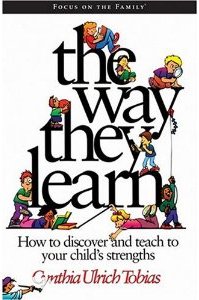
Insight from: The Way They Learn, by Cynthia Tobias

Cynthia Tobias has been writing about kids, learning styles and education for a long time. Her books are incredibly practical.

Decoding My Husband’s Bent

In her book titled, The Way They Learn, “They” can refer to us, or our spouses, or our children, anyone really! So, I found this book to provide helpful and interesting insight into myself, my spouse, my children and other significant relationships in my life. The last time I read it, I retained the most information about my “bent,” my preference for taking in information and processing it. This time, I found myself immersed in the chapters that decoded my husband’s bent.  Even after 14 years of marriage, I don’t always understand his motivations or behaviors.  Cynthia writes:

What seldom occurs to us is that other people, perhaps even those in our own family, may view the world in an entirely different way than we do…and have dramatically dissimilar approaches to life. You begin to realize that people are fundamentally different.

After discovering all sorts of insights into his life, not only did I feel I understood him better, but I trust him more!  Let’s be honest, it’s the areas of our greatest differences—those pesky “opposites attract” areas that create the most strife. Often, we simply don’t understand our spouses, or our children’s attitudes or actions.

When Our Children Are Different Than Us

The more children you have, the more potential you have to see this in action.  Cynthia draws lots of insights from her life experience—she and her husband are raising identical twins, which are identical only to the casual observer! As a parent, being a little less clueless about why our kids do what they do—primarily when it’s different that our “doing”– can be tremendously helpful for us and them.

In my next couple of blogs, here’s what I hope to help you learn from Cynthia’s book.

*What are the two main ways that you, your spouse and your children take in information? Are you a concrete or abstract perceiver?

*What are the two main methods people use to order the perceived information? Do you order information sequentially or in random chunks?

*How does this information help you to have the most beneficial relationship with others, as a parent or spouse or friend?

Discovering your learning style and your loved ones’ learning styles is exciting because it’s empowering. I don’t know about you, but I’m always ready to add some tools to my relational and parenting tool box. Talk to you again soon!

FOL Fridays: Emotions and Learning

Emotions have a tremendous impact on learning.  Simple family activities like rocking together help develop a child’s sense of security and worth, allowing him to grow into an assured, confident learner with healthy self-esteem.

IDEA: Need some music to set the mood?  KI’s music site, play.kindermusik.com, has some great lullabies that make for perfect rocking music.

 – Compiled by Theresa Case, M.Ed.  Theresa’s Kindermusik program at Piano Central Studios in Greenville, South Carolina, is proudly among the top 1% of Kindermusik programs worldwide.