
9 reasons why teachers love our early literacy curriculum

Early Literacy Curriculum with Research-Proven Results

Music and early literacy development go together like peanut butter and jelly, cheese and crackers, or to quote the final song from Grease, “Rama lama lama ka dinga da dinga dong.” When used as part of an early childhood curriculum, music can increase phonemic and phonological awareness, boost vocabulary acquisition and print awareness, and more.

Early Literacy Curriculum with Research-Proven Results

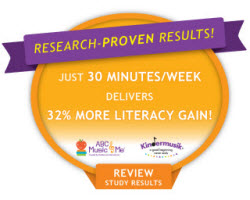
Our early literacy curriculum, ABC Music & Me, uses music and movement to teach young children early language and literacy. A new independent research study proves using this early childhood curriculum just 30 minutes a week delivers a 32 percent literacy gain. SEG Measurement, an independent research firm, conducted the comprehensive study of the effectiveness of ABC Music & Me during the 2012-2013 school year using

both quantitative and qualitative methods. The study shows that children participating in ABC Music & Me experienced significantly greater gains in language and literacy skills as compared to students in classes not participating in this early literacy curriculum.

Teacher perceptions on the effectiveness of early childhood curriculum on student skills

Early childhood educators love teaching ABC Music & Me. In fact, both teachers and parents would strongly recommend the early literacy curriculum to others. As part of the study, teachers identified nine specific areas they perceived to be especially effective on their students’ abilities:

  1. Listening
  2. Vocabulary development
  3. Phonemic and phonological awareness
  4. Pattern recognition
  5. Coordination
  6. Cooperation
  7. Engagement in classroom activities
  8. Attitudes toward learning
  9. Following directions

One participating preschool teacher noted: “The most effective aspects of ABC Music & Me are that the children all participate and have fun doing the different activities each week. The lesson plan is easy to follow. The assessment forms from Fall to Spring show growth in many areas….Overall, I feel that ABC Music & Me has now become a daily part of my lesson plan. I look forward to using the program next year!”

To learn more about bringing our early literacy curriculum—and a 32 percent literacy gain—into your classroom, email us at info@abcmusicandme.com.

6 websites and mobile apps for kids that support early literacy development

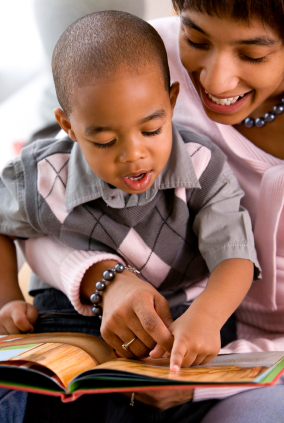
iStock_000002617208XSmall mom-boy readingTalking to babies, toddlers, and preschoolers throughout the day, reading together, and playing learning games for kids all help support early literacy and language development. When babies react to their mothers’ voices, they are responding to the familiar cadence of the language. While sitting in a parent’s lap listening to a story before bedtime, toddlers begin to see and recognize letters and sounds and the proper way to read a book. As preschoolers practice writing letters—and

even their names—they foster phonetic awareness. Throughout this process, children look to their parents as their first and best teacher!

As creators of early childhood curricula, including an early literacy curriculum, ABC Music & Me, we know just how important family involvement in education can be to a young child’s early literacy skills and language development. So, we pulled together six of our favorite websites and mobile apps for kids that support early literacy development and a parent’s role as a child’s first and best teacher. Enjoy!

6 websites and mobile apps for kids that support early literacy development

  1. Reading Rainbow: We love Reading Rainbow! LeVar Burton started RRKidz when the beloved show was canceled so he could continue to bring reading and education to kids using the newest and best technology. This mobile app for kids offers a trusted library of books and video field trips to visit fascinating people and places. New books and videos are added every week expanding the collection. Kindermusik will be partnering with Reading Rainbow to bring a “Musical Island” to the app!
  2. WeGiveBooks: We Give Books supports parent involvement in education and early literacy skills by providing online books for families to read together. Using any device with Internet access, parents can read books to children at home or on the go. The available children’s books include selections of fiction and non-fiction for children through 10 years old.
  3. PBSKids Island: Together, you and your child can visit PBSKids Island and play learning games for kids that feature PBS favorites, such as Sesame Street, Martha Speaks, and Super WHY! While not an early literacy curriculum, these educational activities for kids support early literacy development through letter recognition, rhyming, and even spelling challenges.
  4. Backyard Phonics Adventure: This mobile app for kids uses letters and pictures to teach letter recognition and beginning phonics. Children match a beginning sound to a letter or a beginning sound to another picture with the same beginning sound.
  5. Starfall.com: Many preschools and elementary schools use Starfall.com as a supplement to an early childhood or early literacy curriculum. This free website includes learning games for kids that teach letter recognition and the corresponding sounds, phonics, and more.
  6. Kindermusik@Home: Available as part of enrollment in Kindermusik, Kindermusik@Home supports a parent’s role as a child’s first and best teacher while also providing fun learning games for kids. Accessible Kindermusik@Homefrom any smart phone, iPad, tablet, or laptop, Kindermusik@Home provides educational activities for kids that support early literacy development, such as eBooks, active listening games, virtual field trips, plus an abundance of ideas and developmental insights behind using music and movement to support a child’s early literacy development. The activities connect what happens in the classroom to the everyday routines and rituals of families.

To learn more about enrolling in a Kindermusik class and receiving access to Kindermusik@Home, contact a local educator via our Class Locator.

Schools, preschools, and childcare centers can also benefit from Kindermusik@Home. To learn more about bringing our early literacy curriculum into your classroom while also increasing parental involvement, email us at info@abcmusicandme.com.


Login and Win this September!

MyKindermusik_logoAs your child’s first and foremost teacher, we think it is so important that you extend the learning benefits of Kindermusik into your every day. Your Kindermusik educator has provided you with a my.kindermusik.com account to access your child’s favorite songs, stories, and learning activities from class.
This month, log into my.kindermusik.com to visit Kindermusik@Home and be entered for a chance to win a $50 Kindermusik prize package! If you log into my.kindermusik.com in September, you will also be entered into our Grand Prize drawing at the end of December for a chance to win a brand new iPad for you and your educator!
If you have not already created an account, you will need to register.
At Kindermusik, we firmly believe that the best learning starts when class is over and you tap into the wealth of resources available that help make great parenting easier every day of the week! Ask your Kindermusik educator how to find exciting Kindermusik materials on my.kindermusik.com.

5 Reasons Why Music Classes are Good for Babies' Brains

BabyMusicClasses_KindermusikInternational_BannerEvery activity that your baby participates in contributes to his or her brain development, but the quality, variety, and nature of the activity shape the way neural circuits are designed.  Every experience stimulates certain neural circuits and leaves others idle.  Those that are consistently activated over time will be strengthened, while those that frequently left idle may be discarded.  (adapted from zerotothree.org)

That’s why…  The combination of a weekly Kindermusik class and utilizing the music and resources in your Kindermusik @Home Materials are so powerful.  Repetition strengthens the brain!

“…[O]ver time, the brain reacts to routine stimulus by lowering levels of stimulation.  Anything new causes the body to release adrenaline, and adrenaline acts a memory fixative.  According to Arnold Scheibel, Director of the Brain Research Institute as UCLA, ‘Unfamiliar activities are the brain’s best friend.’”  (from Smart Start!:  Building Brain Power in the Early Years, by Pam Schiller)

That’s why…  Kindermusik classes regularly include a mix of new and repeated activities.

Holding your little one in a variety of positions and moving him or her in different ways allows him/her to experience a variety of perspectives, which stimulates brain development.

That’s why… Your Kindermusik educator will give you lots of ideas for safe and enjoyable ways to move your baby, and your Kindermusik @Home Materials will give you a variety of music to move to at home.

Environments enriched with music and movement allow brain cells and neuropathways to be strengthened and expanded.  With more interconnections, the brain learns and remembers more effectively.

That’s why… Kindermusik, with the way it so effectively combines music and movement, is such a powerful way to stimulate learning and brain development.

Your baby must be emotionally involved in an activity to learn.  Incoming sensory stimulation is processed first through the brain’s non-rational, non-conscious limbic system, the seat of emotion, and only then goes to the neocortex, or rational brain.

That’s why… Your Kindermusik classes will give you lots of opportunities to connect and bond with your baby at deep and lasting emotional levels.

– Compiled and written by Theresa Case, who has an award-winning Kindermusik program at Piano Central Studios in Greenville, SC

How Music Supports Spatial Development

“Exceptional spatial ability at age 13 predicts creative and scholarly achievements more than 30 years later, according to results from a Vanderbilt University longitudinal study, published today in Psychological Science, a journal of the Association for Psychological Science.” (from Early spatial reasoning predicts later creativity and innovation, especially in STEM fields)

Where spatial ability begins…

Kindermusik girl with hoopSo where does spatial ability begin?  The development of spatial awareness actually begins in infancy as babies start to understand spatial relationships through concepts such as up/down, inside/outside, over, under, and all around.  Discovering their hands and feet is also part of the developmental process.
Next comes a greater sense of body awareness for toddlers as they gain an understanding of spatial orientation between self and other objects.  Preschoolers begin to understand the concept of landmarks and gaining a sense of direction.  The learning keeps building and expanding as big kids then also begin to develop a sense of personal space, control of their bodies, and a greater understanding of positional words and directions.

Why we listen, label, dance, and use props…

This is why all of the music listening, labeling, moving, direction following, and use of props that’s done in Kindermusik music classes is so powerful.  And now we have the research to support what we’ve known all along… that there is a connection between early experiences in music and movement and creative and scholarly achievements later on.  Music and learning definitely go hand-in-hand!

Support your early learners with musical play!

For families, find a class near you. Some virtual classes also available!

For teachers, check out our musical play kits.

– Contributed by Theresa Case, owner of an award-winning Kindermusik program at Piano Central Studios in Greenville, SC

5 cognitive benefits of a bilingual curriculum

(Source: Hispanicallyspeakingnews.com)

According to research, learning to speak English as a second language—or another foreign language—impacts the cognitive development in children. Of course, experiencing a bilingual curriculum can help prepare a child for a global workforce as adults. Plus, the younger a child learns a second language the more likely they are to speak like a native speaker.
In our ESL curriculum development for ABC English & Me, we combined our more than 35 years of experience with music and learning with the latest research on English Language Learning. Here are just a few of the benefits revealed in the research.

5 effects of a bilingual curriculum on child brain development

  1. Children who learn another language, including ELL students, score better on standardized tests, especially in math, reading, and vocabulary.
  2. Children who speak more than one language can easily switch between two or more systems of speech, writing, and structure.
  3. Bilingual and multilingual children exhibit stronger memories than monolinguals.
  4. Learning another language boosts the language capabilities of the first language.
  5. Bilingual children score higher on nonverbal problem-solving tests when compared to children who only speak one language.

ABC English & Me - Teaching English to Children through MusicRead more about the positive impact of music and movement on young ELL students, the research behind it, and how our ESL curriculum, which uses English songs for kids, puts it into practice.


New Vice President at Kindermusik lights a spark

Kelly Green, Vice President and General Manager, Schools Division

Spark. It’s what happens in the classroom. Those a-ha moments in early childhood education when children make a fresh discovery, master a new skill, or read words for the first time. That spark of early learning ignites a quest for more knowledge.

Teachers of daycare, preschool, or Head Start curriculum light a “spark” each day in the classroom. So, it’s no wonder Kelly Green chose “spark” as her one word to represent both the start of the new school year and her new role at Kindermusik International.
As Kindermusik’s new Vice President and General Manager of Business to Business and Business to Institution Sales in the US and Canada, Kelly brings  more than 19 years of experience in early childhood education. Prior to Kindermusik, Kelly worked at Hatch Early Childhood as the Vice President of Sales and Business Development.
“I am excited to bring my knowledge and passion for the field of early childhood education to Kindermusik,” explains Kelly. “The research clearly shows how music can be used as a powerful learning tool when used as part of a childcare, Head Start, or a Common Core curriculum. I look forward to sharing the power of the Kindermusik classroom experience with public schools and community-based organizations serving young children.”
Welcome to the Kindermusik International community, Kelly! We know you will help light many new sparks of early learning.

Follow Kelly on Twitter (@KinderKGreen) as she shares her passion for the power of early education.

Music and cognitive development in children

We love music—everything about it. Of course, we love how music and learning go together in Kindermusik classrooms and in homes around the world when parents support cognitive development in children through musical activities. We also love how that certain lullaby or silly nonsense song can calm both a child and a parent during one of those moments. Perhaps one of our favorite things we love about music is its ability to support healthy child brain development.

What our brains look like when we listen to music

(Source: Academy of Finland)

When we listen to and engage in musical activities, our brains light up. Now, new research gives us pictures of what our brains look like when we listen to music. Researchers from Finland, Denmark, and the United Kingdom, used brain imaging and computer modeling to see just want happens to our brains when we listen to music. Led by Dr. Vinoo Alluri, the research team recorded the brain responses of adult participants while they listened to a variety of music, including Vivaldi, Miles Davis, and The Beatles. During the process, they also tracked the musical components, such as timbre, rhythm, and tonality.
The team discovered that listening to music activates the auditory, motor, and limbic regions of the brain as well as the regions of the brain used for self-referential appraisal and aesthetic judgments. Interestingly, our brains respond differently between vocal and instrumental music. When listening to music with lyrics, the brain shifts the processing of musical features towards the right auditory cortex to better process the lyrics.
“The new method provides a powerful means to predict brain responses to music, speech, and soundscapes across a variety of contexts,” explained Dr. Vinoo Alluri in a press release.

Musical variety supports child brain development

Throughout the Kindermusik experience, we deliberately introduce children to a wide variety of musical genres to give them a greater understanding of what is possible through music. One month we may explore the precision of classical music. The next month you and your child may experience the value of improvisation and emotional expression while we play around with jazz. Together we may also move and play along with drumming songs from Africa and South America or dance around to music from New Zealand, China, or France.
Exposure to a variety of sounds and rhythms is critical to cognitive development in children. Varied exposure leads to language proficiency, spatial reasoning, and temporal reasoning. It also increases understanding of moods, emotions, and other cultures. Read more about the four surprising ways your child benefits from a variety of music.

Better yet, find a local educator and come experience it for yourself. Try a free class today!


Taking the Language Learning All the Way Home

Kindermusik International is truly international, and one of the company’s latest initiatives has been to develop a music and movement curriculum called ABC English & Me that provides early language learning (ELL) for English as a foreign language.
Moo Quack NeighAs with all Kindermusik curricula, there is a strong emphasis on the classroom-to-home learning connection, now made more convenient, more accessible, and more powerful through the online learning activities available with the Kindermusik @Home Materials each family receives with their enrollment.
The delightful activity “Moo, Quack, Neigh!” (from the Moo, Quack, Neigh! unit) is a perfect example of how the language learning comes home, reinforcing the fun and learning from class and supporting parent involvement in early childhood education at home.  “Moo, Quack, Neigh!” is just one of many activities for kids at home that makes learning a second language so much fun that the language learning comes easily and naturally.

Take a free peek at “Moo, Quack, Neigh!” for yourself and see if you don’t agree!

Learn more about the positive impact of music and movement activities on young children’s acquisition of English and how our ESL curriculum, ABC English & Me, puts it into practice.

5 ways Kindermusik prepares PARENTS for Kindergarten

From Kindermusik to Kindermusik

Of course, Kindermusik helps prepare young children for school success. (You can read just 9 of the ways our music classes for babies, toddlers, big kids, and families lay the groundwork for success in elementary school.) But, Kindermusik also prepares parents for Kindergarten. Here’s how:

5 ways Kindermusik prepares parents for Kindergarten, including parental involvement in early childhood education

  1. You get real-life experience with your child learning independently in a classroom setting. Kindermusik grows with your child. As your child progresses from infant to toddler to preschooler to big kid Kindermusik classes, your little one (and you!) slowly transition from being together in the classroom all of the time to the parents coming in at the end of class.
  2. You learn how to connect the classroom learning to your everyday lives. In class, Educators share the developmental benefits behind the activities so you learn both the "hows" and the "whys." Plus, Kindermusik@Home gives parents activities for kids, including the music and eBooks from class so the learning happens throughout the week. In later years, when your child comes home from Kindergarten with homework, your family already naturally integrates the learning in fun and engaging ways throughout the week.
  3. Parent involvement in early childhood education becomes second-nature. You are your child’s first and best teacher. As your child grows, more teachers will enter your child’s life, but you maintain the top spot. You will understand from personal experience the positive and unique impact of parental involvement in early childhood education.
  4. All of those animal noises and sounds you make in Kindermusik and at home with your child will make you a highly requested Mystery Reader in Kindergarten. It’s true. Dr. Seuss, Piggie & Gerald, and other favorite children’s books just sound better when the one reading the story can make the silly sounds! So, go ahead, practice your elephant trumpet!
  5. The social skills and confidence your child gains in Kindermusik will make the transition to Kindergarten easier for your little one—and for you. We can’t promise you won’t shed a tear or two, but your child will be more comfortable in a classroom setting, exhibit stronger inhibitory control abilities, and more easily make new friends.

Come see for yourself how Kindermusik prepares you and your child for Kindergarten. Try a free class today!