The ability to think critically about a situation is essential for all problem solving and academic learning. Deductive reasoning, the ability to reason from general premises to more specific premises, is one essential aspect of critical thinking.
In fact, renowned educational researcher, Dr. Howard Gardner, includes deductive reasoning within one of his seven areas of intelligence—the Logical/Mathematical Intelligence. Dr. Gardner (and other researchers) argue that the ability to detect patterns, think logically, and to reason is critical for developing text comprehension, mathematical, and science skills later in school.
What might be surprising to some is that very young children are at the very tip of their capacity for deductive reasoning, but like many areas of development, the most effective growth in learning comes through practice – in this case, brain practice.
The Critical Thinking Co., puts it this way, “Deductive reasoning can be taught, but it is its regular practice that yields the benefits to students. The brain acts like a muscle and exercising it through logic, analysis, and critical thinking is what gives it the strength to question, to learn, and to discover.”
So… if your young child is at the tip of their capacity for deductive reasoning and practicing those skills is so vitally important for learning and discovery, how can a parent tip the cognitive development scale in a child’s favor?
Use this free Kindermusik@Home activity: “Who Could It Be?” to practice some deductive reasoning skills with your child.
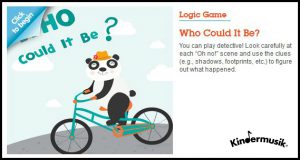
This activity may take some adult interaction and support—but then your child will be hooked! You’ll both delight in that first moment when your child figures out one of the answers on his/her own.
- One way to reinforce a child’s growing deductive reasoning skills is for you to articulate your own reasoning for coming to a conclusion and then to ask your child to do the same. For example, in “Who Could It Be?,” you can clearly explain that you figured out that the sheep took the bunnies in his car because there were tire marks leaving the Pet Shop and only the sheep was driving a car. Then ask your child, “HOW do you know it was the monkey who made a mess at the ice cream cart?”
- Predicting what comes next in a story is another way to develop deductive reasoning. For example, ask your child, “WHAT do you think will happen next? And WHY do you think that?”
It doesn’t take much to boost your child’s critical thinking skills, but it does take intentionality mixed with fun and engaging activities. This is why Kindermusik has been such a favorite experience for parents for so many years – our class activities and @Home Materials give parents the time and the tools to make great parenting – including giving your child every possible cognitive and academic advantage – that much easier and that much more joyful.
To learn more about music supports the development of deductive reasoning skills, visit www.Kindermusik.com.



 Want to learn more about how Kindermusik prepares a young child for success in formal music lessons? Come visit a Kindermusik class! Find your local Kindermusik educator at
 When thinking back to our own childhoods, holiday memories rarely bring to mind a specific gift we received. (Unless, you happen to be Ralphie and you can narrate a whole movie about that Christmas you received a Red Ryder!) For the rest of us, however, we tend to recall the time spent with loved ones.

 Deanna Hanson-Abromeit, assistant professor of music education and music therapy at the University of Kansas, is doing some significant work in learning how music helps premature infants not just survive, but thrive, according to
 This perfectly summarizes what happens in a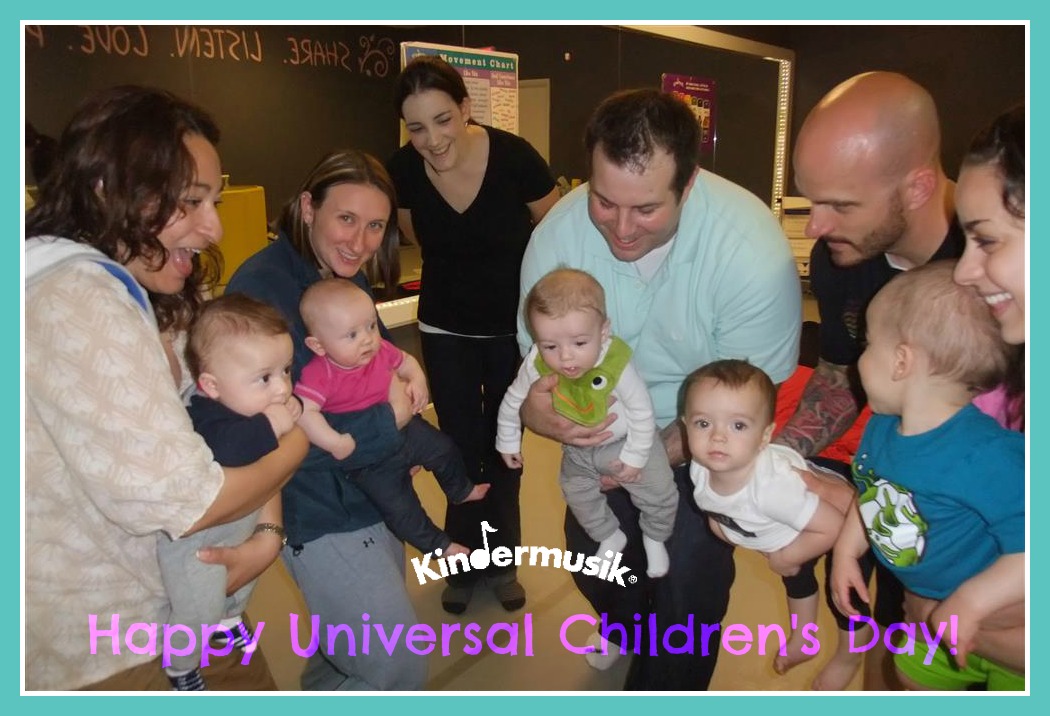


 Ever wonder what happens when a group of teachers gather together for Kindermusik training? Well, we sing, laugh, play instruments, dance with scarves on our heads, and learn through (and about!) music. In fact, it looks a lot like a Kindermusik class without little kids.
 “We would love to give more of these conferences to more schools around the country,” confesses Paula Bassi, International Director Latin America, Central America and Caribbean. “It is wonderful to create a community of Kindermusik schools in Costa Rica and around the world.”