
[vc_row][vc_column][vc_column_text]How many pictures of newborns have you seen in the moments after the little one arrived in the world? I’m talking about a specific category of photos – the beautiful shots of mothers holding their babies for the first time – that all important skin-to-skin contact. Medscape tells us this:
…newborns who are placed skin to skin with their mothers immediately after birth make the transition from fetal to newborn life with greater respiratory, temperature, and glucose stability and significantly less crying indicating decreased stress. Mothers who hold their newborns skin to skin after birth have increased maternal behaviors, show more confidence in caring for their babies and breastfeed for longer durations.
Makes good sense. But what about once your home? Can you spoil your baby by holding her too much? Wendy Wisner over at Scary Mommy brings us the results of some long term studies that indicate there really isn’t a downside to holding your baby too much. Let’s look at the science.
It’s clear from scientific studies that lots of skin to skin contact with the mother is very beneficial for preterm infants. This includes increased grey matter, decreased hyperactivity, and in the long term, fewer absences from school. The study published last December by the American Academy of Pediatrics followed a group of premature infants for twenty years. That’s long term. These subjects even made more money at their jobs than the control group!
But what about full term infants? Can we hold them too much? Is that spoiling them?
Holding that baby will help the little one in many ways – but it also has benefits for you! Check out this info from Baby Science:
So holding a baby close against your body doesn’t just feel good; it’s critical to a baby’s development. And this critical baby-cuddling isn’t just something a parent decides to do; it’s actually biologically triggered by the baby. One international research team showed that an infants’ smell is enough to trigger the brain’s reward system in potential cuddlers. Researchers exposed a group of fifteen mothers and fifteen women who had not given birth, to odor extracted from the pajamas of two-day old infants. All the women underwent MRI brain scans done while being exposed to the odor. In all the women, but more so in the mothers, the reward center in the brain showed enhanced activity.
At the doctor’s office? Did your baby just get a shot? Obviously our instinct is to hold that infant close to help sooth her. And it works – skin to skin contact is a painkiller! In a 2000 study also published in the AAP, 30 infants were pricked in their heels. The results were remarkable:
“Crying and grimacing were reduced by 82% and 65%, respectively, from control infant levels during the heel lance procedure. Heart rate also was reduced substantially by contact.”
The research is clear. The physical and emotional health benefits of holding your baby are tremendous. Study after study tell us that holding your baby when he is fussy or experiencing pain is a good thing. Period. Wendy Wisner says it better than I can:
…it turns out there is basically a treasure trove of scientifically backed-up data out there to prove that there is absolutely no way you can spoil a baby. Zero. Zilch.
In fact, almost all of the research points to the fact that not holding your baby enough could have negative ramifications in terms of health and development.
I almost wish I could go back in time and present all this data to the people who criticized me for keeping my babies in my arms or strapped to me in a baby carrier 24/7. But in all honesty, I’m pretty sure I was like most new moms out there — too exhausted and brain-fried to do much arguing or researching.
[vc_row][vc_column][vc_column_text]We don’t just think music instruction has a cognitive impact; we know it does. The science to prove it continues to pile up. And it’s pretty exciting stuff when you’re talking about things like MRI’s, EEG’s, and behavioral testing being part of the proof.
A recent study, begun by the Brain and Creativity Institute at USC back in 2012 has just revealed some impressive findings. The study actually showed that “…music instruction speeds up the maturation of the auditory pathway in the brain and increases its efficiency.” In other words, your brain works better if you’ve had musical instruction!
“Within two years of the study, the neuroscientists found the auditory systems of children in the music program were maturing faster in them than in the other children. The fine-tuning of their auditory pathway could accelerate their development of language and reading, as well as other abilities – a potential effect which the scientists are continuing to study.”
Kindermusik International has long recognized the connection between music instruction and brain development. You can’t teach a baby to play the piano or violin, but you can still give them rich and powerful early experiences with music that activate and actually change the brain through music and movement activities.
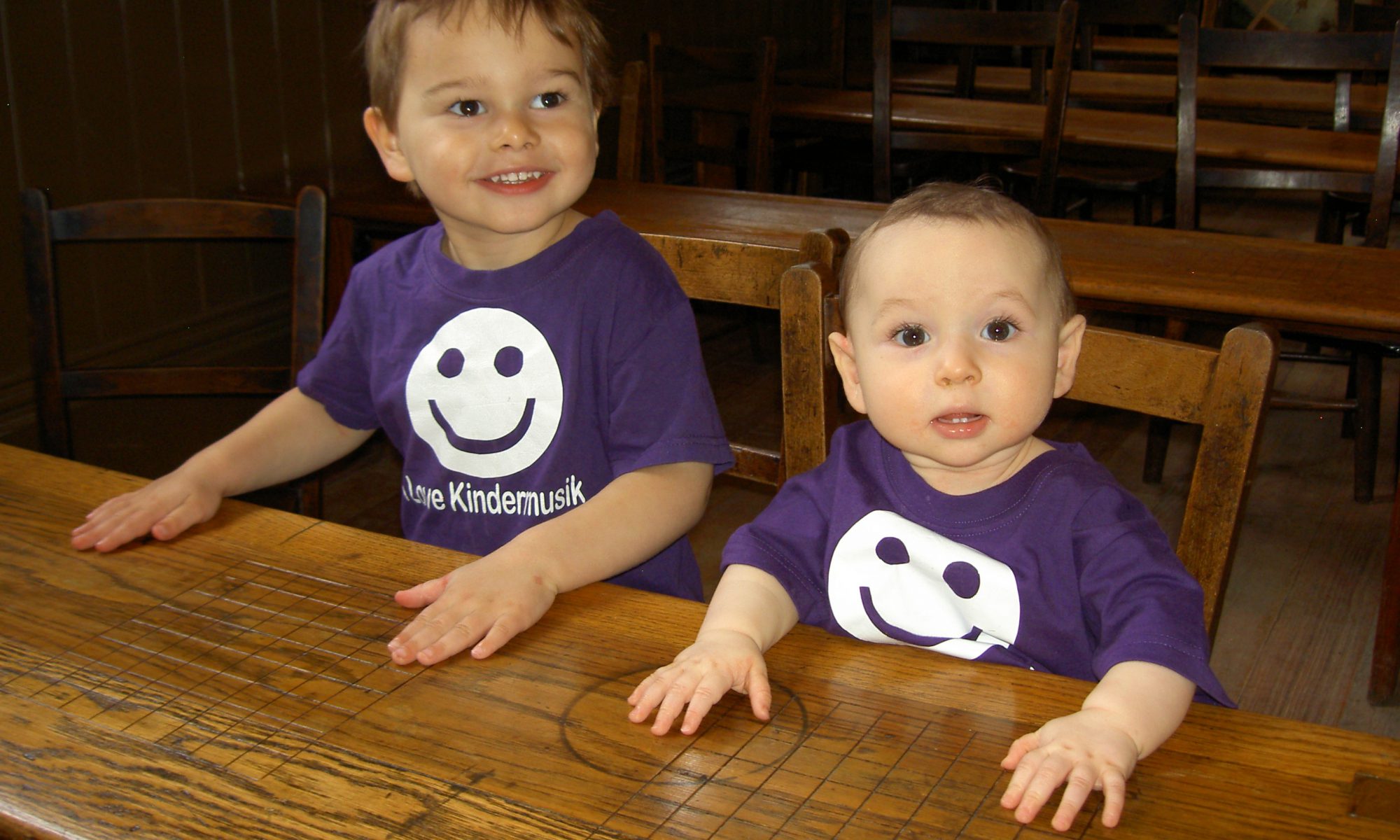
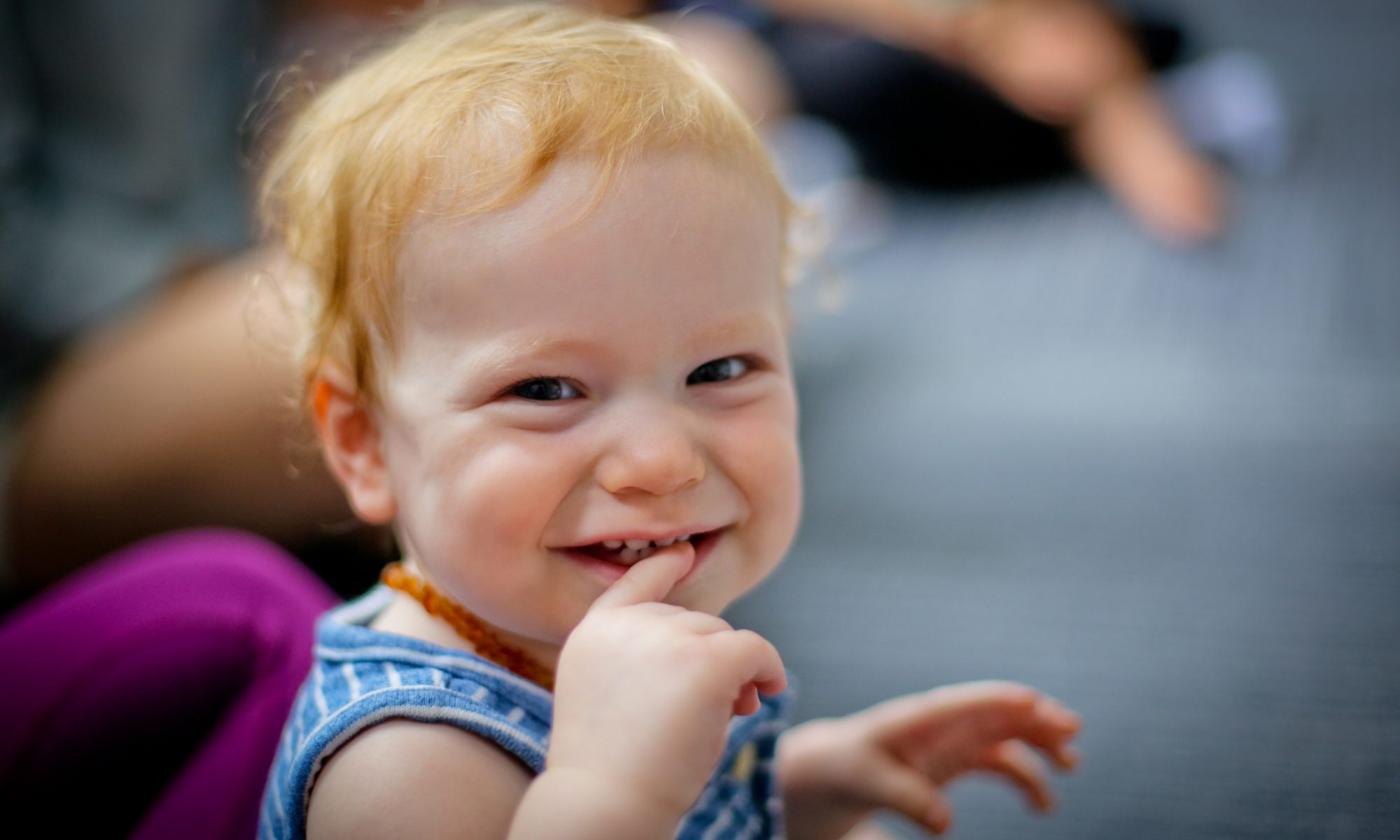
That smile betrays musical fun…impacting brain development!
It is through a curriculum that combines the power of early music experiences for newborns to big kids in a developmentally appropriate setting that Kindermusik is able to deliver a unique music learning experience that puts a song in each child’s heart, helps parents and children bond, and gives kids a chance to play and be kids – all while giving them an early cognitive advantage through singing, dancing, playing instruments, and moving.
But don’t just take our word for it…check out the science for yourself. Kids’ brains really do grow faster, stronger, and happier with music and music classes like Kindermusik! And you’ll both have a lot of happy memories of songs, giggles, and together time to treasure forever too.[/vc_column_text][vc_separator][/vc_column][/vc_row][vc_row][vc_column][vc_column_text]Shared by Theresa Case who loves that kids’ eyes, hearts, and brains have been lighting up for over 20 years now in their Kindermusik classes at Piano Central Studios, where she is the Director.[/vc_column_text][/vc_column][/vc_row]
It happens often – the Jewish observance of Passover and the Christian observance of Easter will coincide this week. Passover began today at sundown and continues until April 18th. Easter will be celebrated this coming Sunday, April 16th. The two holidays actually share an etymological root – Easter is still called Pascha in Greek, which in turn comes from the Hebrew Pesach, a word still used today for Passover.
As with many faiths, music plays an important role in observance and celebration of important holidays. Easter and Passover are no different. Let’s explore some of the music associated with these special festivals.
Chant – lots of Chant
Both faiths historically have used a great deal of chant, a form of elevated speech, to convey concepts, express aspects of faith, and offer praise. There are many chants associated with both Passover and Easter. At the Passover Seder, the ceremonial dinner that recalls the flight from Egypt, songs are song, and text is often chanted. One of the most important is the Ma Nishtana (Hebrew for “this Night”). The Ma Nishtana contains the “Four Questions” and is traditionally sung by the youngest child able to do so. Here’s the text in English:
Why is this night different from all the other nights;
That on all other nights we eat both chametz and matzah, on this night, we eat only matzah
That on all other nights we eat many vegetables, on this night, only maror
That in all other nights we do not dip vegetables even once, on this night, we dip twice
That in all other nights some eat sitting and others reclining, on this night, we are all reclining
Here’s Roni, practicing the Ma Nishtana for her family’s Passover Seder:
An Ancient Easter Chant – Victimae Paschali Laudes
This chant first appeared after the Council of Trent in 1570, thought it is certainly older. It praises Jesus as the Passover victim (you can see that etymological connection in the title – Paschali – Latin for Passover). The original chant tune is still used in Catholic churches and has been arranged in countless ways for solo voice and choral ensembles. Here is a portion of the text:
Let Christians offer sacrificial praises to the passover victim.
The lamb has redeemed the sheep: The Innocent Christ has reconciled the sinners to the Father.
Death and life contended in a spectacular battle: the Prince of life, who died, reigns alive.
Here is the simple chant version, complete with its early musical notation, called neumatic notation, which predates our modern way of writing music. Watch the notes go up and down as the voice goes up and down in pitch.
Handel – Israel in Egypt
Yes, it’s true. George Frideric Handel was not Jewish, but his oratorio, Israel in Egypt, tells the story of the Exodus in grand fashion. The work was premiered in England in April of 1739. This major work, written in three parts, is now commonly performed with just the final two parts – in 39 individual movements! It is primarily choral though there are some solo and duet movements. What is no performed as Part II is an English translation of the Shirat HaYam – The Song of the Sea. In this chorus, which sets the first sentence of the Shirat HaYam, Moses and his people sing together for the first time, celebrating the escape from Pharaoh.
Moses and the children of Israel sung this song unto the Lord, and spake, saying: I will sing unto the Lord, for He hath triumphed gloriously; the horse and his rider hath He thrown into the sea.
Here is the Choir of Christ Church Cathedral, Oxford and the English Chamber Orchestra under the direction of Simon Preston. Note the joyful music as the chorus sings “the horse and his rider hath He thrown into the sea.”
Miriam’s Song
Debbie Friedman, a Jewish American songwriter, composed the well known Miriam’s Song. It offers Moses’ sister’s point of view after the Exodus. Miriam leads the women in dance and song, celebrating their freedom. Friedman’s music is in the folk vein, filled with elation and joy. In the recording below, you can hear the shofar, an ancient musical instrument made of a ram’s horn and used in Jewish religious ceremony, blown at the very end.
As always, music pervades everything we do – holidays, both sacred and secular; our commutes are filled with music; every aspect of modern entertainment is saturated with music from television to movies. Imagine a world without music! It would be quite boring.
[vc_row][vc_column][vc_column_text]How’s this for a fascinating location for a Kindermusik program? Robyn and her family live on a huge rock island in the Atlantic Ocean in the city of St. John’s, located on the far eastern side of Canada. In fact, the most easterly point in North America is not too far away from where Robyn lives. Robyn describes Kindermusik as the “perfect fit” for her, and we couldn’t agree more. She often refers to her sweet Kindermusik kids as little butterflies, growing and spreading their wings of discovery in a big world! Once you get to know Robyn, it’s easy to see why her Kindermusik families adore her, describing her as fun loving, energetic, and passionate about the power of music. Now in her 10th year, Robyn is grateful every day to be able to bring music into the hearts and lives of children and their families!
[/vc_column_text][vc_video link=”https://vimeo.com/212081869″][/vc_column][/vc_row][vc_row][vc_column][vc_column_text]TC: What makes your studio such a special place
RP: Our studio is a place where each family is loved, respected and valued.
TC: Why did you open your studio business?
RP:Funny story… One of my professors gave me a KM brochure almost 20 years ago while doing my music degree in the US. She told me that I should really check into it because she thought I would be a good fit. Fast forward another five years or so, and someone at my church gave me the exact same brochure and told me I should check into it because I might be a good fit for this program. It wasn’t until I had my own two boys that I decided I wanted to be home with them as much as possible, so running my own business felt like a good plan since I was already teaching private voice and piano. I rediscovered those KM brochures and really dug into what Kindermusik was all about. I was overjoyed to see that Kindermusik lined up with my own philosophies on early childhood music education. I am forever grateful for having had people in my life who gave me a nudge in this direction.
TC: What do you love most about being a Kindermusik educator?
RP: One of the things I love most about being a Kindermusik educator getting to be part of the journey of a child from infant right up to “big kid”. It’s absolutely amazing to me. Each person is so individual. Each brings victories and hurdles (children and grownups alike!). As I watch their personalities unfold, I am so grateful to the parents who allow me to share in this small window of time in their child’s life.
TC: What’s the funniest that’s ever happened to you as a Kindermusik teacher?
RP: I don’t even know where to start. My 3 and 4 year olds constantly make me laugh. I always caution parents to be careful what they say because we NEVER know what they are going to share![/vc_column_text][vc_column_text]
Robyn Pearce, Kindermusik Educator from St. John’s – North America’s most easterly city!
[/vc_column_text][/vc_column][/vc_row][vc_row][vc_column][vc_column_text]TC: What’s your favorite Kindermusik dance to lead?
RP: Mama Paquita has always been my favorite dance (just ask my families!), but my new runner-ups have to be “A Tisket, A Tasket” and “Turn, Cinnamon, Turn.”
TC: If you had to name just one secret to success in the Kindermusik classroom, what would it be?
RP: I know I can speak not only for myself, but my whole team. Everyone needs to feel a sense of belonging. While we always want to strive for excellence and professionalism, really connecting with families and letting them see our hearts each week has to come out on top. I want to cultivate connection in a setting that promotes family through music and movement, connection between caregivers and children, connection between families, and connection between educator and family.
TC: What do you feel has made your studio business a success?
RP: I absolutely love teaching! I’ve been blessed to have a family who supports me. I am also fortunate to have a wonderful little team of educators who share my passion. We love our Kindermusik families, and I think it shows.
TC: What are some of the goals you have for your business?
RP: This year I hope to rebrand our studio name. My studio name currently highlights just my name. I am beyond blessed to have amazing admin and educators working with me, and I want a name that reflects a team. I couldn’t reach the volume of families that we serve without my gals. Thank you Gillian, Rachel, Noelle, Nicole (and our old pal, Miss Joanna!). [/vc_column_text][vc_column_text]
Robyn having fun with one of her Kindermusik kids
[/vc_column_text][/vc_column][/vc_row][vc_row][vc_column][vc_column_text]TC: If you could share one tip with a new Kindermusik educator, what would it be?
RP: Never stop learning!
TC: And a little about you outside of Kindermusik… What are some of your hobbies?
RP: Reading, athletics, and of course music. I love to be involved with local musical theatre productions when my schedule permits. It’s SO much fun! Most of my down time is spent time with my family, including our sweet furry pal, Kiki.
TC: This is always a question I love to ask. What is your favorite inspirational quote?
RP:I have a number of them, but I will share two—one that reminds me to be grateful for every day and the people and blessings in it, and the other to remind me to treat every person that crosses my path with kindness and dignity. [/vc_column_text][/vc_column][/vc_row][vc_row][vc_column][vc_column_text]
“Piglet noticed that even though he had a Very Small Heart, it could hold a rather large amount of Gratitude.” – A.A. Milne in “Winnie the Pooh” “I’ve learned that people will forget what you said, people will forget what you did, but people will never forget how you made them feel.” – Maya Angelou
[/vc_column_text][vc_separator][vc_column_text]Shared by Theresa Case, director of Piano Central Studios in Greenville, SC.[/vc_column_text][/vc_column][/vc_row]
Nancy Rose is likely Canada’s most patient photographer. She’s also rather creative. In The Secret Life of Squirrels – A Love Story, Rose uses her skill with the camera, custom created miniature set pieces, and the natural curiosity of these adorable fur balls to tell a story that will bring a smile to kids and adults alike.
Mr. Peanuts has no problems showing emotion in a healthy way.
Our story follows the aptly named “Mr. Peanuts” (Rose uses peanuts to attract the squirrels to her tiny sets) as he prepares for Valentines Day. But wait! Mr. Peanuts is all alone. While preparing to do some yard work in his shed and shopping for groceries (with a peanut in his mouth – clearly his signature), he ponders what life might be like with a special friend.
Of course the appeal here is the charming poses Rose manages to capture, and apparently this is through simple diligence. Nothing is manipulated. The little tableaus are real life squirrel drama. Kids will laugh when they see Mr. Peanut and his special friend, Rosie, spend time on the playground playing hopscotch, enjoying the slide and swing set, and sitting down for a candle-lit dinner for two.
The Secret Life of Squirrels – A Love Story, written and photographed by Nancy Rose and published by Little, Brown and Company.
These squirrels have been coming to visit Rose for some time. From the author’s website, secretlifeofsquirrels.com:
A passion for nature and wildlife, and a lifetime spent as a crafter merged when she discovered the curiousity of the little American Red squirrels who raided the bird feeders in her backyard. Nancy creates squirrel size props using cardboard, clay, and assorted craft supplies and dollar store finds. She arranges them in miniature settings and she has created numerous scenarios on her backyard deck where the inquisitive squirrels find themselves in some rather human like poses as they search for peanuts hidden in the props.
Her favorite squirrel, Mr. Peanuts, was the first to eat from her hand and when he is “in the neighborhood” he is sure to stop by and check out whatever Nancy puts out on her deck rail. Her squirrel visitors have grown in number and Nancy hopes that together they can continue to delight viewers for years to come.
Mr. Peanuts and Rosie enjoy some leisure time on the playground.
The Secret Life of Squirrels – A Love Story, published by Little, Brown Books for Young Readers, is part of a series of books that share Rose’s regular visitors and their entertaining antics. Take a look – they are visually engaging and lovingly created. You can pick up the books at your local book store or online at your favorite retailer. Amazon offers both physical and electronic editions.
Kids with great imaginations and boundless creativity may test your patience at times, but they are the ones with the brightest futures – the ones most likely to invent something fantastic or solve one of the world’s biggest problems. And they are great problem solvers!
It’s in the early years that we adults have the greatest opportunity to support and foster imagination and creativity in a child. That’s one of the things we Kindermusik educators love about Kindermusik – it’s all about being creative, thinking outside the box, and using our imaginations as the children learn about music and explore making music in all kinds of ways.
[vc_row][vc_column][vc_column_text]Some parts of the world are enjoying balmy temperatures right now. Others are digging out from snowstorms and wishing they could enjoy balmy temperatures sooner rather than later. If you’re in the Northern Hemisphere, we’re approaching a momentous day – the first day of Spring! And we’re here to help you celebrate in an easy, family-friendly, happy, memorable kind of way. (After all, that’s what we celebrate about kids and parents in our Kindermusik classes every week!)
You probably read with your child nearly every day, sometimes multiple times a day. And we bet you can even recite, word for word, a few of your child’s most beloved books that you have read over and over again. But you can still make this day and the event of reading a book together by reading something new about Spring. Here are a few of our favorite Spring-themed titles:
Planting a Rainbow by Lois Ehlert The Listening Walk by Paul Showers and Aliki Listen to the Rain by Bill Martin Jr., John Archambault, and James Endicott[/vc_column_text][/vc_column][/vc_row][vc_row][vc_column][vc_column_text]
After you Read the Book, Go on your Own “Listening Walk”
This is a delightful activity that will become a fast favorite… and get you outside for a little healthy exercise and special together time.
Make – and Sail – a Miniature Boat
These cork boats and walnut boats are just adorable – so fun to make and even more fun to “sail” in the sink, in a puddle, or in a creek.
Plant a Seed
If you don’t have a green thumb, or it’s been awhile since you tried planting anything, here’s a super short, super easy, video to inspire you. There’s nothing more fascinating than watching something grow![/vc_column_text][vc_video link=”https://www.youtube.com/watch?v=XL9aRtkSMZw”][/vc_column][/vc_row][vc_row][vc_column][vc_column_text]
Download and Learn Kindermusik’s “The Growing Song” Together
There’s nothing better than bonding together over learning and singing a new song together. Here’s a sweet little song that you can download and add to your repertoire – and your playlist.
Make a Springtime Wreath
Grandma will love this for her front door! Watch the 30-second video tutorial for this adorable little craft that’s perfect for even younger children to make.[/vc_column_text][vc_video link=”https://www.youtube.com/watch?v=0SN5GJm-jIg”][/vc_column][/vc_row][vc_row][vc_column][vc_column_text]
Plan a Picnic – in the Backyard or at a Park
You can really turn this into an “event” by enjoying planning the picnic with your child as much as actually going on the picnic (you’ll find some really fantastic picnic ideas here). Turn it into a play date by inviting a few friends.
Celebrating the little moments is what childhood is all about. And a little simple celebration, sharing some special moments together, will go a long way towards helping your child blossom into a happy, confident, creative individual.
Shared by Theresa Case, owner of Kindermusik at Piano Central Studios in beautiful Greenville, South Carolina, where Springtime is always beautiful![/vc_column_text][/vc_column][/vc_row]
Dr. Stephen Oliverson is principal of Provost Elementary in Provo, Utah. In 2014, Provost was named a National Title I Distinguished School, one of only 59 schools nationwide to receive this honor. What was Dr. Oliverson’s secret to this success? The answer (which is no surprise to us): music. The instructional day was rearranged so that every student at Provost received musical enrichment. This led to increased proficiency in math, science, and reading, long with a host of other benefits.
In Oliverson’s interview with the Provo Daily Herald, he shared his secret for academic success:
“We do a couple of things that are really unique to our school. That is our involvement in the arts. Exposing children deeply in the arts has academic payoffs in literacy and math.
Every student at our school knows how to play the piano, violin, flute and guitar. The whole fourth grade takes violin lessons four days a week, all year long. We expose students to other instruments in fifth and sixth grade after they have that strong string base.”
In his presentation at the 2015 National Title I Conference, Oliverson detailed the benefits of a curriculum rich in musical instruction.
Flourishes artistic and personal expression
Promotes motor task competency
Linked to greater likelihood of graduation
Sharpens cognitive function
Develops superior reading ability
Enhances social skills
It makes your GPA better
Improves emotional outlook
Protective against dementia
Significant predictor of of higher IQ in early adulthood
– Stephen Oliverson and Lauri Driggs, 2014 Title I Conference Presentation
Beyond his successes as a principal, Oliverson and his family are accomplised musical performers in their own right. He plays the piano and composes, and all of his children play violin. Moon Light is the name of the family’s musical group; they perform across the country. Here they are performing an original composition (written by Dr. Oliverson and his daughter, Aubree) tiled Spartacus.
[vc_row][vc_column][vc_column_text]When I became licensed to teach Kindermusik way back in 1994, I never imagined what the next twenty-something years would hold for me…or the hundreds of children and families I’ve been privileged to hold in my heart all this time.
Twenty plus years means that many of those babies I had in my lap are now all grown up, and I’m even starting to see a few come back around to teach for me or to bring their own tiny baby to his first class. I still run into those Kindermusik moms who are always so eager to thank me and to proudly tell me that so-and-so went on to study music, or is playing with a music group, or still sits down at the piano to play.
So many of these Kindermusik kids not only went all the way through our Kindermusik program, but stayed on at our music school to take music lessons. And every single one of those parents and kids all recall with great fondness and warmth just how important Kindermusik was to them in those early years.
So what exactly does it mean to “grow up in Kindermusik”? Here’s a bit of perspective from my own years as a Kindermusik mom, a Kindermusik educator, and Director of Piano Central Studios.[/vc_column_text][vc_column_text]
Theresa Case works her magic with a young musician (yes, friends – Kindermusik Educators are magicians!)
Being allowed to gently unfold and blossom at their own pace, thus deepening their love of music and ensuring that love would stay in their hearts for the rest of their lives.
Reveling in a nurturing environment where each individual was lovingly encouraged to be themselves, to play and be curious and creative, and along the way, to discover for themselves just how much they could come to love making music.
Finding a place to belong, to linger in the delights of childhood, and to savor moments that will never be forgotten.
Asking for music to continue to be a part of their lives even after Kindermusik, by continuing on with music lessons.
Pursuing music as a career or maintaining their musical skills as a beloved hobby.
Forever having a story, a memory, or a song to share from being in Kindermusik class and enjoying Kindermusik together at home throughout the week.
Gratefully acknowledging parents who recognized the power of music not only to shape their children developmentally, socially, and cognitively, but also to nurture their souls and give them great joy the rest of their lives.
[/vc_column_text][/vc_column][/vc_row][vc_row][vc_column][vc_column_text]My experience has held true over and over and over again. Growing up in Kindermusik is one of the best ways a parent – and a Kindermusik teacher – can let a child grow up.
Shared by Theresa Case, Director of Piano Central Studios in Greenville, South Carolina[/vc_column_text][/vc_column][/vc_row]
It’s a beautiful focus on family and an abundant love for music that makes Stefanie Jamison and her studio, The Musik Box, stand out. When you meet Stefanie – which usually also means you get to meet her incredible family, you can’t help but notice the overflow of enthusiasm, energy, and passion for all things family and all things Kindermusik. Stefanie teaches with a lot of heart, and she runs her business with a lot of heart too! Lovingly known as “Mrs. Jamison,” Stefanie has been a studio owner and Kindermusik educator in the Phoenix, Arizona area for over 6 years now, and we are delighted to feature her very inspiring story. Oh and by the way, when she’s not homeschooling or teaching Kindermusik, you’ll probably find Stefanie hand-knitting baby blankets to welcome the newest babies in her Kindermusik family.
TC: I understand that there’s a very special story about how you became a Kindermusik educator.
SJ: Yes, I have a very unique story in how I came to teach Kindermusik. I had a child with serious developmental delays due to a life-threatening infection and intensive surgical intervention in his life when he was a toddler. I knew the power of music therapy from my background of study and research in child development at the University of California, Berkeley. So I took him to Kindermusik, and he learned to sing before he regained his speech. Our experience at Kindermusik was life-changing as a family. We then were blessed with two more children, but we struggled to find a consistent Kindermusik experience for them. With the economy changes in our state we had 10 teachers in less than 5 years. So our last Kindermusik teacher recommended that I become licensed. It was an outrageous thought because at that time I was bedridden from a serious illness. But I thought it would be a way to help my own kids out of the isolation that my illness brought inadvertently to them. It was also a reason for me to get out of bed and get dressed each day. I started with one class a week. Now I teach over 30 classes a week, and I can move without any restrictions. The miracle of sharing music with others is that I feel better than ever. I will always have pain – that’s my reality – and yet singing and dancing helps me to function. Based on what I do on a daily basis as a Kindermusik teacher, no one would ever guess that the prognosis given to me by doctors years ago was that I would never walk again.
TC: How do your Kindermusik kids (or families) describe you?
SJ: The words that people most often share about me are “passionate” and “encouraging.” My goal in all my classes from Village to Young Child is to encourage parents in their most important job – parenting! So often our culture judges moms and dads and I want them to come to a place where they can be loved, served and encouraged right alongside their children. I want to help them to see the gift that is their child.[/vc_column_text][vc_column_text]
Kindermusik Educator Stefanie Jamison
TC: If you had to name just one secret to success in the Kindermusik classroom, what would it be?
SJ: Enthusiastic celebration! I love to celebrate parents and children. My goal is to help each parent to see the gift that is their child and to find great delight in them. To be a force for encouragement in this world is my purpose!
TC: What makes your studio such a special place?
SJ: We provide more than a music class. For example, when I realized how many of my parents were worn out and not getting all-important time alone with each other, we started an outreach on the weekends called “Music Camp Out.” Parents could leave their children in our family’s care for three hours while they enjoyed a night out together. As a family we pick a theme and then build a music class around that theme, incorporating games, crafts and a kid-friendly movie. The funny thing is that the kids that attend could care less about the movie. They are more interested in the social activities and music. It’s a way for our family to share some of our favorite songs and activities from across all the different curricula. Kids look forward to these nights just as much as parents. We are able to give respite to the weary and help them to carry on in their most important role as parents. We do this in part because our belief is that strong families are made by strong marriages.
TC: What’s your favorite part of teaching Kindermusik?
SJ: I love teaching Kindermusik for many reasons. I delight in seeing young children’s faces light up during different activities in class. It is particularly touching to see parents connect with their children and tell me how their kids go home and enjoy music class at home with their parents.
TC: What’s your favorite Kindermusik song to sing?
SJ: “We’re a Musical Family” – because that is our family theme song. We truly are a Kindermusik family! And my kids changed the lyrics to “I Love My Family” to say “they’re the best for me!”
TC: What’s the most touching thing that’s ever happened to you as a Kindermusik teacher?
SJ: The most touching is that I have provided a place for special needs kids and families to feel loved and welcomed. They know that I will do whatever it takes to make it possible for their children to succeed in class. One little girl that will graduate into Young Child next year has been with me since she was a baby. She was born without an optic nerve, so her gross motor skills were impacted, her speech was delayed, and fine motor development completely non-existent. She attended classes for four years with a parent. The big leap for her to come on her own was a challenge. Who would help her navigate the classroom? So my daughter became her shadow in class. My student refers now to my daughter as her sister, and she adores having a “helper.”
TC: What are some of the goals you have for your business?
SJ: Right now, I am a one-woman teaching staff. I hired an administrator last year which has helped saved my sanity. However, I am looking to hire teachers to expand my program and provide back-up for me in part because we are about to realize our greatest goal and dream – opening up our first designated studio space. No longer will I be traveling all over our city to provide music classes. Best of all, my family will be able to retire from their “roadie” duties of helping mom load and unload our minivan affectionately called “The Musik Box.”
TC: What’s one thing that has significantly impacted the direction of your business?
SJ: The best thing I ever did for my business was to join the Studio Expansion Program. Going through the program helped realize that I am a business woman. Before I acted like teaching was more of a hobby and so I tried to accommodate everyone’s needs – something that was to my own detriment. The SEP has helped me to identify and embrace my values, what I offer, who my ideal client is, and how to expand my business to reach more families with Kindermusik.[/vc_column_text][blockquote cite=”Stefanie Jamison”]”I have a student in Young Child and her little sister is in Sing and Play. Their mom told me that one day she found her older daughter teaching her younger daughter everything she learned in her Young Child class, pretending to be Mrs. Jamison.”
TC: What do you feel has made your studio business a success?
SJ: Personal attention. I first started with four families in 2011 and I did it for my own children to meet other kids. At that point I was still struggling with my health, so teaching in my home was the reason to get out of bed and get dressed. It is amazing to see how it has grown and how my health has improved alongside that growth. My doctors marvel that I discontinued all my medicine. I attribute that to the power of music. Teaching really does make me feel better! Truly this business is a family affair as my husband and kids serve our families right alongside me. God has certainly blessed us beyond what we ever expected or imagined when we started.
TC: What’s something new and exciting that’s happening with your business?
SJ: Since I started my business, I have taught in both Arizona (my home state) and in Oregon while my husband was on a long-term training assignment with his company. I have taught at my house, a friend’s house, a community center, and even a toy store. Now my business has expanded to the point where I can sustain teaching in my own studio. I will be moving to my own studio within the month! It’s a wonderful teaching space near my house. Best of all, my husband will be my neighbor, as his business is in the adjoining suite! We are even eyeing the next city that we want to open our next studio in! So we see growth as a serious possibility!
TC: What is one of your own favorite Kindermusik memories?
SJ: I have a student in Young Child and her little sister is in Sing and Play. Their mom told me that one day she found her older daughter teaching her younger daughter everything she learned in her Young Child class, pretending to be Mrs. Jamison. I love hearing stories like that! It shows that the Kindermusik tag line is so true: “A good beginning never ends.”