
The Recipe for Learning Success

Recipe for Learning Success

The below post comes to us courtesy from Miss Analissa via the Studio3Music blog. Studio 3 Music is a Maestro Kindermusik educator, meaning in the top 1%, and serves the greater Seattle area with locations in Seattle, Bellevue, Kirkland, Redmond and more!

I started reading the Little House on the Prairie series to Natalie a couple of months ago. (She’s 6, and unlike my boys, totally enraptured by Laura’s story.) She was shocked to learn that on Sundays, Laura had to sit still and play quietly or read. Natalie tried it, and lasted about 7 minutes.

Recipe for Learning Success

We just got to the part in On the Banks of Plum Creek where Laura and Mary go to school for the first time. This time, Natalie was dumbfounded that Laura would have been slapped on the hands “many times” with a ruler if she had wiggled, swung her legs, or talked during school.

What a difference a 120 years makes! I’m so glad we live in a time where we know so much more about the brain, and how learning and moving go hand in hand.

Carla Hannaford (award winning author and eductor) writes, “Movement is essential to learning. Movement integrates and anchors new information into our neural networks. Every time we move in an organized…manner, full brain activation and integration occurs, and the door to learning opens.”

Combine movement, which fully activates the brain, and creates and strengthens neural networks, with music, which is the only activity that simultaneously stimulates every area of the brain, and you have a recipe for successful learning. Continue reading “The Recipe for Learning Success”
FOL Fridays: The Movement-Learning Connection

Music and Movement Classes for Toddlers

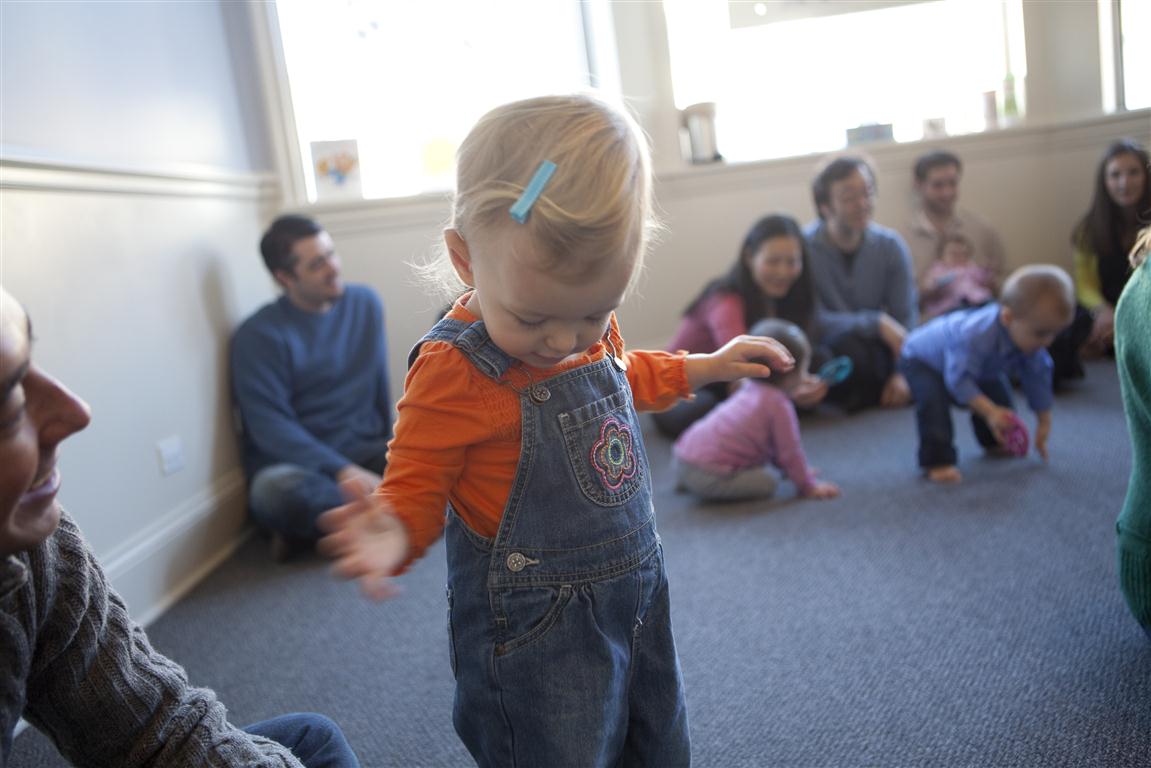
Music and Movement Classes for ToddlersChildren learn best with their bodies. By providing a venue for movement, either in Kindermusik class or at home, children have a chance to “try out” a variety of creative, self-expressive movements. Being sensory learners, children should be encouraged to move, use their imaginations, and engage their large and small muscle groups, all in a safe place where they are mentally and emotionally connected. Physical, mental, and emotional developmental qualities of young children are so interwined and interrelated that when one area is affected, the other two areas are equally affected (adapted from Geigert, 2006).

Ideas for parents: Find ways to give your child the freedom and opportunity to move. Children who are not yet walking still enjoy moving with, and being moved by, an adult. Once your child learns to walk, encourage him to run and play outdoors, both in free play time and as age-appropriate, with more structured or organized activities. Simply dancing and moving to music is one of the best ways to help children learn through moving, whether that’s at home with the iPod or radio or in the studio at a Kindermusik class.

– Contributed by Theresa Case, whose Greenville, SC program, Kindermusik at Piano Central Studios, is proudly among the top 1% of Kindermusik programs worldwide.

FOL Fridays: The Singing-Speaking Connection

“Singing ability is related to the ability to control speech fluctuations, and speech activities appear to help develop tuneful singing skills. The ability to sing and the ability to converse with expressive speech are closely related. Playing with rhythm speech (chants, poems, rhymes, etc.) as well as simple tonal melodies helps the child develop both singing and speech skills.” (adapted from McDonald and Simons, 1988)

Tips for parents: So what is the best resource for learning (or remembering!) those all-important songs and chants that help your child become a better speaker and a better singer? You’ll learn a ton of great music and activities in your Kindermusik classes, but you can also borrow from Mother Goose, pull from your childhood memories, or make up your own songs and chants. Piggyback songs, where you adapt a song by substituting your own words, are also lots of fun.

– Contributed by Theresa Case, whose Greenville, SC program, Kindermusik at Piano Central Studios, is proudly among the top 1% of Kindermusik programs worldwide.

Sing & Sway the Summer Away!

Looking for a summer adventure?

Look no further! It’s time to swing, sway, dance & play the summer away with Kindermusik. Your local Kindermusik studio offers a variety of Kindermusik summer camps & adventures – from baby music classes to drop off music camps for older kids. With fun, summery themes you can sink your feet into, discover why so many families with young children love Kindermusik, especially during the summer time! In our short summer camp classes, we’ll give you a summer’s worth of music, stories, and activities created to inspire a lifetime of learning and love for music.

You can find a Kindermusik studio near you on www.kindermusik.com.

Kindermusik and Your Child: Listen… Listen..

Shhh! What do you hear? Turn on your listening ears and you will hear many things in a Kindermusik class on any given day: the sound of a dog barking, the rain dripping on a tin roof, or the quiet, low “thump-thump” of your very own heart beat. But why is listening so important for a child?

The infant listens and learns to recognize the sweet sound of his mother’s voice early on. The toddler listens and learns to imitate and speak his language. The preschooler listens, and learns to follow instructions. As they listen, and listen, they learn, and grow, and their world expands.

Active listening differs from simple hearing in that we must choose it as an intentional act. We are surrounded by a cacophony of noise in our world, and we must choose whether or not to listen and process the sounds we hear. Active listening opportunities like those provided in Kindermusik allow children the opportunity to learn to listen intentionally. So turn on your listening ears! You might be surprised what you will hear!

Compiled by Theresa Case, whose Kindermusik program at Piano Central Studios in Greenville, SC, is proudly among the top 1% of Kindermusik programs worldwide.

FOL Fridays: The Value of Play

Kindermusik Music Class Playtime

Play is a natural activity for children. The child a play is self-motivated and actively engaged. Whereas

games are governed by rules, the value of play is that it provides freedom from evaluation and judgment. The freedom of a playful atmosphere fosters intellectual development as well as self-construction and the development of personality.

Tips for parents: There are many things we as parents can do to inspire play. Just making sure your child has lots of time for free play is an important first step. You might also want to look at the play areas – inside and outside – and ensure that they are safe and inviting. Finally, consider adding some very simple toys and props to the playroom – things like wooden blocks, cardboard boxes and tubes, blankets, dress-up clothes, etc. will all help your child make his imagination come alive through his play.

– Contributed by Theresa Case, whose Greenville, SC program, Kindermusik at Piano Central Studios, is proudly among the top 1% of Kindermusik programs worldwide.

Minds on Music Quote

Minds on Music Quote

Minds on Music Quote

Music isn’t just learning notes and playing them. You learn notes to play to the music of your soul. ~Katie Greenwood

FOL Fridays: Where’s the Balance?

The semicircular canals are three tiny, fluid-filled tubes in our inner ear that help us keep our balance. When we move our heads around, the fluid triggers the hairs that line each canal. These hairs translate the movement of the fluid into nerve messages that are sent to the brain. This is how the body knows to stay balanced (“Semicircular Canals.” 1995-2006). Interesting, huh?!

Tips for parents: Rocking, moving from side to side, and running are all physical activities that move our heads and result in helping our bodies stay balanced. This is why rocking and other healthy activity is so important to your child’s coordination and well-being. So take some time today to rock. Rocking can be calming

or energizing, depending on the need of the moment!

See how rocking is incorporated into this Kindermusik class:
[youtube]http://www.youtube.com/watch?v=sDvwNpkNd8U&w=400&h=300[/youtube]

– Contributed by Theresa Case, whose Greenville, SC program, Kindermusik at Piano Central Studios, is proudly among the top 1% of Kindermusik programs worldwide.

Kindermusik and Your Child: Praise or Encouragement?

Kindermusik Music Classes

Kindermusik Music ClassesChildren need feedback on the work they do. But how can we provide feedback most effectively? Conventional wisdom would espouse that constant praise is necessary in our child-rearing… but is it really the most effective way to provide that much-needed feedback?

There is actually new research that would indicate that constantly praising our children is backfiring and even undermining their confidence! Praise, by definition, is an expression of worth, approval, or admiration. It is usually given to a child when a task or deed is well done or completed. In an article entitled "Encouragement or Praise for Children?" written by Elvin Klassen (written as a resource for parents teaching overseas), the author suggests that encouragement , rather than praise, should be our goal as parents and educators.

Encouragement in its best form should be specific, focused on the process rather than the finished product, sincere, focused on the effort made, non-comparative, and enabling the child to develop an appreciation for his own achievements. For example, instead of "Sally, you’re such a nice girl" – encouragement would say "Sally, I noticed you shared with Molly today." Remember, praise gives a value judgment and focuses on the person, while encouragement makes an observation about a behavior. We need to convey through words and gestures that we appreciate our child’s efforts and improvement, not just their accomplishments. Continue reading “Kindermusik and Your Child: Praise or Encouragement?”