"Music is the
universal language of mankind." ~ Henry Wadsworth Longfellow


Minds On Music – The Kindermusik Blog
For three generations, Kindermusik has helped millions of children around the world build a strong foundation for a lifetime of learning.
"Music is the
universal language of mankind." ~ Henry Wadsworth Longfellow
“Singing ability is related to the ability to control speech fluctuations, and speech activities appear to help develop tuneful singing skills.” (McDonald, Dorothy and Gene M. Simons.)
 The ability to sing and the ability to converse with expressive speech are closely related. Kindermusik classes will nurture your child’s speaking and singing voice by playing with rhythmic speech (poems and rhymes) as well as introducing and modeling simple tonal melodies with a limited range, and when you continue your play with both words and timbre sounds in your home during the week, these skills will be strengthened in your child and retained!
Many toddlers will first attempt to say a word, phrase, rhythms pattern or vocal inflections while alone or at play. These imitations are called “approximation of singing” It is by “playing with sounds” that the children master the muscular feel of producing a singing sound and come to realize that they can produce these kinds of sounds which are different from speech. We model and encourage children to explore the upper or head voice and to employ their voice for singing tasks as much as possible. Playing with vocal glissandos, singing tasks like “Toys Away”, and pitching songs in the best range for young children helps your child learn to become a successful singer.
Compiled by Theresa Case, whose Kindermusik program at Piano Central Studios in Greenville, SC, is proudly among the top 1% of Kindermusik programs worldwide.
The below article is from Miss Analiisa, of Studio3Music, the largest Kindermusik studio in the greater Seattle area. You can visit Studio3′s Web site here.
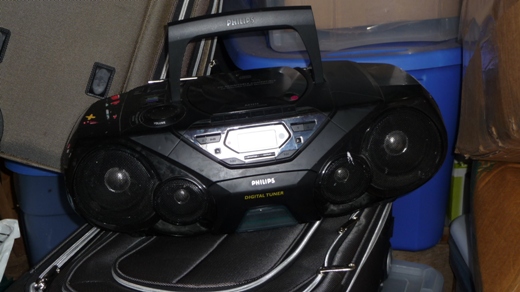
In our backyard, we have a shed. In it are the garden tools, the suitcases, the outdoor toys, a bag of Natalie’s outgrown clothes I’m saving for her cousin, and, I noticed, as I went to put a box of Playmobil away, the kids’ old portable CD player.

From the time we brought them home from the hospital, I played music at bedtime and naptime. Lullabies, classical music, Farmer Jason, and Kindermusik CDs. As they got older, we transitioned to books on CD (or books on tape on the Fisher Price tape recorder!) and then radio dramas. Of course, keeping their favorite music as well.
What I loved about that CD player was that I could take my children’s CDs and the player anywhere they had to stay overnight that wasn’t at home. I’d put in the CD and their new surroundings immediately got a little less unfamiliar and scary. They eased into slumber smoothly.
My children are 13, 10 and 6 now, and belong to the generation that is transitioning from CDs to music downloads on iPods and iPads. They are making many of their own music choices, but they still love audio books and those radio dramas.
So, as I stared at this lonely, worn out CD player in my shed, I wondered what I would be doing if I had very young children now. I’m assuming that electronic devices require some sort of reading ability to be able to find the tracks you want. When they were pre-readers, my kids could visually find the CD they wanted and put in the player.
I’m really curious. Are you a parent with pre-readers?
Are today’s kids so electronically adept that they use the visual cues to find the tracks they want, without technically “reading” the titles?
Please, leave a comment and let us know.
-posted by Miss Analiisa, who is loves her iPad, but can’t believe that her
6 year old has filled it to capacity 3 times with her video productions.
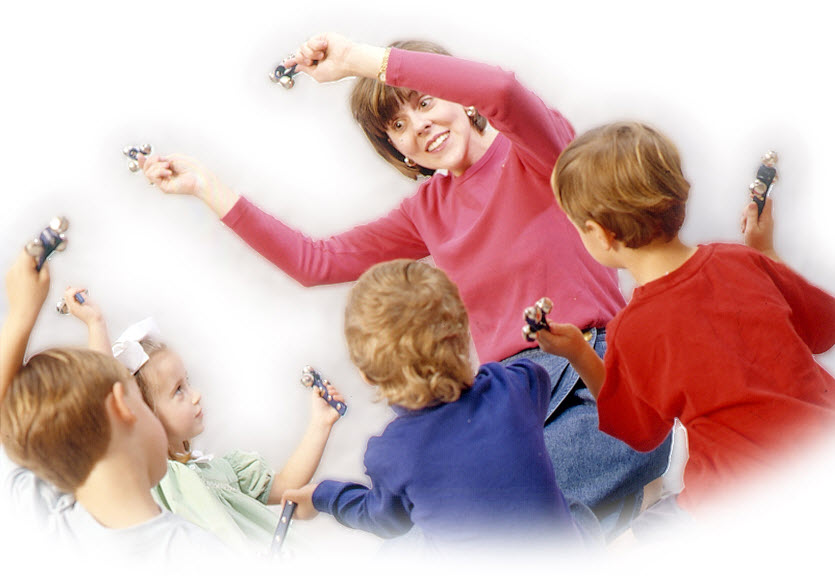
The developing brain is wired to learn as the body moves. To achieve the precision of the mature brain, stimulation in the form of movement and sensory experiences during the early developing years is necessary. Providing children with sensory-motor experiences, including activities that integrate visual information, sound, and find-motor movements, stimulate and strengthen the brain’s wiring patterns. When children play instruments, movement and sound come together to create a rich, multisensory experience.
(adapted
from http://earlychildhood.com/Articles?index.cfm?FuseAction=Article&A=360)

Who knew that playing instruments could have such significant impact on brain development and learning?! To inspire this kind of learning (and fun!) at home, it takes nothing more than a few favorite instruments and a few favorite recordings on the iPod or CD. For ideas for child-safe instruments, go to the Kindermusik Store and shop by age.
– Contributed by Theresa Case, whose Greenville, SC program, Kindermusik at Piano Central Studios, is proudly among the top 1% of Kindermusik programs worldwide.

 Here’s a great story from a Kindermusik Parent – we had to share!
Thank you to Fiona & Fiona’s Mommy for posting on the
Family Gathering Forum.
“Remember when I posted about when to start cleanup time with a toddler? I mentioned how in Kindermusik they have a “toys away” song that we sing each time we put materials away. Well, Fiona has recently made the connection and started applying the concept to cleaning up her own toys. She will sing, “put ’em away, put ’em away” and put her toys in the basket. She is still kind of playing at it, because then she will pour them back out and yell, “oh no, Max!” or “Dragon!” – in other words, Max from Max and Ruby is dumping the toys all over the floor, and she has to clean them up all over again. But she is definitely starting to really get the concept of it, which is great!
Also, tonight she used the same strategy when she was done with her dinner. In the past, I have had to really watch for when she was finished, because she would dump it in the floor. But tonight, she started singing that song, put the uneaten food on her plate, handed it to me, and said “tank you!”
I am so proud of her – the first night of Kindermusik when she threw a fit each time we had to put toys away, I had a hard time believing she would get to this point before turning two!”
We would love to hear your great experiences with Kindermusik, please share!
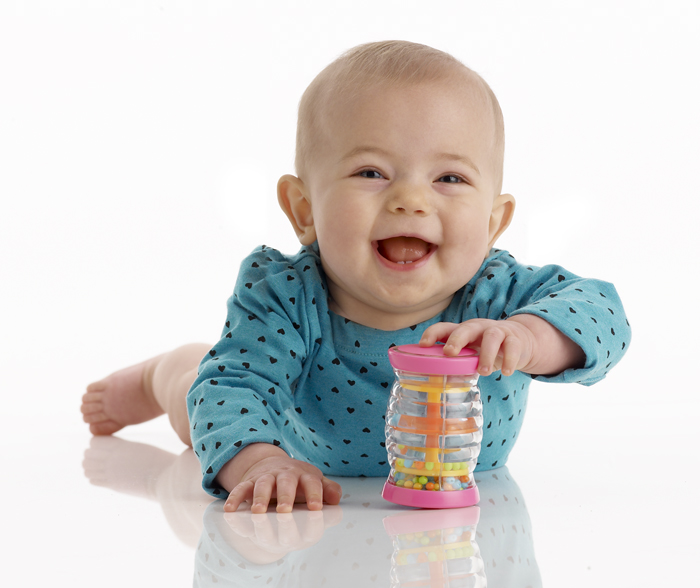
 Next to playing with mom, playing music is one of your baby’s favorite activities—and one of the most natural things your baby can do. Making sounds with easy-to-grasp instruments gives your baby an “I can do this” sense of accomplishment. Shaking a chime, her curiosity is instantly gratified and she’s inspired to make things happen again and again, encouraging independence and perseverance, twoimportant developmental skills.
Keep lots of baby-safe instruments within reach for free-play and exploration time.
For their light, high sounds, and special fit for tiny hands, some of your baby’sfavorite instruments will be:
Beyond the musical benefits, playing instruments like these gives your baby theopportunity to use his fine motor skills.
Grasping instruments between the thumband index finger or with a fisted grasp pattern encourages the development of these important skills, which will eventually be necessary to turn a page in a favorite book, pinch cereal or peas, grasp a cup, and even hold a crayon.
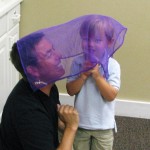

Your child needs more than exposure to music. Your child needs participation in music! He/she thrives on emotionally engaging music activities which integrate sight, sound, touch, and movement. Through these joyful music experiences your child is learning to love music for all of her life, plus a whole lot more!
Activities that incorporate learning through several senses are known as multisensory activities. In the Kindermusik classroom, every activity is a multisensory activity because we know that:
Our best advice? Think of your child as a string. If you push it, it bunches up. If you guide it along, it moves beautifully. So joyfully accept your child as he is, and work with him to make the most of his abilities as they relate to his learning style. We think it is worth restating the following quote this week in the context of our multi-sensory focus.
"Short-term memory has the ability to hold about seven bits of information. But when patterns and related groupings of information are bound together as a unit (as in our multisensory play) the volume of material stored increases. "
– Rhythms of Learning by Chris Brewer and Don G. Campbell
At Kindermusik, we support the wonder and uniqueness of each child, and we’re really proud of the way that the Kindermusik curricula embrace all learning styles by providing multisensory activities to appeal to as many of your child’s senses as possible. But we also recognize that it us up to the teacher and the parent to identify – and celebrate – the wonderful variety of learning styles that are in each class!
Compiled by Theresa Case, whose Kindermusik program at Piano Central Studios in Greenville, SC, is proudly among the top 1% of Kindermusik programs worldwide.

We are very thankful for all the wonderful Kindermusik educators in our communities, helping to change the world through music!
Help your child understand the importance of gratitude, by suggesting they thank their teacher for a favorite memory from their Kindermusik classes this year. This same concept can be used for any teacher, but we are especially grateful for our Kindermusik teachers and want to pass the message along.
Here are a few questions to ask your kids…helping them think about what they appreciate from their Kindermusik teachers. Encourage them to share these great experiences with their teachers:
- What was your favorite song at Kindermusik this year?
- Did you have a favorite book from Kindermusik class?
- What instrument did you like learning with your teacher?
The idea is to help our children understand teachers are very important in their lives, whether it’s their Kindermusik teacher, their school teacher, or even you…being a teacher to your children every day. Reflecting on gratitude is an important part of development for children (and adults) so remember to take a minute and think about what you’re grateful for – and express that with those who make a difference in your life.


We are on our way – and excited to network with other moms during many of the great events over the weekend!
Today is the official first day of the conference and so much to look forward to!
Tonight before the Welcome Party, from 6:00 – 7:00 PM, Kindermusik is hosting a little get together at Rumbar – at the hotel. We look forward to meeting some of the amazing working mothers that make this whole thing spin.
After all, that’s what this conference is about – initiating conversations between moms and marketers – and utilizing this feedback to make us better.
Friday and Saturday are filled with top-notch speakers such as:
As an online marketer for about 10 years now, this is a hot topic for me and one I’m personally very interested in. Knowing how the Kindermusik family utilizes social media, we know this is an important aspect of marketing moving forward. We are looking forward to learning new
trends in social media measurement.
Ok, so all of these are going to be awesome and hopefully the weather is too!
We look forward to connecting with other moms at the summit. If you’re not able to attend, stay tuned! I’m sure we’ll have lots to share after this great weekend.
— Shellie Foriska
Manager, Online Marketing
Kindermusik International
Children instinctively understand the language of music. Music draws children in, inviting them to match its pitches, incorporate its lyrics, move to its beat, and explore its harmonic and emotional dimensions. Music’s physical vibrations, organized patterns, engaging rhythms, and subtle variations interact with the mind and body. Even as music delights, it helps mold children’s mental, emotional, social, and physical development (adapted from Campbell, 2000).
Ideas for parents: You may not have any musical background, but you can be a musical parent by the kind of environment, experiences, and encouragement you give to your child to foster and support a love of music. Playing music in the home and car and taking your child to Kindermusik classes and later, to music lessons, are important aspects of musical parenting. The best gift you can give your child is to instill a love of music in the early years and then support your child as she pursues and develops that interest throughout the rest of her life.
– Contributed by Theresa Case, whose Greenville, SC program, Kindermusik at Piano Central Studios, is proudly among the top 1% of Kindermusik programs worldwide.