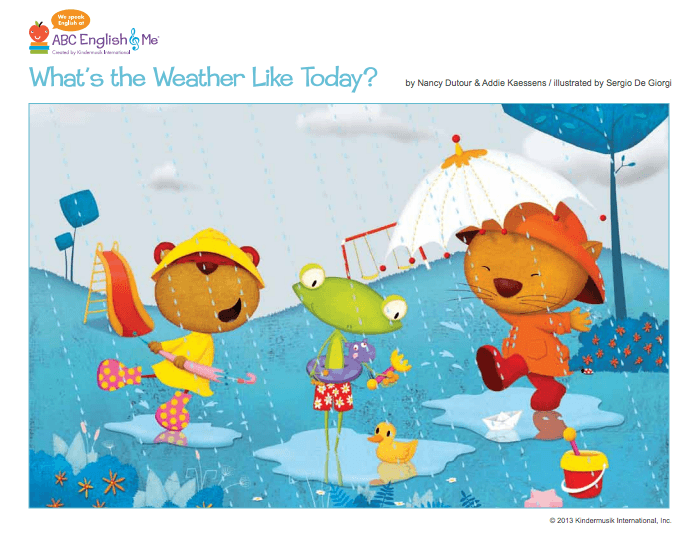
Sunny Day/Rainy Day uses the weather to help emerging language learners
There are so many songs to sing about the weather! Rain, Rain, Go Away … The Eensy Weensy Spider … and Let It Snow! This four-week unit combines your favorite children’s songs about the weather and combines them with interactive stories and activities — carefully created to help emerging language learners.
First, we’ll meet Teddy Bear, who is learning what to wear in the weather! Should he wear a rain hat in the snow? No! We’ll help Teddy Bear get dressed, learn colors and the English words clothing (such as blue jeans and rain hat), as well as help emerging language learners in your classroom develop rhythm, solve problems, sing, share, and take turns — all while developing a musical love for English!
Download the Sunny Day/Rainy Day Digital Teacher’s Guide
FEATURED SONGS
The Little Green Frog
I Like to Sing When the Rain is Falling
Eensy Weensy Spider
There’s a Spider on the Floor
Rain, Rain, Go Away
I Like to Sing When the Snow is Falling
‘Round and ‘Round
Let It Snow
Good-bye Song
VOCABULARY
snow/snowy, rain, sunny, bear, He puts on…, clothes: pajamas, t-shirt, sweatshirt, socks, shoes, jeans, shorts, sunhat, sunglasses, snow coat, snow boots, mittens, snow hat, raincoat, rain boots, rain hat, umbrella; colors: green, blue, red, yellow, white, black, brown, and more!
INTERACTIVE STORIES ACTIVITIES
In addition to singing songs and reading stories about Teddy getting dressed, children will receive paper dolls to bring the learning home!The Teddy Bear paper doll activity will help children learn to identify colors, such as yellow, and the English word for clothing, such as rain coat and rain hat.
Activities that encourage a child to move or STOP moving in response to a cue help the child develop inhibitory control.
This ability to control one’s own body movements is an important first step toward developing both coordination and self-discipline.
Tips for parents:
One start/stop learning game for kids is to turn on a favorite recording or song and have your child dance until you push “pause”. Then start dancing again when the music starts up again.
Learning Through Sign Language
You can also teach your child this ASL sign for STOP. Sometimes giving children something to do, i.e., making the sign for stop themselves, helps them be able to stop their bodies.
– Contributed by Theresa Case, whose Greenville, SC program, Kindermusik at Piano Central Studios, is proudly among the top 1% of Kindermusik programs worldwide.
By mid January, we’ve reached the tender time in New Year’s resolution making when our December 31st proclamations are either set to become a reality, or they’re fading into the holiday’s festive ghost.
2012 was a significant year for KI Green, most notably because:
We sold approximately 12,000 digital home material credits, eliminating the printing and shipping costs of nearly 3,000 home material kits per semester (4 months), which included books, CD’s, instruments, and packaging.
Through our Smart Wood Fund, we contributed $2,400 to the World Wildlife Fund’s mahogany protection program in 2012. We gave much more than our goal of $0.20 per dulcimer product established in our 2011 Sustainability report – we ended up donating $1 per dulcimer sold. We will continue to contribute $1 per dulcimer sold in 2013.
We engaged nearly 80 Kindermusik parents and educators through contest submissions for our Green Competition to celebrate the powerful efforts our community is contributing to save the planet. We want to double that number in 2013.
Photo Credit: Planet Forward
We’re proud of our achievements. But we can always be better. We were pleased to read Newsweek’s Top 10 Greenest Companies list and find many of these award-winning practices in play, on a smaller but powerful level, at Kindermusik – working remotely, going paperless, reducing company waste and recycling old products. These companies inspire us, but we are hungry to be challenged by our own community.
How can we be better in 2013? What resolutions do YOU have for KI Green? Comment below, or share on Facebook!
My eldest son, started Kindermusik when he was 5. He is in the Young Child music classes, which builds the foundations of musical theory & performance. He’s learning high and low, rests and beats (steady beats, of course), and is embarking on learning how to read music and play the glockenspiel (what many of us would call a xylophone). It’s a curriculum that’s easy to understand, especially being a musician myself, because it simply teaches the foundations of music through fun, interesting exercises, and at-home learning extensions.
When I had my second son, I thought it would be amazing to attend Kindermusik classes with him for the entire 7 year curriculum, knowing what I know about the benefits music & movement classes have on early childhood development. As a violist and vocalist married to a professional bass player who majored in music education, we believe in and understand the benefits of early exposure to music. This makes music very important to our family. Unlike many early childhood activities, Kindermusik has true lasting extensions that contribute to your child’s brain, body, heart & soul. The curricula is research-based and developed with key foundations of learning that improve cognitive, emotional, social, & physical development, which basically gets your child ready for school and life. So, of course, I decided to enroll my baby in January 2012.
We went to our first “Cock-A-Doodle-Moo” class this Monday and I was not 100% sure what to expect. I had a lot of unanswered questions… How will my 7 month old react to a room full of strange people? Would he cry the whole time because he’s teething really badly right now? Will he be screaming when all the other kids are quiet and quiet when the rest are engaged? Would all the other Moms already know each other from last semester? Would I or my son be judged by the other Moms? I had already watched this Kindermusik video, which did help alleviate some of my concerns (but I was still a little apprehensive)
Here’s what I learned in my first Kindermusik baby music class:
You will need “sole!” Shoes have to come off and there’s a lot of floor-based sitting & activities. A lot of the parents had really cute socks on, knowing this. Comfortable clothes that cover your derriere, when sitting, are also a must!
A good voice is nice to have, but not necessary! Our class is focused on the farm and includes familiar children’s music, folk songs, & nursery rhymes. Everyone who wanted to sang could, but there was no pressure; the educator carried the singing. There were about 8 kids in the class, mostly Moms, but and 2 Dads (both musicians, with the best voices in the class, by far)!
All ages were welcome! All the babies were aged around 6 months to 18 months, although the class is open to newborn+. The activities seemed to be enjoyed by all ages.
What a work out! One unadvertised bonus of Kindermusik is that it is a good way to lose some baby weight! I moved, grooved, marched (forward and backward), rocked, swooped, laughed, sang, and danced with my near 20 lb. baby in my arms. Phew!
Baby bonding at its best! The class is a great opportunity to bond with your baby. We spent some quiet lullaby time with lights off, looking at the twinkly lights on the ceiling. We also spent some time doing baby massage, which I know is really beneficial to the parent-child bond.
Parents can be parents. Like everywhere else where you have parents gathering, people do compare their babies to yours and their development too. Many love talking about their experiences as a parent and this is a perfect “Mommy and Me” class environment for it. (Again, Dads were welcome and there too!) In my case, I was proud to hear others say, “Wow! He’s 7 months old and THAT mobile?” *Blush* But, considering my two children developed VERY differently, I could see myself questioning my child and his abilities – comparing him versus the others. A good Kindermusik educator should ensure to set expectations to all parents in the room, celebrating the individuality of every child in the class. And, being in a social environment with other children is such a good motivator for little ones. Kindermusik has had a lot of success with special needs children in the classroom because they have a chance to interact with other children through enjoyable learning activities.
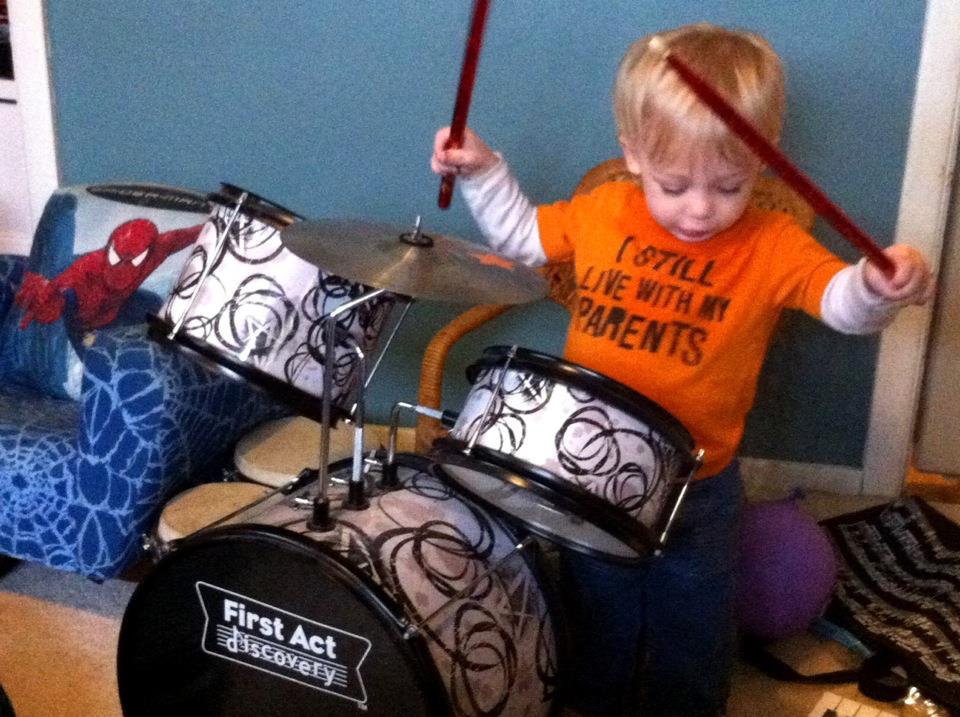
Kids do the darnedest things. For the first class, your baby or child will be a little out of his element. My little one kind of sat there and looked around. Although he is very mobile and is usually off like a rocket shot, he DID cling to me and seem a little surprised about everything around him. He clung to me a lot of the time and we had to do some modified movements; for example, he was NOT all about laying still for the massage. But, we cuddled and had a moment anyway! He LOVED when we would walk around/march and sing. The grin on his face during those activities was enough to make the class worth it times a thousand.
Kids are seriously cute! If you like kids, Kindermusik music classes seriously equal cuteness overload. Babies are free to break free in these classes, explore, meet other little ones, and just have fun. Educators guide the classroom through activities, but in a flexible way that makes the little ‘extras’ that the kids do just a part of the fun! I haven’t laughed so hard as I did when a little 10 month old girl walked up to another baby boy and spent an entire activity hugging and making faces at him. It was just too much.
There is a definite sense of community! There is a good chance a lot of the other families will know each other. People who go to Kindermusik classes tend to put all of their kids in classes, building a community amongst themselves over time. And, semesters build on each other. So, if you’re in the Monday at 11:30 class in the fall semester, you’re likely to continue with the same group for the spring semester. I (and one other latecomer) were the sole ‘new families’ in our class. This meant that introductions meant “everyone introduce themselves to Jamie!” I had a friend in the class, which made it extra fun and everyone was very open and friendly.
I GOT OUT OF THE HOUSE AND TALKED TO ADULTS FOR A SECOND (even if it was between songs!) It was really nice for me to meet other Moms of children the same age, since I am one of the first in my group of girlfriends to have had children.
Ilearned all kinds of fun things! Our Kindermusik classes are chock full of what are called “Foundations of Learning” (or FOLs) that explain why you do each activity and how it helps your little one develop his brain or body. Kindermusik prides itself on providing applicable parenting resources and at-home learning tools with each of its classes and sends you home with all kinds of fun educational tools for you and your little one!
Well, it was an interesting first year of Kindermusik class. As my little one passed his 1 year birthday, he became interested in simply running and colliding with every child in Kindermusik. Since there were newborn babies in that class who looked as if they could be fragile, I made the decision to move him into another class more suitable to his developmental needs – and was thrilled that his Kindermusik teacher and studio owner was able to work with us to find a better class match. We moved up to a Family-based class, where he fit in much better (and couldn’t accidentally kill any babies) – and was also sometimes on the receiving end of a collision. Huge progress!
The year in music was the best ever! Both of my little ones are so musical, it’s incredible. My 18 month old bangs on drums and literally sings day and night. His favorite toys and activities play music. Anytime music comes on anywhere, he dances! He has been using sign language, much learned in Kindermusik class, to communicate. And, is highly interested in books and other learning games related to music class. As a family, we really enjoyed the digital Kindermusik @Home learning materials provided through those classes too and have still been dancing to the songs and reading the eBooks almost every day. And, now, every time it’s time for music class, my 18 month old races off, grabs his sneakers, and sits at the door, waiting for us. I’m so excited he will get a full 7 years of benefit from this program!
Here he is, in his musical element:
One Year Later, a Typical Kindermusik Kid!
The author attends Kathy’s Music with her two sons in Pittsburgh, PA. Her 6 year old has been known to say some very cute things about music class, including: “I love Miss Kathy. She’s the best teacher ever. Can you tell her that?” and “Music class is the best part of being a kid.”
The town of Cateura, Paraguay, is the largest landfill in a nation long-suffering from political and economic corruption. The world’s poorest children take the brunt of environmental injustice. As the primary landfill for Paraguay’s capitol, Asunción,
1,500 tons of solid waste are dumped in the town every single day. One third of the population, about 2.2 million people, live on less than $2 per day.
A violin costs more than the average house.
Still, this is a city thriving with young musicians. Over 8,000 students in 120 Paraguayan communities are engaged in a Swiss NGO’s Sonidos de la Tierra (Sounds of the Land) Initiative to bring classical and folkloric music to children. Not only are these children taught to play music, they also learn how to build and repair musical instruments found in the landfills (or supplied through grants).
Alberto made a drum out of an X-ray of a spine. His teacher made a guitar from sweet potato cans. This initiative champions our core values and proves that sustainability is more than a watery notion of “going green.” Not only does it exhibit creative solutions to an environmental disaster, it has established sustainable social impact and a changed community – one that is empowered through musical education – truly changing the world for children through music.
(Source: Carol Read’s ABC of Teaching Children blog)
“Use your words.” Early literacy and preschool teachers, parents, grandparents, and other caregivers can often be heard patiently saying that same phrase to young children throughout the day. Teaching and encouraging children to use words to express thoughts, feelings, and opinions not only supports a child’s social-emotional development, but also increases vocabulary acquisition. Not surprisingly, new data released from the National Assessment of Educational Progress shows a strong connection between vocabulary acquisition and literacy.
Connections between literacy and vocabulary acquisition
The report released last month compares vocabulary results from 2009 with 2011 reading assessments. Both assessments were based on nationally representative samples of fourth-graders, eight-graders, and twelfth-graders.
Fourth-grade students performing above the 75th percentile in reading comprehension in 2011 also had the highest average vocabulary score.
Lower-performing fourth-graders at or below the 25th percentile in reading comprehension had the lowest average vocabulary score.
At both grades 4 and 8, the average vocabulary scores for at risk students were lower than the scores for other students.
Using music as part of an early literacy curriculum
While this report measured literacy and vocabulary abilities of fourth, eighth, and twelfth graders, we know that vocabulary acquisition and literacy begin much earlier. ABC Music & Me, an early literacy curriculum created by Kindermusik International, uses music to support young children’s early literacy and language development, including vocabulary acquisition. Picture vocabulary cards support unit-by-unit vocabulary, comprehension, memory, and pre-literacy skills. The ABC Music & Me early literacy curriculum is full of vocabulary-building opportunities. Our stories, songs, and activities introduce students to hundreds of words and their meanings.
For more information about using the ABC Music & Me early literacy curriculum in your classroom, school, or district, email us at info@abcmusicandme.com.
The annual Consumer Electronics Show is in full swing right now in Las Vegas, unveiling all the gadgetry and geekery your heart desires. New word nerd alert: Phablets, a phone and tablet combo. A fork that tells you to slow down, a lost luggage gadget tracker, and a new iPhone case to make the metal surface more interactive on the mobile phones are among the more novel offerings, per CNN.com.
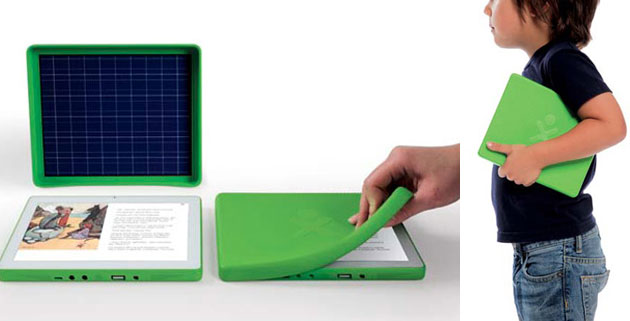
But we’re most curious to hear about the new leaps being made in the tablet market, and thrilled to hear how these devices are getting more kid friendly.
1. Have you always had a green approach to teaching your KI Jonesboro class?
Yes, our city of Jonesboro started their recycling program right after my family and I moved here in 1995. We began participating immediately by recycling all #1 & #2 plastics, clear glass, aluminum cans, newspapers & cardboard. I started my KM business a year later and I wanted to continue that same proactive approach there as well.
2. We all know what we should do when it comes to protecting the environment. What inspires you to act rather than to passively accept these overwhelming issues?
I was taught at an early age that I should take care of what I have, take pride in my personal belongings and space, be a good steward of our God given resources, and do my best to make my little corner of the world a little cleaner, healthier, and safer, and better for others. I was raised in the 1970’s & 1980’s when it was common to read the popular slogan “Don’t Be A Litterbug! Keep America Beautiful” on park and street signs. It was a time when littering was considered an unpatriotic thing to do. Unfortunately, as materialism and wealth have increased in our nation over the next two decades, many citizens became complacent and the overabundance of trash and lack of landfill space became a real concern. It is encouraging to see that the campaign for “going green” is a way to bring the public awareness back to the forefront so Americans will become proactive with their efforts to conserve and recycle.
It is no secret that parent involvement in early childhood education can be a pivotal factor in a child’s academic success, especially early literacy. In fact, research shows that children’s reading achievement, vocabulary, and comprehension skills improve when their parents read to them.
While the benefits of reading together and modeling the joys of reading may be common knowledge in early literacy circles, a new study published by the UK’s National Literacy Trust shows a widening gap between the reading habits of mothers versus fathers. The National Literacy Trust surveyed 21,000 8- to 16-year-olds from nearly 130 schools in England, Northern Ireland, Scotland, and Wales. One of the revealing trends indicates that fathers’ involvement in reading and literacy is significantly less than mothers and continues to decline.
“It’s a continuum, not a category, over the course of a lifetime. If you think of them as emergent learners, you will never leave behind their languages and their cultures.”
García wrote “Bilingual Education in the 21st Century: A Global Perspective”, a massive text on the topic, and is a globally-known speaker and advocate for promoting a translanguaging, an approach to emerging English learners, where speakers switch from one language to another. It’s a bottom/up understanding of the bilingual learning process, García says, instead of top/down.





 By mid January, we’ve reached the tender time in New Year’s resolution making when our December 31st proclamations are either set to become a reality, or they’re fading into the holiday’s festive ghost.