
Recommendations for reaching Hispanic ELL preschoolers

As children, many of today’s preschool teachers probably picked up a Spanish word or two while watching Sesame Street. (Anyone else remember Luis looking for agua?)

Now, with people of Hispanic descent making up the fastest growing segment of the population in the United States, those same educators teaching a daycare or preschool curriculum probably can put those words to good use in the classroom. However, effectively teaching English Language Learners in preschool takes more than speaking one or two words in Spanish.

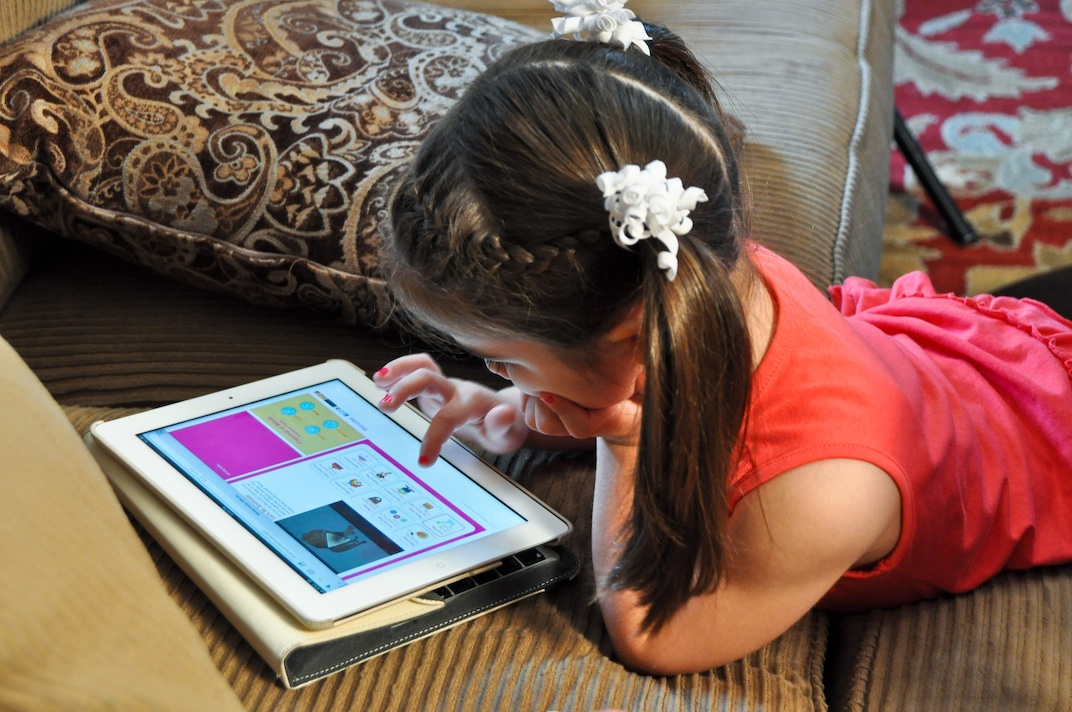
Hispanic ELL students in preschool

(Source: Hispanicallyspeakingnews.com)

Longitudinal studies show the lasting effects of a quality preschool curriculum on at-risk students, including increasing the likelihood of graduating high school and attending college. While these studies primarily focus on at-risk children in general, many of today’s at-risk students are English Language Leaners. In fact, 21 percent of all children under the age of 5 are Hispanic (although not all are English Language Learners). A recent policy brief published by NIERR (National Institute for Early Education Research) asks whether or not today’s preschool curriculum is preparing Hispanic children in particular to succeed in school. The report outlines recommendations for decision makers to consider when evaluating or establishing a preschool curriculum or program.

4 recommendations for states to consider for Hispanic English Language Learners in public preschool, according to NIEER

  1. Evaluate preschool education policies with Hispanic children in mind. If ELL status is not a factor considered for targeted program eligibility, a consideration should be given to making it so.
  2. As future programs expand, conducting comparative analyses of targeted programs and PreK for all children may prove useful. Universal programs can cost less per child and resolve problems of eligibility.
  3. States should ensure programs have some support for ELL children in their home language. Research shows that preschool curriculum that also supports the language used at home improves cognitive, linguistic, and social outcomes.
  4. It should be a high priority at the state and federal levels to develop better reporting systems to ensure quality data for stronger research on Hispanic children and early education policies.

You can read the full policy brief here: “Is Public Pre-K Preparing Hispanic Children to Succeed in School?

Use music to teach ELLs early literacy and language development

Every child speaks music! ABC Music & Me uses music to teach early literacy and language development and school readiness skills to young children and engage families in their children’s education. The research-based curriculum can be especially beneficial for English Language Learners. In every unit of ABC Music & Me, children hear stories read aloud and sing songs that include new vocabulary words. Words essential to the unit’s theme are included on picture cards along with recommended instruction for ELL students, expanding the possibilities for vocabulary acquisition. Plus, ABC Music & Me aligns with Title III requirements and our “English Language Learners Strategies Guide” provides unit-by-unit, lesson-by-lesson tips.

According to the NIEER report, Hispanic families continue to encounter barriers to sending their children to preschool, including lack of parental education and language barriers. However, we build parental involvement right into our preschool curriculum, because we know that a parent is a child’s first and best teacher. ABC Music & Me includes materials in English and Spanish, including robust literacy activities, to increase parent involvement and support the common language spoken in the home.

For more information about using ABC Music & Me with English Language Learners or other young children as a preschool or toddler curriculum, email us at info@abcmusicandme.com.

Lessons from “How I Forced My 5 Year Old To Become an Environmentalist”

Recently, treehugger.com published an article by mother Meaghan O’Neill called “How I Forced My 5 Year Old to Become an Environmentalist, or, an Interview with Philippe Cousteau.”

This article is worth reading for a few reasons. First, we can all probably understand Meaghan’s guilt towards being her family’s own environmental role model– ordering take out, driving daily, and buying too many toys. But more importantly, Meaghan’s active role in the environmental community has created some amazing opportunities for her family to meet leading environmental authors, scientists, and speakers. Not only does Meaghan work with her son at home to instill environmental values– telling him to protect “his island” where they live, pick up trash on the beach and learn about the many species sharing their habitat– she continues to grow herself by attending attending national environmental conferences and staying engaged in the forefront of the movement.
Meaghan was lucky enough to arrange for her son to talk to Philippe Cousteau, founder of Earth Echo International, a non-profit dedicated to empowering youth on water issues. Cousteau’s newest book, Make a Splash, a children’s guide to helping oceans, rivers, and wetlands by taking action– going outside, exploring, researching, and being “political” by reminding their parents, teachers, and friends about water issues. It focuses on execution of these ideals by helping them keep a log of their project plan and activities.

We agree with Meaghan that hiding children from the world’s harsh truths is not beneficial; rather, parents should focus on explaining these issues early on in terms their children can understand. Make a Splash examines oil spills, climate change, and extinction without being cutesy or too “gloom and doom.” If you like the book, you can also check out the video game, “Rescue Reef,” Philippe developed.

Being an environmentalist is a dynamic, changing role. Learning is an environmentalist’s chief responsibility– then teaching. As parents, we should check our own instinct to teach teach teach, making sure that the information is new and improved by the ever-changing scope of scientific research.

The 2013 We Love Kindermusik Winners!

We Love Kindermusik Contest Winners!

We Love Kindermusik Contest Winners!
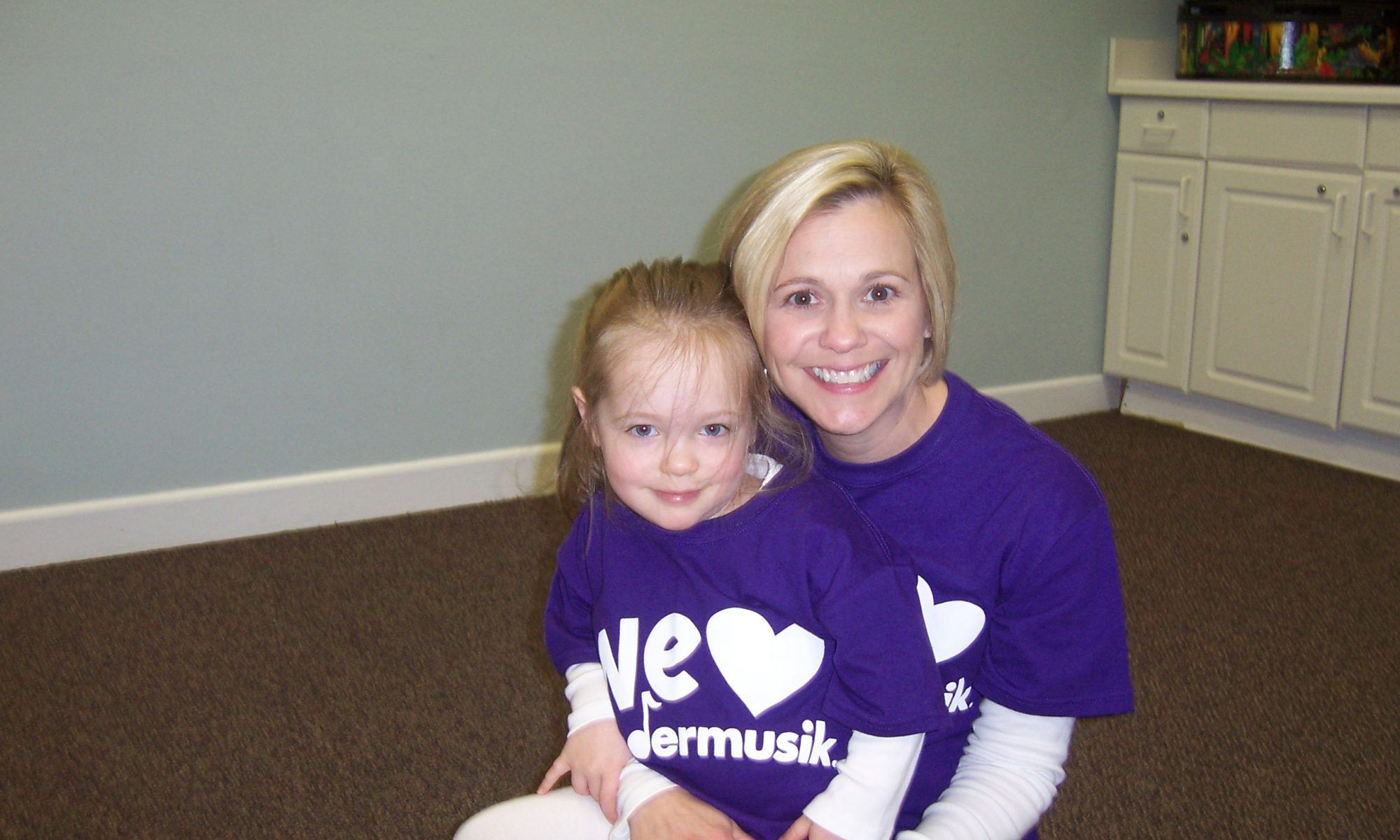
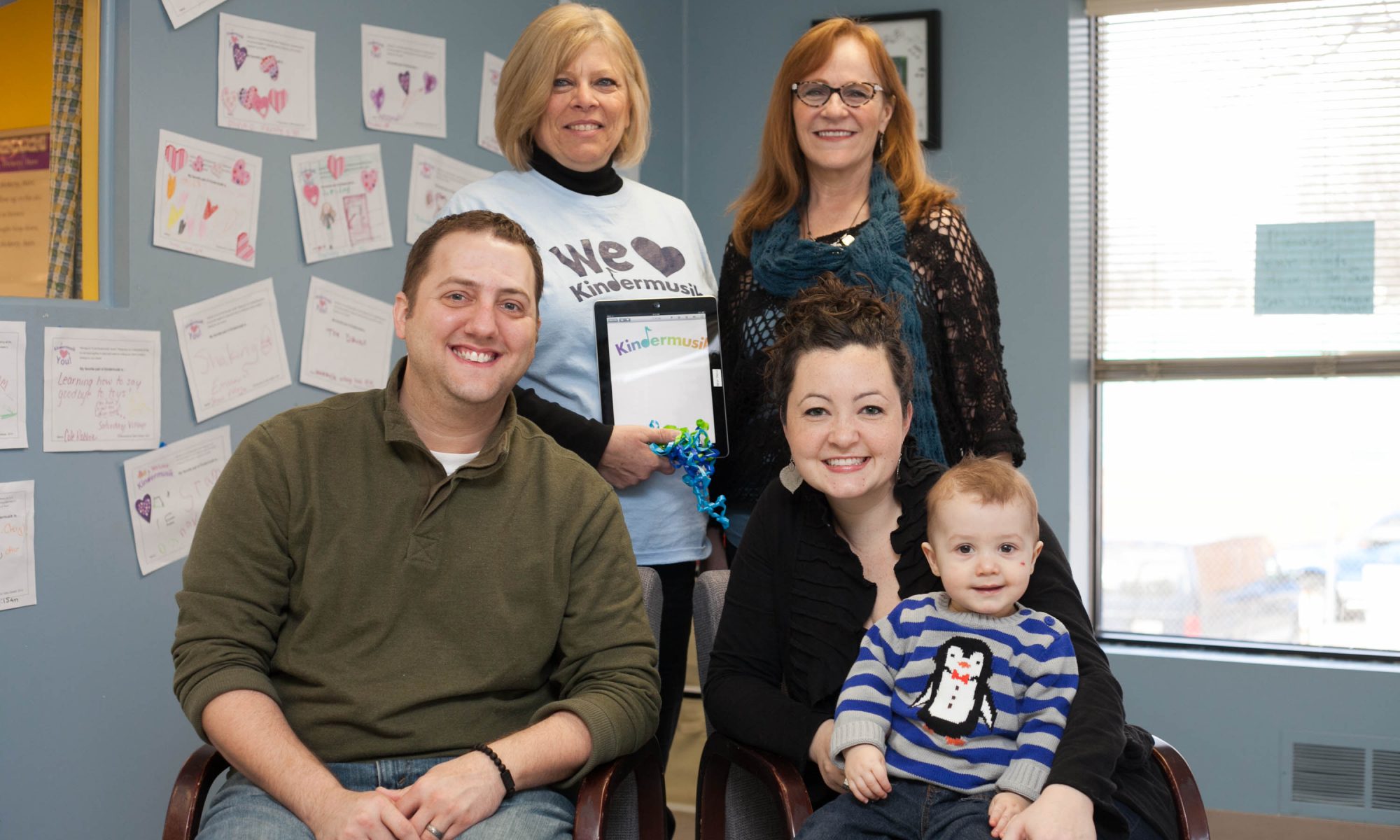
**CONTEST WINNERS** Upper: Cathy Siebert (Owner/Educator), Cheryl Bruemmer (Educator) Lower: Geoff, Kate, & Lukas Schwerzler

Drumroll, please! After receiving an unbelievable 2,114 valid entries, we are so pleased to announce the winner of the first We Love Kindermusik Contest as The {super adorable} Schwerzler Family of the Kindermusik Cathy Siebert, LLC Studio, also a winner!

Kate Schwerzler’s randomly selected, winning entry was:

We love Kindermusik because it is instilling the love of music in our child at a young age! He is learning beat, friendship, songs and more. We see him at home playing with instruments and loving everything there is to love about music!

Studio-owner, Cathy Siebert, has known Kate {the Mom of the family} since she was in 2nd grade and took piano lessons in Cincinnati, Ohio, back in the early nineties. She says, “It’s been fun seeing her grow up. I happened to reconnect with her on Facebook and enjoyed “seeing” her get married, become pregnant and meeting Lukas. Lukas began taking Kindermusik in January and we are so happy to have the family in our program!”

Winning the We Love Kindermusik contest was particularly exciting this year because Cathy Siebert is celebrating her 25th year of being a Kindermusik educator!

On why she loves Kindermusik, Cathy said, “I have enjoyed being a part of so many family’s lives for so many years. One former Kindermusik graduate is a Rhodes scholar (in music composition), another just returned from the Peace Corps, one is an art educator and two former students just graduated with degrees in Music Education! Working with a child until they match pitch or seeing their compositions in Young Child still makes teaching Kindermusik a joy!”

Mom, Kate, was very excited to win and REALLY loves Kindermusik now! 😉 She thinks her sweet boy will love Kindermusik @Home and she can’t wait to see how much he learns!

Congratulations to the SchwerzlerFamily and the Kindermusik Cathy Siebert, LLC studio!

The Schwerzler’s won:

  • A new iPad
  • A full year access to Kindermusik@Home, our digital learning platform
  • $500 to charity of choice

*The charity the Schwerzler chose to receive this donation is the Valley View Foundation. It is a fantastic nature preserve attached to Pattison Elementary School, where Mom Kate works (and uses the nature preserve in many of her students’ lessons)! The donation is in honor of principal, Mr. Gregg Curless. He is retiring this year and he has a great love of nature (and music!).

The Kindermusik Cathy Siebert, LLC Studio won:

  • A new iPad
  • $500 of digital home materials credits

We want to thank you ALL for taking the time to spread the Kindermusik love this year.

Here are some great contest entries we’d like to share!

We Love Kindermusik

Kindermusik has changed our lives and along with music came many lifelong friendships for me and my children. I am such a true believer in music shaping a child’s brain, Kindermusik is one of those things…I could not imagine our life without.

We love Kindermusik because it’s “our thing,” special time together for me and my daughter. I recommend Kindermusik to everyone I know with young children. It is the best money spent because the lessons last forever!

We love Kindermusik because of how inclusive their classrooms are! My daughter is 3 years old and is autistic. The teachers at Kindermusik have gone above and beyond to make sure that we were comfortable in the class and always email us to see what they can do to help our daughter feel more included. My daughter has gone from being non verbal to singing and participating in class, which is a huge change compared to when we started a year ago with Kindermusik. We are forever grateful to have found such an accepting program that truly values every child that walks in the door. Thank you Kindermusik for making my daughter smile every week!

Kindermusik has many valuable aspects – music, play, socialization, child and parent interaction, singing and make believe. It is a happy time in the week that is fun for the whole family.

I love Kindermusik because it’s a wonderful way to allow my daughter to interact with other kids in a fun, safe, and educational environment. I love to watch her blossom.

My son, Tyler (2), and I started taking kindermusik classes last winter, when he was just a year old. Tyler, who was born with Down syndrome, has grown and learned so much over the last year because of this class. At first, he’d just sit and watch all the other children, while swaying to the music. As time has gone by, he’s become much more engaged and interactive with other children, which has been amazing, as his parent, to watch. Other moms now joke with me that he could be running the class. He loves to scoot into the middle of the circle and he watches everything Ms. Peggy does, often mimic-ing her. He loves all the instruments and he loves music so much. He’s also using a tremendous amount of sign language signs throughout the class, so his communication is so much better. I’ve witnesses so much growth since we’ve started these classes. The socialization alone, with other children who are both typically developing and who have special needs, has been invaluable.

Kindermusik is a chance for my son to learn and explore through movement and music. It awakens his senses, teaches him life valuable skills, and provides bonding time for the two of us. He is so happy when he is in Kindermusik class!

When I went to a trial of Kindermusik I thought I was going to a singing class. It is so much more. Children learn to share, listen, express themselves and they don’t even know they are learning. They have so much fun and for my daughter, it increased her confidence 10 fold. Thank you Kindermusik.

Have a LOVELY & MUSICAL day!

[youtube]http://www.youtube.com/watch?v=exbOByiFtMo&context=C3229ac6ADOEgsToPDskKlO2Eiy4jnX15O78vWuD8w&h=320&w=480[/youtube]

Early language development helps toddlers manage emotions

(Source: Raisingchildren.net.au)

Make no mistake. Toddlers wear their hearts on their sleeves. No one expresses pure emotion quite like an 18 month old. From the sheer delight of enjoying the sticky goodness of an ice cream cone to the depths of despair when it’s time to leave the playground, toddlers give Oscar-worthy performances daily.

Child development research shows that parents, preschool teachers, and other caregivers can support the early language and early literacy development of young children by labeling those emotions and encouraging young children to use their words. Now, a new longitudinal study published in the journal Child Development indicates that toddlers with stronger early language skills show less anger as preschoolers.

Early language development helps preschoolers manage anger

Researchers studied 120 children starting at 18 months old until they turned 4 years old. Through home and lab visits, the research team measured children’s language development and their ability to cope with tasks that might lead to frustration, such as waiting to open a present. The team found that children with more advanced early language development skills at 18 months old and whose language abilities increased more quickly than other children expressed less anger at age 4. In addition to waiting patiently to open a present at age 3, the children with more language skills calmly sought their mother’s support while they waited. By age 4, those same children were better able to occupy themselves by talking out loud during the wait.

“Better language skills may help children verbalize rather than use emotions to convey needs and use their imaginations to occupy themselves while enduring a frustrating wait,” explained Pamela M. Cole, PhD, lead researcher, in a press release.

Early language development through music

Created by Kindermusik International, ABC Music & Me uses music to support young children’s early literacy and language development, including vocabulary acquisition. The ABC Music & Me early literacy curriculum is full of vocabulary-building opportunities. The Picture Vocabulary Cards in our preschool curriculum support unit-by-unit vocabulary, comprehension, memory, and pre-literacy skills. Plus, our stories, songs, and activities introduce students to hundreds of words and their meanings. In addition, we provide materials to increase parent involvement in early childhood education by connecting the learning from the classroom into the home.

For more information about using the ABC Music & Me early literacy curriculum in your classroom, school, or daycare, email us at info@abcmusicandme.com.

Steady Beat: It’s more than just music!

Kindermusik was fortunate to contribute a guest blog post on the Reading Rainbow blog. As our missions align in inspiring children through reading and music, we are grateful for this opportunity and are excited to share it with our community!

Special Guest Post: Kindermusik – Steady Beat: It’s more than just music!

You’ve been there. You’re driving in the car and you find yourself unconsciously nodding your head or drumming the steering wheel to the beat of the music you hear. Thanks to the steady beat of our hearts, we are naturally wired for responding to a steady beat. Even infants are born with the ability to keep a steady beat – their own internal beat, particularly after 9 months of hearing Mom’s heartbeat or her singing while in utero! However, the ability to consciously recognize and demonstrate steady beat takes practice, and can lead to far greater moments in child development.

Why steady beat matters in music, child development, and reading

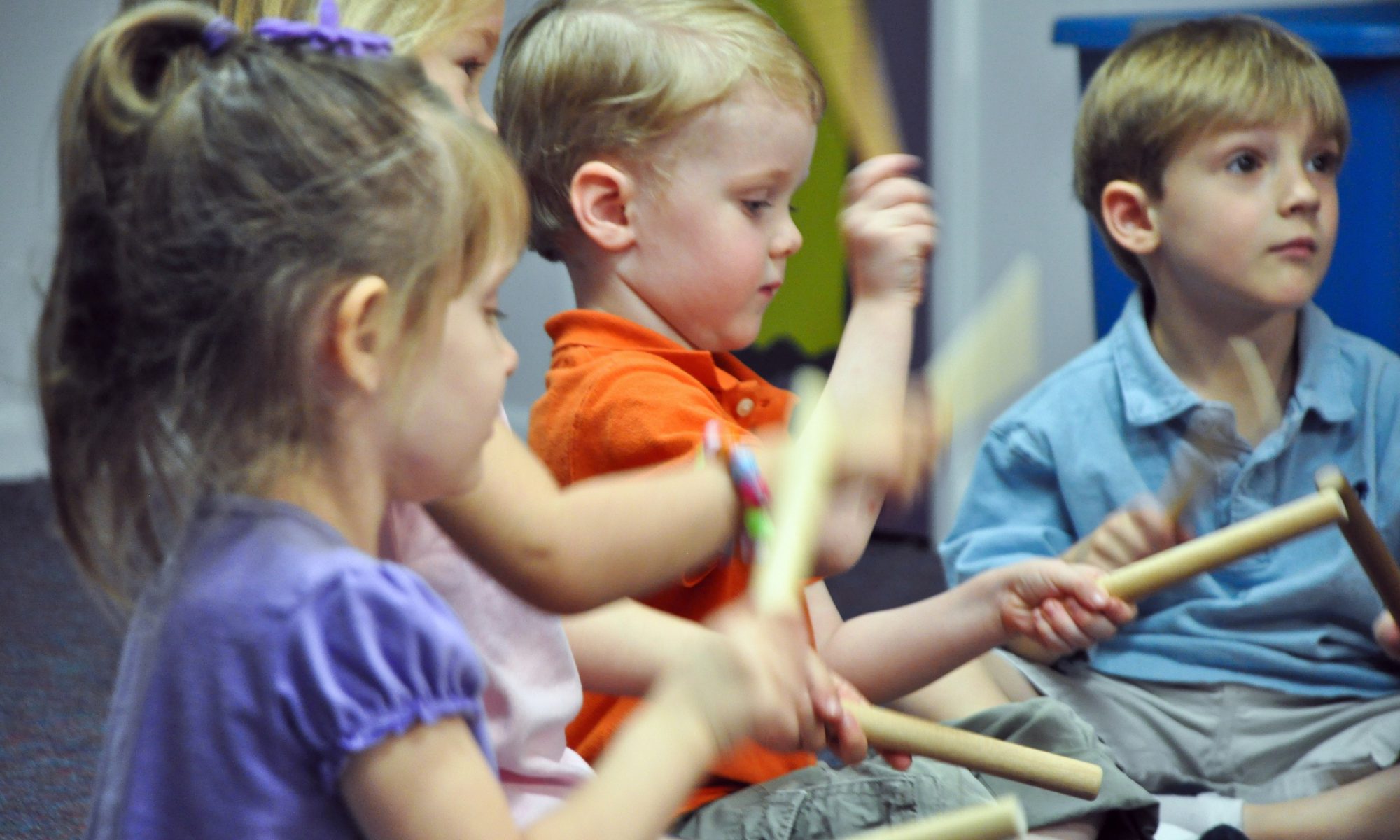
The most basic property of music is steady beat: the underlying, unchanging, repeating pulse. If you’ve ever come to a Kindermusik studio class for toddlers, babies, big kids, or families, you’ll notice that we include a steady beat activity every week, in every age group from newborn to 7. It might involve instruments, reciting nursery rhymes, singing, dancing, lap bounces, rocking, or even tiptoeing.

There’s a reason for that.

We know that the capacity to identify and maintain a steady beat can be used for more than singing or playing an instrument.

For babies

Exposure to steady beat (hearing it, feeling it, “seeing it”, and being moved to it) is natural for babies, but very important for a their developing sense of steady beat and the world around them. An internalized awareness of beat and rhythm helps a baby to coordinate movements.

For 18 months through 3 years old

At this age, children are learning to control and coordinate their body’s movements. The ability to keep a steady beat helps them to walk with a smooth gait, leading to running, jumping, and dancing with confidence.

For preschoolers and early school-aged children

Steady beat competency is central to the development of movement organization, such as marching in time, dribbling and shooting a basketball, using scissors, and writing smoothly.

But that’s not all! The best thing about steady beat is its contribution to early literacy and language development.

An understanding of the concept of a steady beat helps a child speak and read with a smooth cadence, thereby enhancing communication abilities and reading comprehension.

After all, the same sense of steady beat experienced in music can be experienced when reading. Ever try reading a Little Blue Truck book without a sense of rhythm or steady beat? “Beep, Beep, Beep went the little blue truck!” just wouldn’t be the same without it! It’s no wonder that research shows children who can keep a steady beat score higher on reading assessments. They also rate higher on math tests and show stronger behavioral skills.

4 steady beat activities for families

As a child’s first and best teacher, parents and primary caregivers can set their child on a path to “go anywhere and be anything!” Try these activities together to reinforce a sense of steady beat and support a child’s emerging literacy skills:

1. MOVE: Turn on music and pretend to be a marching band. March, stomp or jump to the music. Dance with them around the room to the steady beat of the music.

2. Play Instruments: Use children’s instruments or make your own. Practice keeping a steady beat along with the music. Homemade drums (like a pot + wooden spoon) and instruments are great additions to your pretend marching band or family dance party!

3. Read and Sing Nursery Rhymes: Clap or tap along as you recite your child’s favorite rhymes.

4. Have a Steady Beat Treasure Hunt: Search for things that make a steady beat. The clock? Dripping water? Microwave timer? How many can you find?

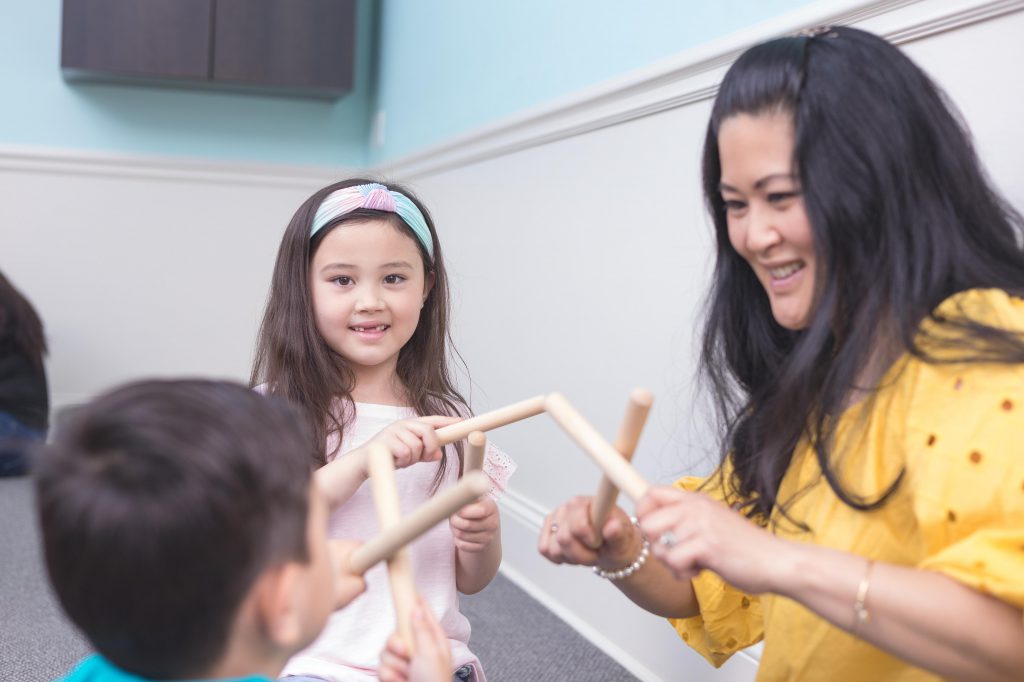
Want to boost steady beat skills in a group music and movement class? Find one near you. You can also check out our rhythms sticks—a great instrument for practicing steady beat! For teachers, check out how you can infuse these steady beat activities into your day through one of our audio-led curriculum kits.


Reading Rainbow wants to thank Kindermusik for contributing to their guest blog on early literature and music. We appreciate their support in our mission to inspire a love of reading in children and connect them to the world they live in through quality literature so they can “Go anywhere. Be anything.

Digital learning in the early childhood classroom (and at home!)

Have you seen the video of the one-year-old child interacting with her father’s iPad and then a print magazine? After touching the tablet screen to make images increase in size, she tried doing the same thing to pictures in a magazine. Of course, that didn’t quite work!

Most children today will never remember a time before the Internet, smart phones, and tablets. Not to mention, with 30 percent (and rising!) of today’s college students taking at least one online class, higher education will look quite different for our children.

Digital learning and early childhood

Children engage in digital learning from an early age. Even the youngest child can model the actions of a parent talking on a smart phone or reading an eBook. A recent report, Take a Giant Step: A Blueprint for Teaching Children in a Digital Age, published by the Digital Age Teacher Preparation Council, includes strategies and tactics to better equip preschool and elementary teachers to provide age-appropriate digital learning opportunities for young children.

“Teaching young children today demands a new approach to an exciting but increasingly complex set of challenges,” said Linda Darling-Hammond in a press release. “Quality early learning programs in our digital age will be led by highly prepared, flexible teachers who can effectively integrate what they know about healthy child development with the resources of an always connected, thoroughly modern environment.”

The report highlights the understanding that integrating digital learning into early childhood works best when it enhances children’s engagement, such as talking, interacting, manipulating, pretending, reading, constructing, and exploring. (Sounds like a Kindermusik class to us!) In order to help early childhood educators best capture the power of digital learning, the report outlined several goals to accomplish by 2020:

  1. Advance technology integration and infrastructure
  2. Modernize professional learning programs and models
  3. Expand public media use as a cost-effective asset for teachers
  4. Create a Digital Teacher Corps

Digital learning: making connections between the classroom and home

In one early childhood digital learning study featured in the report, researchers worked with a Kindergarten teacher and her five- and six-year-old students. The researchers loaded math activities, video clips, and digital worksheets onto tablet computers. The tablets also included material for parents on the goals of the activities and information on the math topics and keywords the students learned at school. For homework, each student received a tablet to take home for four weeks.

After the four weeks ended, parents said that they felt more connected to what was happening in the classroom and were better able to offer their children help because they knew exactly what they were working on and what concepts they should understand. Plus, children spent more time on their homework and improved mathematics skills.

Digital learning and eBooks with Kindermusik@Home

After more than 30 years of developing early childhood curricula, including music classes for toddlers, babies, big kids, and families, we understand that the days may pass slowly but the years fly (or dance) by. One day a baby may be taking her first steps in a Village class and seemingly the next day she is walking across the stage to receive a high school diploma. Wow. Talk about a fast dance.

Kindermusik@HomeWe know that music can impact a young child in profound ways and can set a child up for early academic success.  We also know, as the above report showed, how important technology fluency will be to your child, which is one of the reasons we created Kindermusik@Home. With Kindermusik@Home, families can engage in age-appropriate digital learning, such as virtual field trips and active listening games, read eBooks, and download all the music from class. Kindermusik@Home connects the classroom learning with a family’s everyday life, making the learning (and fun!) last throughout the week.

To learn more about enrolling in a Kindermusik class and receiving access to Kindermusik@Home, contact a local educator via our Class Locator.

Schools, preschools, and childcare centers can also benefit from Kindermusik@Home. To learn more about bringing our digital early learning curriculum into your classroom while also increasing parental involvement, email us at info@abcmusicandme.com.

We Love Kindermusik Video

Celebrate We Love Kindermusik week with all Kindermusik educators & children. See some of our community below!

[youtube]http://www.youtube.com/watch?v=exbOByiFtMo&context=C3229ac6ADOEgsToPDskKlO2Eiy4jnX15O78vWuD8w&h=320&w=480[/youtube]
Dare to Share Why YOU Love Kindermusik

There’s no doubt about it – today’s technology has made many aspects of our lives much easier, especially our ability to share experiences.  From Instagram to Facebook to Skype, you can share nearly anything online.

This month Kindermusik educators all around the world will celebrate “We Love Kindermusik Week” from February 10 – 16.

To help facilitate the sharing of what we all love about Kindermusik, Kindermusik International just announced a “We Love Kindermusik” contest where you and your Kindermusik educator could win some pretty fantastic prizes!

All Kindermusik kids and their parents have to do to enter is share why they love their Kindermusik educator and experience! The contest is open February 3-16, 2013 (midnight EST). Winner will be selected at random.

The lucky winning Kindermusik kid and their parent will receive:

  • iPad with retina display, Wi-Fi and 32GB {perfect to use with Kindermusik@Home}
  • 1 Year of Kindermusik@Home access
  • $500 to charity of choice

When you win, your Kindermusik Educator also wins!

  • iPad {with retina display, Wi-Fi and 32GB – perfect to use in class!}
  • $500 of Kindermusik@Home credits {to assign to parents & kids at their studio}.

Enter the We Love Kindermusik Contest

All you have to do to enter is…We Love Kindermusik
Step 1: Click Here.
Step 2: Tell us why you love Kindermusik.

Fine print: We will randomly select one valid entry as the winner, and that entrant’s educator will win the educator Grand Prize. If the entrant has an inactive educator, or for any other reason is not associated with an educator, we will do a random drawing for the educator prize using the currently active list of licensed educators.


Daycare teachers promote early literacy skills with music

If Shakespeare had developed daycare or preschool curriculum instead of sonnets and plays, he may have rewritten one of his most famous lines: “If music be the food of love literacy, play on.” Research continues to prove this sentiment, including a new University of Buffalo study published earlier this month.

Training equips preschool teachers to use music

Before conducting this study, professors from the University of Buffalo knew what the research said about music’s ability to greatly impact a child’s early literacy and language abilities. With their study, however, they specifically wanted to see if early childhood teachers, with little to no music background, could be trained to use music in developmentally appropriate ways to boost early literacy development.

Led by Maria Runfola, PhD, and Elisabeth Etopio, PhD, the team recruited 165 preschoolers to participate in music activities led by 11 daycare teachers. As part of the daycare curriculum, the preschool educators leading the music classes received training in musicianship skills and specific strategies for leading preschoolers’ music development. Prior to this early literacy study, these preschool teachers did not have any music training. The researchers found that participating preschoolers experienced a boost in oral vocabulary and understanding of grammar compared to students not enrolled in the preschool curriculum. Plus, children with lower initial literacy skills saw the biggest positive impact.

“First, we found that the musicianship of the early childhood teachers improved as did their ability to guide music activities in ways that enhanced student music development,” explained Runfola in a press release, Study Finds Link Between Music and Preschoolers Reading Readiness.

Since the preschool teachers did not come from a musical background, it was not surprising that participating children did not experience a significant boost to musicality, such as rhythm-pattern achievement. However, the researchers concluded that early childhood teachers without a music background could be trained to teach a daycare curriculum that uses music as a vehicle for early literacy and language development.

“Administrators need to better understand the importance of the arts to children’s development,” Runfola concluded in the press release. “We hope this research will help music educators and childhood educators support their requests for music time for the youngest of our students.  Children need daily appropriate music activity to stimulate their neural activity to develop tonal and rhythm audiation that in turn appears to help their emergent literacy skill.”

If music be the food of literacy, then play on indeed!

Preschool curriculum helps daycare teachers use music to boost early literacy

Created by Kindermusik International, ABC Music & Me is a daycare curriculum that uses music and movement activities to boost early literacy and language skills while also cultivating turn-taking and sharing, improving coordination, enhancing creativity, and more.

Through a robust classroom kit that includes Digital Teacher Guides, ABC Music & Me provides step-by-step planned out lessons so even educators with no musical experience can begin teaching this daycare curriculum immediately.

For more information about using ABC Music & Me as a supplemental daycare curriculum, email us at info@abcmusicandme.com.