As the month of April ends and so does National Poetry Month in the U.S. we wanted to share this collaborative effort from Reading Rainbow. For the first time ever, they have combined a number of responses from their fans and followers on Facebook and Twitter – and have crafted a community poem, themed: Dare to Read!
Watch the video below to hear LeVar Burton read part of this brand new Reading Rainbow Community Poem.
We’d love to hear from the Kindermusik Community.
Please, share your comments below on why you and your children love to read – or perhaps, your favorite book from Kindermusik class!
Monday mornings are best begun with a poem. We think this E.E. Cummings poem, "in Just-" celebrates spring, children, and music in a refreshingly dissonant way. What do you think?
in Just– E.E. Cummings
in Just-
spring when the world is mud-
luscious the little
lame balloonman
whistles far and wee
and eddieandbill come
running from marbles and
piracies and it’s
spring
when the world is puddle-wonderful
the queer
old balloonman whistles
far and wee
and bettyandisbel come dancing
from hop-scotch and jump-rope and
it’s
spring
and
the
goat-footed
balloonMan whistles
far
and
wee
Rhythm is central to this poem. It is typographical – the disjointed spacing, repetition of verses, and vertical arrangement makes movement tangible: moving children, wind, and the whistle thread the poem together in evolving combinations. It is also lyrical – the refrain, the balloonMan’s whistle "far and wee," is contrasted with the huffing breaths of young children running, slurring names "eddieandbill" and "bettyandisabel" together. The whistle has the effect of an ice cream truck’s song, calling children to chase after it. To the adult (the reader?), the whistle is the belittled sound of a, "lame," "little," "goat footed" man. But to the children, the whistle is a mysterious a-harmonic tune. It is a mysterious sound. It implores them to break away from their games and explore an even more magical realm of the imagination.
What does this poem mean to you? Share your thoughts below, or share another poem that reminds you of spring, play, rhythm, or the imagination below!
This year, the theme for Earth Day is the Face of Climate Change – and we want to know what the Kindermusik community is doing to support our environment.
Please share your comments, or post pictures from your events to the Kindermusik Facebook page. At Kindermusik International, you can see ways we embrace sustainability for kids in our business practices, protecting our children’s world – and some of our notable green business initiatives over the last year.

We also like to share information from other organizations, like this Earth Day infographic published by Elite Research, found on the edudemic.com site which highlights some interesting facts about recycling, highest pollution areas around the world, and ways we can protect our environment just by changing some routines in our daily lives.
Share your Earth Day 2013 stories or comments below!
Bill McKibben’s new climate change movie, “Do the Math,” airs April 21st across the United States.We’ve always loved Bill McKibben for his scientific integrity – his ability inspire people through his careful articulation of the evolving data behind climate change. In a world where science has largely eroded from the pop culture “green movement,” Bill McKibben is a crusader for a movement based on pure science. Watch the trailer below:
Science and math tend to scare people. We think we encounter numbers in a limited scope: as prices, hours, pounds, or grocery items. The irony, of course, is that numbers are ubiquitous; numbers describe the very atoms that make you you, and me me. And science is just a way of interpreting and predicting them.
The psychological impact of numbers is why we think the name of McKibben’s campaign, 350.org, is so powerful. 350 is the number that leading scientists say is the safe upper limit for carbon dioxide—measured in “Parts Per Million” in our atmosphere. 350 PPM—it’s the number humanity needs to get back to as soon as possible to avoid runaway climate change. If we can internalize this number, we can internalize behaviors which, on the individual level, can stop the global catastrophe that Bill McKibben foretells. Numbers are not opinions, they are iterations of truth. Truth alone inspires people.
We are proud of our passionate, adaptive, curious Kindermusik community of educators and leaders. You all would make tremendous advocates for the 350.0rg campaign – and we just recently learned how you can join! 350.org hosts workshops where you can learn how to achieve climate change goals specific to your community’s environmental issues, policies, and economic development.
Find out more about becoming a 350.org workshop leader here, an opportunity which will teach you how to:
Understand recent climate science and policy.
Be able to present your own stories through the lens of Public Narrative.
Know how to communicate effectively about climate change and local organizing.
Be able to identify strategic targets and goals.
Understand campaign nuts and bolts.
Develop a campaign plan.
We’ll leave you with 350.org’s definition of leaders. Leaders are those who do the work of helping others to achieve purpose in the face of uncertainty.
Now for the drum-roll deserving, edge-of-your-seat, epic, astrological, million dollar question. What makes a good parent?
We’d cue the drum-roll but that would be redundant. Of all the pillars of child-rearing– instilling good behavior, table manners, diligence and potty training– the most critical aspect of parenting is something so obvious it’s practically shouting at us. The answer is simply that good parents talk to their babies.
Hart & Risley Study – Parents Talking to their Children
A 1995 study by Betty Hart and Todd R. Risley at the University of Kansas found that parent-to-child baby talk is perhaps the most critical part of early child development (specifically from birth until age three). Hart and Risley studied 42 families from varying socioeconomic backgrounds over six years, measuring the speech patterns between parents and their children. Not only did they measure how many words parents from affluent, working-class, and welfare dependent families spoke to their children per hour — they measured the number of “conversational turns” and ratio of positive and negative tone to the conversation.
The results?
Affluent parents spoke over 2,100 words per hour to their babies. Working-class 1,200 words per hour. Welfare… 600 words per hour. When it came to conversational tone, Hart and Risley found the ratio of affirming (encouraging) words to prohibition words to be 32:6 per hour. For working-cass families, families accumulated 12 affirmatives and seven prohibitions per hour (approximately 2:1 affirmatives to negatives). For the average welfare family, the ratio of affirmations to prohibitions was 1:2. On one hand, these discrepancies are easy to explain. Families on welfare are under more stress and may not have the same educational backgrounds to garner a generational vocabulary. But overwhelmingly, welfare parents were reportedly unaware that talking was connected to their child’s intellectual development.
“The greater the number of words children heard from their parents or caregivers before they were 3, the higher their IQ and the better they did in school.”
Hart and Risley’s study, reviewed in this recent NYTimes article by Tina Rosenberg, cuts to the heart of Kindermusik’s mission. The power of talking can just as easily be said for the power of singing. Whether you’re transporting your child to the stony, riverside city of Galway singing “All the Way to Galway” or counting with “Wheels on the Bus,” you’re exposing your child to the world’s complexities in a fun, nurturing way– not leaving them without a means of expression and understanding. In Kindermusik classes for babies and toddlers, there are many activities that support parent and child interaction, especially involving talking and singing with your child. For example, in one of our music classes for toddlers, we have fun with a song called Morning Song which allows parents to sing with their child, letting the kids insert the sounds an animal makes when they get up in the morning.
Parent: “When dogs get up in the morning, they always say good day.”
Child: “Ruff, ruff, ruff, ruff”
Parent/Child together: “That is what they say.”
Parents can extend the learning at-home by making up their own verses and using different animals and sounds to teach their children.
You can Try a Kindermusik Class for Free to experience the positive connections parents and children make each day — by participating in class and taking the learning home to support your child’s development.
Photo Credit: learningstarts.org “Giving children a stimulating mathematical environment as infants and toddlers is vitally important and can enhance future abilities in mathematics (Mazzocco, Feigenson, & Halberda 2011).”
This idea, as well as the following four pointers, comes from the NAEYC’s study, “The Patterns of Music: Young Children Learning Mathematics through Beat, Rhythm, and Melody.” We thought this article takes an interesting approach to the integrative benefits of music and math, adding to the fundamental belief that music and math have inextricable developmental links.
1. Maintain a steady beat throughout the mathematics lesson. For math teachers or parents, this entails having your child pat their knees, march in place, or lightly tap a drum during a math lesson or homework session. You will know if the tempo and rhythm is right if your child seems engaged in the math, not the music or activity itself. Fast tempos may overstimulate your child and cause them to yell or run around the room. If you see fidgeting, inattention, or talking to a friend about an unrelated topic, it’s possible that children are bored because the music is too slow or too soft.
2.Change the beat’s tempo and dynamics regularly. Flexibility in the music’s tempo and volume increases children’s attention to the activity. It requires them to understand the math lesson as a dynamic mental activity which requires the brain to constantly adjust to varying concepts and levels of difficulty. Changing the tempo of steady beat enhances listening that is also critical for verbal learning skills.
3. Observe, listen, and respond to the children’s musical behaviors. When in doubt if your child is comfortable with your music’s tempo, turn the music off for a bit and observe the child’s behavior. You can then match their energy and behavior with your tempo. Children also reveal what volume they need to hear by singing. You can have children sing a song before teaching a math lesson and base your tempo and volume off of how loudly and quickly they sing the song.
4. Try to keep the music and math activities concept based and open-ended. It’s important to remember that, for the purpose of improving your child’s math skills, the math lesson should take priority over the music activity. Secondly, it is the steady beat of music that is scientifically linked to pattern, spatial-temporal reasoning skills, and quantitative ability– not necessarily the verbal connection between lyrics involving numbers, shapes, counting, etc. While there is no harm in having songs that focus solely on specific skills such as counting or naming shapes, these activities do not take advantage of what the research tells us about how music affects the brain. Begin by developing an activity that facilitates the construction of mathematical knowledge by encouraging the child to think mathematically, and then add musical elements to enhance the activity.
For more information about using ABC Music & Me as a preschool or daycare curriculum, email us at info@abcmusicandme.com.
Here are a dozen reasons why families enrolled in Kindermusik (just like you!) love Kindermusik@Home.
12 Reasons Why Parents Love Kindermusik@Home
Easy access—available from any smart phone, tablet, laptop or computer so the learning can happen anywhere at anytime.
Go-to and trusted source for “play time” ideas for you and your child to do together, both online and offline.
Introduces children to technology in an age-appropriate and family-friendly way that encourages hands-on learning.
Adds new stories, games, and music! to your family’s expanding library that grows with your child and is
specifically designed to reach those early childhood milestones, from birth to 7 years old.
Provides inspiration for “together time” through dance and movement activities, focused listening games, video field trips, find-it/count-it style activities, and more!
Connects your classroom learning with your family’s daily routines and rituals.
Gives you the ability to do activities offline, including providing printable activity pagesandlyrics pages for all of the songs.
“Why It’s Good for Your Child” area provides you with expert advice and educational insight behind the activities.
Music downloads: songs, rhymes, stories and sounds from class.
Literature book in eBook format encourages early literacy and language development and can be read anywhere.
Supports a parent’s role as a child’s first and best teacher.
It’s fun for the whole family—now and for years to come!
How to activate Kindermusik@Home
I think you will find Kindermusik@Home easy for you. Good for your little one. Fun for all! To activate your Kindermusik@Home account, click on this link: My.Kindermusik.com and select “New User” to create a profile.
If you are not enrolled
in a Kindermusik class, you can also give it a try for free for 14 days at trial.kindermusik.com. That’s it!
Photo Credit: goinggreentoday.com
We’re made to think it’s a no-brainer – that e-books are greener than print books, because paper production has a greater footprint than producing the technology. Right? As the leading digital publisher for children’s music education, we clearly believe that the benefits of digital publishing have educational and environmental advantages. We’ve saved nearly five millions sheets of paper each year since 2011, when we released our first Kindermusik@Home digital products. But, as educators, constantly probing beyond the surface of these tough, nebulous issues, we wanted to dig into the reason why e-books really are better for the environment.
In short: replacing all printed materials with one Kindle has less environmental impact, because the energy needed to create the Kindle is less than the energy needed to produce thousands of paper pages. Printed books result in the emission of almost four times the amount of greenhouse gases than e-readers. They also emit larger quantities of ozone-depleting substances and chemicals associated with acidification through their life cycles.
This surprised us for three main reasons:
Technology has a lot of parts. It’s complicated to make, and complicated to produce the materials. That must require more energy than producing paper and ink, right?
We assumed e-books created more toxic, less biodegradable trash.
We assumed making “more” of something – i.e. producing more tablets, ipads, and other digital templates – was worse than sticking with books.
To point number one: on average, each ton of paper produces 3,300 kg of emissions, consumes 18 trees, 67,500 liters of water and 9,500 kWh of power. Beyond that, there are carbon costs of driving to get book after book, as opposed to clicking “purchase.” According to Green Lifestyle, using a Kindle saves you an average of 168kg of greenhouse gas emissions a year (if you don’t buy any paper books). The bottom line is that the eco costs of producing enough paper to supply paper publishing demands outweighs the costs of producing the technology for digital formats.
To point two: it’s true that digital formats have a less eco-friendly finale. The vast majority of printed books are retained, sold or donated, rather than being discarded. In Australia, where this article was published, 92% of households recycle or reuse paper products. Generally, unsold books are returned to paper mills where they are pulped and recycled into other products. While the commodity aspect of technology always makes us want the latest and greatest, those of us truly in it for the environmental benefits should consider keeping one template until it reaches its true end.
Our last point, that creating “more” is always worse than creating less, is true. Unfortunately, though – “not creating” is impossible. Humans are consumers. But think of it this way. The first computer was over 1800 square feet and weighed 27 tons. That’s a lot of rare-earth metals used for one computer! What defines technological innovation is “less with more.” For every Kindle or iPad out there, there are thousands of apps. It’s becoming less about what you’re using, but what you’re using your Kindle for. To read new books, you need to get more stuff. To read new e-books, you don’t.
Thanks a lot @_sarahwilson_ for writing the article that inspired this post. Click here to read her full article, “what’s better for the environment: ebooks or print books?”
(Source: The News Tribune DEAN J. KOEPFLER/Staff photographer)
Reading nooks, daily book reading during circle time, bring-your-favorite-book-to-school day, dressing up like the Cat in the Hat for Dr. Seuss’ birthday—the opportunities for preschool teachers to infuse early literacy and language activities into a daycare or toddler curriculum abound. A quick search on Pinterest can quickly add even more ideas! However, discovering age-appropriate and research-supported methods to integrate eBooks and digital learning into a preschool curriculum can be a bit more challenging.
Using eBooks during shared book reading in a preschool curriculum
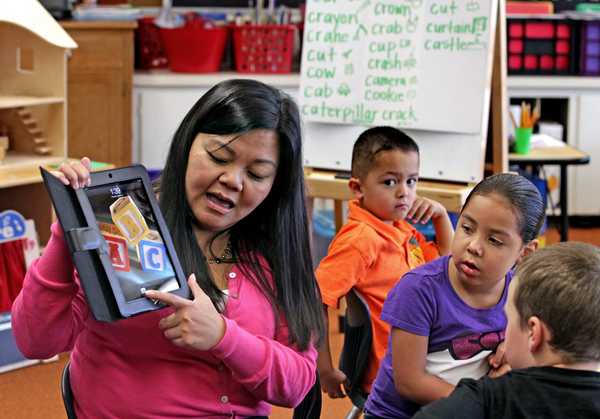
A new study published in the Journal of Literacy and Technology observed how preschool teachers used eBooks in the classroom. As published in the article, the observations of Kathleen Roskos, PhD and Karen Burstein, PhD focused on preschool teachers’ implementation of a vocabulary-focused, shared book routine; language strategies at the touchscreen; mobile devices to extend the shared reading experience; and children’s learning of 40 target words. The research team wanted to gain a better understanding of using eBooks for kids as an instructional resource in a preschool curriculum.
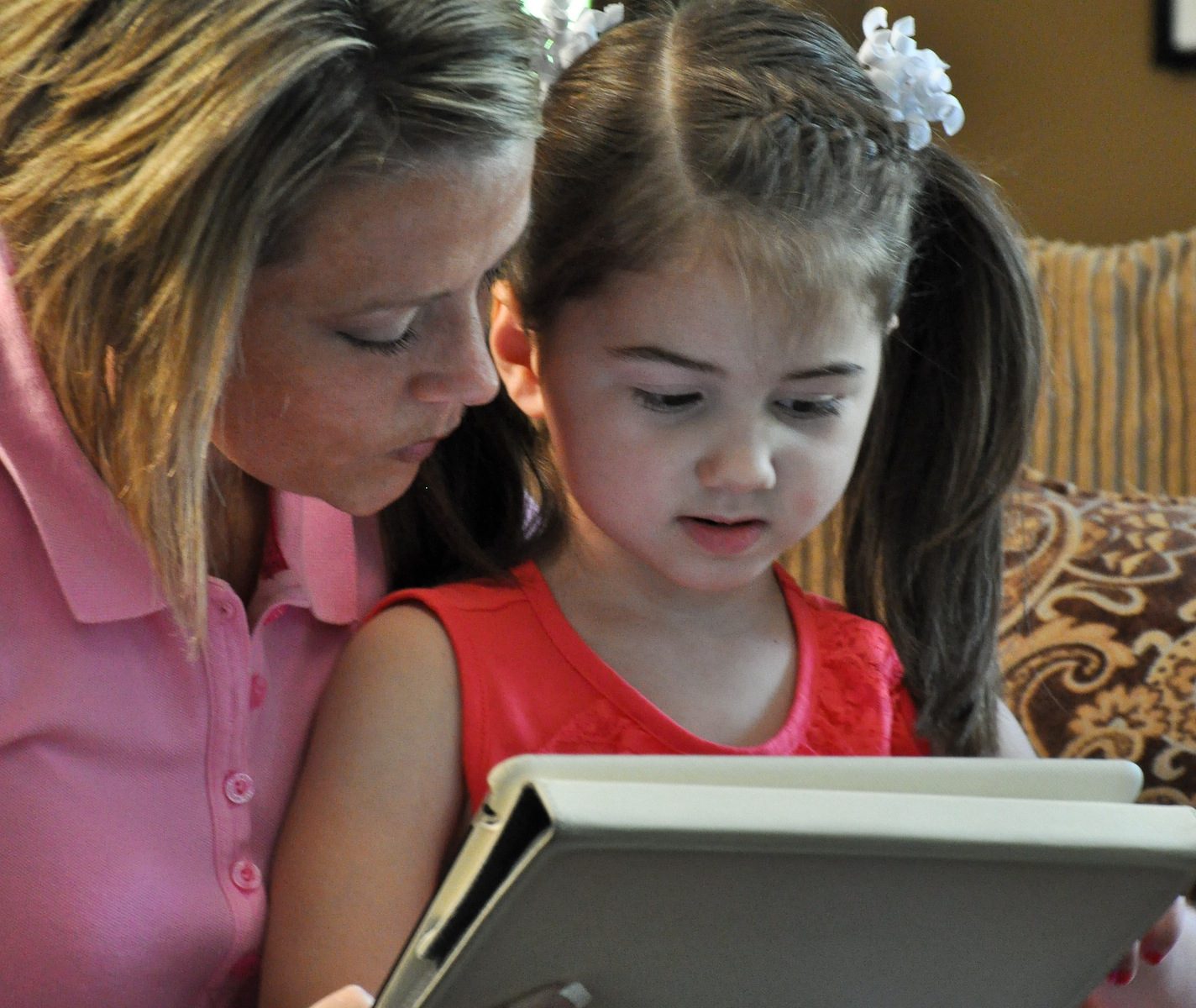
Over a four-week period, the eight preschool teachers participating in the study imbedded eight eBook shared reading sessions with each eBook being read two times. In addition, the children browsed or reread the eBooks on a digital device. The researchers found that eBooks can support vocabulary acquisition and that teachers easily transitioned from traditional books to eBooks as part of the shared book reading. The teachers used the same reading methods whether using a traditional book or an eBook. However, it came as no surprise that additional digital learning research specifically focused on instructional techniques and strategies are needed to maximize eBook features and support eBook browsing and reading on mobile devices, especially when used with the youngest learners as part of a preschool or toddler curriculum. The researchers noted that eBooks with rich visualizations, sounds and music appear to support early language and literacy, especially for young at-risk students.
You can download the full article, “Descriptive Observations of Ebook Shared Reading at Preschool,” here.
Preschool curriculum uses eBooks and digital learning with music
With twice as many children reading eBooks today than just two years ago, eBooks for kids can become a key component to a preschool or daycare curriculum and a way to increase parent involvement in early childhood education. At Kindermusik International, we know how important it is to implement the latest research (and tools!) on how young children learn best. After all, with more than 35 years of experience creating music classes for toddlers, babies, big kids, and families, as well as standards-aligned preschool and daycare curriculum, we’ve experienced breakthroughs over the years on reaching even the youngest learner. In fact, we continue to create new early childhood curriculum that implements the latest research, including how to use digital learning—and eBooks for kids—in an age-appropriate and effective manner. For example, with Kindermusik@Home parents can easily access favorite Kindermusik songs and activities, music, eBooks, and lyrics—as well as recipes, learning games for kids, crafts, and more in a green-friendly digital format any time from any smart phone, iPad, tablet, laptop, or computer. Families and teachers also love our music apps for kids.
To learn more about enrolling in a Kindermusik class and receiving access to Kindermusik@Home, contact a local educator via our Class Locator.
Schools, preschools, and childcare centers can also benefit from Kindermusik@Home. To learn more about bringing our daycare curriculum into your classroom, email us at info@abcmusicandme.com.
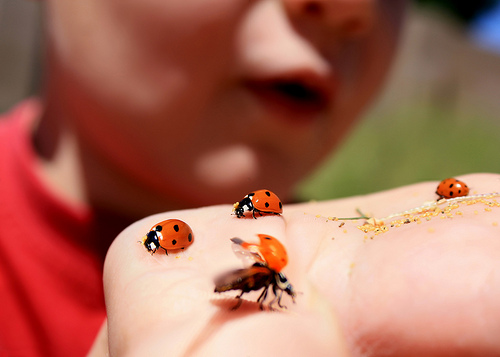
Children get mixed messages when it comes to animals. They’re supposed to love things that are cute and fluffy, and squish things with more than four legs. Kindermusik celebrates animals through song, language learning games, role-play and listening activities, but the fact is that many of us don’t have access to thirty acre backyards teeming with wildlife.
Instead, we go to the zoo (or buy a fish – dogs if we’re lucky). An estimated 98% of Americans have been to the zoo at least once in their lifetime, according to this study by Dunlap and Kellert. When families were asked why they were visiting, the majority said they were interested in “family togetherness” or the fact that going to the zoo was a “fun activity.” Being in the presence of wild animals was not a hot topic. It’s not surprising, then, that a swath of cultural attitude studies have reported “generational wildlife amensia” and increasing “biophilia” among younger generations (Phillips & McCulloch, 2005). In other words – kids are scared of wild animals – domestic animals too. Since when has the llama evoked as much fear as the Loch Ness Monster?
This study by Gail F. Melson found many reasons for animal fear. Of course… parents are the central cause. Whether or not we mean to imbue our children with nature fear, our reactions to things like ants in the house, bluejays on the bird feeder, rats in the subway, a wasp in the car, are, increasingly, the only times many children see and experience wildlife. As your child’s #1 teacher, a peeved reaction to cockroaches in the kitchen translates into a general dislike of nature.
Naturally, our reactions to invasive creatures is unavoidable – not to mention, human behavior that began long before the technological age. What is REALLY important, is that we allow children to experience nature in the following ways:
in unstructured environments, where kids are allowed to stare, listen, touch, or follow animals as long as they want
without parents giving scripted explanations of certain species (i.e. “bluejays are bad,” or “snakes bite”) – but letting a child intuit the animal’s own characteristics
by letting the animals take central focus at the zoo or on a hike, though we may be motivated to do these activities for family togetherness time.
Kick off an animal weekend with dozens of KI songs for the car or bath time – then unplug and go for a silent walk to listen and observe the sights and sounds of early spring.