
How music helps a teacher and children in Monaco live happily ever after

Munchkins Club Monoco 2Once upon a time, an educator who loved music moved from Milan, Italy, to bring the joy of learning English through music to children in a land faraway. Around the same time, an enchanting place called Monte Carlo Munchkins Club opened its doors to welcome children during their most formative years. As in any great fairytale, the two were destined to meet.

On the way to happily ever after

And, so begins the magical journey of Kindermusik educator Alina Botezatu, who explains in her own words how teaching children is changing her life and theirs!
“I love Kindermusik and seeing how the little curious minds assimilate information like sponges. It took some time to win the children’s trust, but now, as soon as they see me, they hug me and are excited about joining the class. This is such a wonderful feeling for a teacher. 
teaching ELL students“I’ve only been living in Monte Carlo and teaching Kindermusik at the Munchkins Club for a few months but I can already see the children’s progress in so many ways, including:

  • They learn new English words faster.
  • They sing many of the songs with me.
  • They dance and move their bodies in a more balanced way.
  • They know the stories we read together.
  • They have better concentration and listening abilities.
  • They are happy to take turns sharing instruments and helping each other and me during the class.

“It is always a lot of fun to sing and dance together. I’d like to thank my mentor, Laura D’Abbondanza Berryman, for all her invaluable support and my cute friends—the puppets—that make the children laugh and have fun during the lessons!”
Inauguration Monte-Carlo Munchkins Club 2013Of course, what fairytale is complete without a princess? Alina’s story includes Princess Charlene of Monaco, who visited the Munchkins Club to show her support for early childhood education.
We love happy endings. And, with Kindermusik, it is a good beginning with a happy ending that never ends!

Learn more about bringing Kindermusik’s ABC English & Me to your Language School, Nursery School, or Children’s Centre.

4 Reasons Why the Creative Arts Matter in Early Childhood Education

4 reasons why Creative Arts Matter in Early Childhood EducationYoung children love music, dancing, painting, playing, and other creative ways to express themselves and make sense of the world around them. However, as if those reasons weren’t enough to include things like art and music in early childhood education, research indicates that the arts, including music education for kids, significantly impacts cognitive development, increases self-esteem, and actively engages everyone in learning—children, parents, and teachers!
We believe that music is the best vehicle for early childhood learning. We want to empower our Educators, parents, and teachers to instill a lifelong love of music and learning in their children.

4 Reasons to Include the Arts in Early Childhood Education

  1. The creative arts engage children through multi-sensory learning.

    Multisensory Learning - Creative Arts in Early Childhood EducationChildren thrive on (and naturally respond to!) multi-sensory learning opportunities, such as music and the visual arts. Each of our five senses (sight, smell, sound, touch, taste) activates specific neurons in the brain. For young children, multi-sensory activities provide more learning opportunities than single-sensory activities because more of the brain becomes involved in the lesson. For example in a music class, children experience multi-sensory learning when they listen to and imitate animal sounds vocally or with an instrument, see the animals in the story, and then move around like them. Art activities can bring in the sense of smell and taste through edible art works, such as creating rainbows out of colored cereal or even using edible finger paints for the youngest learners. Plus, experiences that integrate several senses simultaneously are responsible for lasting impressions and greater retention.

  2. Musical activities stimulate development in every area of the brain.

    While multi-sensory learning engages children and provides greater retention, music education for children—in particular—provides research-proven cognitive benefits. Incorporating music and movement into a child’s learning routine stimulates all areas of the brain, including: vision, balance, hearing, speech, behavior, sensation, cognition, movement, and emotion. Take a look at the mental benefits of playing music: [youtube]https://www.youtube.com/watch?v=R0JKCYZ8hng#t=76[/youtube]

  3. Art and music classes teach children to love learning and school.

    Teachers and parents agree. We all want children to love learning and school. After all, it makes those early morning wake-up calls and afternoon lunch slumps a little bit easier. When asked: “What was your favorite thing about school today,” art and music consistently rank high on the list for young children. Why? It’s fun! As children grow beyond the early years, they carry that love of learning and school into the upper elementary years and beyond. Plus, the lessons learned in music classes can be applied throughout the day. Children who actively participate in playing music together learn teamwork, sharing, listening to and incorporating the ideas of others–and in turn learning the value of their own ideas, too! Plus, musical activities can help children learn self-regulation, the ability to regulate thoughts, feelings, and actions. All together, these skills translate into being ready to learn and success in school.

  4. Grown-ups love the arts, too.

    While we spend much time thinking about children in early childhood education (of course!), the grown-ups remain equally important. After all, children can tell when educators enjoy teaching. When teachers laugh and smile during the lesson, they model for students that learning is fun…and it is! For parents, the arts provide an easy way to support children’s education and get actively involved. Kindermusik Educators have fun in their early childhood programsThis could mean listening intently as a child explains the colors of the rainbow on a painting brought home from school and then finding the perfect spot on the refrigerator to hang it. Or it can mean singing and dancing to the songs from music class or pretending to be favorite characters in the book from circle time.

Music In the Classroom

In our Preschool curriculum (ABC Music & Me supplemental curriculum for ages birth to early elementary), children and teachers sing and play instruments, participate in dance and creative movement activities, engage in vocal and pretend play, and receive all of the benefits of the creative arts.
KindermusikPresents_ABCMusicAndMe_AGlobalEarlyChildhoodCurriculum[1]Plus, teachers and parents love Kindermusik. It’s easy to use with minimal planning and intentionally provides a method for teachers to participate, notice, and observe the class. Teachers can just pop in the hosted audio and a trained Kindermusik educator comes alive in their classroom through the guided activities.
ABC Music & Me brings the learning home with materials that provide a peek into the classroom with “teachable moment” extensions and favorite songs, stories, and activities from class.

Want to Learn More? Request a Demo: abcinfo@kindermusik.com

Contributed by Lisa Camino Rowell, a freelance writer living in Atlanta, Georgia.

Music Video Brings in the Clowns to Develop Kids' Gross Motor Skills

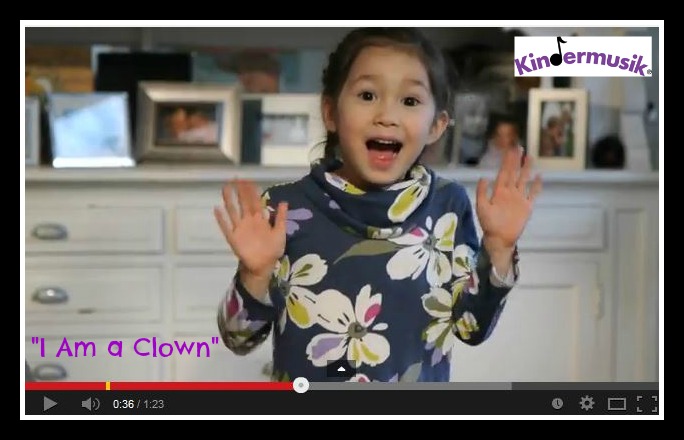
I am a clown video
When you send in the clowns, you can also introduce a whole lot of fun practicing all kinds of ways to move, jump, listen, focus, and even stop.  At first glance, it might seem like an activity such as “I Am a Clown” is just about moving and dancing.  But watch a little more closely, and you’ll see that there are a whole lot more benefits than just developing gross motor skills.
Linking language and movement – With each new verse, there’s a new movement… and a new movement word for labeling that movement.  This is how children expand their vocabulary and their repertoire of moves.
Inhibitory control – This is that all-important skill of learning self-control, both externally and internally.  Having to stop their movements helps children learn how to be better in control of not just their bodies, but also their emotions and their interactions with others.
Active listening – “I Am a Clown” is a fun way for children to practice listening and responding to those aural cues.  Active listening is a learned skill, and one that will serve a child well even into adulthood.
Following directions – Bringing together several different ways of moving into the different verses of the same song helps children with the all-important excecutive function skill of following directions.
Social-emotional development – There’s nothing much more powerful than bonding together through music and movement activities, whether that’s parent-child together time or whether it’s enjoying the company and inspiration of friends in a music activity.
Kindermusik is where music and learning playWith all of these great benefits from a simple music and movement activity, enjoy a little “clowning around” with your own child (or with your whole class if you’re a teacher!) for a sneak peek into how the Kindermusik curriculum works through music and movement.

Why Music is One of the Best Things for Early Language Development

iStock_000006570426Large toddler dancing - language development through music and movement activitiesJust google it: “children’s language development.”  Over 35 million hits will appear almost instantaneously.  From tips for parents to academic dissertations, there’s a flood of information and opinion out there.  And while we haven’t checked all 35 million hits, we can guarantee that one of the common threads woven into the fabric of early language development is music.
That’s because we learn music and language in a similar progression.  First we are steeped in it. Gradually we detect and then imitate its sounds and patterns in babbling.  Eventually, our desire to communicate and the experience of our ears, brain and muscles converge and we speak our first  words – or sing our first notes!

So, how exactly can a music and movement class affect language development?

Vocal play encourages children to imitate, practice, and repeat words, phrases, rhythms,  accents, synchronization and tempo – all integral parts of communication.
Focused listening heightens sound discrimination, helping children isolate, identify, and imitate specific sounds.
Rhymes and chants develop rhythmic awareness, which aids speech fluency and an awareness of the rhythmic structure of language.
Pretend play provides rich opportunities for communication and self-expression as children share ideas and interact cooperatively with each other.
Moving and labeling those movements aids in language acquisition in the early years and expand vocabulary in the toddler and preschooler years.
Singing directly exposes children to patterns of language, including rhythm, speech sounds, syntax and rhyme.  Pattern awareness is crucial to learning, memory, and language development.
Expressive and receptive language activities give children practice and experience with both speaking and understanding, two very different but essential parts of language development.

Find out more about Kindermusik and the benefits of music at www.Kindermusik.com.


How Music Helps Children Listen, Share, & Cooperate

Kindermusik Friends

Kindermusik FriendsHappy.  Well-adjusted.  Confident.  Shows empathy.  Cooperates with peers.  Has good self-control.  Any parent would be delighted to hear this assessment of his or her child.  These words describe the social-emotional skills that are so closely tied to success in school and success in life.
For young children, social-emotional development can be enhanced through age-appropriate group musical experiences, like those in the Kindermusik classroom.

From music skills to life skills…

Here are just a few examples of how music and movement classes improve children’s listening skills and support social-emotional development:

  • Gathering time where the children informally explore instruments or play with special props gives lots of opportunity for practicing sharing… and resolving conflict when two children want the same instrument.
  • Kindermusik Class in ChinaEnsemble experiences help children to listen closely and work together as they play-along and sing-along together as a group.
  • Waiting for a turn to explore a special instrument or to share an idea helps children learn self-control.
  • Sitting on the Story Blanket during musical story time teaches children how to empathize (Where can Susie sit?), cooperate (Let’s make sure all of our friends can see.), and listen.
  • “Stop and go” activities also give opportunities for children to practice inhibitory control in a fun way – including using the ASL sign for “Stop!”

Improve Children's Listening Skills through Music

  • “Follow the leader” activities require children to listen and cooperate, take turns, and practice inhibitory control.  You can practice this at home with an impromptu musical parade around the house as you take turns being the band leader.
  • Circle dances require every one to move together in the same direction and at the same speed.  But they also inspire a sense of community, belonging, and self-esteem.
  • Listening to music, moving to music, and singing are ways children can communicate about their feelings, helping them begin to better self-regulate and providing them with a safe and creative outlet for self-expression.

Find out more about Kindermusik at www.Kindermusik.com.

Music Tunes Kids in for a Great Year

Music tunes kids in to learning from the very first day of life. After all, even babies in neonatal care experience reduced heart rates and deeper sleep when listening to live music. Research shows that musical activities stimulate development in every area of the brain: vision, balance, speech, behavior, sensation, skill, movement, and emotion. Music also impacts all learning domains (cognition, language and literacy, social and emotional, physical, creative, music). Music celebrates the unique joys of each year and developmental stage and prepares children for a lifetime of learning.

Musical activities to try at home or in the classroom that tune kids in to learning

For Babies: A baby cooing and babbling and imitating a lullaby being sung is learning how language works while also bonding with a caregiver. Gently swaying with the baby in time to the music adds vestibular development, pivotal to balance, coordination, eye control, and movement.
Music activities for kidsFor Toddlers: Toddlers who march, stomp, jump, and tiptoe to a steady beat tapped on rhythm sticks are discovering new ways to move their bodies—and gaining confidence and an understanding of spatial awareness, too. Instructing children to stop when the beat stops (and moving when the beat starts again) includes inhibitory control development as toddlers learn to control their bodies.
For Preschoolers: In a Preschool class when children experience musical rhythm patterns through movement, they also lay an early foundation for reading music and words on a page. When preschoolers play instruments along to the rhythms in a song, they also practice active listening and pattern recognition—with strong correlations to word recognition, speaking, reading, writing, and even math.
For Big Kids: When children intently listen for the sounds of a specific instrument in a song, use wood blocks to produce a staccato sound, or move smoothly with scarves when they hear the music change from staccato to legato, children practice active listening. Considering that school children spend an estimated 50 to 75 percent of classroom time listening to the teacher, to other students, or to media, developing strong active listening skills prepares kids for classroom learning.

Musical learning: The ultimate multi-tasker

According to the National Association for the Education of Young Children (NAEYC), “Any activity that stimulates one area of development automatically influences others. Good curriculum design must recognize and plan for this integration.” Activity by activity, every lesson in Kindermusik is designed to address multiple areas of development—and to tap into a variety of individual learning styles. Kindermusik’s carefully crafted activities and deliberately integrated sequences set the stage for optimal, multi-sensory learning experiences.
For example, children exploring the concepts of fast and slow might hear music that alternates between the two tempos. They may practice moving or playing instruments in time with what they hear. They could hear a story about a slow snail and a fast cheetah. In short, they explore and internalize the new concepts more effectively through multiple senses and activity types. (Not to mention, such an activity cluster also hones listening skills, self-control, expressive movement proprioception, coordination, and other skills!)

YC boy with new logoFind out more about Kindermusik at www.Kindermusik.com

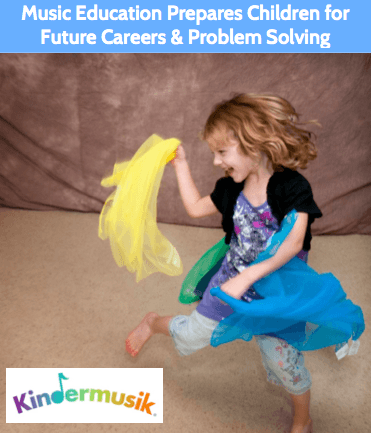
Music Education Prepares Children for Future Careers & Problem Solving

We sing about the benefits of music a lot. Some might even call us melomaniacs—people who are passionate about music. (By the way, we are!) After all, we never hesitate to explain how music helps children develop listening skills, supports early language and literacy, builds social and emotional skills, and even boosts balance and coordination. We even belt out a song or two—or twenty—at random times throughout the day. We can’t stop ourselves! We love music.

Survey Says! Music education prepares kids for successful careers.

Music_Education_Prepares_KidsApparently, most Americans love music, too, at least when it comes to music preparing them for successful careers. According to a new Harris Interactive Poll of 2,286 adults, 71 percent of Americans say that the teachings and habits from music education equip them to be better team players in their careers and two-thirds confess that music education prepares people with a disciplined approach to problem solving and prepares someone to manage tasks on their job more successfully. Other attributes learned in music classes applicable to successful careers include working as part of a team toward a common goal, striving for individual excellence in a group setting, and flexibility in a work situation.

Ready for the future, celebrating the moment

Children respond to music in profound ways. Music literally lights up all areas—on both hemispheres—of the brain. In our classes, we know that playing music together is more than, well, playing the individual instruments, singing the words, or moving together in a circle dance. It is learning how to work as a group, how to share, how to listen and respond to others, and it’s even about learning that every child’s ideas hold value. Creating music together also imbeds lifelong memories into the banks of our children’s thoughts. So, whether singing a lullaby to your infant each night to signal bedtime, combining music with movement to enhance motor skills and muscle development in a Head Start or Preschool program, or singing the songs together as a family in the car, participating in music classes celebrates the beauty of childhood and gives children skills applicable as an adult in the working world.

Find out more about Kindermusik at www.Kindermusik.com.

Contributed by Lisa Camino Rowell, a freelance writer living in Atlanta, Georgia.

Music & Movement Benefits: The Color of Music

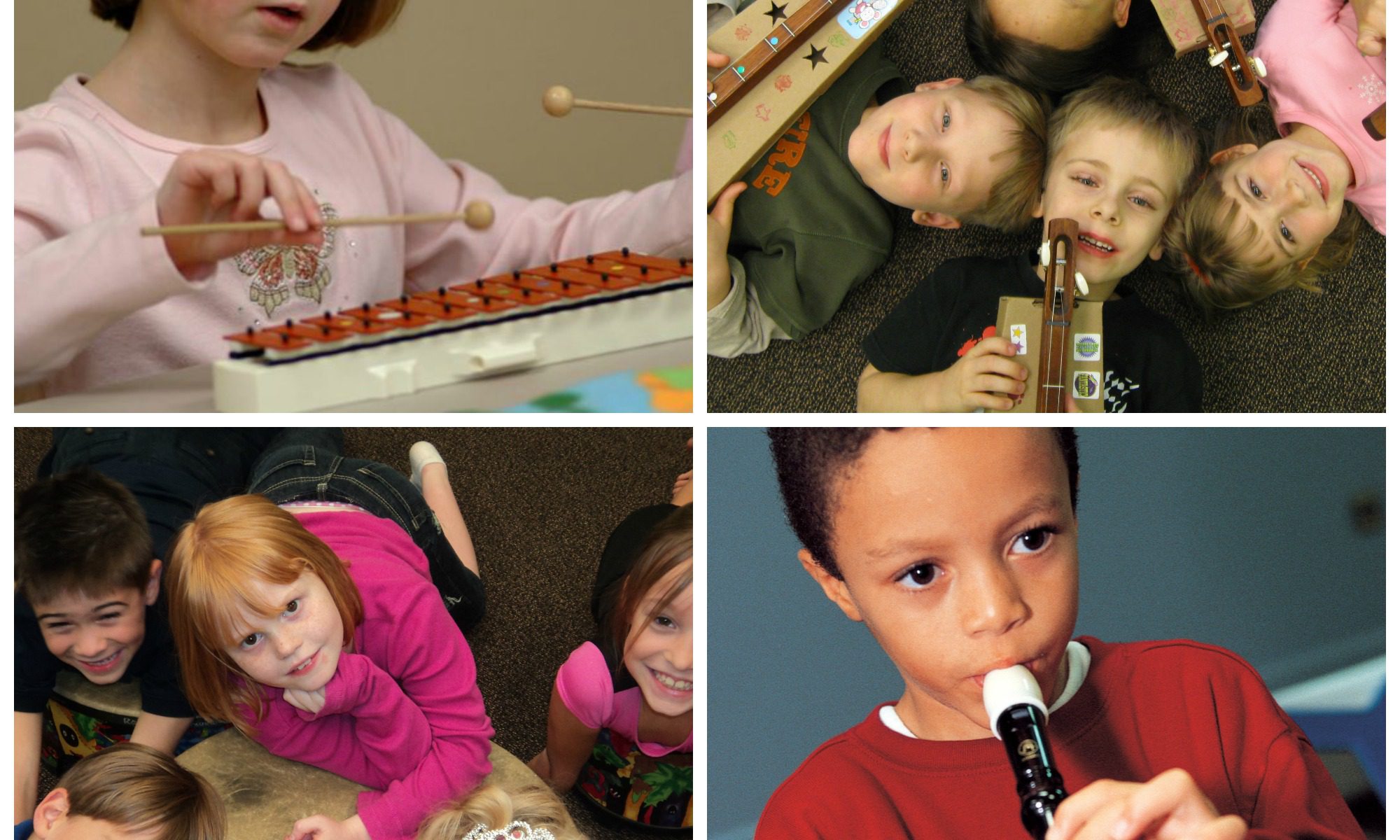
Young Child students play glockenspiel dulcimer drum and recorderEver heard of a dulcimer, a didgeridoo, or a dun dun?  Our Kindermusik students have!  By exploring a variety of instruments, the children hear, see, and experience a variety of sounds – scratchy sounds, booming drum sounds, ringing sounds, trickling sounds, and more.  And not just on Uncommon Instrument Awareness Day (which happens to be today, by the way!).  Musically speaking, the distinctive quality of these sounds is called “timbre.”
As your child experiences the variety of sounds he/she can make with musical instruments and everyday objects, he or she is developing the listening vocabulary necessary for sound discrimination preceding language.  In fact, Kindermusik builds on your child’s sound discrimination skills throughout their Kindermusik years.  Here are just a few examples:
BABIES

In our babies music classes, our focus is on exposing your baby to a variety of timbres to build a base for his/her listening vocabulary to develop.  Developing a “vocabulary of sound” at a very young age not only helps children better tune in to the subtle distinctions of both music and speech, but also encourages them to try to make those sounds for themselves with instruments or voice.
TODDLERS
In our toddlers music classes, your child is introduced to a variety of timbres related to animals, transportation, home, and everyday object sounds.  The children are also exposed to the timbres of wooden instruments, metal instruments, and shaker instruments.  We use these experiences to begin the process of teaching your child how to develop discriminating listening skills.
PRESCHOOLERS
In our preschoolers music classes, we explore the timbres of specific rhythm and orchestra instruments( i.e. such as resonator bars, slide whistles, clarinets, and trombones), teaching your child to learn to identify these timbres as well as discriminate the timbres of voices – male, female, child, children, etc.   While learning these skills your child is also taught to hear in layers; in other words, to listen to many things at the same time.
BIG KIDS

As your child progresses to our music classes for big kids, we introduce all the families in the orchestra.   Along the way, your child will learn the distinctive sound of over twenty orchestra and keyboard instruments.  Plus they’ll learn about and listen to instruments from all around the world.  Pretty impressive!

Try A Free Kindermusik ClassCome see all the fun and learning that happens with all of the many different instruments we use in Kindermusik classes every week!  Try a class for free… and then enroll so that you can enjoy the instrumental variety in class and at home each week.

Compiled by Theresa Case, who has an award-winning Kindermusik program at Piano Central Studios in beautiful upstate South Carolina.

Music Before your Baby is Born

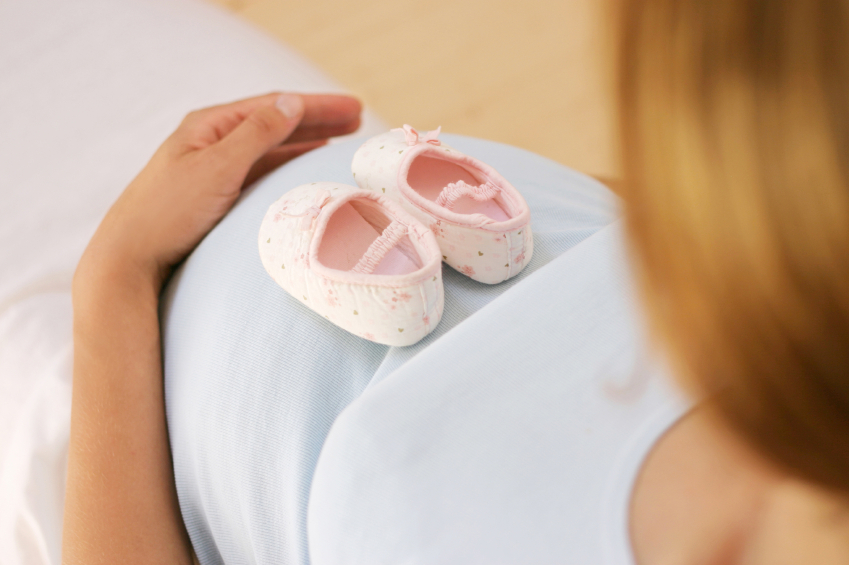
benefits of prenatal musicExpectant parents plan for – and worry about! – a lot of things.  Your unborn baby’s musical development may not be on the check list just yet, but don’t worry – you and your baby are more prepared than you might think.
Your baby is already musical!  After all, he/she has been listening to the steady beat of your heartbeat and listening to your voice – which happens to be the most beautiful sound in the world to your little one’s ears!
Your baby is able to see, hear, feel, and learn even before birth.  Music is a powerful stimuli, and as such, can help enhance physical, emotional, sensory, and mental development.  According to Dr. Sarah Brewer, “…[m]usically stimulated babies seem to develop more quickly, talking up to six months earlier, and have improved intellectual development.”
Your baby is already developing musical preferences.  Studies have shown that the music a baby hears frequently while in the womb will be some of his favorite music to listen to when he’s born… until he’s around two years of age, that is.  After that, he’ll let you know what his new opinions are about music!
Your baby benefits from a variety of music.  You don’t have to limit your pregnancy play list to only Mozart or quiet lullabies.  “Diversity of different kinds of music are essential and can be useful for the baby’s future writing, reading, and language skills,” says Dr. Philip A. De Fina, chief neuropsychologist and director of neurotherapies at the NYU Brain Research Laboratories.
As with all good things, the key with music stimulation is moderation.  If you’re getting tired of listening to certain music, chances are your baby is too!  To find some great music recordings and musical inspiration, look no further than your nearest Kindermusik educator.  One of the hallmarks of Kindermusik is our musical variety in class and at home through your @Home Materials.  Your local Kindermusik educator would be delighted to have you come visit a class, even before your baby is born.  And then your Kindermusik enrollment is one more thing you can check off the list before your new arrival turns your life happy-crazy upside-down.
ways to hold baby posterAnd so, when things settle down a bit, we’ll look forward to having you and your newborn in Kindermusik.  The brain grows and develops at an astounding rate in the early years, and there’s no better window of opportunity for exposing your baby to the rich developmental benefits of music.  Plus you’ll love the opportunity to gain precious insights into this new little miracle as you spend special time together in class, make new friends, find a support network, and savor these precious, fleeting moments of babyhood.  Parents agree… there’s no better bonding experience than Kindermusik.  We’ll look forward to seeing you in class soon!
Find your local Kindermusik educator and schedule your free visit today!

Contributed by Theresa Case whose award-winning Kindermusik program is located in beautiful upstate South Carolina.