
The Magic of Snow

Whether you’re looking at it or wishing for it, there’s something magical about snow.  Here are a few of our favorite musical ideas and fun snow-themed crafts that you can enjoy with your child.

Try indoor skating!

Skating indoors is easy and fun.  All you need is a pair of paper plates – one set per skater – and some skating music.  You may remember this activity from Kindermusik class. You can even decorate the top side of your skates if you like.  Music that’s not too fast or too slow is ideal.  (Think something like the Blue Danube Waltz…)  Push the furniture out of the way and have skate away!

Create your own charming Chalky Snow Art

For this art project, all you need is ½ cup of water, ½ cup of liquid laundry starch, and chalk.  First, mix the water and starch together.  Brush it over a piece of dark colored heavy paper (or even something like cardboard).  Next, draw on the wet paper with the chalk.  If the end of the chalk gets sticky before you are finished, simply scrape it off and keep drawing.

Sing, sing, sing and move, move, move!

You know that familiar childhood song, “If You’re Happy and You Know It”?  You’re sure to get lots of giggles by trying all kinds of snow-related movements:

If you’re happy and you know it…

Stomp in the snow
Slide on the ice
Catch the snowflakes
Clap your mittens
Roll in the snow

And when you’re all done enjoying the magic of snow, why not cuddle up for some hot chocolate?

Shared by Theresa Case, whose Kindermusik program at Piano Central Studios in Greenville, SC, is proudly among the top 1% of Kindermusik programs worldwide.

Digital learning in the early childhood classroom (and at home!)

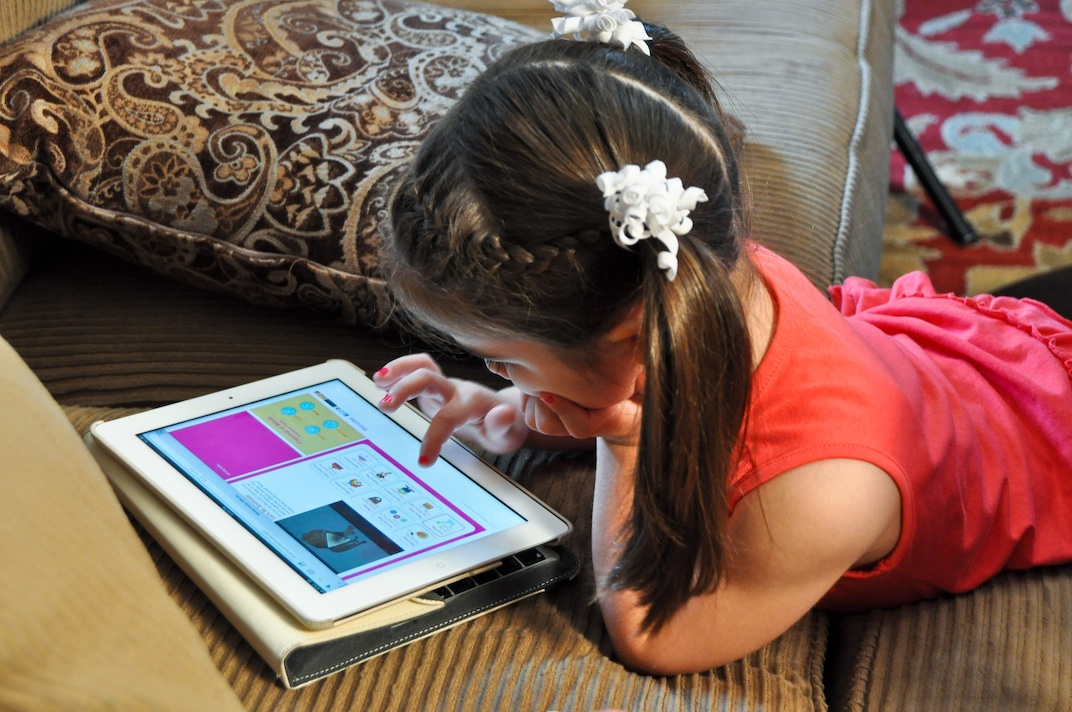
Have you seen the video of the one-year-old child interacting with her father’s iPad and then a print magazine? After touching the tablet screen to make images increase in size, she tried doing the same thing to pictures in a magazine. Of course, that didn’t quite work!

Most children today will never remember a time before the Internet, smart phones, and tablets. Not to mention, with 30 percent (and rising!) of today’s college students taking at least one online class, higher education will look quite different for our children.

Digital learning and early childhood

Children engage in digital learning from an early age. Even the youngest child can model the actions of a parent talking on a smart phone or reading an eBook. A recent report, Take a Giant Step: A Blueprint for Teaching Children in a Digital Age, published by the Digital Age Teacher Preparation Council, includes strategies and tactics to better equip preschool and elementary teachers to provide age-appropriate digital learning opportunities for young children.

“Teaching young children today demands a new approach to an exciting but increasingly complex set of challenges,” said Linda Darling-Hammond in a press release. “Quality early learning programs in our digital age will be led by highly prepared, flexible teachers who can effectively integrate what they know about healthy child development with the resources of an always connected, thoroughly modern environment.”

The report highlights the understanding that integrating digital learning into early childhood works best when it enhances children’s engagement, such as talking, interacting, manipulating, pretending, reading, constructing, and exploring. (Sounds like a Kindermusik class to us!) In order to help early childhood educators best capture the power of digital learning, the report outlined several goals to accomplish by 2020:

  1. Advance technology integration and infrastructure
  2. Modernize professional learning programs and models
  3. Expand public media use as a cost-effective asset for teachers
  4. Create a Digital Teacher Corps

Digital learning: making connections between the classroom and home

In one early childhood digital learning study featured in the report, researchers worked with a Kindergarten teacher and her five- and six-year-old students. The researchers loaded math activities, video clips, and digital worksheets onto tablet computers. The tablets also included material for parents on the goals of the activities and information on the math topics and keywords the students learned at school. For homework, each student received a tablet to take home for four weeks.

After the four weeks ended, parents said that they felt more connected to what was happening in the classroom and were better able to offer their children help because they knew exactly what they were working on and what concepts they should understand. Plus, children spent more time on their homework and improved mathematics skills.

Digital learning and eBooks with Kindermusik@Home

After more than 30 years of developing early childhood curricula, including music classes for toddlers, babies, big kids, and families, we understand that the days may pass slowly but the years fly (or dance) by. One day a baby may be taking her first steps in a Village class and seemingly the next day she is walking across the stage to receive a high school diploma. Wow. Talk about a fast dance.

Kindermusik@HomeWe know that music can impact a young child in profound ways and can set a child up for early academic success.  We also know, as the above report showed, how important technology fluency will be to your child, which is one of the reasons we created Kindermusik@Home. With Kindermusik@Home, families can engage in age-appropriate digital learning, such as virtual field trips and active listening games, read eBooks, and download all the music from class. Kindermusik@Home connects the classroom learning with a family’s everyday life, making the learning (and fun!) last throughout the week.
To learn more about enrolling in a Kindermusik class and receiving access to Kindermusik@Home, contact a local educator via our Class Locator.

Schools, preschools, and childcare centers can also benefit from Kindermusik@Home. To learn more about bringing our digital early learning curriculum into your classroom while also increasing parental involvement, email us at info@abcmusicandme.com.

We Love Kindermusik Video

Celebrate We Love Kindermusik week with all Kindermusik educators & children. See some of our community below!

[youtube]http://www.youtube.com/watch?v=exbOByiFtMo&context=C3229ac6ADOEgsToPDskKlO2Eiy4jnX15O78vWuD8w&h=320&w=480[/youtube]

Dare to Share Why YOU Love Kindermusik

There’s no doubt about it – today’s technology has made many aspects of our lives much easier, especially our ability to share experiences.  From Instagram to Facebook to Skype, you can share nearly anything online.

This month Kindermusik educators all around the world will celebrate “We Love Kindermusik Week” from February 10 – 16.

To help facilitate the sharing of what we all love about Kindermusik, Kindermusik International just announced a “We Love Kindermusik” contest where you and your Kindermusik educator could win some pretty fantastic prizes!

All Kindermusik kids and their parents have to do to enter is share why they love their Kindermusik educator and experience! The contest is open February 3-16, 2013 (midnight EST). Winner will be selected at random.

The lucky winning Kindermusik kid and their parent will receive:

  • iPad with retina display, Wi-Fi and 32GB {perfect to use with Kindermusik@Home}
  • 1 Year of Kindermusik@Home access
  • $500 to charity of choice

When you win, your Kindermusik Educator also wins!

  • iPad {with retina display, Wi-Fi and 32GB – perfect to use in class!}
  • $500 of Kindermusik@Home credits {to assign to parents & kids at their studio}.

Enter the We Love Kindermusik Contest

All you have to do to enter is…We Love Kindermusik
Step 1: Click Here.
Step 2: Tell us why you love Kindermusik.

Fine print: We will randomly select one valid entry as the winner, and that entrant’s educator will win the educator Grand Prize. If the entrant has an inactive educator, or for any other reason is not associated with an educator, we will do a random drawing for the educator prize using the currently active list of licensed educators.


The BBC on Why Birds Sing

"Inspired by musician and eco-philosopher David Rothenberg’s book of the same title, this documentary explores the intriguing, charming, complex and often conflicting theories on why birds sing like they do and why humans are so attracted to the sound.

"The film features contributions from musicians including Laurie Anderson, Jarvis Cocker and Beth Orton; enlightening and often startling analysis from some of the world’s most eminent birdsong scientists; a literary guide

to birdsong in poetry; a bizarre birdsong-themed art ‘happening’; the creation of a new musical composition from the Afro-Celt Sound System, entirely made up of manipulated birdsongs; and a strange musical duet at New York’s Bronx Aviary, featuring humans and birds.

"Filmed in the forests, aviaries, studios and laboratories of England, Germany and the USA, this is a colourful, entertaining, informative and occasionally weird journey through the songs of nature that have enchanted and perplexed humans for thousands of years."

Do you love to sing? Ask today about using Kindermusik to help more families sing together – for the joy of it.

Daycare teachers promote early literacy skills with music

If Shakespeare had developed daycare or preschool curriculum instead of sonnets and plays, he may have rewritten one of his most famous lines: “If music be the food of love literacy, play on.” Research continues to prove this sentiment, including a new University of Buffalo study published earlier this month.

Training equips preschool teachers to use music

Before conducting this study, professors from the University of Buffalo knew what the research said about music’s ability to greatly impact a child’s early literacy and language abilities. With their study, however, they specifically wanted to see if early childhood teachers, with little to no music background, could be trained to use music in developmentally appropriate ways to boost early literacy development.

Led by Maria Runfola, PhD, and Elisabeth Etopio, PhD, the team recruited 165 preschoolers to participate in music activities led by 11 daycare teachers. As part of the daycare curriculum, the preschool educators leading the music classes received training in musicianship skills and specific strategies for leading preschoolers’ music development. Prior to this early literacy study, these preschool teachers did not have any music training. The researchers found that participating preschoolers experienced a boost in oral vocabulary and understanding of grammar compared to students not enrolled in the preschool curriculum. Plus, children with lower initial literacy skills saw the biggest positive impact.

“First, we found that the musicianship of the early childhood teachers improved as did their ability to guide music activities in ways that enhanced student music development,” explained Runfola in a press release, Study Finds Link Between Music and Preschoolers Reading Readiness.

Since the preschool teachers did not come from a musical background, it was not surprising that participating children did not experience a significant boost to musicality, such as rhythm-pattern achievement. However, the researchers concluded that early childhood teachers without a music background could be trained to teach a daycare curriculum that uses music as a vehicle for early literacy and language development.

“Administrators need to better understand the importance of the arts to children’s development,” Runfola concluded in the press release. “We hope this research will help music educators and childhood educators support their requests for music time for the youngest of our students.  Children need daily appropriate music activity to stimulate their neural activity to develop tonal and rhythm audiation that in turn appears to help their emergent literacy skill.”

If music be the food of literacy, then play on indeed!

Preschool curriculum helps daycare teachers use music to boost early literacy

Created by Kindermusik International, ABC Music & Me is a daycare curriculum that uses music and movement activities to boost early literacy and language skills while also cultivating turn-taking and sharing, improving coordination, enhancing creativity, and more.

Through a robust classroom kit that includes Digital Teacher Guides, ABC Music & Me provides step-by-step planned out lessons so even educators with no musical experience can begin teaching this daycare curriculum immediately.

For more information about using ABC Music & Me as a supplemental daycare curriculum, email us at info@abcmusicandme.com.

Jump for joy: Busy bodies and second language learning

This video demonstrates the Total Physical Response approach to second language learning and shows a parent and child at home using one of the recorded activities from ABC English & Me.

It all started with movement. When James Asher, a professor of psychology at San Jose State University in California, started asking why young children were dropping out of school, he found a link to second language acquisition:

“The most difficult learning task for both children and adults may be the attempt to acquire a second language in school. A number of studies have shown that few students – often less than 5% who start in a second language – continue to proficiency. This lack of success is striking when compared to the language achievement of most six-year-olds, who without schooling have mastered all the essential parts of the individual’s native language.”

Searching for a solution, Asher started looking at why some young learners developed a second language skill and why others didn’t. The link was movement. What he found is that children who could hear a movement word, and demonstrate comprehension of that movement word by doing it – such as jump, dance, or run – were better able to learn and retain the new information over a period of time.

He developed a method for second language learning centered on movement and wrote a book about it, Learning Another Language Through Actions: The Complete Teacher’s Guidebook.

Asher called this physical approach to teaching a second language: total physical response or TPR.

In study after study for 25 years, laboratory experiments and classroom observations have demonstrated results that were extremely positive. When the instructor skillfully uses the target language to direct the student’s behavior, understanding of the utterance is transparent, often in only one exposure. Also, the understanding is achieved without stress and then retained for weeks, months, and even years. Language-body communications is a fascinating and powerful principle of learning. It seems to be a universal principle that holds true for language including sign language for the deaf. It seems to hold true for an age group that has been studied from children to senior citizens.

This approach is an essential part of the ABC English & Me program. And we were so delighted to watch a parent and child share the joy of learning – and moving – at home.

It’s the kind of learning that makes you jump for joy.

Would you like to know more about the research-based approach of ABC English & Me? Click here for more information. We’d love to show you how it works.