
Sing in the New Year with Kids

(Source: She Knows Canada)

The holidays look a little bit different when children enter the family and New Year’s Eve is no exception. So, while you probably won’t be watching the ball drop in Times Square, oohing and awing at the fireworks at the stroke of midnight, (or even staying awake that late…unless you count that midnight feeding), your young family can start new traditions. We put together a few of our favorite ways to ring sing in the New Year with young children.

4 Ways to Ring in the New Year with Kids

  1. Make a musical time capsule with a 2015 playlist of your family’s current favorite music. Over the years, your family will love listening to past favorites and rediscovering the memories, too.
  2. Pick a country ringing in the New Year about an hour before your child’s regular bedtime and celebrate the stroke of midnight with them. After all, it’s midnight somewhere in the world! This will help to keep your child’s bedtime at a “normal” time while also giving your family plenty of opportunities to celebrate 2015 through song and dance and, of course, the countdown to the New Year.
  3. Sing “Goodbye” to 2014. Change the words to your favorite Kindermusik goodbye song or make up your own. These two Kindermusik cuties brought out instruments for their special goodbye song.

[youtube]https://www.youtube.com/watch?v=rdpyDGi0Zh4[/youtube]

  1. Put a Kindermusik twist on a New Year’s Eve staple. The song “Auld Lang Syne” is a nostalgic expression of friendship. So, why not celebrate the turning of the calendar with your favorite Kindermusik activities to remember your new and old friends from class? Some of our favorites include lap bounces like “Giddy Up Horsey,” instrument exploration, hayrides, ball play, and hammocking. Need some more ideas? How about 24 more?

Want to sing in the New Year with your family? Find a local educator at www.Kindermusik.com and visit a free class in 2015.

Contributed by Lisa Camino Rowell, a freelance writer in the Atlanta area.

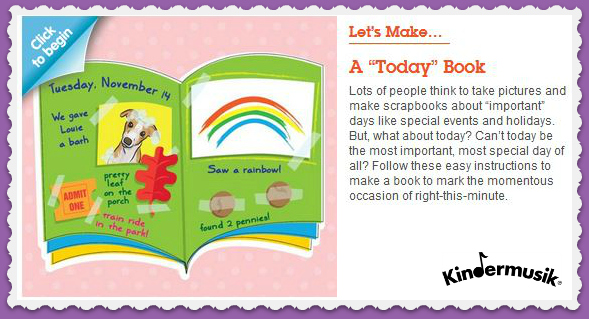
Make a Today Book with Kids

It’s easy to think about taking pictures or making scrapbooks about “important” days like holidays or birthdays.  But even the ordinary days can transform into extra special memories with an easy homemade book that marks the momentous occasion of “savor-this-moment.”

Follow these easy instructions to make – and enjoy! – this simple together time craft.

Make a Today BookAnd if the warm fuzzies and happy moments that you’ll have from making a memory book with your child aren’t enough, we thought we’d share another wonderful benefit of making a Today Book.

One important pre-literacy skill is called “Concepts of Print.” Simply put, it means that before children can learn to read, they need to understand what a book is and how it works—which way to hold it, which direction their written language goes (left-to-right, top-to-bottom, or right-to-left), and that print carries meaning.  Making a book is a terrific way to develop this valuable pre-literacy skill that will put your child on the path to reading.

Oh, and we’re pretty sure you’ll love the cuddles and hugs that are sure to occur when you read and re-read your Today Book with your child!

Looking for more activities to do with your child?  Come visit a Kindermusik class.  Find your local licensed Kindermusik educator at www.Kindermusik.com.

Rhythmic Dictation and Early Literacy Skills

Do you remember taking spelling tests as a child? Sitting at your desk, listening intently as your teacher said a word, and then trying to visualize what the word looked like while also attempting to write it on your paper or (gasp!) spell it out loud in front of the whole class? Ugh! For English speakers, that silent “e” caught many of us off guard. You probably didn’t realize it at the time but listening, identifying the word, and then writing the word down helped you become a better reader.

Although we don’t give spelling tests (or any tests, for that matter) in Kindermusik, we do give children’s ears lots of musical practice in listening to rhythms, identifying what they hear, repeating them, and using rhythm cards to “write” the patterns down. We call this process rhythmic dictation. So, while we “ta ta ti-ti ta,” clap, pick out the right rhythm card, or play an instrument along with a song, children gain practice in recognizing relationships between sounds and symbols, which supports children’s budding musicianship and early literacy skills.

Rhythmic Dictation Inside the Kindermusik Classroom

[youtube]https://www.youtube.com/watch?v=FPosMJF1mBQ[/youtube]

You can try this at home or in your classroom, too.  Clap out a rhythm and let child(ren) repeat it. Make each clapping rhythm more difficult than the last. Take turns being the copycat.

To learn more about the benefits of music on early literacy development visit http://www.kindermusik.com/schools/benefits

Contributed by Lisa Camino Rowell, a freelance writer living in the Atlanta area.

Leave the Detective Work to the Kids

The ability to think critically about a situationKIstock53_musicnotes_color is essential for all problem solving and academic learning. Deductive reasoning, the ability to reason from general premises to more specific premises, is one essential aspect of critical thinking. 
In fact, renowned educational researcher, Dr. Howard Gardner, includes deductive reasoning within one of his seven areas of intelligence—the Logical/Mathematical Intelligence. Dr. Gardner (and other researchers) argue that the ability to detect patterns, think logically, and to reason is critical for developing text comprehension, mathematical, and science skills later in school.

What might be surprising to some is that very young children are at the very tip of their capacity for deductive reasoning, but like many areas of development, the most effective growth in learning comes through practice – in this case, brain practice.

The Critical Thinking Co., puts it this way, “Deductive reasoning can be taught, but it is its regular practice that yields the benefits to students. The brain acts like a muscle and exercising it through logic, analysis, and critical thinking is what gives it the strength to question, to learn, and to discover.”

So… if your young child is at the tip of their capacity for deductive reasoning and practicing those skills is so vitally important for learning and discovery, how can a parent tip the cognitive development scale in a child’s favor?

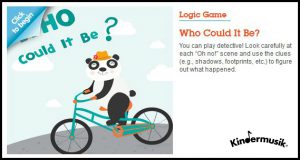
Use this free Kindermusik@Home activity: “Who Could It Be?” to practice some deductive reasoning skills with your child.

Who Could It Be deductive reasoning development game

This activity may take some adult interaction and support—but then your child will be hooked! You’ll both delight in that first moment when your child figures out one of the answers on his/her own.

  • One way to reinforce a child’s growing deductive reasoning skills is for you to articulate your own reasoning for coming to a conclusion and then to ask your child to do the same. For example, in “Who Could It Be?,” you can clearly explain that you figured out that the sheep took the bunnies in his car because there were tire marks leaving the Pet Shop and only the sheep was driving a car. Then ask your child, “HOW do you know it was the monkey who made a mess at the ice cream cart?”
  • Predicting what comes next in a story is another way to develop deductive reasoning. For example, ask your child, “WHAT do you think will happen next? And WHY do you think that?”

It doesn’t take much to boost your child’s critical thinking skills, but it does take intentionality mixed with fun and engaging activities.  This is why Kindermusik has been such a favorite experience for parents for so many years – our class activities and @Home Materials give parents the time and the tools to make great parenting – including giving your child every possible cognitive and academic advantage – that much easier and that much more joyful.

To learn more about music supports the development of deductive reasoning skills, visit www.Kindermusik.com.

5 Musical Ways to Manage Holiday Meltdowns

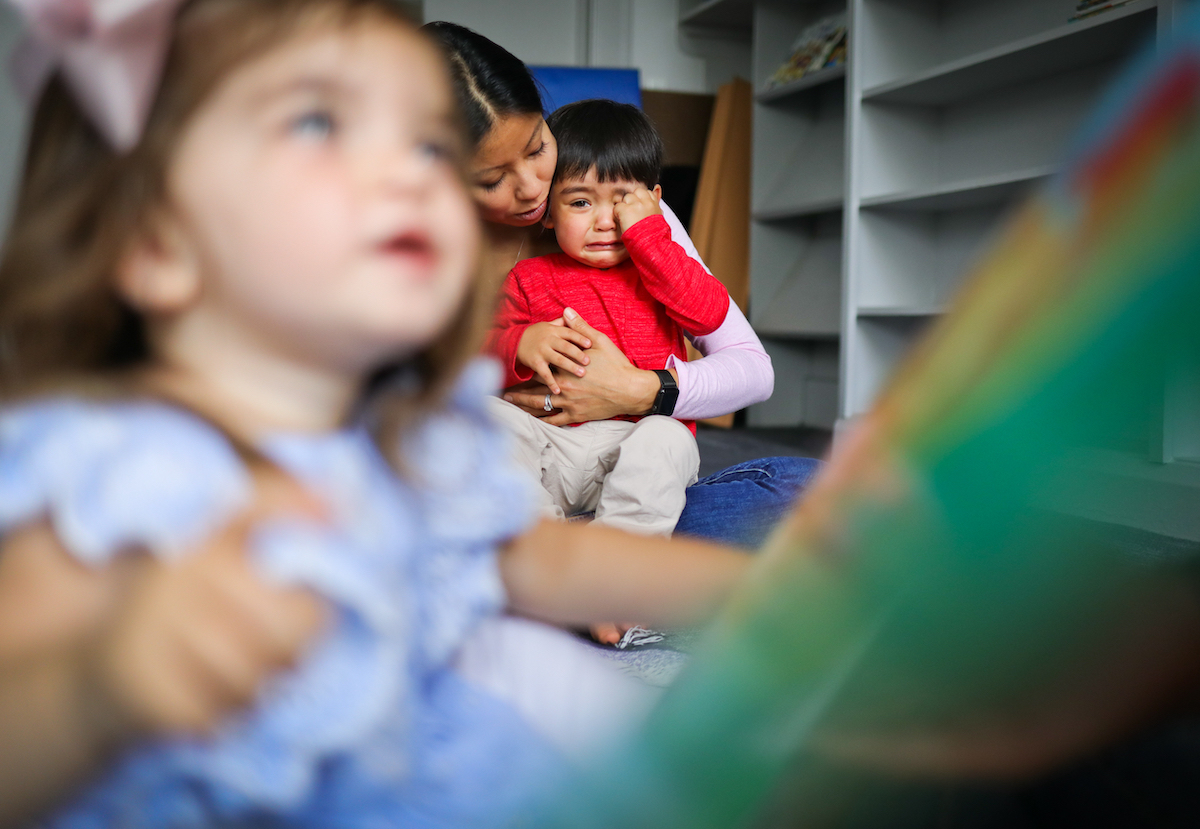
A mom uses gentle rocking to comfort her toddler during a meltdown.

Ah, the holidays—a time of rest, joyous family gatherings, and the harmonious sound of…meltdowns.

The reality is that this season often adds stress to families, especially for its youngest members.

Different schedules, new places, travel times, rich foods, family photos, and general overstimulation affect everything from mealtime to bedtime, which can contribute to not-so-merry meltdowns.

While grownups have the ability to command self-control faster, the brain’s pre-frontal cortex (where this function is typically associated) is not fully developed until adulthood. Additionally, relaxation is a learned behavior, which is why trying to reason with a toddler during a tantrum doesn’t usually work.

So, in the midst of holiday chaos, it’s important to gently teach children how to relax. Music and movement are some of the best tools out there to help little ones reset, recoup, and get ready for the next event.

Continue reading “5 Musical Ways to Manage Holiday Meltdowns”

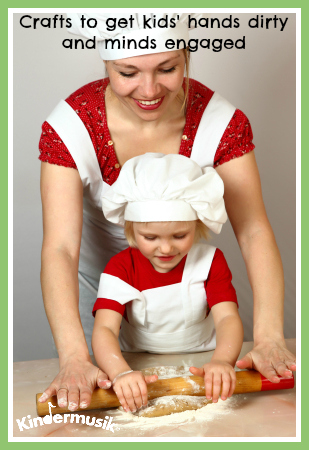
7 Crafts to Get Kids' Hands Dirty and Minds Engaged

We love this quote around here at Kindermusik: “We didn’t realize we were making memories – we just knew we were having fun.”
crafts to get kids hands dirty and minds engagedThis perfectly summarizes what happens in a Kindermusik class and at home whenever families engage in musical activities together. This quote also rings true around the November and December holiday season, too. As you gather together with family at home—or at school for special holiday open houses—consider adding a few of these hands-on crafts for kids into the mix. Of course, we would also suggest adding in some music, too!
TIP:  Whip up any of these ahead of time so that it’s easy to give your child something new to explore while you wrap gifts or cook dinner.
#1:  Puffy Paint
1 part white glue
1 part shaving cream
glitter or food coloring
squeeze bottles
Mix equal parts of the shaving cream and glue in a bowl. Now you can add food coloring or glitter. The surprising texture after it has dried is fun, too.
#2:  Bubble Bath Finger Paints
2 cups flour
water
1 teaspoon salt
food coloring
bubble bath (not the foamy type)
Mix water with the flour until you get a paste. Add food coloring and bubble bath until you get the thickness you like. This works well in the bath tub. They can paint themselves or the walls and it washes right off. It may turn the water the color of the food coloring but it won’t stain the child. If you want to make different colors, try putting them in a muffin tin!
#3:  Bubbles
1 cup water
1/3 cup dish soap (Joy, Sunlight, etc.)
2 Tablespoons light corn syrup
Combine ingredients and enjoy. Try using different objects from your utensil drawer as a bubble wand.
Bubble Blowing Tools
Use a plastic straw, or make lots of little bubbles by wrapping colored masking tape around five or six plastic straws.
Berry baskets
Fly-swatters
Plastic rings from soda six-packs
Wands made from pipe cleaners
#4:  Flubber!
In a large container combine:
1 1/2 cups warm water
2 cups white glue
Food coloring
In second, smaller container, combine:
1 1/3 cups warm water
3 tsp. Borax
Mix ingredients in each container thoroughly.  Pour contents of smaller container in to large container.  Gently lift and turn mixture until only about a tablespoon of liquid is left. FLUBBER will be sticky for a moment or two. Let excess liquid drip off then FLUBBER will be ready!  Next, play!  You’ll be amazed at how your Flubber will stretch, bounce, and roll!
Store in an airtight container for about three weeks of use.
#5:  Silly Putty
1 part Sta-Flo Liquid Starch
1 part Elmer’s White Glue*
Food coloring (optional)
Mix glue and starch together until it feels like a putty. If desired, add food coloring and mix thoroughly. When not in use, Silly Putty may be stored in an airtight container.
*Important Note: Be sure to use Elmer’s White Glue, NOT Elmer’s “Washable” or “School Glue.”
#6:  Edible Peanut Butter Playdough
1/2 cup peanut butter
1/2 cup honey
1 cup powdered milk
Knead until smooth, then shape and enjoy!
#7:  Slime
Corn starch
Water
Food coloring (optional)
Put cornstarch in bowl. Add enough water to make a paste. If desired, you may also add food coloring. This makes a messy slime that goes from liquid to solid.
Did you know??  Children rely on sensory input to learn about their environment.  Sensory play builds neural connections that support thought, learning, and creativity.
Learn more about music classes for kids at www.Kindermusik.com.

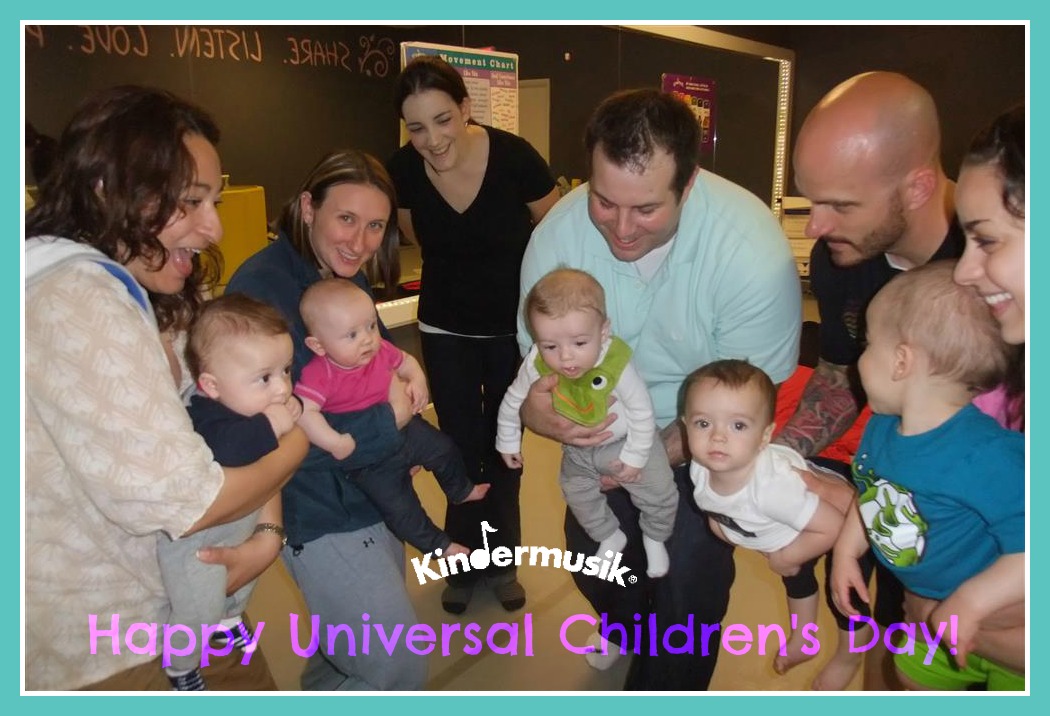
Happy Universal Children's Day!

Happy Universal Children's DayMake and celebrate!  In celebration of Universal Children’s Day, we’re happy to share this Kindermusik @Home activity idea for a homemade instrument that you can make and enjoy together.

Make a shaker-scraper Kindermusik

Learn more about how Kindermusik celebrates kids, families, and music every day at www.Kindermusik.com.

Singing when you’re happy (and you know it!) builds kids’ social-emotional skills

Young children (and parents of young children) instantly recognize the “Happy” song by Pharrell Williams. We feel happy and can’t help but “clap along.” We love this version:
[youtube]https://www.youtube.com/watch?v=uJ4diEohODE[/youtube]
You clapped along, too, didn’t you? It’s easy for adults to acknowledge the “feeling” of happy in the song. However, young children must learn to identify feelings such as happy, sad, angry, scared, surprised, etc. In fact, being able to recognize and label feelings contributes to social-emotional development.

Kindermusik@Home Activity to Help Young Children Identify Feelings

Learning to relate facial expressions with emotions is important just before and during the early school years. For example, when a friend is feeling angry, her face might scrunch up or her eyes might close. When a friend is feeling sad, he might cry or put his head down. If children are going to learn empathy for others, they need to first learn to identify how other people are feeling. Try this sample activity, “How Do You Feel?” from Kindermusik@Home:
Social-emotional Activity for young children_Kindermusik

Singing Together and Social-Emotional Development

Research shows that when children actively participate in group music and movement activities it supports development in all seven areas of social-emotional development, including communication, relatedness, and cooperativeness.

Learn more Kindermusik at www.kindermusik.com.

Contributed by Lisa Camino Rowell, a freelance writer in the Atlanta area.

Early Language Development Flourishes through Music

Pediatricians will often recommend music classes for children with language delays.  Speech therapists regularly incorporate music and rhymes in their therapy sessions with young children.  Researchers have identified talking and singing with a small child as one of the most effective tools for closing the word gap with under-served populations.

nothing more powerful than musicHere are six music activities that support early language development – all six are favorites of our Kindermusik parents in class and at home:

Vocal Play – “Bah-bah-bah.” (pause) 

Conversational back-and-forth play with parts of words, whole words, parts of songs, and short rhythms gives mouth muscles practice forming syllables and words.

Nursery Rhymes – “Hey diddle-diddle, the cat and the fiddle.

Nursery Rhymes are not only rich with the sounds that vowels and consonants make, they are also catchy and repeatable.

Timbre – Scritch-scratch, tap-tap, jingle!

Hearing and labeling the very different and distinct sounds of instruments expands listening skills and enriches vocabulary.

Movement labels – Gallop, skip, twist, twirl!

Simultaneously moving and labeling the movements engages the brain with the body and grows a bigger vocabulary.

Steady beat – “ta – ta – ta – ta and stomp-stomp-stomp-stomp!”

Recent studies have found a close link between rhythmic skills and language skills.  So the more you dance, march, and play-along with music, the stronger your music and language skills will be.

Instrument Exploration – “Can you say guiro? It goes ritch-ratch, ritch-ratch.”

Exploring and labeling instruments and their sounds in a relaxed, non-structured time of instrument exploration provides another perfect opportunity to practice and repeat sounds and words that we don’t always use every day.
So go ahead.  Sing, chant, listen, label, move, and explore your way through your day with your child.  You’ll be amazed at how a little bit of music and some musical activities here and there each day will enhance his or her language development!
Kindermusik is where music and learning playLearn more about how Kindermusik can give you the inspiration you need for improving your child’s language development at www.Kindermusik.com or by clicking on the buttons to the right.
 

Answer that Baby Babble to Speed Up Language Development

Hang around babies long enough and you start hearing things. From soft sweet coos to long monologues of “dadadadadada,” babies talk a lot—even though we have no idea what they are really saying! That’s okay. We don’t need to understand all the words (or non-words!) to join in the conversation.

How Parents Respond to All that Baby Babble Matters

VocalPlay_Boosts_Early_Language_Development_KindermusikNew early childhood research from the University of Iowa and Indiana University found that how parents respond to all that baby talk can speed up a baby’s vocalizing and language development. That’s great news for those of us no longer fluent in Baby talk.
“It’s not that we found responsiveness matters,” explained co-author Julie Gros-Louis in a press release, “It’s how a mother responds that matters.”
In this six-month-long study, the research team watched the interactions between a dozen mothers and their 8-month-old babies two times a month for 30 minutes. During this free playtime, the researchers monitored how mothers responded to their babies’ positive vocalizations when directed toward them.
Researchers learned that how the mothers respond makes a big difference in the language development of their babies:

  • Babies with mothers who responded to what they thought their babies were saying showed an increase in developmentally advanced, consonant-vowel vocalizations.
  • The babbling of these babies became sophisticated enough to sound more like words.
  • Over time these babies also began directing more of their babbling toward their mothers.
  • Babies whose mothers did not try as much to understand them and instead directed their infants’ attention to something else did not show the same rate of growth in their language and communication skills.

Bottom line: Respond to all that baby babble!

How to Answer that Baby Babble with Music

Babies love the sound of their parents’ voices. Parents can feed that love and grow their babies’ use of language at the same time by singing, listening, moving, and dancing to music. After all, music is a language parents and babies both understand.  Musical activities, such as those included in every Kindermusik class, help parents engage with their children and be responsive to them. Here are ways for parent-baby pairs and other caregivers and teachers to use music to support the early language development of babies.
1. Engage in vocal play—one of the earliest stages of language development. Vocal play is how babies’ learn to use the tongue, gums, and jaw muscles needed to produce vowels and consonants. When caregivers participate, too, they expose babies to the sounds that make up our language and encourage them to practice taking turns communicating. Vocal play works best when a parent and baby can see each other’s faces, making it easier for a child to mimic mouth movements. Plus, this eye contact also helps parents and babies bond.
Parenting Tip: Sing “Old MacDonald Had a Farm” with your little one. Pause after key parts of the song, such as “E-I-E-I-O” and wait for your baby to respond. You can also explore the different sounds the animals on the farm make like these families did in Kindermusik class:
[youtube]https://www.youtube.com/watch?v=lsLil1s_wbE[/youtube]
2. Let babies experience steady beat by bouncing to music. The brain processes music in a similar way to how it processes language. Research even shows that children who can repeat and create a steady beat show increased neural responses to speech sounds when compared to other children. Steady beat competency relates to a child’s ability to speak and read fluidly during the school year.
Parenting Tip: Put on some music and bounce to the beat with your baby on your lap or on your hip. This lets babies experience steady beat with their whole bodies. Try one of our favorite lap bounces: Pizza, Pickle, Pumpernickel.
3. Rocking the way to language development. Gently rocking babies throughout those quiet moments of each day gives parents the opportunity to combine vocal play and steady beat—and receive 2x the benefits!
Parenting tip: At the end of the day or after a feeding, hum “Hush Little Baby” (or another favorite lullaby) while you gently rock or sway your little one to the beat. As with “Old MacDonald,” pause during key phrases and wait for your baby to respond. Before too long, your baby will grow into your toddler and be able to “rock” in a new way, like this Kindermusik toddler does at home while listening to music from class!
[youtube]https://www.youtube.com/watch?v=dFP_DVDKezA[/youtube]
Throughout the Kindermusik experience, we use music to help parents engage with their children, be responsive to them, and gain developmental insights and practical tips along the way. After all, a parent is a child’s first and best teacher.

Learn more about using music to support early language development at www.kindermusik.com.

Contributed by Lisa Camino Rowell, a freelance writer living in the Atlanta area.